eBook - ePub
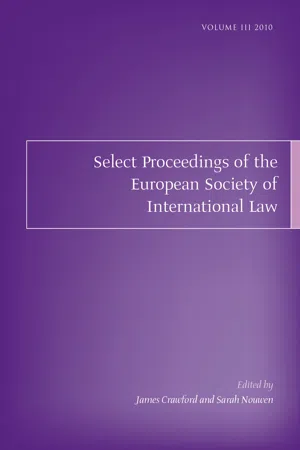
Select Proceedings of the European Society of International Law, Volume 3, 2010
- 418 pages
- English
- ePUB (mobile friendly)
- Available on iOS & Android
eBook - ePub
Select Proceedings of the European Society of International Law, Volume 3, 2010
About this book
This book continues the series Select Proceedings of the European Society of International Law, containing the proceedings of the Fourth Biennial Conference organised by ESIL and the University of Cambridge in 2010. The title of the conference was 'International Law 1989-2010: A Performance Appraisal'. The highlights, selected for publication in this volume, cover a wide spectrum of topics in international law.
Information
Part I:
1989–2010: The World and International Law
1
International Law 1989–2010: A Performance Appraisal
THE IDEA OF appraising the performance of international law across the post-Cold War years clearly represents a daunting challenge. It is daunting in terms of the range of possible criteria that might be used to evaluate performance—Justice? Legitimacy? Effectiveness? Survival? It is daunting in terms of the politics of place. All theories and evaluative schema are bounded by place and draw their relevance from the particular contexts in which they are developed and deployed. Indeed this is a central part of the intellectual challenge involved in studying global governance or global order. This necessarily presses us to imagine what patterns of order and governance look like—analytically and normatively—when we stand back from the parochial preoccupations of Washington, or Berlin, or Beijing, or New Delhi.
And it is daunting in terms of the politics of time. Trying to appraise and evaluate international law in the post-Cold War period must necessarily involve some view of how the period fits within broader narratives of historical change. On one side, as I will suggest, this means revising our views of how the Cold War and post-Cold War periods are linked and questioning the claim that the end of the Cold War represents quite such a decisive break in patterns of global politics as is often claimed. It also involves taking a position on where we might now be standing. On this question, we can, I believe, get a sense of the post-Cold War period as one that is now moving towards an end.
The tectonic plates are indeed shifting. Both the international political system and the structures of global capitalism are in a state of flux and uncertainty. Power is shifting in global politics from the old G7 to a new group of emerging powers. The global system is increasingly characterised by a diffusion of power, including to emerging and regional powers; by a diffusion of preferences with many more voices demanding to be heard both globally and within states as a result of globalisation and democratisation; and by a diffusion of ideas and values, with a reopening of the big questions of social, economic and political organisation that were supposedly brought to an end with the end of the Cold War and the liberal ascendancy. There is a strong argument that we are witnessing the most powerful set of challenges yet to the global order that the United States sought to construct within its own camp during the Cold War and to globalise in the postCold War period. Many of these challenges also raise questions about the longer-term position of the Anglo-American and European global order that rose to dominance in the middle of the nineteenth century and around which so many conceptions and practices of power-political order, international legal construction and global economic governance have since been constructed.
It is for international lawyers themselves to discuss and debate the detailed and technical evolution of the international legal order itself. I am going to avoid any direct assault on the assembled mass ranks of the international legal community and, instead, probe down the flanks. In the first part of this lecture, I will say a little about the evolution of global politics in the post-Cold War period and consider some of the complex and contradictory ways in which this evolution has shaped debates about the legal order and about how international law might be appraised. In the second part of these remarks I will turn to arguments about global justice, again looking for connections between the performance of international law on the one hand and its normative aspirations and imaginative possibilities on the other.
I.
In the 1990s global order was widely understood through the lens of liberal internationalism or liberal solidarism.1 Globalisation was rendering obsolete the old Westphalian world of Great Power rivalries, balance of power politics and an old-fashioned international law built around state sovereignty and strict rules of non-intervention. Bumpy as it might be, the road seemed to be leading away from Westphalia—with an expanded role for formal and informal multilateral institutions; a huge increase in the scope, density and intrusiveness of rules and norms made at the international level but affecting how domestic societies are organised; the ever-greater involvement of new actors in global governance; the moves towards the coercive enforcement of global rules; and fundamental changes in political, legal and moral understandings of state sovereignty and of the relationship between the state, the citizen and the international community.
In addition to an expansion of inter-state modes of governance, increased attention was being paid to the world of complex governance beyond the state. Such governance was characterised by the complexity of global rule-making; the role of private market actors and civil society groups in articulating values which are then assimilated in interstate institutions; and the increased range of informal, yet norm-governed, governance mechanisms often built around complex networks, both transnational and transgovernmental, and the inter-penetration of international and municipal law and of national administrative systems. From this perspective the state was losing its place as the privileged sovereign institution and instead becomes one of many actors and one participant in a broader and more complex social and legal process.
Such developments were central both to the evolving practice of international law and to those who sought to chart and map its changing character—as, for example, Joseph Weiler’s geological metaphor of four different layers of law and of law-making—from predominantly bi-lateral, contractual treaties, to a much greater emphasis on multilateral agreements, to important constitutional treaties (such as the UN Charter), to an everthickening layer of administrative and regulatory rules.2
These developments posed great analytical and practical challenges for international law. A vast amount of normatively framed regulatory practice and global administration was emerging that did not at all easily fit within the standard model of law between states. Such rule-making and regulatory practice is hard to square with traditional doctrinal ideas of sources, of state voluntarism, of even delegated consent. The optimists did not seem to worry overmuch: they saw great potential in the disaggregated state, in fluid and flexible networks of experts, and in the claims that dynamic experimental rule making can be both efficient and deliberatively inclusive.3 Skeptics worried about precisely these same features—the dangers posed by the often hidden rule by experts and embedded orthodoxy, the marginalisation of meaningful politics, and the perils of de-formalisation and of the deepening fragmentation of the legal ‘system’.4
John Rawls famously observed that ‘the correct regulative principle for a thing depends on the nature of that thing’.5 The post-1989 period may indeed have been a period of intensive legalisation. Law may indeed have become ever more central—both functionally but also as a broadly appealed-to source of normative judgement. But, in the case of the international legal order, the nature of the ‘thing’ is extraordinarily difficult to pin down, identify and categorise. For example, it seems clear that many innovations in governance and many developments in international law have shifted or eroded our understandings of public and private and of the boundaries between them. If so, it follows that finding adequate regulative principles must involve broadening our understandings about what constitutes public power at the international or global level; that we can no longer see states as the only subjects of political legitimacy; and that we should instead concern ourselves with all those forms of power that constrain the autonomy or welfare of those subject to them. Others have sought to use notions of publicness and principles derived from public law as a basis for understanding legal normativity within the global administrative spaces that have become such an important element of global governance and for preserving the distinctively legal character of law in the face of rampant instrumentalism.6 Much of the debate on the character of the legal order has been framed in terms of a set of choices: reassert the old doctrinal practices and boundaries; move forward to some variety of global constitutionalism; or try to navigate the messy byways of the new legal pluralism.7
How to Explain What Was Going on?
Academics, especially in Europe and the United States, told three kinds of liberal stories. Some stressed institutions and the cooperative logic of institutions. Institutions are needed to deal with the ever more complex dilemmas of collective action that emerge in a globalised world. The complexity of the governance challenges meant that international law and international regimes would necessarily increase in number, scope and variety. It also meant that as large states, including large developing states, expanded their range of interests and integrated more fully into the global economy and world society—as they ‘joined the world’ in the idiom of the 1990s—they would be naturally drawn by the functional benefits provided by institutions and pressed towards more cooperative and ‘responsible’ patterns of behaviour. The process would not necessarily be easy or automatic; but, on this view, the broad direction of travel is clear.
Others stressed the Kantian idea of the gradual but progressive diffusion of liberal values, partly as a result of liberal economics and increased economic interdependence, partly as a liberal legal order comes to sustain the autonomy of a global civil society, and partly as a result of the successful example set by the multifaceted liberal capitalist system of states.
A third group told a more US-centred story. The US was indeed the centre of a unipolar world. But, true both to its own values and its rational self-interest, Washington had a continued incentive to bind itself within the institutions that it had created in the Cold War era in order to reassure smaller states and to prevent balancing against US power. A rational hegemon in an age of globalisation would understand the importance and utility of soft power. In return for this self-binding and the procedural legitimacy it would create, and in return for US-supplied global public goods and the output legitimacy that they would create, other states would acquiesce and accept the role of the United States as the owner and operator of the system.8
The challenge of the Second World had been seen off. Through a mix of these three processes those states of the old Third World that had previously challenged the western order would now become increasingly enmeshed, socialised and integrated. The nature and dynamics of power were changing. Soft power would outstrip hard coercive power in importance and concentrations of liberal power would attract rather than repel or threaten. Just as the example of a liberal and successful EU had created powerful incentives on the part of weaker and neighbouring states towards emulation and a desire for membership, so, on a larger scale and over a longer period, a similar pattern would be observed in the case of the liberal, developed world as a whole. A new raison de système would emerge that would alter and ultimately displace old-fashioned notions of raison d’état.
The 1990s, then, were marked by a clear sense of the liberal ascendancy; a clear assumption that the US had the right and power to decide what the ‘liberal global order’ was all about; and a clear belief that the western order worked and that it had the answers. Yes, of course there would be isolated rogues and radical rejectionists. But they were on the ‘wrong side of history’ as President Clinton confidently proclaimed.
Two other points should be noted here.
First, this was a period in which an enormous normative ambition ran together with relatively weak institutionalisation. Through the 1990s the normative ambition of the international legal order continued to expand dramatically. But these expansive and expanding goals were to be achieved on the back of very thin institutional structures—lots of networks, lots of market mechanisms, lots of private or hybrid governance; but rather little in the way of serious multilateralism or institutional renewal or reform. A comparison with the world order debates of the late 1940s is instructive. Looking back it is hard to avoid the conclusion that much of the talk of global governance was a rhetorical façade. The real heavy lifting was to be done by the apparently effective centralisation of power around the United States and a liberal Greater West.
Second, this was a period of striking and far-reaching legal and normative revisionism. It is often simply assumed that the dominant state or group of states in terms of power can be associated with the status quo. It is emerging states or rising powers that seek to challenge the ‘basic norms of the system’ or to revise its ‘foundational principles’.9 However, any status quo has at least two dimensions, the first focused more or less directly on the distribution of material power; the second on the character of the international order and its dominant norms. From the perspective of the dominant norms of the system, the United States has rarely been a status quo power and, as its power has grown so too has the revisionist character of its foreign policy. Since the end of the Cold War it has been in many ways a strongly revisionist power, sometimes a revolutionary power: in the 1990s in terms of pressing for new norms on intervention and for the opening of markets and for the embedding of particular sets of liberal values within international institutions; in the early years of this century, in terms of its attempt to recast norms on regime change, on the use of force, and on the conditionality of sovereignty more generally.10 Hence, for example, the states of the Global South have not faced the United States within a stable notion of a ‘Westphalian order’. Quite the contrary. Just as countries such as China had come to accept and to stress many of the core principles of the old pluralist system (non-intervention, hard sovereignty, hierarchy based on power), the dominant western states were insisting that many of the most important norms of the system ought to change, above all in ways that threatened greater interventionism and sought to mould the ways in which societies were to be ordered domestically. Nor is this simply a story of a traditional sovereignty-obsessed South seeking to remain in its comfort zone. In the case of climate change, it has been the South that has sought to protect the globalist commitments of Kyoto against the revisionism of the United States and some of its allies. Understanding the contested character of notions of ‘status quo’ and ‘revisionism’ and the political construction of ideas about ‘responsible behaviour’ is fundamental to understanding the ways in which changes in the distribution of power may be affecting the international legal order.
II.
However, even before we get to the Bush Administration and to September 11, and certainly well before the financial crisis, it was clear that these sorts of liberal narratives represented only one part of the picture. Much of the academic analysis of international law and international order in the post-Cold War period took the form of critique—drawing out the many flaws of the liberal image of the 1990s and giving far greater weight to inequality, hierarchy and coercion.
Although analytically beguiling, liberal writing on global governance tended to skirt far too easily over the problem of managing power, especially unequal power, and the difficulties of mediating between conflicting values. Debates on governance focused on the identification of collective action problems and on the ...
Table of contents
- Cover
- Title
- Copyright
- Foreword
- Foreward
- Contents
- Introduction
- Part I - 1989–2010: The World and International Law
- Part II - 1989–2010: Legalisation and Law-Making
- Part III - 1989–2010: International Law and the State
- Part IV - 1989–2010: International Law and International Institutions
- Part V - 1989–2010: International Law and the Regions
- Part VI - 1989–2010: International Law and the Challenges of 2010
- Part VII - Appraisal
- Epilogue - 1989–2010: The Black Hole
Trusted by 375,005 students
Access to over 1.5 million titles for a fair monthly price.
Study more efficiently using our study tools.
Frequently asked questions
Yes, you can cancel anytime from the Subscription tab in your account settings on the Perlego website. Your subscription will stay active until the end of your current billing period. Learn how to cancel your subscription
No, books cannot be downloaded as external files, such as PDFs, for use outside of Perlego. However, you can download books within the Perlego app for offline reading on mobile or tablet. Learn how to download books offline
Perlego offers two plans: Essential and Complete
- Essential is ideal for learners and professionals who enjoy exploring a wide range of subjects. Access the Essential Library with 800,000+ trusted titles and best-sellers across business, personal growth, and the humanities. Includes unlimited reading time and Standard Read Aloud voice.
- Complete: Perfect for advanced learners and researchers needing full, unrestricted access. Unlock 1.5M+ books across hundreds of subjects, including academic and specialized titles. The Complete Plan also includes advanced features like Premium Read Aloud and Research Assistant.
We are an online textbook subscription service, where you can get access to an entire online library for less than the price of a single book per month. With over 1.5 million books across 990+ topics, we’ve got you covered! Learn about our mission
Look out for the read-aloud symbol on your next book to see if you can listen to it. The read-aloud tool reads text aloud for you, highlighting the text as it is being read. You can pause it, speed it up and slow it down. Learn more about Read Aloud
Yes! You can use the Perlego app on both iOS and Android devices to read anytime, anywhere — even offline. Perfect for commutes or when you’re on the go.
Please note we cannot support devices running on iOS 13 and Android 7 or earlier. Learn more about using the app
Please note we cannot support devices running on iOS 13 and Android 7 or earlier. Learn more about using the app
Yes, you can access Select Proceedings of the European Society of International Law, Volume 3, 2010 by James Crawford, Sarah Nouwen, James Crawford,Sarah Nouwen in PDF and/or ePUB format, as well as other popular books in Law & International Law. We have over 1.5 million books available in our catalogue for you to explore.