Textbooks on international law, dicta of the International Court of Justice and the International Law Commission's 'Guiding Principles applicable to unilateral declarations of states capable of creating legal obligations' of 2006, all reflect the fact that in international law a state's unilateral declaration can create a legally binding obligation. Unilateral declarations are common, as a look at the weekly headlines of any major newspaper will reveal. Many of the declarations made at the highest level are, of course, vaguely expressed and carry no tangible legal commitment. But others deliver a very clear message: for instance the US's April 2010 declaration on its future use of nuclear weapons or Kosovo's declaration of independence and pledge to follow the Ahtisaari Plan, are two recent and prominent examples of unilateral declarations at the international level.
The same sources, however, also reveal that while state promises are accepted as a means for states to create full blown legal commitments, the law governing such declarations is far from clear. This monograph fills a gap in international legal scholarship by raising and answering the question of the precise legal value of such pledges in the realm of public international law.
After a brief introduction state promises in international law are defined and contrasted with other unilateral acts of states, and the history of promises in state practice and court decisions is delineated, together with scholarly opinion. The book then provides a detailed picture of the international legal framework governing promises of states, and ends with a brief assessment of the raison d'être for promises as a binding mechanism in international law, along with their advantages and disadvantages in comparison with the classical mechanism for assuming international obligations - the international treaty.
This is currently the only book to present a comprehensive overview of the legal effect of promises by states in international law.
- 356 pages
- English
- ePUB (mobile friendly)
- Available on iOS & Android
eBook - ePub
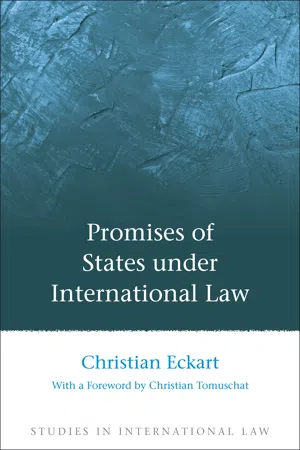
Promises of States under International Law
About this book
Information
1
Delimiting the Subject: Promise as a Unilateral Act
THIS BOOK’S CENTRE of attention rests on unilateral declarations which are held to manifest a state’s will to commit itself legally to follow a certain line of conduct in the future. It is this chapter’s aim to describe and define this sort of declarations more closely.
I DRAWING FROM THE DEFINITION OF UNILATERAL ACTS
As the above-mentioned state action forms a subcategory of ‘unilateral acts of states’, it would seem methodologically sensible to start from their overall definition and subsequently identify and simply add on those characteristics which will finally single out the unilateral act of ‘promise’. The definition of unilateral acts has, however, proven extremely difficult1 and despite the International Law Commission’s efforts in this field, it remains true that ‘no all-encompassing, uniform and precise definition of unilateral acts exists’.2 In its 10 years of work there were various attempts by the ILC to define ‘unilateral acts of states’ but the issue remained unsettled till the very end.3 Yet, surprisingly, the commentary to Guiding Principle 1 says:
The wording of Guiding Principle 1, . . . seeks both to define unilateral acts in the strict sense and to indicate what they are based on.4
As the relevant part of Guiding Principle 1 reads ‘Declarations publicly made and manifesting the will to be bound may have the effect of creating legal obligations’,5 unilateral acts in the strict sense6 would accordingly be defined as declarations publicly made and manifesting the will to be bound.
The ILC points out that it was directly inspired by the Nuclear Tests cases in adopting this definition7 and it is thus not surprising that its wording comes close to describing, without however precisely defining, the very subcategory of unilateral acts with which the International Court of Justice was dealing in its ruling, ie that of binding unilateral assurances, termed ‘promises’ in international law. For the following reasons, however, it cannot be taken as our starting point and be understood to constitute the ‘all-encompassing, uniform and precise definition of unilateral acts’, the absence of which was lamented before.
Whether the word ‘act’ may be substituted by the term ‘declaration’ had been debated within the ILC and several members correctly voiced their opposition,8 since ‘declarations’ are an underinclusive description of unilateral state action. While a vast majority of unilateral acts of states might indeed be found in declarations, and promises are held to be limited to declarations, not all unilateral acts are. A declaration relates to the form in which a manifestation of will is presented and can only be understood to mean an express act; any behavior that might not express yet imply a manifestation of will can hardly be considered a ‘declaration’ and would thereby be discarded as a potential unilateral act of state.9 That non-express state conduct may constitute a unilateral act is, however, far from being doubtful. The commencement of diplomatic relations is usually considered as an act of implicit recognition of the state with which formal diplomatic relations are established even though recognition as such is not declared.10 The same is true for protests which will usually but need not necessarily be included in a declaration: calling your ambassador home is a quite frequently used mechanism employed by states in this regard and warning shots by a military vessel or a jet vis-à-vis an intruder into contested waters or airspace may also effectively deliver the protest message without declaring it.11 Even a waiver, although never presumed, may according to legal doctrine be made implicitly.12
The term declaration furthermore wrongly excludes ‘mere silence’ from ever constituting a legally relevant act. While the state acting implicitly does not spell out its message of, for example, recognition or protest (and is therefore silent in this regard), it still acts; the ‘silent state’ however refrains from any physical action. The distinction is quite subtle, as legal doctrine might nevertheless infer a legally relevant will from a state that remains silent and completely inactive; it will do so in situations which warrant a protest. In these settings ‘saying nothing’ is considered as noticeable absence of protest, ie as having ‘said nothing against’ a certain situation, and is turned into and now termed ‘qualified’ or ‘eloquent’ silence.13 A state which in the face of a notorious claim persistently refrains from protesting,14 will hence be taken to have ‘expressed’ its tacit recognition or acceptance in the form of acquiescence.15 A state by remaining silent can therefore be held to have unilaterally manifested its will in a legally relevant way, ie to have legally acted, a fact that needs to be reflected in any definition adopted.16 The word ‘declaration’ clearly does not do so.17
Also, protest is commonly considered to constitute a unilateral act and the ILC indeed thought it was.18 But even he who expressly protests does not make a public declaration ‘manifesting the will to be bound’, quite on the contrary. While protest is a manifestation of will, it is a manifestation of a will not to be bound, not to acquiesce and is designed to hinder the creation of any legal obligation. A protesting state is in no way bound by its declaration, as yesterday’s protest in no way restrains today’s recognition should a state change its mind.
Finally, it is quite surprising that the purported definition of ‘unilateral acts in the strict sense’ does not make any effort nor even allude to the declaration’s necessarily unilateral, let alone strictly unilateral character. Not every ‘declaration publicly made and manifesting the will to be bound’ can be seen as constituting a unilateral act in the strict sense as the definition now seems to claim. Unilateral acts covered by the Law of Treaties, such as the acceptance of an offer, the accession or the reservation to a treaty, are often said to be excluded from the regime here in question because they lack a strictly unilateral character. All of them are, however, encompassed in the ILC’s ‘definition’, which uses neither the word ‘strictly’ nor ‘autonomous’ in order to restrict its scope. While abandoning the material concept of autonomy or that of a strictly unilateral act as commonly understood is possible through the application of the lex specialis principle, and indeed preferable,19 the Commission’s outcome is contradictory when it drops any reference to an act’s unilateral, let alone ‘strictly’ unilateral character in its definition, but via the Commentary claims to uphold this concept and even define what a ‘strictly unilateral act’ is.
Despite its Commentary’s claim to the contrary, the adopted Guiding Principle 1 therefore neither provides a valid definition of all unilateral acts, as its focus on declarations made in order to be bound is too narrow, nor does it define unilateral declarations (much less acts) ‘in the strict sense’, as in this regard it is drafted too broadly.20
The delimitation of the unilateral act labelled ‘promise’ will therefore not start from an accepted overall definition of unilateral acts in general, for the reason that the latter still cannot be considered to have been found. While such a general definition would have been a helpful starting point, it is not a necessary prerequisite as long as the unilateral act of interest here is found to be clearly delimitable.
II DISTINGUISHING PROMISES FROM OTHER CLASSES OF UNILATERAL ACTS
Even though no final definition of unilateral acts was found within the ILC, a perusal of the various definitions proposed21 clearly shows that the Commission was not going to be concerned with all sorts of unilateral state action.22 Instead, it chose from the outset, and in conformity with legal doctrine, to focus only on acts of state which may be considered as an expression of will, carrying an intention to have a legal effect and to which international law will attribute the (apparently) intended effect of creating, preserving, altering or extinguishing a state’s legal relation to one or numerous other subjects of international law.23
Despite imposing this first filter on unilateral acts of states, the ILC quickly realised that it was still faced with a great variety of acts, a fact which made it seemingly impossible to apply a ‘one rule fits all’ approach to them. The Commission had nevertheless intended to address a vast array of state actions and, as already indicated, had anticipated overcoming the obstacle presented by the various acts’ peculiarities by dividing the draft articles into a general and a special part, the latter containing subsections, each of which were destined to deal with a typified sort of unilateral act.24
In attempting to start with the design of a general part on all unilateral acts, the Commission acted in conformity with a majority of legal doctrine, which assumes the existence of a coherent category of state action to be labelled ‘unilateral acts of states’ and encompassing acts which share enough similarities to have a common set of rules made applicable to them. Yet, in light of the great differences between the various acts of states qualifying for this category, rules applicable to each and every act can only be elaborated if they are either formulated very broadly or cover only a limited set of general questions.
The following aspects fit this description and were to be contained in the General Part on which the Special Rapporteur was working till the very (abrupt) end: the capacity of states, amongst others, to formulate unilateral acts is commonly answered in the affirmative and was designed as the starting ground within the General Part. It indeed leaves little room for controversy as it is of no great regulatory use and even those opposing a codification of unilateral acts can at least live with a statement indicating a state’s ability to act unilaterally. Also, the non-existence of formal requirements for unilateral acts is fairly settled, especially in the light of clear ICJ jurisprudence in this regard and the fact that international law is generally considered to impose no formal requirements unless explicit stipulations to the contrary exist.25 The question who has the competence to formulate a unilateral act on behalf of a state is equally practically uncontroversial, at least and as long as it remains limited to those state representatives mentioned by Article 7(2)(a) of the Vienna Convention on the Law of Treaties, ie ‘Heads of State, Heads of Government and Ministers of Foreign Affairs’.26 Also, any manifestation of will issued by a state is usually held to have to be without vices in order for international law to give it legal effect, just as consent in the area of treaties has to be, and hence error, fraud, corruption as well as the coercion of a state or its representative as codified for treaties in Vienna Convention, Articles 48 to 52 are usually mentioned in this regard. Similarly, there is no visible opposition to holding void a unilateral act violating a norm of ius cogens. But this is as far as it goes in relation to the bulk of unilateral acts. Even though an analogy to Articles 46 (and 27) of the Vienna Convention27 is sometimes drawn28 and might indeed be sensible (although currently national constitutional norms applicable to unilateral commitments by states seem to be largely lacking), it is not a norm of general applicability as long as protest is considered to be a unilateral act of state subject to the general framework, since the latter does not express a ‘consent to be bound’. Going a step further and turning towards the central question whether unilateral acts are revocable, an aspect intimately related to their binding force, will also lead us away from norms of general applicability.29 Hence, a differentiated approach is called for and with it a categorisation of unilateral state action.30
While legal doctrine has shown that it is possible to categorise unilateral state action using various criteria, such as eg their form or their ‘dependence’,31 a distinction focusing on the ‘material content’ of the act has proven most suitable when attempting to group only that sort of conduct together to which the same legal rules can be said to apply.32 And indeed, as form hardly matters when it comes to unilateral acts33 and an act’s legal effect is primarily crafted according to a state’s expressed will, it is only logical that state action with similar content, ie containing similar manifestations of will, is likely to trigger similar effects under international law.34 Legal doctrine accordingly usually differentiates between the four unilateral acts already mentioned: promise, recognition, waiver and protest.35 Never intended as an exhaustive list, these four are considered as very common unilateral expressions of states, which are furthermore not embedded in a special legal framework.36 Some authors have added or subtracted categories from and to the list37 or established ‘intermediate’ categories, placing especially promise and recognition together.38 Also, ‘notification’ – the act by which a state makes a certain fact to which legal consequences may be attached known to its addressee(s)39 – has rather frequently been identified as an additional typical unilateral expression of will of legal importance.40 All five will be briefly addressed in the following sections, thereby including only a few remarks on notification, as other authors have already convincingly shown that on a closer look it does not form a separate category of unilateral acts of states.41 Unlike books or articles dealing with the overall topic of unilateral acts, the point of this exercise is not to provide a full picture of the normative legal framework and case law existing for each specific unilateral act. The following pages, especially from chapter two on, will focus on promises only. Yet the decision to do so was not made until after the various unilateral acts had been briefly analysed, as this process reveals important differences between the four acts; differences which effectively hinder any legal analysis from providing satisfactory answers for core doctrinal matters when considering all acts en bloc. It is these characteristics which furthermore explain why answers accepted in relation to one sort of unilateral state action are not necessarily transferable to the other acts, merely on account of them sharing some common features as unilateral manifestations of a state’s will. In briefly going through the ‘standard’ categories of unilateral acts, it should also become clear what kind of unilateral acts are outside the scope of this book.
A Promise
A picture of the legal framework which has evolved over time for promises as well as its doctrinal underpinnings is discussed at length in chapter three. For now it is primarily the difference between promise and the other three typical unilateral acts which is of interest and requires a first glimpse at our actual subject matter. A...
Table of contents
- Cover
- Title
- Copyright
- Foreword
- Acknowledgements
- Contents
- Abbreviations
- Table of Cases
- Introduction
- 1 Delimiting the Subject: Promise as a Unilateral Act
- 2 A History of Promises
- 3 The Law on Promises
- 4 Looking Ahead: A ‘Promising’ Future?
- Concluding Remarks
- Annex I
- Annex II
- Bibliography
- Index
Trusted by 375,005 students
Access to over 1.5 million titles for a fair monthly price.
Study more efficiently using our study tools.
Frequently asked questions
Yes, you can cancel anytime from the Subscription tab in your account settings on the Perlego website. Your subscription will stay active until the end of your current billing period. Learn how to cancel your subscription
No, books cannot be downloaded as external files, such as PDFs, for use outside of Perlego. However, you can download books within the Perlego app for offline reading on mobile or tablet. Learn how to download books offline
Perlego offers two plans: Essential and Complete
- Essential is ideal for learners and professionals who enjoy exploring a wide range of subjects. Access the Essential Library with 800,000+ trusted titles and best-sellers across business, personal growth, and the humanities. Includes unlimited reading time and Standard Read Aloud voice.
- Complete: Perfect for advanced learners and researchers needing full, unrestricted access. Unlock 1.5M+ books across hundreds of subjects, including academic and specialized titles. The Complete Plan also includes advanced features like Premium Read Aloud and Research Assistant.
We are an online textbook subscription service, where you can get access to an entire online library for less than the price of a single book per month. With over 1.5 million books across 990+ topics, we’ve got you covered! Learn about our mission
Look out for the read-aloud symbol on your next book to see if you can listen to it. The read-aloud tool reads text aloud for you, highlighting the text as it is being read. You can pause it, speed it up and slow it down. Learn more about Read Aloud
Yes! You can use the Perlego app on both iOS and Android devices to read anytime, anywhere — even offline. Perfect for commutes or when you’re on the go.
Please note we cannot support devices running on iOS 13 and Android 7 or earlier. Learn more about using the app
Please note we cannot support devices running on iOS 13 and Android 7 or earlier. Learn more about using the app
Yes, you can access Promises of States under International Law by Christian Eckart in PDF and/or ePUB format, as well as other popular books in Law & International Law. We have over 1.5 million books available in our catalogue for you to explore.