The United Nations is commemorating the 25th anniversary of the 1986 Declaration on the Right to Development, which proclaimed the right to be: 'an inalienable human right by virtue of which every human person and all peoples are entitled to participate in, contribute to, and enjoy economic, social, cultural and political development, in which all human rights and fundamental freedoms can be realized'. The UN now aims to mainstream the right into its policies and operational activities, and is reviewing prospects for an internationally-binding legal instrument. The evolution of the right to development, however, has been dominated by debates about its conceptual validity and practical ramifications. It has been hailed as the cornerstone of the entire human rights system and criticized as a distracting ideological initiative. Questions also persist about the role of the right in reforming the international economic order.
This book examines the legal and moral foundations of the right to development, addressing the major issues. It then considers the right to development in the global economy, noting the challenges of globalization and identifying key principles such as differential treatment of developing countries, participation and accountability. It relates the right to broad objectives such as the Millennium Development Goals, the human rights-based approach to development, and environmental sustainability. Implications for international economic law and policy in the areas of trade, development finance and corporate responsibility are assessed. The conclusion looks to the legal and ethical contributions - and limitations - of the right to development in this new context. With an academic and professional background in international law, human rights and moral theology, the author brings a unique interdisciplinary focus to this timely project.
eBook - ePub
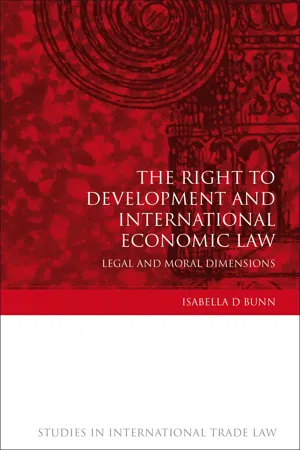
The Right to Development and International Economic Law
Legal and Moral Dimensions
- 368 pages
- English
- ePUB (mobile friendly)
- Available on iOS & Android
eBook - ePub
About this book
Information
PART ONE: FOUNDATIONS OF THE RIGHT TO DEVELOPMENT
Part One of this book on The Right to Development and International Economic Law: Legal and Moral Dimensions focuses on foundations of the right to development. It begins with a review of the political and ethical context in which it emerged. Chapter two, on the legal formulation of the right, traces its origins in both the law of human rights and the law of development. With the adoption of the UN Declaration on the Right to Development (UNDRD) in 1986, the UN initiated implementation efforts in both the human rights and the development spheres. Chapter three considers the moral basis for the right to development, examining key precepts raised within the UN debate on the UNDRD.
The following chapters offer an evaluation and critique of the right to development. Chapter four raises questions about the theoretical basis of the right within human rights law. Chapter five explores the various understandings of development. The analysis in chapter six then turns to the substance of the right to development in terms of its beneficiaries, duty-holders, key characteristics, and enforcement.
The final chapter in Part One assesses the status of the right to development under international law. Indicative of some of the controversy, questions persist as to whether the right to development is really a human right. The chapter takes up a number of normative issues, including UN resolutions, customary law, soft law and the concept of sustainable development. It concludes by considering the potential evolution of the right under international law
Part Two of the book will examine the place of the right to development in the global economy. The implications of the right for international economic law and policy will draw upon the legal and ethical foundations set forth in Part One.
1
The Context of the Right to Development
THE EMERGENCE OF the right to development must be understood within a certain historical context – both with respect to the political climate and prevailing ethical tenets.
I. POLITICAL CONTEXT OF THE RIGHT TO DEVELOPMENT
To set the historical context for the emergence of the right to development, this section reviews some key political and economic factors in the period from the formation of the United Nations Organization in 1945 to the adoption of the Declaration on the Right to Development in 1986.1 The international policy agenda, especially with regard to problems of human welfare and economic development, was transformed. These four decades also witnessed a dramatic shift in public consciousness on certain social issues.
A. The New World Order
The period following the Second World War, ushered in by the establishment of the UN in 1945, is characterized by a new world order based on international cooperation.2 The advent of nuclear weapons heightened the need for principles of non-aggression and collective security. Institutions and programmes in areas such as peace, human rights and economic development expanded dramatically.
The dominant political and economic feature of the time was the super-power rivalry between the United States of America and the Soviet Union.3 In strategic terms, the race for military advantage settled into a policy of nuclear deterrence. This so-called balance of power offered a semblance of stability based on ‘mutual assured destruction’. In ideological terms, the competition between democracy and communism shaped virtually all international policy debates and decisions. As will be seen, these Cold War tensions influenced initiatives in both human rights and international development.4
Another key feature of the post-war period was the process of decolonization, including the dismantling of the British Empire.5 As peoples in Africa, Asia and elsewhere secured their independence, the dynamics of international political and economic relations changed dramatically. Among other consequences, this contributed to the growth of UN membership from 51 states at its inception to 159 by 1986.6 Here again, the Cold War fueled competition between the US and USSR to expand their spheres of influence. Efforts to secure friends and allies among the new nations often became linked to support for questionable leaders and to substantial military expenditures. These too, held implications for both human rights and development.
B. Increasing Interdependence
Increasing interdependence characterizes the international system, with trade, travel and communications reshaping basic models of political relations.7 Technological advances accelerate such interaction. The international arena holds a wider range of actors, including governmental and non-governmental organizations, regional associations, strategic alliances, trade unions, transnational corporations, religious movements, educational and charitable foundations. The expansion of the media, especially radio and television, allows for instantaneous reporting of developments throughout the world. The overall result is a global awareness of issues – including those of poverty, inequality, oppression and violence – on an unprecedented scale.
C. North-South Dialogue
The terms ‘North’ and ‘South,’ though not wholly accurate from a geographic standpoint, are considered as broadly synonymous with rich and poor, with developed and developing. The debate surrounding North-South relations was given impetus by the 1980 Report of the Independent Commission on International Development Issues.8 Headed by Willy Brandt, the Independent Commission investigated ‘the grave global issues arising from the economic and social disparities of the world community’. It sought to promote solutions to the problems of development and of absolute poverty.9
Rather than looking at just questions of aid or assistance, the emphasis is on a rearrangement of international relations, ‘the building of a new order and a new kind of comprehensive approach to the problems of development’.10 The focus of development is on people, and its primary objective is ‘to lead to self-fulfillment and creative partnership in the use of a nation’s productive forces and its full human potential’.11
The Brandt Report examines a wide range of problems, including hunger, population, the environment, energy, international trade and finance, and disarmament. It also asserts:
International social justice should take into account the growing awareness of a fundamental equality and dignity among all men and women. Scientific, technological and economic opportunities should be developed to allow a more humane social and economic order for all people. Strong efforts should be made to further a growing recognition of human rights and of the rights of labour and international conventions for protecting them.12
Clearly, this influential group of experts saw the complex cluster of issues associated with development as linked to questions of human rights.
D. World Hunger
To select the year 1970 as an example, 918 million people, or 35 per cent of the population of the developing world, were chronically undernourished.13 Such poverty is accompanied by inadequate clothing, shelter and medical care. Lack of safe water and sanitation compounds the problem, leading to disease and death. Infant mortality rates are high; children that survive may suffer irreversible brain damage due to poor nutrition. The consequences of hunger not only exacerbate human misery, they sap the nation’s meagre resources and impair its productive capacity.
Famines in the Congo, Bangladesh and Biafra received widespread international attention and were targeted by relief organizations such as Actionaid, CARE International and Oxfam. While hundreds of thousands of lives were saved, it became evident that in addition to poor harvests, natural disasters or conflicts, other causes of hunger must also be addressed.
Improvements in agricultural technology – from new irrigation systems to more productive grains to better storage techniques – were mobilized in this effort. This was termed the ‘green revolution’.14 But structural causes of poverty – inequalities of power nationally and internationally, the legacy of Western colonialism, domination by multinational corporations, unfair terms of trade, the debt burden, the politicization of food aid – increasingly entered into the debate. Writing in 1976, Susan George maintained:
Today’s world has all the physical resources and technical skills to feed the present population of the planet and a much larger one. Unfortunately for the millions of people who go hungry, the problem is not a technical one … Hunger is not a scourge but a scandal.15
George stops short of characterizing world hunger as a crime; but she does encourage a critical examination of the causes of hunger and the responsibility for alleviating it. Thus to an ever greater extent, the problem is viewed in terms of social and economic injustice.
E. Human Rights Violations
The history of the post-war period is marked by a succession of large-scale human rights violations, as well as efforts to try to address them. A partial list of horrors would include the legacy of Nazi concentration camps and the systematic extermination of the Jewish population, the ‘Iron Curtain’ descending across Eastern Europe leaving millions of people under the stronghold of Stalinism, disappearances and torture in Argentina, apartheid struggles in South Africa, race riots during the American civil rights movement, resistance to the Chinese occupation of Tibet, cultural revolution in China, genocide in Pol Pot’s Cambodia, Idi Amin’s reign of terror, the plight of thousands of Vietnamese boat people, the rise of Islamic fundamentalism in the Middle East and the oppression of political dissidents throughout the world. Aside from efforts within the United Nations, individual countries began taking up human rights issues as part of their foreign policies.16 Groups like Amnesty International, a worldwide voluntary movement founded in 1962 to prevent government violations of fundamental human rights, achieved prominence.17 Moreover, women, indigenous populations, ‘untouchables’ and other categories of individuals pressed for equal rights. ‘Human rights’ became an indispensable concept in political discourse.
F. Development and Disarmament
A link is made between development and disarmament.18 Not only are war and violence seen as inimical to the development process, the massive resources spent for arms are a drain to economies throughout the world. Advocates for the poor urge that military expenditures be redirected to combat disease and hunger and meet human needs. In World Armament and World Hunger, Willy Brandt observes that the arms race has assumed dimensions which can no longer be grasped by the human mind:
Every day the world spends millions and millions of dollars for military purposes; we stockpile more explosives than food, and we are more concerned with what is called military security than with hunger and malnutrition, which in the end may pose an even greater threat. Every warning seems to have fallen on deaf ears.19
Another aspect of the problem is that a nation’s increased militarization may lead to greater repression of the local population. Violent attitudes may become more entrenched within the government leadership and security forces. Additionally, the economic pressures of unbalanced spending could lead to public unrest, provoking official crackdowns.20 This, in turn, may influence the political stability of the country and the perceived risk to foreign investment. The lack of financial resources could further impede development prospects.
G. Transnational Corporations
The post-war period saw enormous growth in the size and number of transnational corporations (TNCs). The reach of TNCs expands even further through corporate affiliations, as well as hundreds of thousands of other relationships such as subcontracts, licensing arrangements and strategic alliances.21 Transnational corporations came into being as firms sought opportunities abroad through investment outside their national markets.22 Reasons for foreign direct investment include the desire for vertical integration; availability of resources such as oil or minerals; access to labour supplies; proximity to local markets; advantages in tariffs, transportation or other costs; ...
Table of contents
- Cover
- Title
- Copyright
- Contents
- Introduction: The Debate on the Right to Development
- Part One: Foundations Of The Right To Development
- Part Two: The Right To Development In A Global Economy
- Conclusion: The Legal and Moral Contributions of the Right to Development in a New Global Context
- Bibliography
- Appendix 1: Text of the UN Declaration on the Right to Development
- Appendix 2: Table of United Nations Core Human Rights Conventions
- Appendix 3: Table of United Nations Documents and Reports
- Appendix 4: Table of Church and Ecumenical Documents
- Appendix 5: Table on the United Nations Global Partnership for the Right to Development
- Index
- Acknowledgements
Trusted by 375,005 students
Access to over 1.5 million titles for a fair monthly price.
Study more efficiently using our study tools.
Frequently asked questions
Yes, you can cancel anytime from the Subscription tab in your account settings on the Perlego website. Your subscription will stay active until the end of your current billing period. Learn how to cancel your subscription
No, books cannot be downloaded as external files, such as PDFs, for use outside of Perlego. However, you can download books within the Perlego app for offline reading on mobile or tablet. Learn how to download books offline
We are an online textbook subscription service, where you can get access to an entire online library for less than the price of a single book per month. With over 1.5 million books across 990+ topics, we’ve got you covered! Learn about our mission
Look out for the read-aloud symbol on your next book to see if you can listen to it. The read-aloud tool reads text aloud for you, highlighting the text as it is being read. You can pause it, speed it up and slow it down. Learn more about Read Aloud
Yes! You can use the Perlego app on both iOS and Android devices to read anytime, anywhere — even offline. Perfect for commutes or when you’re on the go.
Please note we cannot support devices running on iOS 13 and Android 7 or earlier. Learn more about using the app
Please note we cannot support devices running on iOS 13 and Android 7 or earlier. Learn more about using the app
Yes, you can access The Right to Development and International Economic Law by Isabella D Bunn in PDF and/or ePUB format, as well as other popular books in Law & International Law. We have over 1.5 million books available in our catalogue for you to explore.