In recent decades there has been a considerable growth in the activities of international tribunals and the establishment of new tribunals. Furthermore, supervisory bodies established to control compliance with treaty obligations have adopted decisions in an increasing number of cases. National courts further add to the practice of adjudication of claims based on international law.
While this increasing practice of courts and supervisory bodies strengthens the adjudicatory process in international law, it also poses challenges to the unity of international law. Most of these courts operate within their own special regime (functional, regional, or national) and will primarily interpret and apply international law within the framework of that particular regime. The role of domestic courts poses special challenges, as the powers of such courts to give effect to international law, as well as their actual practice in applying such law, largely will be determined by national law. At the same time, both international and national courts have recognised that they do not operate in isolation from the larger international legal system, and have found various ways to counteract the process of fragmentation that may result from their jurisdictional limitations.
This book explores how international and national courts can, and do, mitigate fragmentation of international law. It contains case studies from international regimes (including the WTO, the IMF, investment arbitration and the ECtHR) and from various national jurisdictions (including Japan, Norway, Switzerland and the UK), providing a basis for conclusions to be drawn in the final chapter.
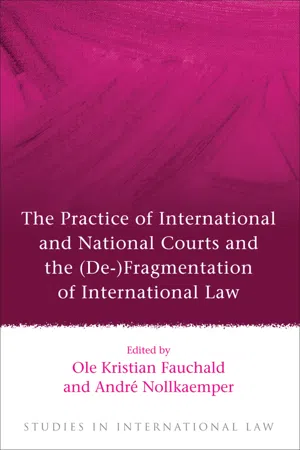
eBook - ePub
The Practice of International and National Courts and the (De-)Fragmentation of International Law
- 382 pages
- English
- ePUB (mobile friendly)
- Available on iOS & Android
eBook - ePub
The Practice of International and National Courts and the (De-)Fragmentation of International Law
About this book
Information
Part One
International Courts
1
Introduction
IN RECENT DECADES there has been a considerable growth in the activities of international tribunals. We have seen an increase in the case-load of existing tribunals and the establishment of new tribunals. The practice of the International Court of Justice (ICJ), the dispute settlement mechanism of the World Trade Organization (WTO), investment arbitration (mainly through the International Centre for Settlement of Investment Disputes), the International Tribunal for the Law of the Sea and regional human rights courts illustrates the trends. Furthermore, supervisory bodies that have been established to control compliance with treaty obligations in respect of human rights, multilateral environmental agreements and international labour law, have adopted decisions in an increasing number of specific cases. National courts further add to the practice of adjudication of claims based on international law.
From one perspective, the increasing practice of courts and supervisory bodies strengthens the adjudicatory process in international law, and may be seen as strengthening the international rule of law. International law is more likely now than ever before to be followed up through formalised procedures designed to ensure that the law is applied in specific cases.
From another perspective, this development poses challenges to the unity of international law. Most of these courts operate within their own special regime (functional, regional, or national) and will primarily interpret and apply international law within the framework of that particular regime. While they may and often do apply rules of general international law, their powers to do so and the interpretations that they offer will be limited and coloured by that particular regime. The role of domestic courts poses special challenges, as the powers of such courts to give effect to international law, as well as their actual practice in applying such law, will be coloured by national law.
The challenge that the practice of (international) tribunals poses for the unity of international law is part of a much broader phenomenon of fragmentation, which also relates to such phenomena as relatively autonomous international organisations, regionalism, unilateralism and bilateralism.1 Increasingly specialised treaty regimes and international organisations with differing memberships and overlapping jurisdictions2 may not sufficiently take account of one another, and thus may produce inconsistencies within the general international order.3
Of course, fragmentation is not at all a new phenomenon. It stems from a multitude of factors that are familiar to traditional international law, including sovereign equality of states, the lack of centralised organs, specialisation of law, different structures of legal norms (for example, hierarchical and non-hierarchical), parallel and sometimes competing regulations, an expanding scope of international law, and different dynamics for rule development.4
The proliferation and increasing activity of international courts and compliance mechanisms have provided new dimensions to the phenomenon of fragmentation.5 While the increasing use of international tribunals can be seen as a function of the expansion and maturity of international law,6 it may lead to further fragmentation. Globally dispersed courts, tribunals, arbitration panels and alternative dispute resolution bodies are so closely coupled with their own specialised regimes, both in terms of organisation and self-perception, that they are likely to contribute to fragmentation.7
The fragmentation of international law through the operation of tribunals has institutional, procedural and substantive aspects. At an institutional level, the proliferation of tribunals and compliance organs for specific treaty regimes has given rise to a concern over deviating jurisprudence and forum-shopping. At the one extreme is the ICJ with its broad substantive jurisdiction combined with specific compulsory jurisdiction as set out in certain treaties.8 At the other extreme are investment tribunals which are established ad hoc and which may or may not have an institutional affiliation.9 The rights and obligations of legal subjects may depend on which body is seized to recognise them.10
At the procedural level, the procedures to be followed by the tribunals differ significantly and may or may not be conducive to their coordination with other tribunals. Of particular interest are the rules on the applicable law and on interpretation. It has been suggested that procedures to seek information from, informal or formal advice from, or formal decisions by, organs established under other treaties may improve the prospects for coordination.11
At the substantive level, problems consist of the emergence of ‘special laws’, treaty-regimes, and functional clusters of rules and specialised branches of international law that raise questions in terms of their relationship inter se and to general international law.12 These are factors that may lead to substantive inconsistencies in jurisprudence. Even in cases where the same case is argued on the basis of almost identical rules before tribunals following almost identical procedures, the results may differ significantly.13 The lack of specific rules concerning the methodology to be used in the mandates of most tribunals means that they are potentially open to a very broad range of interpretive arguments. Given the significant human and economic resources available to most parties to cases before international tribunals, we observe that such tribunals are being subjected to broad ranges of such arguments, which frequently result in lengthy and complex decisions.14
The extent to which the current level of fragmentation is problematic is contested. It may well be argued that overall, the different international tribunals share a coherent understanding of international law. Moreover, the fundamentals of general international law tend to remain the same regardless of which tribunal is deciding the issue. The risk of conflicting judgments is largely a theoretical problem and whilst there are instances of overlapping jurisdiction between tribunals which share the same competence to settle disputes on the basis of international law, this does not generally lead to disagreement or disorder.15
It can even be argued that it is through the decisions of the national and regional tribunals that we are witnessing a progressive development and application of international standards. These tribunals generally act more as agents and instruments for the unity and integrity of international law than as sources of its fragmentation.16 Some authors have also down-played the problems of fragmentation on the ground that competition for influence among institutions as a generative and market-like pluralism has produced more progress toward integration and democratisation than could have been achieved through more formal means.17 Charney has noted that the alternative fora that complement the work of the ICJ strengthen the system of international law, notwithstanding some loss of uniformity. Even different approaches adopted in relation to the same subject may only represent a healthy ‘level of experimentation in a collective effort to find the best rule to serve the international community as a whole’.18
Still others have challenged the view of fragmentation as a negative development and a threat to the legal system, by suggesting that international law is not fragmenting, but rather is being transformed into a pluralist system. Instead of being undermined by fragmentation, the rules, institutions, and practices of the international legal order can be strengthened by the emergence of an international legal pluralism. It has been argued that the ‘respect of legitimate difference inherent in such a pluralist conception may actually enhance the effectiveness of international law by increasing the legitimacy and political acceptability of international legal rules.’19
On the other hand, presidents of the ICJ, including Jennings, Schwebel and Guillaume, have pointed to problematic aspects of fragmentation among international tribunals. Judge Guillaume emphasised that the prospect of forum-shopping may generate unwanted confusion and distort the operation of justice. Such concerns were followed by suggestions to facilitate the resort to advisory opinions from the ICJ.20
It has been pointed out that differences in the development of dispute settlement mechanisms in various areas of international law may lead to careful consideration of some interests while other interests are regarded as irrelevant or not accorded corresponding weight. Such concerns are particularly relevant where a limited range of interests is protected through mandatory dispute settlement. One example is the discussion of how the dispute settlement mechanism and the rules of the WTO could be reformed to strike an appropriate balance between trade and other interests.21
Others have argued that fragmentation may sabotage the evolution of a more democratic and egalitarian international regulatory system. Benvenisti and Downs have emphasised three main reasons why we should consider fragmentation to be a serious problem, all of which are relevant in the context of international tribunals. They have suggested that fragmentation limits the opportunities for weaker actors to build the cross-issue coalitions that could potentially increase their bargaining power and influence, that it increases the transaction costs that international legal bodies must incur in trying to reintegrate or rationalise the legal order, and that it creates a regulatory order that reflects the interests of the powerful.22
While the debate on the question whether fragmentation on the whole is a positive or negative force in international law is thus ongoing, and more work certainly needs to be done, in this volume we approach the issue of fragmentation from a different angle. There is a need to move beyond general st...
Table of contents
- Cover
- Title
- Copyright
- Preface
- Abbreviations
- Part One: International Courts
- Part Two: National Courts
Trusted by 375,005 students
Access to over 1.5 million titles for a fair monthly price.
Study more efficiently using our study tools.
Frequently asked questions
Yes, you can cancel anytime from the Subscription tab in your account settings on the Perlego website. Your subscription will stay active until the end of your current billing period. Learn how to cancel your subscription
No, books cannot be downloaded as external files, such as PDFs, for use outside of Perlego. However, you can download books within the Perlego app for offline reading on mobile or tablet. Learn how to download books offline
Perlego offers two plans: Essential and Complete
- Essential is ideal for learners and professionals who enjoy exploring a wide range of subjects. Access the Essential Library with 800,000+ trusted titles and best-sellers across business, personal growth, and the humanities. Includes unlimited reading time and Standard Read Aloud voice.
- Complete: Perfect for advanced learners and researchers needing full, unrestricted access. Unlock 1.5M+ books across hundreds of subjects, including academic and specialized titles. The Complete Plan also includes advanced features like Premium Read Aloud and Research Assistant.
We are an online textbook subscription service, where you can get access to an entire online library for less than the price of a single book per month. With over 1.5 million books across 990+ topics, we’ve got you covered! Learn about our mission
Look out for the read-aloud symbol on your next book to see if you can listen to it. The read-aloud tool reads text aloud for you, highlighting the text as it is being read. You can pause it, speed it up and slow it down. Learn more about Read Aloud
Yes! You can use the Perlego app on both iOS and Android devices to read anytime, anywhere — even offline. Perfect for commutes or when you’re on the go.
Please note we cannot support devices running on iOS 13 and Android 7 or earlier. Learn more about using the app
Please note we cannot support devices running on iOS 13 and Android 7 or earlier. Learn more about using the app
Yes, you can access The Practice of International and National Courts and the (De-)Fragmentation of International Law by Ole Kristian Fauchald, André Nollkaemper, Ole Kristian Fauchald,André Nollkaemper in PDF and/or ePUB format, as well as other popular books in Diritto & Diritto internazionale. We have over 1.5 million books available in our catalogue for you to explore.