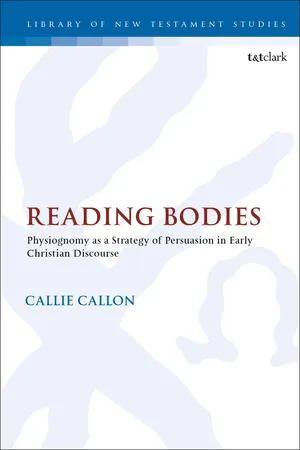
Callie Callon investigates how some early Christian authors utilized physiognomic thought as rhetorical strategy, particularly with respect to persuasion. Callon shows how this encompassed denigrating theological opponents and forging group boundaries (invective against heretics or defence of Christians), self-representation to demonstrate the moral superiority of early Christians to Greco-Roman outsiders, and the cultivation of collective self-identity.
The work begins with an overview of how physiognomy was used in broader antiquity as a component of persuasion. Callon then examines how physiognomic thought was employed by early Christians and how physiognomic tropes were employed to "prove" their orthodoxy and moral superiority. Building on the conclusions of the earlier chapters, Callon then focuses on the representation of the physiognomies of early Christian martyrs, before addressing the problem of the acceptance or even promotion of the idea of a physically lacklustre Jesus by the same authors who otherwise utilize traditional physiognomic thought.
eBook - ePub
Reading Bodies
Physiognomy as a Strategy of Persuasion in Early Christian Discourse
- 184 pages
- English
- ePUB (mobile friendly)
- Available on iOS & Android
eBook - ePub
About this book
Information
Chapter 1
OVERVIEW OF ANCIENT PHYSIOGNOMY AND THE STATE OF THE QUESTION
In 76 B.C.E., Marcus Tullius Cicero undertook the defense of Quintus Roscius Gallus. Roscius was a Roman actor being sued on the contention that he had swindled the litigator C. Fannius Chaerea out of a substantial amount of money. In order to convince his audience that Roscius’s character would not lend itself to such deceit but that Chaerea’s certainly would, Cicero invites the jury to consult the latter’s physical appearance on display before them. Cicero queries,
Doesn’t that head and those eyebrows so closely shaved seem to reek of evil intent and scream out sharp practice? If a person’s silent face allows any conjecture, doesn’t Chaerea’s whole body, from the tips of his toes to the top of his head, seem to unite in showing him made of cheating and trickery? His eyes, brows, forehead, in sum, the whole face, which is the speech of the unspoken mind, has brought people to commit crimes of deception.1
While in a modern North American or European courtroom an appeal to the physical character traits of persons involved in a case would likely be laughed out of court, this excerpt from Cicero’s defense speech clearly illustrates the persuasive power that physiognomy—the perceived correlation between physical appearance and moral character—held in the ancient world. Unlike idealized modern commonplaces that discourage persons from making these sorts of inferences, in antiquity forging these connections was not only commonly accepted practice but was also deemed by many to an accurate diagnostic tool for discerning an individual’s “true” character or moral disposition.
Jennifer Glancy observes that despite lack of intention to do so, today we still make implicit value judgment of persons by how we perceive their bodies. In discussing Maud Gleason’s argument that the body is shaped and interpreted as a cultural artifact in her work on physiognomy in the Second Sophistic, Glancy notes that this is a concept both alien and familiar to a modern audience: “Alien because we do not like to admit that we make assumptions about other persons based on corporal presentation: whether a stranger is lithe or squat, pockmarked or ruddy-faced; whether a new acquaintance returns our gaze. Familiar because we make such assumptions daily: we assume that the deep voice we hear on the phone is male and we do not know how to respond when the speaker identifies herself as Mary.”2
Mladen Popovic briefly discusses the similarities and differences between ancient physiognomy and contemporary tendencies to form an opinion of an individual based on his or her appearance, dress, and mannerisms. While modern evaluations of this type are similar to physiognomy in that certain assumptions and prejudices inform an evaluation of a person’s character based on appearance, Popovic rightly notes that this contemporary practice is different from ancient physiognomy in that “[a]lthough preconceptions undoubtedly play a role, this is hardly applying in a conscious way a fixed set of rules for judging the physical traits of someone else as indications of his or her personality. It is precisely this conscious reflection on the body as signifier and what is signified by it that characterizes the art of physiognomics in a more formal sense.”3
In antiquity, physiognomy proved exceedingly useful in situations where rhetorical invective or encomium could advance a speaker’s or author’s position. Physiognomic thought played an important role in the art of persuasion in the ancient world.
The underlying logic of the principles of physiognomy was predicated on the view that the body and soul were sympathetically related and intrinsically intertwined, and that each acted upon the other. The view that “body and soul react on each other”4 provided the basis for the physiognomic belief that moral character could be discerned by physical characteristics, including how one comported or cultivated one’s body. As Sextus Empiricus remarks, “[T]he body is a kind of expression of the soul, as in fact is proved by the science of physiognomy.”5 On this understanding, aspects of an individual’s physical appearance were scrutinized and evaluated on the belief that the proper understanding of a given physical trait would reveal insight into the person’s character. Physicality was inextricably linked with and provided insight into morality.
Remarkably little about a person’s physical appearance was left unevaluated in ancient physiognomy. Any aspect of physicality, no matter how unimportant or obscure it might seem to a modern audience, could be given physiognomic readings. As Pseudo-Aristotle advises, “The physiognomist draws his data from movements, shapes and colours, and from habits as appearing in the face, from the growth of hair, from the smoothness of the skin, from voice, from the condition of the flesh, from parts of the body, and from the general character of the body.”6 Not only were static features of appearance (such as eye color and nose shape) ripe for physiognomic analysis, but so too was how one cultivated and comported one’s body (discussed further below). These components of physicality were subject to numerous analytical dissections, providing varied potential inferences to be concluded about an individual’s character. Yet, as Mladen Popovic rightly notes, “[a]lthough the physical descriptions seem to evolve into ever more complex and nuanced distinctions, the characterization of people stays broadly within familiar stereotypes, as known from, for example, Theophrastus.”7 Thus, despite the intricate specifications that comprise aspects of physical appearance, the “type” of character that they indicate is not nearly so varied as there existed a conception of stock “types” of persons in the ancient world, predicated on the idea of their having dispositions toward particular virtues or vices.
One of the premises of physiognomy was also what (rather circularly) bolstered its appeal: the appeal to what was deemed “self-evident” and grounded in nature. Physiognomy was conceived of by many as a reliable and impartial tool to assess and categorize others, in accordance with “nature” or how the cosmological world had arranged things. Consequently, it was deemed all the more persuasive as it was couched as an objective truth that could be arrived at by empirical observation, and being cognizant of what these observations indicated. It was frequently deemed to be a form of objective knowledge of the nature of things, a science or art (τέχνη) in its own right.8
Given that it was thought to be an objective and empirical process, it was believed that it could be relied upon to detect a moral failing that a subject might otherwise try to conceal. And it was generally understood that all individuals had some sort of moral shortcoming they would wish to hide. As Gleason observes, “[T]he physiognomic subject, it is taken for granted, has something to conceal . . . physiognomy must therefore always be alert to deception. Signs that one’s subject is overcompensating is a dead giveaway.”9 As such, physiognomy itself could be used to conceal, but in most instances only to a point—ultimately, some slipup of the subject’s physicality will reveal the truth. Cicero provides an excellent example of this seeming tension. In his advice to his son, he cautions him to pay specific attention to his gait so as not to appear effeminate or of disordered mind, yet he also cautions against paying too much attention to how one should comport his body for fear of going too far and making a mockery of the look one is hoping to achieve. He states, “[C]onsequently, there is need of constant management of the eyes, because the expression of the countenance ought not to be too much altered, for fear of slipping into looks that are in bad taste, or into some distortion.”10
However, this appeal to objectivity predominantly only masked cultural and ideological assumptions and commonly held conventions, perpetuating socially constructed perspectives. As Maria Michela Sassi remarks, “[A] bodily feature is judged according to the general impression produced by the individual, who is in turn influenced by that same feature and by the meaning it carries in a context clearly structured by a scale of social values.”11 Nonetheless, despite the paucity of evidence that was not socially constructed to appeal to, physiognomy was still understood as something of a scientific undertaking, predicated on empirical observation and the processes of deduction. Sassi has formulated the underlying rationale of the practice as a logical syllogism, recreated here:
Major premise: All animals with large limbs (B) are courageous (A)
Minor Premise: C is an animal with large limbs (B)
Conclusion: C is courageous (A)12
Thus, physiognomy was understood as a logical deduction process predicated on rational thought. In other words, in the ancient world, physiognomy was credited by many to be a reliable analytical tool to discern character, one grounded in sound and logical principles, and thus was taken with a proportionate degree of gravity. It had a significant amount of traction both in formal study as well as in popular consensus in informing evaluations of a subject’s character. Given the respect it commanded, it is little wonder that it was so widely employed, especially in view of the face-to-face nature of the ancient Mediterranean, where personal interaction was nearly inescapable in forming social and business connections.
In ancient Rome, the boundaries between public and private were “hopelessly blurred,” given that sections of the home were essentially public spaces, with the omnipresence of slaves and, in the case of patrons, their clients who came to pay their respects each morning.13 In this context, Van Houdt notes that even so-called private behavior takes on a broader significance: “it becomes a kind of social gesture and public behaviour:...
Table of contents
- Cover
- Series Information
- Title Page
- Contents
- Acknowledgments
- Introduction
- Chapter 1 Overview of Ancient Physiognomy and the State of the Question
- Chapter 2 The Physiognomy of a Heretic: Physiognomic Polemic as a Component of Persuasion in Demarcating “Insiders” and “Outsiders”
- Chapter 3 The Physiognomy of the (Ideal) Early Christian
- Chapter 4 The Physiognomy of a Martyr
- Chapter 5 “He Had Neither Form Nor Beauty”: The Physiognomic Curiosity of the Negative Descriptions of the Physical Appearance of Jesus
- Conclusions
- Bibligraphy
- Author Index
- Subject Index
- Copyright Page
Trusted by 375,005 students
Access to over 1.5 million titles for a fair monthly price.
Study more efficiently using our study tools.
Frequently asked questions
Yes, you can cancel anytime from the Subscription tab in your account settings on the Perlego website. Your subscription will stay active until the end of your current billing period. Learn how to cancel your subscription
No, books cannot be downloaded as external files, such as PDFs, for use outside of Perlego. However, you can download books within the Perlego app for offline reading on mobile or tablet. Learn how to download books offline
Perlego offers two plans: Essential and Complete
- Essential is ideal for learners and professionals who enjoy exploring a wide range of subjects. Access the Essential Library with 800,000+ trusted titles and best-sellers across business, personal growth, and the humanities. Includes unlimited reading time and Standard Read Aloud voice.
- Complete: Perfect for advanced learners and researchers needing full, unrestricted access. Unlock 1.5M+ books across hundreds of subjects, including academic and specialized titles. The Complete Plan also includes advanced features like Premium Read Aloud and Research Assistant.
We are an online textbook subscription service, where you can get access to an entire online library for less than the price of a single book per month. With over 1.5 million books across 990+ topics, we’ve got you covered! Learn about our mission
Look out for the read-aloud symbol on your next book to see if you can listen to it. The read-aloud tool reads text aloud for you, highlighting the text as it is being read. You can pause it, speed it up and slow it down. Learn more about Read Aloud
Yes! You can use the Perlego app on both iOS and Android devices to read anytime, anywhere — even offline. Perfect for commutes or when you’re on the go.
Please note we cannot support devices running on iOS 13 and Android 7 or earlier. Learn more about using the app
Please note we cannot support devices running on iOS 13 and Android 7 or earlier. Learn more about using the app
Yes, you can access Reading Bodies by Callie Callon in PDF and/or ePUB format, as well as other popular books in Theology & Religion & Biblical Studies. We have over 1.5 million books available in our catalogue for you to explore.