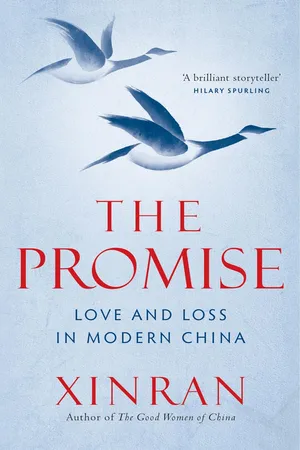
At the start of the twentieth century in China, the Hans were married in an elaborate ceremony before they were even born. While their future was arranged by their families, this couple had much to be grateful for. Not only did they come from similar backgrounds – and as such were recognized as a good match - they also had a shared passion in their deep love of ancient Chinese poetry. They went on to have nine children and chose colours portrayed in some of their favourite poems as nicknames for them - Red, Cyan, Orange, Yellow, Green, Ginger, Violet, Blue and Rainbow. Fate, and the sweep of twentieth century history would later divide these children into three groups: three went to America or Hong Kong to protect the family line from the communists; three were married to revolutionaries having come of age as China turned red; while three suffered tragic early deaths. With her trademark wisdom and warmth, Xinran describes the lives and loves of this extraordinary family over four generations. What emerges is not only a moving, beautifully-written and engaging story of four people and their lives, but a crucial portrait of social change in China. Xinran begins with the magic and tragedy of one young couples wedding night in 1950, and goes on to tell personal experiences of loss, grief and hardship through China's extraordinary century. In doing so she tells a bigger story – how traditional Chinese values have been slowly eroded by the tide of modernity and how their outlooks on love, and the choices they've made in life, have been all been affected by the great upheavals of Chinese history. A spell-binding and magical narrative, this is the story of modern China through the people who lived through it, and the story of their love and loss.
- 288 pages
- English
- ePUB (mobile friendly)
- Available on iOS & Android
eBook - ePub
About this book
Information
Part I
A Love Coloured by Wars and Political Movements
First Sister

Red
∙ born 1920 ∙
Not long after China Witness was published in 2010, I received a quite unexpected call from a family friend.
‘Xinran! I’ve just started reading your new book, and there’s something I simply have to tell you about …
‘For the past year, I’ve been working at a retirement home looking after elderly cadres and their families. Not long ago, one of the old officers I look after fell gravely ill. Knowing he didn’t have long left, he made two final wishes: one was for us to go and visit his house; the other was to grant his wife one simple request.
‘And so, after he died, another member of staff and I ended up visiting his widow in the home they had shared for Lord knows how many years. My colleague was grumbling the whole way over, saying that in the ten years he’d worked at the home, he’d never been invited into the old couple’s house.
‘But, in fact, no one had been. People who came to deliver letters or Chinese New Year gifts were made to leave them at the door. Even when one of them needed medical attention, they’d always wait for the ambulance outside. Behind their backs, the younger members of their work unit would whisper about them.
‘When we walked in, we were the first visitors for many years. There was literally nothing in the house, apart from the old lady. We didn’t dare stay too long, and after a few minutes of polite small talk we got ready to leave. On our way out, the old lady thanked us for granting her husband’s dying wish, before very subtly slipping a pink envelope into my hand. “His other wish is written inside,” she said calmly. The envelope was sealed.
‘On the way back, my colleague spoke of nothing but that envelope and what it might contain. But on its front, in the most beautiful handwriting, were written the words:
Unless the spring has sprung, the flowers will not bloom.Unless you received this letter, you must not open it.
‘It wasn’t until I got home that evening that I finally found myself alone. Inside the envelope was a single sheet of writing paper, beautifully emblazoned with a pattern of golden-red roses. On the page itself there was just one sentence: “Please arrange for me to have a virginity test.” The letter was signed “Han Anhong”.
‘A virginity test?! I thought I must have misunderstood the message, so I went and found the internal phone book and dialled the old lady’s number. On the other end of the line, her voice was adamant: “Yes, that was my husband’s other dying wish.”
‘“And do you want to have the test?” I asked, because it was, after all, her body and not her husband’s.
‘“Yes, I do. I want for us both to have some sense of closure. Please make the necessary arrangements, and after that we can speak again. Thank you, and goodnight.” With that, she hung up.
‘Not long after, in accordance with her husband’s wish, I took the old lady to the General Hospital of the People’s Liberation Army (PLA) for a gynaecological examination. When I saw the results, I could barely believe my eyes.
‘She had never had sex with her husband.
‘Xinran, we all knew the old couple had no children, but I just can’t understand why, in sixty-one years of marriage, they had never had sex. Would you agree to interview her? I can help make the introductions. You should know, though, that the old couple were somewhat eccentric; they were never ones to join in any community events or talk to their neighbours, let alone invite people into their home. So it’s hard to say whether the old lady will agree to this or not.’
Since I became a radio talk show host in 1989, I have interviewed more than three hundred Chinese women, exploring the ways in which their lives and loves have been defined largely by external forces. It didn’t take long to notice a clear pattern in how these forces changed according to their age – women from my grandparents’ generation were often forced into arranged marriages by their parents, while it was political turmoil that shaped the love lives of my parents’ generation. As for women of my own generation, money seemed to be the main driving force behind their search for a husband.
Many of their stories ended in tragedy – I’d even heard of women in the countryside who had killed themselves in order to help their families – but I had never before come across a story like the one just recounted to me. Without a moment’s hesitation, I asked my friend to do everything she could to help put me in touch with this enigmatic old lady.
I started planning my visit the day I arrived back in China.
Our initial contact, however, was far from smooth. Our first telephone call lasted less than two minutes, with the old lady politely but firmly refusing to speak to me. It seemed completely out of the question that she would invite me into her home.
In my book China Witness, I explored the lives of the first two generations of modern China – those born before 1950 – and found the majority of them to have been silent, passive bystanders to the world around them. This was not just a result of the turbulent times they lived in, but also a remnant of ancient Chinese legal customs.
The concept of guilt by association was one of the most notable features of ancient Chinese law. Relatives and associates were held accountable alongside the criminal themselves, which not only led to fierce loyalty among individual factions and families, but also gave rise to a kind of ‘clan consciousness’ – no one would dare speak out for fear of being implicated themselves. This became so ingrained in Chinese culture that it had a profound and lasting effect on the way Chinese people behave, making them inherently cautious and reluctant to take assertive action for fear of the consequences.
This ‘clan consciousness’ withstood the great social and political upheavals of twentieth-century China – the collapse of the Qing dynasty, the chaos of the Warlord Era, the Sino-Japanese War, the Civil War and the Communist Revolution – because in the unspeakable chaos of these times, China never gave its people the chance to learn how to be ‘conscious’ of themselves as individuals, or how to talk about their own feelings.
Only after the ‘Reform and Opening Up’ programme of economic reforms spread through China in the 1980s did these people sense that the doors were slowly creaking open – between China and the world; between China’s past and its present; between individuals and the government; even between family members.
But this does not mean Chinese necessarily think and act like others do. Caution and restraint have governed Chinese public expression for so long that forty years is far too brief a time to bring about any meaningful change, and freedom of speech in China continues to be hedged by ignorance and fear.
The traumas that Chinese people have lived through over the past few generations have been caged in their memories. To get them to talk about what they have witnessed, one must first find a way to help them open those cages. No easy task, but thirty years of interviewing, listening, studying and understanding have strengthened my resolve. If they can record a lifetime of Chinese history, then why can’t I wait a few more days, months, or even years?
After numerous requests over the telephone, the old lady began to relent ever so slightly. ‘Let me think about it, OK?’
‘Of course,’ I told her. ‘I come back to China twice a year, and I’m happy to wait until next time, or the time after, or even the time after that. I gather these oral histories for the sake of our younger generations, so that they can better understand both the lives of their ancestors and the history of modern China. After a hundred years of chaos and upheaval in our country, historical records are lacking and subject to th...
Table of contents
- Promises and ‘Talking Love’ • My Inspirations for This Book
- Key Dates
- Han Family Tree
- Introduction
- Note on the Text
- Part I • A Love Coloured by Wars and Political Movements
- Part II • A Communist Family Tree
- Part III • A Bird’s Love during the Cultural Revolution
- Part IV • Diverse ‘Lovers’
- Afterword • In and Out the Door of Life
- Author’s Heartfelt Thanks
- Notes
Trusted by 375,005 students
Access to over 1.5 million titles for a fair monthly price.
Study more efficiently using our study tools.
Frequently asked questions
Yes, you can cancel anytime from the Subscription tab in your account settings on the Perlego website. Your subscription will stay active until the end of your current billing period. Learn how to cancel your subscription
No, books cannot be downloaded as external files, such as PDFs, for use outside of Perlego. However, you can download books within the Perlego app for offline reading on mobile or tablet. Learn how to download books offline
Perlego offers two plans: Essential and Complete
- Essential is ideal for learners and professionals who enjoy exploring a wide range of subjects. Access the Essential Library with 800,000+ trusted titles and best-sellers across business, personal growth, and the humanities. Includes unlimited reading time and Standard Read Aloud voice.
- Complete: Perfect for advanced learners and researchers needing full, unrestricted access. Unlock 1.5M+ books across hundreds of subjects, including academic and specialized titles. The Complete Plan also includes advanced features like Premium Read Aloud and Research Assistant.
We are an online textbook subscription service, where you can get access to an entire online library for less than the price of a single book per month. With over 1.5 million books across 990+ topics, we’ve got you covered! Learn about our mission
Look out for the read-aloud symbol on your next book to see if you can listen to it. The read-aloud tool reads text aloud for you, highlighting the text as it is being read. You can pause it, speed it up and slow it down. Learn more about Read Aloud
Yes! You can use the Perlego app on both iOS and Android devices to read anytime, anywhere — even offline. Perfect for commutes or when you’re on the go.
Please note we cannot support devices running on iOS 13 and Android 7 or earlier. Learn more about using the app
Please note we cannot support devices running on iOS 13 and Android 7 or earlier. Learn more about using the app
Yes, you can access The Promise by Xinran Xue, William Spence in PDF and/or ePUB format, as well as other popular books in Politics & International Relations & Political Biographies. We have over 1.5 million books available in our catalogue for you to explore.