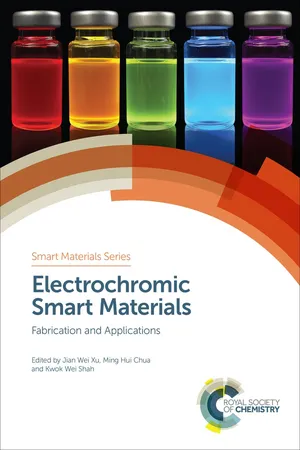
Interest in and attention on electrochromic technology has been growing since the 1970s, with the advent of numerous electrochromic devices in commercial and industrial settings. Many laboratory-based colour-changing electrochromic device prototypes have surfaced following research breakthroughs in recent years, and the consumer market has been expanding continuously. Electrochromic devices have a wide range of applications, such as displays, self-dimming mirrors for automobiles, electrochromic e-skins, textiles, and smart windows for energy-efficient buildings. Electrochromic Smart Materials covers major topics related to the phenomenon of electrochromism, including fundamental principles, different classes and subclasses of electrochromic materials, and device processing and manufacturing. It also highlights a broad range of existing and potential applications of electrochromic devices, with an analysis of the current market needs and future trends. Providing a comprehensive overview of the field, this book will serve as introductory reading to those new to this area, as well as a resource providing detailed, in-depth knowledge and insights to the seasoned audience. Featuring contributions from researchers across the globe, it will be of interest to postgraduate students and researchers in both academia and industry interested in smart design, materials science and engineering.
eBook - ePub
Electrochromic Smart Materials
Fabrication and Applications
- 528 pages
- English
- ePUB (mobile friendly)
- Available on iOS & Android
eBook - ePub
About this book
Trusted by 375,005 students
Access to over 1.5 million titles for a fair monthly price.
Study more efficiently using our study tools.
Information
CHAPTER 1
Introduction to Electrochromism
Institute of Materials Research and Engineering (IMRE), the Agency for Science, Technology and Research (A*STAR), 2 Fusionopolis Way, Innovis, #08-03, Singapore 138634
*Email: [email protected]
*Email: [email protected]
1.1 General Introduction
Chromic materials are materials which exhibit a reversible colour change in response to an external stimulus such as temperature (thermochromism)1 and light (photochromism).2 The source of the colour changes is the variation in absorption spectra of the materials across the UV–visible–near-infrared (NIR) region. Besides the above-mentioned stimuli, oxidation and reduction of certain substance upon application of an electrical bias can also lead to distinct photo-optical and colour changes. This phenomenon is known as “electrochromism”.3–6 Electrochromic (EC) materials generally exhibit colour changes between two coloured states or between a coloured state and a bleached state. Materials that reveal coloured hues in their oxidised or reduced states are referred to as anodically colouring or cathodically colouring respectively.10–12 Several EC materials that exist in multiple redox states reveal the unique ability to switch between several coloured states. This is known as polyelectrochromism.7–9 EC materials are highly applicable in smart windows and optical display technology. Furthermore, as the region of optical changes can be extended beyond the UV–visible region into the NIR, the thermal infrared and even the microwave region, these EC materials are potentially useful in defence related applications.13
Many different classes of compounds were reported to exhibit EC properties: (i) transition metal oxides (WO3 and TiO2),14–23 metal coordination complexes (CoFe(CN)6 and Prussian Blue),24–28 organic molecular dyes (e.g. viologen)29–33 and organic conducting polymers (e.g. polythiophenes, polyanilines and poly(3,4-ethylenedioxythiophene (PEDOT))).34–44 Amongst these, organic EC materials possess advantages such as intense colouration, ease of structural modification, good processability, low cost and good film-forming ability. On the other hand, their inorganic counterparts were reported to exhibit good chemical and electrochemical stabilities as well as a wide range of working temperatures.45 In addition, organic/inorganic nanocomposites were also developed to combine the advantages of both organic and inorganic EC materials. Such hybrid materials could be prepared from the use of either only EC-active organic or inorganic materials or both. In the EC nanocomposites, much attention has been paid to modifying the interfacial interactions between organic and inorganic parts because such interactions are vital for structure strength, mass transport, electron conduction and EC performance.46–48
1.2 History of Electrochromism
The first EC device was documented by Deb in 1969, where he demonstrated the controlled and reversible changing of colour with the use of tungsten trioxide (WO3).49,50 Since then, many classes of EC materials and corresponding devices have been reported, which include metal oxides, viologens and conjugated polymers. Due to their facile colour changes in the visible region, EC materials were highly sought after and employed for optical display applications. Early research in the US, Soviet Union, Japan and Europe on EC materials were motivated by their potential applications in information displays. There were intense research efforts during the first half of the 1970s at several large international companies such as IBM,51,52 Zenith Radio,53,54 the American Cyanamid Corporation55 and RCA in the US56–60 as well as Canon in Japan,61 Brown Boveri in Switzerland62 and Philips in the Netherlands.63 Through the years, electrochromism continues to receive wide attention in the area of fundamental research. In the mid-1980s, interest in EC materials was boosted again given the potential application in fenestration technology, which was deemed as a way to achieve better energy-efficiency in buildings. The newly conceived “smart” window technology could vary the transmittance of light and solar energy, leading to energy savings and indoor comfort.64–67 Moving on, breakthroughs in device engineering and manufacturing techniques allow for electrochromism to move beyond traditional applications such as smart windows and optical displays into emerging applications such as wearable electronics and defence-related technologies.
1.3 Mechanism of Electrochromism and EC Devices
EC materials undergo colour (and sometimes, fluorescence) changes upon the application of an electric field. Generally, the mechanism of EC activities involves the electrochemical oxidation and/or reduction of EC materials, resulting in changes in the optical band-gap, which is thus reflected in colour changes observed. In most cases, a constant supply of electric current is required to sustain a certain colour associated with an electro-oxidised or -reduced state. There are, however, some materials that require almost zero-current consumption to maintain a certain colour state, which is known as the “memory effect”. The detailed mechanism of electrochromism will be discussed in subsequent chapters.
For real-life applications, EC materials have to be incorporated into functional EC devices. Typically, EC materials exist as thin films within the EC devices, allowing them to be in close contact with electrodes and electrolytes for electric current to flow through the devices. An EC thin-film device normally adopts a multi-layered structure as shown in Figure 1.1, which can be used to tailor the optical properties of a device on applying a voltage, and revert to the original state when the polarity of the voltage is reversed. Having good electrical contact between layers is required to ensure good stability and EC performance. As shown in Figure 1.1, a typical EC device has at least five layers: transparent-conducting oxide (TCO) layer/ion-storage layer (IS)/ion-conducting...
Table of contents
- Cover
- Title Page
- Copyright Page
- Preface
- Contents
- Chapter 1 Introduction to Electrochromism
- Chapter 2 Fundamentals of Electrochromic Materials and Devices
- Chapter 3 Conjugated Polymers for Electrochromic Applications
- Chapter 4 Donor–Acceptor Type Conjugated Electrochromic Polymers
- Chapter 6 Bistable Electrochromic Windows from Conjugated Polymers
- Chapter 7 Electroluminochromism: Classical Materials and New Developments
- Chapter 8 Donor–Acceptor Electrochromic Conjugated Polymers with Different Structures
- Chapter 9 Electrochromic and Electrofluorescence Liquid Crystals
- Chapter 10 Electrochemical Properties and Electrochromic Device Applications of Polycarbazole Derivatives
- Chapter 11 Arylamine-based High Performance Polymers for Electrochromic Applications
- Chapter 12 Viologens-based Electrochromic Materials and Devices
- Chapter 13 Metallo-supramolecular Polymers with Electrochromic Properties
- Chapter 14 Nanostructured Electrochromic Materials
- Chapter 15 Electrodeposition Based Electrochromic System
- Chapter 16 Electrochromic Smart Windows for Green Building Applications
- Subject Index
Frequently asked questions
Yes, you can cancel anytime from the Subscription tab in your account settings on the Perlego website. Your subscription will stay active until the end of your current billing period. Learn how to cancel your subscription
No, books cannot be downloaded as external files, such as PDFs, for use outside of Perlego. However, you can download books within the Perlego app for offline reading on mobile or tablet. Learn how to download books offline
Perlego offers two plans: Essential and Complete
- Essential is ideal for learners and professionals who enjoy exploring a wide range of subjects. Access the Essential Library with 800,000+ trusted titles and best-sellers across business, personal growth, and the humanities. Includes unlimited reading time and Standard Read Aloud voice.
- Complete: Perfect for advanced learners and researchers needing full, unrestricted access. Unlock 1.5M+ books across hundreds of subjects, including academic and specialized titles. The Complete Plan also includes advanced features like Premium Read Aloud and Research Assistant.
We are an online textbook subscription service, where you can get access to an entire online library for less than the price of a single book per month. With over 1.5 million books across 990+ topics, we’ve got you covered! Learn about our mission
Look out for the read-aloud symbol on your next book to see if you can listen to it. The read-aloud tool reads text aloud for you, highlighting the text as it is being read. You can pause it, speed it up and slow it down. Learn more about Read Aloud
Yes! You can use the Perlego app on both iOS and Android devices to read anytime, anywhere — even offline. Perfect for commutes or when you’re on the go.
Please note we cannot support devices running on iOS 13 and Android 7 or earlier. Learn more about using the app
Please note we cannot support devices running on iOS 13 and Android 7 or earlier. Learn more about using the app
Yes, you can access Electrochromic Smart Materials by Jian Wei Xu, Ming Hui Chua, Kwok Wei Shah in PDF and/or ePUB format, as well as other popular books in Technology & Engineering & Electrical Engineering & Telecommunications. We have over 1.5 million books available in our catalogue for you to explore.