eBook - ePub
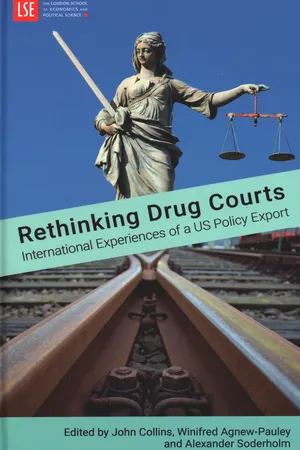
Rethinking Drug Courts: International Experiences of a US Policy Export
International Experiences of a US Policy Export
- 172 pages
- English
- ePUB (mobile friendly)
- Available on iOS & Android
eBook - ePub
Rethinking Drug Courts: International Experiences of a US Policy Export
International Experiences of a US Policy Export
About this book
What are drug courts? Do they work? Why are they so popular? Should countries be expanding them or rolling them back? These are some of the questions this volume attempts to answer. Simultaneously popular and problematic, loved and loathed, drug courts have proven an enduring topic for discussion in international drug policy debates. Starting in Miami in the 1980s and being exported enthusiastically across the world, we now have a range of international case studies to re-examine their effectiveness. Whereas traditional debates tended towards binaries like "do they work?", this volume attempts to unpick their export and implementation, contextualising their efficacy. Instead of a simple yes or no answer, the book provides key insights into the operation of drug courts in various parts of the world. The case studies range from a relatively successful small-scale model in Australia, to the large and unwieldy business of drug courts in the US, to their failed scale-up in Brazil and the small and institutionally adrift models that have been tried in England, Scotland, Wales and Ireland. The book concludes that although drug courts can be made to work in very specific niche contexts, the singular focus on them as being close to a "silver bullet" obscures the real issues that societies must address, including (but not limited to) a more comprehensive and full-spectrum focus on diverting drug-involved individuals away from the criminal justice system.
Information
Publisher
London Publishing PartnershipYear
2019Print ISBN
9781907994852
Edition
1eBook ISBN
9781907994876
Chapter 6
Diversion in the Criminal Justice System: Examining Interventions for Drug-Involved Offenders
The criminal justice system (CJS) routinely deals with drug-related crime and offenders. This includes a wide spectrum of offenders, such as (1) individuals charged with using or possessing illicit drugs; (2) individuals who have problematic drug use, or are dependent on the use of drugs, and/or use criminal means as a way to procure drugs; (3) individuals who are involved in the sale or trafficking of drugs; and (4) individuals who fall into more than one or all of these categories. Individuals involved in drugs and crime have varying levels of needs within the CJS, particularly those whose offending behaviour is directly linked to illicit drug use. Criminal justice systems internationally have gradually adapted to recognise the inefficiency and ineffectiveness of dealing with drug-related crime through traditional justice mechanisms and have begun acknowledging the complex relationship between drugs and crime (Longshore et al., 2001; Lutze and van Wormer, 2014). To address these issues a wide range of responses and interventions have evolved. The overarching aim of these interventions has been to seek alternative ways of dealing with drug-involved offenders that result in more positive outcomes at the individual and community level.
Such interventions are known as diversion programmes. These programmes are characterised as any intervention that re-routes offenders away from traditional criminal justice processing and/or encourages participation in alternative programmes or services. Diversion can be used for various offending groups, such as individuals who use drugs, young people and individuals with mental health issues. This review will focus on drug-related diversion programmes. The motivations for implementing diversion programmes are varied and wide-ranging, including, for example, introducing a greater emphasis on public health outcomes; addressing the stigma associated with, and the criminogenic influence of, formal contact with the CJS; lessening the burden on criminal justice resources, such as overcrowded prisons; and improving the cost-effectiveness of the CJS (Clancey and Howard, 2006; Prichard, 2010; Shanahan et al., 2017b). Referrals that come through the CJS are also an increasingly important route for services to identify and make contact with prospective clients and for individuals to access these services, particularly in the case of hard-to-reach populations (Hayhurst et al., 2015).
Diversion programmes have existed both formally and informally for some time, ranging from early youth courts to informal police warnings or cautions. It is important to note that police routinely ‘divert’ potential offenders from the CJS through the exercise of police discretion, particularly drug-related offenders for minor infractions (Baker and Goh, 2004). However, over time these mechanisms have become more formalised, regulated and codified into policy and legislation (Bull, 2005). This has had a broad range of implications, yet has largely represented a positive shift towards the adoption of alternative procedures for engaging with people who use drugs and a recognition of the inefficiencies of the CJS in absorbing large numbers of individuals with complex social needs and health issues.
Drug diversion was initially met with some resistance from policymakers and law enforcement for being a ‘soft’ option, in a political climate where being ‘tough on crime’, and therefore ‘tough on drugs’, has generally prevailed (Hughes, 2007). However, the expansion and proliferation of drug diversion programmes in the United Kingdom (UK), the United States (US), Australia and many other countries (Bull, 2003) suggests diversion has withstood initial resistance despite entrenched political ideas and rhetoric. Recognising this climate, the initial implementations of drug diversion programmes, for example the Illicit Drug Diversion Initiative introduced in Australia in 1999, were framed as maintaining ‘the structures of the criminal law, but [offering] drug users a second chance’ (Hughes, 2007, p. 364). Beneath this framing remained a recognition that viewing drug diversion programmes purely as drug use and crime reduction mechanisms neglected their potential for broader social impact. In fact, drug diversion that is premised purely on the reduction of drug use or crime may ‘increase the likelihood of harm and be counterproductive’ (Hughes, 2007, p. 364).
Internationally, growing support for diversion programmes coincided with a recognition of the need to address drug use and drug-related crime as a broader social issue:
Diversion should be seen as initiating the process of social change, rather than simply treating ‘drug problems’. Good diversion practice will recognise the interplay of various social issues, e.g. employment, finance, health, legal etc. and will engage, where appropriate, a whole range of support services to address them.
This chapter will critically examine drug diversion in the CJS to address the questions of what can be understood by the term ‘d...
Table of contents
- Introduction
- About the editors and authors
- Drug Courts in the United States: Punishment for ‘Patients’?
- Drug Courts in Australia
- The Irish Experience: Policy Transfer from US Drug Courts
- Drug Policy, Therapeutic Jurisprudence and Criminal Justice in Brazil
- Explaining the Failure of Drug Courts in the United Kingdom
- Diversion in the Criminal Justice System: Examining Interventions for Drug-Involved Offenders
Trusted by 375,005 students
Access to over 1.5 million titles for a fair monthly price.
Study more efficiently using our study tools.
Frequently asked questions
Yes, you can cancel anytime from the Subscription tab in your account settings on the Perlego website. Your subscription will stay active until the end of your current billing period. Learn how to cancel your subscription
No, books cannot be downloaded as external files, such as PDFs, for use outside of Perlego. However, you can download books within the Perlego app for offline reading on mobile or tablet. Learn how to download books offline
Perlego offers two plans: Essential and Complete
- Essential is ideal for learners and professionals who enjoy exploring a wide range of subjects. Access the Essential Library with 800,000+ trusted titles and best-sellers across business, personal growth, and the humanities. Includes unlimited reading time and Standard Read Aloud voice.
- Complete: Perfect for advanced learners and researchers needing full, unrestricted access. Unlock 1.5M+ books across hundreds of subjects, including academic and specialized titles. The Complete Plan also includes advanced features like Premium Read Aloud and Research Assistant.
We are an online textbook subscription service, where you can get access to an entire online library for less than the price of a single book per month. With over 1.5 million books across 990+ topics, we’ve got you covered! Learn about our mission
Look out for the read-aloud symbol on your next book to see if you can listen to it. The read-aloud tool reads text aloud for you, highlighting the text as it is being read. You can pause it, speed it up and slow it down. Learn more about Read Aloud
Yes! You can use the Perlego app on both iOS and Android devices to read anytime, anywhere — even offline. Perfect for commutes or when you’re on the go.
Please note we cannot support devices running on iOS 13 and Android 7 or earlier. Learn more about using the app
Please note we cannot support devices running on iOS 13 and Android 7 or earlier. Learn more about using the app
Yes, you can access Rethinking Drug Courts: International Experiences of a US Policy Export by John Collins, Winifred Agnew-Pauley, Alexander Soderholm, John Collins,Winifred Agnew-Pauley,Alexander Soderholm in PDF and/or ePUB format, as well as other popular books in Social Sciences & Criminology. We have over 1.5 million books available in our catalogue for you to explore.