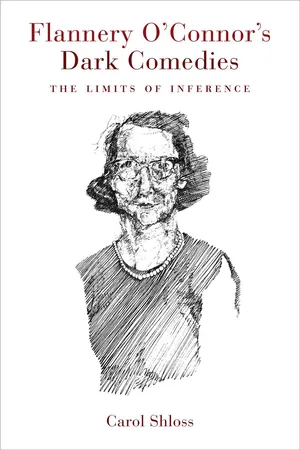
In Flannery O'Connor's Dark Comedies, Carol Shloss moves from biographical, thematic, and theological approaches and instead focuses her criticism on the successes and failures of O'Connor as a rhetorician.
This valuable study of O'Connor's style uses reader-response theory to dissect the author's use of hyperbole, distortion, allusion, analogy, the dramatization of extreme religious experience, the manipulation of judgment through narrative voice, and direct address to the reader.
Schloss aims to return Flannery O'Connor to her readers on fathomable terms, to offer a rhetorical, rather than theological, perspective from which to understand the country preachers, square-jawed farm wives, wise rubes, foolish intellectuals, huckster Bible salesmen, killers, and other "good country people" who populate O'Connor's fiction.
- 176 pages
- English
- ePUB (mobile friendly)
- Available on iOS & Android
eBook - ePub
About this book
Information
Notes
Introduction
1 E. A. R. Ennion and N. Tinbergen, Tracks (Oxford, England: Oxford University Press, 1967), 13. For calling my attention to this book, I am indebted to E. H. Gombrich, “The Evidence of Images,” in C. S. Singleton (ed.), Interpretation: Theory and Practice (Baltimore: Johns Hopkins University Press, 1969), 35-104.
2 Object does not refer necessarily to something that exists in the world, for often the fiction imitates nothing that exists concretely. Thus the object of representation may refer to the imaginings of the author, to the contents of mind. For further discussion of this, see William H. Gass, Fiction and the Figures of Life (New York: Alfred A. Knopf, 1972), 37.
3 Morris R. Cohen and Ernest Nagel, An Introduction to Logic (New York: Harcourt, Brace and World, 1962), 7-8.
4 Flannery O’Connor to “A.,” August 2, 1955, in Sally Fitzgerald (ed.), The Habit of Being: Letters of Flannery O’Connor (New York: Farrar, Straus, Giroux, 1979), 92.
5 David Eggenschwiler, The Christian Humanism of Flannery O’Connor (Detroit: Wayne State University Press, 1972), 13.
6 Flannery O’Connor, Mystery and Manners: Occasional Prose, ed. Sally and Robert Fitzgerald (New York: Farrar, Straus, Giroux, 1970), 47.
7 See Miles Orvell, Invisible Parade: The Fiction of Flannery O’Connor (Philadelphia: Temple University Press, 1972), 52.
8 Robert Fitzgerald, Introduction, Everything That Rises Must Converge, by Flannery O’Connor (New York: Farrar, Straus, Giroux, 1956), xvi.
9 For an attempt to construe the nature of O’Connor’s personal beliefs from her readings in theology, see Sister Kathleen Feeley, Flannery O’Connor: Voice of the Peacock (New Brunswick: Rutgers University Press, 1972).
10 Josephine Hendin, The World of Flannery O’Connor (Bloomington: Indiana University Press, 1970), 7.
11 Richard Stern, “Flannery O’Connor: A Remembrance and Some Letters,” Shenandoah, XVI (Winter, 1965), 5-6.
12 Hendin, World of Flannery O’Connor, 12-15.
13 Margaret I. Meaders, “Flannery O’Connor: ‘Literary Witch,’” Colorado Quarterly, X (Spring, 1962), 385.
14 Betsy Lockridge, “An Afternoon with Flannery O’Connor,” Atlanta Journal and Constitution, November 1, 1959, p. 40.
15 C. Ross Mullins, Jr., “Flannery O’Connor: An Interview,” Jubilee, XI (June, 1963), 35.
16 O’Connor, Mystery and Manners, 224.
17 Flannery O’Connor, A Good Man Is Hard to Find (New York: Harcourt, Brace, 1955), 143.
18 See Victor Erlich, Russian Formalism: History and Doctrine (The Hague: Mouton, 1965), 178.
19 Although only seven of O’Connor’s stories are discussed here, they can be taken as representative, given O’Connor’s propensity to repeat narrative structures. Many of the stories were revised and published under separate titles, or incorporated in later novels. For example, “The Geranium,” the opening story of O’Connor’s master’s thesis at the Iowa Writers Workshop, was rewritten and published posthumously in 1965 as “Judgement Day.” The stories “The Train,” “The Peeler,” “The Heart of the Park,” and “Enoch and the Gorilla” were all eventually incorporated into the novel Wise Blood. Similarly, “You Can’t Be Any Poorer Than Dead” became the opening chapter of The Violent Bear It Away. Also, O’Connor inclined toward the same situations and character types even in stories that are quite dissimilar in superficial tenor. “The Lame Shall Enter First” repeats the situation of a dry intellectual getting his comeuppance from a young, “uncivilized” boy like the one in The Violent Bear It Away. “The Comforts of Home” and “The Enduring Chill” reiterate the dependent child-widowed mother relationship of “Greenleaf.” In “The Temple of the Holy Ghost,” there is a child as sour and ugly as the one in “The Circle in the Fire.”
20 Irving Howe, “On Flannery O’Connor,” New York Review of Books (September 30, 1965), 16. “Flannery O’Connor could bring into play resources of worldliness such as one might find in the work of a good many sophisticated modern writers. ... Except for an occasional phrase, which serves partly as a rhetorical signal that more than ordinary verisimilitude is at stake, there are no unavoidable pressures to consider these stories in a strictly religious sense. They stand securely on their own, as renderings and criticisms of human experience.” See also, John Hawkes, “Flannery O’Connor’s Devil,” Sewanee Review, LXX (Summer, 1962), 398.
One
1 Robert Fitzgerald, Introduction, Everything That Rises Must Converge, by Flannery O’Connor (New York: Farrar, Straus, Giroux, 1956), xxxiii.
2 Flannery O’Connor, Mystery and Manners: Occasional Prose, ed. Sally and Robert Fitzgerald (New York: Farrar, Straus, Giroux, 1970), 32. “I see from the standpoint of Christian orthodoxy. This means that for me the meaning of life is centered in our Redemption by Christ and what I see in the world, I see in its relation to that.”
3 Wilfrid Sheed, “The Good Word: On Keeping Closets Closed,” New York Times Book Review (September 2, 1973), 2.
4 Erich Auerbach, Mimesis: The Representation of Reality in Western Literature (Princeton: Princeton University Press, 1953).
5 Joseph Conrad, quoted in O’Connor, Mystery and Manners, 80.
6 Flannery O’Connor to “A.,” July 5, 1958, in Sally Fitzgerald (ed.), The Habit of Being: Letters of Flannery O’Connor (New York: Farrar, Straus, Giroux, 1979), 290.
7 O’Connor, Mystery and Manners, 15.
...Table of contents
- Cover
- Title Page
- Copyright Page
- Contents
- Acknowledgments
- Introduction
- ONE: The Problem of Textual Implication
- TWO: The Writer’s Sense of Audience
- THREE: Extensions of the Grotesque
- FOUR: The Rhetorical Uses of Analogy and Allusion
- FIVE: Control of Distance in The Violent Bear It Away
- SIX: Epiphany
- Conclusion: The Limits of Inference
- Chronology of Flannery O’Connor’s Fiction
- Notes
- Selected Bibliography
- Index
Trusted by 375,005 students
Access to over 1.5 million titles for a fair monthly price.
Study more efficiently using our study tools.
Frequently asked questions
Yes, you can cancel anytime from the Subscription tab in your account settings on the Perlego website. Your subscription will stay active until the end of your current billing period. Learn how to cancel your subscription
No, books cannot be downloaded as external files, such as PDFs, for use outside of Perlego. However, you can download books within the Perlego app for offline reading on mobile or tablet. Learn how to download books offline
We are an online textbook subscription service, where you can get access to an entire online library for less than the price of a single book per month. With over 1.5 million books across 990+ topics, we’ve got you covered! Learn about our mission
Look out for the read-aloud symbol on your next book to see if you can listen to it. The read-aloud tool reads text aloud for you, highlighting the text as it is being read. You can pause it, speed it up and slow it down. Learn more about Read Aloud
Yes! You can use the Perlego app on both iOS and Android devices to read anytime, anywhere — even offline. Perfect for commutes or when you’re on the go.
Please note we cannot support devices running on iOS 13 and Android 7 or earlier. Learn more about using the app
Please note we cannot support devices running on iOS 13 and Android 7 or earlier. Learn more about using the app
Yes, you can access Flannery O'Connor's Dark Comedies by Carol Shloss in PDF and/or ePUB format, as well as other popular books in Literature & North American Literary Criticism. We have over 1.5 million books available in our catalogue for you to explore.