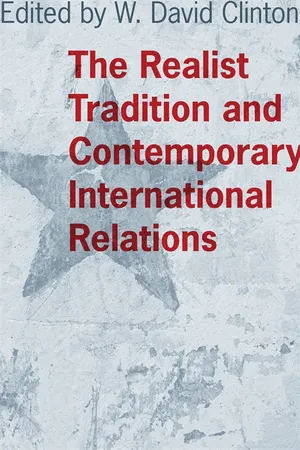
The tradition in international relations theory known as realism has often been associated with the Cold War. The contributors to this intriguing volume argue, however, that realism remains a profound and relevant perspective on contemporary international politics. They point out that classical realism is based on concepts that were elucidated long before the Cold War began and are not confined by its boundaries. Further, they believe that insights of the realist tradition can provide valuable guidance in our contemporary world.
W. David Clinton and ten scholars of foreign policy reexamine the work of thinkers spanning twenty-five centuries who have contributed to the development of realism across the ages. In their essays, the authors consider two key questions: What makes these thinkers "realists"? And how is their work relevant to the modern, post--Cold War world? These essays take a fresh look at such canonical thinkers as Thucydides, Augustine, Machiavelli, Hobbes, Hume, Burke, Carr, Niebuhr, and Morgenthau. Countering the widespread belief that realism has nothing left to offer, this collection demonstrates that continuities remain in the political world -- and that the ideas rooted in realism are too important and too useful to ignore.
While there are obvious differences among the political philosophers whose works are considered here, they share a common concern about human limitations and the possible dangerous consequences of ignoring those limitations. Each in his own way, these classic thinkers discuss the need for prudence to counter the ever-present threat of tragedy resulting from our innocent, hopeful, or self-righteous efforts for perfection. These provocative essays demonstrate that though a realist understanding of the nature of international relations is at least as old as Thucydides, it is also as contemporaneous as the most recent headline.
- 272 pages
- English
- ePUB (mobile friendly)
- Available on iOS & Android
eBook - ePub
The Realist Tradition and Contemporary International Relations
About this book
Information
What’s “Realistic”?
A Framework for an Augustinian Analysis of Contemporary Approaches to International Relations
The end of the Cold War has found the scholarly tradition of classical political realism both attacked from without and undermined from within. The attacks from without surprise no one: the history of liberal and idealist questionings of realist premises runs long and deep. What should surprise us is the extent to which the foundational premises of classical realism have given way to the more liberal, structuralist premises of neorealism. In little more than a generation the classical realism of Niebuhr, Morgenthau, and Kennan has, it seems, been almost completely replaced by the neorealism of Waltz, Gilpin, Grieco, Mearsheimer, Krasner, and Jervis.1 The few studies pointing out the disparity between these two realisms seem lost in the sea of voices—whether neorealist or neoidealist—apparently determined to solidify the new structuralist foundations of political realism.2
An intriguing irony thus lurks behind the contours of this new neorealist-neoidealist debate. When viewed from the historically distant perspective of one of the key founders of political realism, Augustine, the two sides turn out to have more in common than in distinction. Both neorealist structuralists and neoidealist institutionalists, it seems, draw their foundational assumptions from the well of seventeenth-century liberalism.3 Neorealists acknowledge their debt to Thomas Hobbes, but without clear appreciation for the body of common assumptions shared by Hobbes and the more obvious founder of liberalism, John Locke.
In this chapter, I point out this fundamental agreement first by grounding the contemporary debate in its Lockean and Hobbesian suppositions, and then by bathing it in the older—but perhaps brighter and fuller—light of Augustinian Christianity. In doing so, I aim not only to illumine the poverty of neorealism but also, and thereby, to highlight the paucity of heuristic models currently available to mainstream students of international politics. In showcasing an Augustinian model, which I believe offers a richer and more comprehensive view of the human experience relevant to understanding the array of forces at work in the international arena, then, a further irony arises. By capturing more of the human condition and, potentially, explaining more of human political experience, Augustine’s realism amplifies and transcends not only the structuralist bearers of the realist torch, but their liberal institutionalist critics as well.4
The Break from Classical Realism through Appeal to Hobbes
What is neorealism and how does it justify itself? Is it indeed a break with the classical realist tradition, and, if so, what is the nature of that break? Indeed, what are the origins of the break? This last question, perhaps the least difficult to answer, points to a clear consensus of opinion that the origins of neorealism lie in the work of Kenneth Waltz.5 Waltz’s Man, the State, and War first presented to scholars the view Waltz later fleshed out in his Theory of International Politics (1979): that international conflict arises not necessarily because of human nature or because of the particular forms of governments found in certain states, but rather because of the anarchic structure of international politics.6 Waltz’s “third image” conclusion gave way to a host of studies following up on this finding. The debate, now couched in the Hobbesian language of “rational actors” in an anarchic international “state of nature,” shifted its focus to issues of “polarity,” “state actors,” and “stability” in the international system.
Neorealists still claim to be pessimists about human nature, but they seek to move beyond what they understand to be the conceptually vague notion of human nature. As Nye puts the matter, “the significance of Waltz’s work is not in elaborating a new line of theory, but in the systemization of realism.” According to Nye, then, Hans Morgenthau, “by basing international politics on human nature’s drive for power,… explained too little by explaining too much. Human nature does not adequately account for variation.” Going beyond Morgenthau, “Waltz provides a more elegant theoretical basis for realism.” He “did for the classical realists what they never did for themselves.”7 Jervis later echoes this analysis, noting that Waltz’s neorealism, which he describes as “the most influential current theory,… shares many of Morgenthau’s basic premises but proceeds with greater rigor.” Indeed, says Jervis, “the fact that [classical] realism does not readily yield testable propositions has been a source of frustration for political scientists who sought to make their discipline more of a science.”8 The progressive movement beyond the limitations of classical realism has thus become an almost casual assumption. While some intra-realist debate does continue, it does so only as to the propriety of using either the system or the state actor as one’s methodological starting point. The foundational premises appear firmly embedded.9
What are these premises? Neorealists are quick to state them, often as a way to demonstrate the continuity of their work with the older realist tradition. Jervis defends his work at “the intersection of realism and game theory,” for example, as follows: “Although common interests are stressed [in game theory] more than in some forms of realism, the basic assumptions clearly fit within this school: the focus is on the state as an actor and on the strategies that can rationally be used to further its interests.”10 Likewise Gilpin, noting that “realism is founded on a pessimism regarding moral progress and human possibilities,” finds clearly present in the tradition “three assumptions regarding political life” from which he begins his own work. These assumptions include the “conflictual nature of international affairs,” the understanding that the “essence of social reality is the group,” and the “primacy in all political life of power and security in human motivation.”11 Finally, Grieco lists the “five propositions” of realism: “First, states are the major actors in world affairs. Second, the international environment severely penalizes states if they fail to protect their vital interests or if they pursue objectives beyond their means … Third, international anarchy is the principal force shaping the motives and actions of states. Fourth, states in anarchy are preoccupied with power and security … [Fifth], international institutions affect the prospects for cooperation only marginally.”12
The neorealist restatement of the basic premises of classical realism, though, has resulted in a fundamental shift in emphasis, a shift that appears to the neorealists as superficial and innocuous but is in fact dramatic and telling. Nye states it unapologetically: Waltz’s more “elegant” theory “avoids references to humans pursuing power as an end; pursuit of power as a means is sufficient for his theory.”13 Looking closely at the work of each of the neorealists already cited finds this commonality obviously at work. The application of such techniques as the prisoner’s dilemma, and game theory more generally, on the basis of neorealist premises makes good sense only if power is merely a means to some other goal, such as security or independence. Indeed, the neorealist assumption of rational actors in the international system, rational in the sense of wanting only to be left securely to their own devices, leads naturally to the conclusion of most neorealist scholars that a certain kind of cooperation among states—one leading to the mutual peace of self-direction—really is the primary goal of states as rational actors. Charles Glaser lays out this ironic turn of events when he reports that realists (neorealists, here) are really optimists, in that the self-help they identify in state motivational calculi ends up being in fact a goad to cooperation.14
A fascination with the anarchic structure of international relations follows readily upon this shift of ground. Try as they might to depart from it, neorealists seem ever to return to the problem of sovereign, potentially independent, and rational states seeking to find their way to physical security in an anarchic milieu. As Shimko puts it, “there is disagreement among neorealists about what exactly anarchy causes, but there is agreement that anarchy causes it.”15 Mearsheimer’s controversial prediction of instability in Europe after the Cold War, for example, rested sturdily on the assumption of international anarchy. “Conflict is common among states,” he states, citing both Morgenthau and Waltz here, “because the international system creates powerful incentives for aggression.” Indeed, he goes on, the “root cause” of such aggressive tendencies is “the anarchic nature of the international system.” Since “in anarchy there is no higher body or sovereign that protects states from one another,” each state living thus “faces the ever-present possibility that another state will use force to harm or conquer it.” At base, then, “this competitive world is peaceful [only] when it is obvious that the costs and risks of going to war are high, and the benefits … are low.”16 Reactions to Mearsheimer’s position question neither his assumption of international anarchy nor his assumption of rational state actors. Instead, they concentrate on issues of polarity within the anarchy, of prospects for cooperation given the rational nature of state decision making, or of social—as opposed to material—integrity as a goal and premise of state action.17
The new realism thus appears to rest contentedly on at least implicit assent to straightforward Hobbesian premises. Yet, for whatever reason, it fails to see in the Hobbesian groundwork the liberal, reductionist view of human experience that Hobbes developed. For Hobbes, both the ontological and psychological character of human beings (and human societies in relation to each other, he says) grows out of a condition of existential aloneness: the well-known “warre … of every man against every man.” As the neorealists are quick to discover, though, the physical insecurity that breeds conflict, for Hobbes, grows out of a rational calculus of personal interest. Human beings simply wish to protect and preserve their bodily integrity, and such integrity is threatened by the unpredictability of natural human interaction. As a result, their “feare of Death, and Wounds,” along with their equality of ability to injure or destroy one another when pursuing their self-understood ends, lead them naturally to a kind of existential and primal anxiety, insecurity, and even dread. Yet with the proper incentive and rationale to cooperate, human beings can easily be made to see that their interests lie in making a covenant with others, a covenant that they agree to have overseen by a superior power (what Hobbes calls a “soveraign”) and which in this way allows for some predictability and thus peace in their interpersonal affairs. The ultimate goal for Hobbesian individuals is not power, then, but physical security and peace. “The finall Cause, End, or Designe of men … in the introduction of that restraint upon themselves,” writes Hobbes in opening part II of his Leviathan, “is the foresight of their own preservation, and of a more contented life thereby.”18
For Hobbes, then, the real problem for human beings concerns their natural condition of aloneness and insecurity, and the lack of predictable, that is, “enforced,” structures of interaction. Such condition breeds at base an existential fear of violent injury or death. But for rational, “calculating” human beings, it breeds as well a desire for peace: “The Passions that encline men to Peace, are Feare of Death; Desire of such things as are necessary to commodious living; and a Hope by their Industry to obtain them.”19 Hence, as Donald Hanson has rightly pointed out, Hobbes’s goal in his political writing is not simply to describe human misery, but to construct for rational human beings a “highway to peace.”20 Human beings are not so much baneful as fearful, not so much malignant as self-absorbed. They are, as it were, victims of circumstance; but they are also capable of calculating their way out of such circumstance. As Hobbes puts it, “The Desires, and other Passions of man, are in themselves no Sin. No more are the Actions, that proceed from those Passions, till they know a law [under government] that forbids them.”21
Of course in the international arena, Hobbes finds little hope for transcending the “posture of War” that particular states confront. The lack of sovereign power over otherwise independent polities means that international relations will, “in all times,” says Hobbes, represent the archetypal “state of nature.”22 But here again, the problem is not the rational actors but the anarchic situation with which these actors must contend. As Shimko, in his description of the neorealist movement, sums up the point, “the neorealist formulations of the security dilemma and the prisoner’s dilemma embodied in game theory do not assume that some of the actors are out to exploit others; they are agnostic on this issue. The only thing that need be assumed is the possibility of being exploited, not the desire to exploit.”23
The Neoidealist Critique and Its Lockean Basis
How do contemporary critics of realism respond to the neorealist vision? Interestingly, their critiques sound some very familiar neorealist notes. And alas: such familiarities will shock us only if we fail to realize that the Lockean premises from which they launch their attacks are indeed from the same liberal family as the Hobbesian premises undergirding their targets.
Consider, for example, Charles Kegley’s presidential address to the 1993 meeting of the International Studies Association. “While it endured,” Kegley states, “the Cold War seemed to confirm and validate many of the principles and predictions that realists emphasized prior to and in the wake of World War II, and to invalidate the principles that idealists advocated after World War I.” Realism thus found “a hospitable home” during “the conflict-ridden fifty-year system between 1939 and 1989,” a time “when lust for power, appetite for imperial expansion, ...
Table of contents
- Cover
- Title Page
- Copyright Page
- Contents
- Preface
- Reinhold Niebuhr: A Personal Reflection and Political Evaluation
- Thucydides on Peace
- What’s “Realistic”?: A Framework for an Augustinian Analysis of Contemporary Approaches to International Relations
- International Law from a Machiavellian Perspective
- Mathematici versus Dogmatici: Understanding the Realist Project through Hobbes
- “Every Man Supposed a Knave”: David Hume’s Political Realism
- Edmund Burke’s Theory of International Order: The Debate between Realism and Rationalism
- The Relevance of E. H. Carr’s Realism in the Post–Cold War World
- Reinhold Niebuhr’s Christian Realism/Christian Idealism
- Morgenthau’s Political Realism and the Ethics of Evil
- Conclusion: The Relevance of Realism in the Post–Cold War World
- Contributors
- Index
Trusted by 375,005 students
Access to over 1.5 million titles for a fair monthly price.
Study more efficiently using our study tools.
Frequently asked questions
Yes, you can cancel anytime from the Subscription tab in your account settings on the Perlego website. Your subscription will stay active until the end of your current billing period. Learn how to cancel your subscription
No, books cannot be downloaded as external files, such as PDFs, for use outside of Perlego. However, you can download books within the Perlego app for offline reading on mobile or tablet. Learn how to download books offline
Perlego offers two plans: Essential and Complete
- Essential is ideal for learners and professionals who enjoy exploring a wide range of subjects. Access the Essential Library with 800,000+ trusted titles and best-sellers across business, personal growth, and the humanities. Includes unlimited reading time and Standard Read Aloud voice.
- Complete: Perfect for advanced learners and researchers needing full, unrestricted access. Unlock 1.5M+ books across hundreds of subjects, including academic and specialized titles. The Complete Plan also includes advanced features like Premium Read Aloud and Research Assistant.
We are an online textbook subscription service, where you can get access to an entire online library for less than the price of a single book per month. With over 1.5 million books across 990+ topics, we’ve got you covered! Learn about our mission
Look out for the read-aloud symbol on your next book to see if you can listen to it. The read-aloud tool reads text aloud for you, highlighting the text as it is being read. You can pause it, speed it up and slow it down. Learn more about Read Aloud
Yes! You can use the Perlego app on both iOS and Android devices to read anytime, anywhere — even offline. Perfect for commutes or when you’re on the go.
Please note we cannot support devices running on iOS 13 and Android 7 or earlier. Learn more about using the app
Please note we cannot support devices running on iOS 13 and Android 7 or earlier. Learn more about using the app
Yes, you can access The Realist Tradition and Contemporary International Relations by W. David Clinton in PDF and/or ePUB format, as well as other popular books in Politik & Internationale Beziehungen & Politische Philosophie. We have over 1.5 million books available in our catalogue for you to explore.