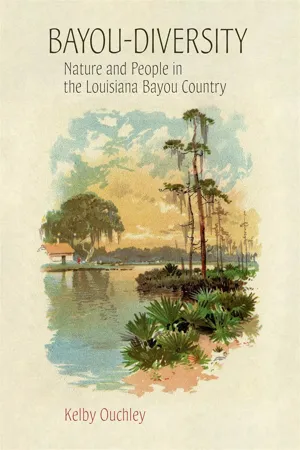
Louisiana's bayous and their watersheds teem with cypress trees, alligators, crawfish, and many other life forms. From Bayou Tigre to Half Moon Bayou, these sluggish streams meander through lowlands, marshes, and even uplands to dominate the state's landscape. In Bayou-Diversity, conservationist Kelby Ouchley reveals the bayou's intricate web of flora and fauna.
Through a collection of essays about Louisiana's natural history, Ouchley details an amazing array of plants and animals found in the Bayou State. Baldcypress, orchids, feral hogs, eels, black bears, bald eagles, and cottonmouth snakes live in the well over a hundred bayous of the region. Collectively, Ouchley's vignettes portray vibrant and complex habitats. But human interaction with the bayou and our role in its survival, Ouchley argues, will determine the future of these intricate ecosystems.
Bayou-Diversity narrates the story of the bayou one flower, one creature at a time, in turn illustrating the bigger picture of this treasured and troubled Louisiana landscape.
- 240 pages
- English
- ePUB (mobile friendly)
- Available on iOS & Android
eBook - ePub
About this book
Information
Topic
Sciences biologiquesSubtopic
Histoire de l'Amérique du NordBIOTA
The Plant and Animal Life of a Particular Region
1
BAYOU-FLORA
Plants in a Place of Bayous
Spent day w/Dr. Thomas on refuge [near Judd Bayou]; found rare shell-bark hickory grafted on pecan stump, 20″ dbh sassafras, & black gum.
—KO Field Diary, 27 September 1983—Tensas River NWR
To Riverwood “protected” tract in Caldwell Parish near Cypress Creek to check old known site of yellow ladies slipper; has not been seen here in several years since adjacent clearcut—Found 3 plants, not in flower yet, leaves about 5″ long; I’ve never seen this plant in La. before.
—KO Field Diary, 2 April 1996
No less than 3,249 species and subspecies of vascular plants have been found growing in Louisiana. Of this number, 826 (25 percent) are considered non-native in the state and were introduced intentionally or accidentally. Many in this category are troublesome invasive species, which displace native plants, reduce species richness, and disrupt ecosystem processes. Chinese tallow and water hyacinth are examples. The native plants include generalists, like deciduous holly, which grow in a wide variety of habitats and are found in every parish, and specialists with exacting requirements, such as leatherwood, which grow only in restricted niches. Their stories abound.
Baldcypress I
Nothing characterizes a southern swamp more than a giant, moss-draped cypress tree standing knee-deep in a backwater slough. Technically known as baldcypress, these survivors of ancient life forms once found across North America and Europe are now greatly restricted in range. In the United States they are native to river bottoms and swamps in the Deep South and along the eastern seaboard north to Delaware. In Louisiana, although the last large virgin stands are gone, cypresses can still be found in every parish.
Cypress trees once grew to 17 feet in diameter and 140 feet in height. They were the largest trees in the South and lived to be 400 to 600 years old. A few were estimated to be more than 1,000 years old. Even though cypresses are at home in wetlands, their seeds cannot germinate underwater and young seedlings soon die if they are overtopped by floodwaters during the growing season. For that reason, the trees growing in Monroe’s Bayou DeSiard, Old River in Natchitoches, and Lake Pontchartrain near New Orleans began life on dry or muddy ground that was not flooded during the growing season for at least a couple of years. Older trees can adapt to intermittent flooding regimes and usually develop fluted trunks, but permanent, deep flooding will eventually kill most mature trees. Throughout the state, including the areas mentioned above, a steady decline of cypresses resulting from human-altered flooding regimes is ongoing.

Baldcypress
Historically, cypress has always been important to humans in Louisiana. The reddish heartwood of old trees is durable and resistant to decay in a climate that fosters the rapid decomposition of most woods. For thousands of years Native Americans in bayou country used cypress for dugout canoes. Early colonists were quick to discover its value as a building material. In 1797, Don Juan Filhiol described Fort Miro, the first sizable colonial structure in the Ouachita Valley, as “an enclosure in post of tipped cypress … in an area [in]which is found the principal house … covered in cypress shingles.” In the late 1800s, the demand for cypress lumber for boats, furniture, pilings, trim, shingles, siding, and coffins was great. It was during this period that the vast virgin stands were logged over. By 1925, the once-thriving cypress industry was in a spiraling decline as the last of the raw product was exhausted.
Most cypress stands today are second growth, but there still remain a few giants among us, towering 100 feet above the earth. They exist because they are hollow and thus not merchantable or because they grow in an area so remote as to make harvest unfeasible. They laid down their first annular rings during the classical period of the Mayan culture. They germinated and grew into seedlings as Charlemagne was crowned Holy Roman Emperor. They were sound and mature when the sun gleamed from the swords of Hernando de Soto’s men as they marched across northeastern Louisiana in a fruitless search for gold. It is possible that their limbs were once laden with the weight of a thousand passenger pigeons and that their bark was probed by ivory-billed woodpeckers. Cougars and bears may have sought refuge in their hollows. It is likely, too, that a few of these will still be greeting each spring with a fresh feathering of needle-like leaves in centuries to come.
Baldcypress II
In Louisiana cypress trees have their own unique and proper place in the world. For those of us who live among the swamps, that place is along the bayous, lakes, and brakes of our wetlands. Nothing could be more enigmatic than to find this tree growing at the base of steep hills and limestone cliffs adjacent to streams that are crystal clear and actually flowing. Such is the case, however, in the central Texas hill country. It is the last place I would expect to find a bald-cypress tree.
For whatever reason they thrive in this environment of drought and sudden flashfloods, leaning downstream like contorted gnomes, often with flood debris 30 feet up in their limbs. Cypress knees are uncommon in this habitat, but their roots form serpentine lattices, some like a ball of giant cottonmouths wrapped around small boulders. Like inverted Medusas they cling to the earth and brace for Mother Nature’s tempests. Their cohorts are sycamores and occasional wild sweet pecans.
Up the narrow, V-shaped side canyons grow the perfect cypress trees—the tall, straight, tight-barked individuals that escaped the cross-cut saw only because of their inaccessibility. We knew the last of those trees in Louisiana soon after 1900. In Texas, the surviving Amazonians guard transparent dripping pools smothered in maidenhair fern and tower over the nearby live oaks and juniper. Their attendant epiphytes are ball moss instead of the familiar Spanish moss. In their own way they are just as much at home as those along Bayou Teche or in the Atchafalaya Swamp. It is only our perception that sees them as out of place.
Baldcypress III
The legacy of Louisiana’s official state tree should not end in your flower bed. Mulching to control weeds and conserve water is a great idea; using mulch made from cypress trees is not. Most mature cypress forests in this state were cut for lumber decades ago. Almost all of the remaining stands are relatively young—too young to be used for timber and too young to reproduce naturally. When clearcutting of these young stands occurs to produce cypress mulch, any chance of future reproduction is eliminated, and, unlike pines, cypress is rarely replanted behind a harvesting operation. The bottom line is that the current rate of baldcypress harvest to fuel the demand for mulch is not sustainable.
Florida was first to recognize this issue, and many counties there restrict the use of cypress mulch. In Louisiana, Governor Kathleen Blanco commissioned a special study entitled Report to the Governor from the Science Working Group on Coastal Wetland Forest Conservation and Use. Baldcypress and water tupelo were determined to be the primary species in coastal swamp forests, a critical component of Louisiana’s imperiled wetlands. Significantly, the study found a current lack of regeneration in our remaining cypress forests.
Recent research has shown that the popular demand for cypress mulch is at least partly driven by myths. Consumers often buy cypress mulch under the assumption that it is more durable and long lasting. This is not the case since today’s mulch is made from young trees yet to develop rot-resistant heartwood. Work by the Florida Co-op Extension Service found other problems: “When dry, cypress mulch repels water, making it difficult to wet, particularly if it is on a mound or slope.” Moreover, once it is wet “cypress mulch appears to have a high water-holding capacity that may reduce the amount of water reaching the plant root zone.” Even its attractive color soon fades away.
Cheaper and effective alternative mulches are available. A University of Florida study found that wood chips, pine bark, and pine straw rated just as high as cypress. Efforts to stem the loss of Louisiana’s coastal wetlands are hollow without a strategy to keep our state tree in the swamps instead of in flower beds.
Baldcypress resides with cohorts that also evoke images of bayou country.
Spanish Moss
Spanish moss is not. What I mean is that Spanish moss is not Spanish and is not a moss. It does not grow in Spain but rather in the southeastern United States down into South America. It is not a true moss like sphagnum but rather a flowering plant in the bromeliad family very closely kin to pineapples. Often associated with our images of southern swamps, Spanish moss grows in long, draping, thread-like, gray veils on trees, where it absorbs moisture and nutrients from the air. The plants are not parasitic and don’t harm their host trees.
Many types of wildlife use Spanish moss in their lifecycles. Squirrels and birds use it for nest materials. Along bayous, parula warblers build their nests almost exclusively in draping clumps of the plant. Some species of bats roost in Spanish moss, and it is the sole habitat for one kind of jumping spider.
Humans have used Spanish moss for centuries. Early European colonists recorded Native Americans wearing clothing made from the plant. Louisiana Cajuns made a concoction of mud and Spanish moss known as bousillage for mortar and house insulation. Later, an entire commercial industry developed around the harvest and processing of the plant into manufactured products. It was used for packing materials, as mulch, and in saddle blankets. Thousands of tons were ginned for mattress stuffing until as late as 1975, when synthetic fibers replaced the natural filaments. In recent years, researchers have studied components of Spanish moss as a possible drug to control blood pressure.
Because Spanish moss receives all of its nutrients from the air, it is very sensitive to wind-borne pollutants, such as heavy metals from exhaust fumes and pesticides. Early explorers in Louisiana often remarked about the dismal, dreary atmosphere associated with moss-laden swamps. We now know that the presence of healthy Spanish moss is an indicator of good air quality, and is thus a welcome part of our bayou scenery.
Cane
Canebrakes were once one of the most unique features of the Louisiana landscape. President Teddy Roosevelt described them well in a turn-of-the-twentieth-century visit to East Carroll and Madison parishes. He wrote, “The canebrakes stretch along the slight rises of ground, often extending for miles, forming one of the most striking and interesting features of the country. They choke out other growths, the feathery, graceful canes standing in ranks, tall, slender, serried, each but a few inches from his brother, and springing to a height of fifteen or twenty feet. They look like bamboos; they are well nigh impenetrable to a man on horseback; even on foot they make difficult walking unless free use is made of the heavy bush-knife. It is impossible to see through them for more than fifteen or twenty paces, and often for not half that distance. Bears make their lairs in them, and they are the refuge for hunted things.”
In describing the Morehouse Parish haunts of legendary woodsman Ben Lilly, J. Frank Dobie wrote, “Canebrakes stretched for miles and miles, the hollow stalks that waved their green blades fifteen or twenty feet up in the air rooted so densely that only bears, razorback hogs and a man with a knife could penetrate them.” He also stated that they were the last refuges for hunted things, including some men.
Commonly known as switch cane, this perennial, woody member of the grass family is found in every parish of the state except those bordering the coast. More than a thousand related species grow mainly in the tropical and subtropical areas of the world and are usually referred to as bamboo. Several of the exotic species have been introduced into Louisiana. One striking characteristic of most species is that they produce seeds only once in their lifetime, which may exceed 100 years, and then die.
For local Native Americans canebrakes furnished abundant raw materials for a plethora of products. It was used in the manufacture of blowguns, darts, arrow shafts, shields, knives, spears, duck calls, whistles, and flutes. Cane was weaved into rafts, baskets, bedding, roofing, and floor and wall coverings. Cane containers held everything from seeds for the winter larder to bones of the dead. Later, European settlers valued cane for cattle forage.
Today only scattered small remnants of the once vast canebrakes can be found. Several factors seemed to have been involved in their decline. Overgrazing by domestic cattle was likely an early influence. Occasional fires and floods are thought to be important requirements in the natural lifecycle of cane. Fire protection, levees, and drainage have decreased the frequency of these events. Without a doubt, though, most canebrakes were converted to agricultural fields. In a voyage to Louisiana in 1803, C. C. Robin wrote, “This reed only grows on land that is never (or almost never) flooded … These cane brakes, on account of the large amount of humus that they deposit, make the soil very fertile, and the farmers regard their cane brakes as the best possible land; in fact, they judge the quality of the soil by the thickness of the cane.”
Animals around the world are dependent on bamboo for their existence. Endangered pandas feed almost exclusively on bamboo in China, and some birds in Central America are found only in bamboo thickets. Such a relationship may have existed in Louisiana with the Bachman’s warbler, a rare or possibly extinct songbird. No documented sightings of this bird have occurred in several years, and most observations in the past have been in association with canebrakes. This example reinforces the connectivity of all living things within our ecosystems. Rarely do we modify even one component of our surroundings without impacting others.
Mayhaw
For those of us who might be considered unrefined epicureans, May is the month of ritual pleasures involving a wild gourmet treat. It is the season to gather mayhaw fruits and make one of the finest jellies to grace a buttermilk biscuit.
Born of southern swamps, mayhaws are small trees technically considered hawthorns in the rose family. They grow in wetlands across the Southeast and are usually found only in soils that have a sandy component. Accordingly they are rare in the heavy clay soils near the Mississippi River and common along the Ouachita/Black River system and its tributaries.
The white mayhaw flowers occur in February and March and often present the first splash of spring color to local woodlands. Flowers usually occur before and during the emergence of leaves. Marble-size reddish fruits resemble small apples and ripen in May and June. An old axiom claims, “If mayhaws flower in the water, they will fall in the water.” This refers to the backwater flooding common to most mayhaw habitat. Studies have shown that trees standing in water have a delayed bloom period.
Mayhaws are an important food source for many kinds of wildlife. Deer, raccoons, squirrels, opossums, and several species of birds relish the fruits. Native Americans undoubtedly consumed them for thousands of years, and the first Europeans quickly learned of their value. One pioneer Louisiana diary account reveals that mayhaw-gathering could be quite an adventure. Miss Caroline Poole, a schoolteacher in the frontier village of Monroe, writes in her entry of May 7, 1836, “Hunt for May-haws. Rode sixteen miles on horseback. Saw rattlesnake. Crossed bayous where the water was above the saddle skirts, thirty yards wide. Saw black snakes in abundance. Camped in the woods. Coffee. Bacon cooked on a stick. Enjoyed the day but very much fatigued.” A note in The Gazette of Farmerville on May 2, 1894, reads, “Mayhaws are ripening and the teeth of the small boy will soon ware a wire edge, but he will cut the mayhaws all the same.”
Currently, during years of abundant crops, hundreds of thousands of pounds of mayhaws are gathered from Louisiana swamps by individual connoisseurs. A commercial market has also been developed, and it’s now possible to enjoy a fine local mayhaw wine with the exquisite jelly on that buttermilk biscuit. Amen.
Bottomland Oaks
Oaks are dominant tree species in bottomland hardwood forests. They can be divided into two major groups: red oaks and white oaks. The white oak group has leaves with rounded edges and acorns that mature in a single season. Examples of white oaks that grow in lowlands include overcup oak, delta post oak, and cow oak. Leaves of red oaks are usually bristle-tipped, and their acorns take two years to mature. Lowland species include willow oak, water oak, cherrybark oak, and nuttall oak. Willow oak and water oak are commonly called pin oaks in Louisiana, but true pin oaks don’t occur in the state and generally grow north of central Arkansas.
In natural settings oak trees are site specific by species. Lowland oaks are tied closely to land elevation, hydrology, and soil type. Overcup oaks grow on the lowest, wettest sites. Moving upward in elevation in the swamp, perhaps only a few inches, the oak component will change to willow oak and nuttall oak. These in turn will be replaced by water oak and cherrybark oak as one progresses upward to the subtle ridges along bayous and rivers.
Over thousands of years each species has adapted to grow best in specific site conditions. Changes in these conditions, either natural or manmade, can prove devastating to a species. A good example can be found along Bayou D’Arbonne in Ouachita and Union parishes, where hundreds of acres of willow oak are dying. The die-off is tied to the development of the Ouachita River Navigation Project, which raised water tables in the affected area. The trees, being unable to adapt to the new wetter site, are severely stressed, making them more susceptible to natural diseases and insects.
More than 7 million acres of bottomland hardwood forests have been cleared and converted to agriculture in t...
Table of contents
- Cover Page
- Title Page
- Copyright Page
- Dedication
- Contents
- Acknowledgments
- Introduction
- BIOTA: The Plant and Animal Life of a Particular Region
- CONFLUENCE: A Flowing Together of Two or More Streams of Life in a Physical Place
- Epilogue
- Appendix: Loui si ana Bayou Names
Trusted by 375,005 students
Access to over 1.5 million titles for a fair monthly price.
Study more efficiently using our study tools.
Frequently asked questions
Yes, you can cancel anytime from the Subscription tab in your account settings on the Perlego website. Your subscription will stay active until the end of your current billing period. Learn how to cancel your subscription
No, books cannot be downloaded as external files, such as PDFs, for use outside of Perlego. However, you can download books within the Perlego app for offline reading on mobile or tablet. Learn how to download books offline
Perlego offers two plans: Essential and Complete
- Essential is ideal for learners and professionals who enjoy exploring a wide range of subjects. Access the Essential Library with 800,000+ trusted titles and best-sellers across business, personal growth, and the humanities. Includes unlimited reading time and Standard Read Aloud voice.
- Complete: Perfect for advanced learners and researchers needing full, unrestricted access. Unlock 1.5M+ books across hundreds of subjects, including academic and specialized titles. The Complete Plan also includes advanced features like Premium Read Aloud and Research Assistant.
We are an online textbook subscription service, where you can get access to an entire online library for less than the price of a single book per month. With over 1.5 million books across 990+ topics, we’ve got you covered! Learn about our mission
Look out for the read-aloud symbol on your next book to see if you can listen to it. The read-aloud tool reads text aloud for you, highlighting the text as it is being read. You can pause it, speed it up and slow it down. Learn more about Read Aloud
Yes! You can use the Perlego app on both iOS and Android devices to read anytime, anywhere — even offline. Perfect for commutes or when you’re on the go.
Please note we cannot support devices running on iOS 13 and Android 7 or earlier. Learn more about using the app
Please note we cannot support devices running on iOS 13 and Android 7 or earlier. Learn more about using the app
Yes, you can access Bayou-Diversity by Kelby Ouchley in PDF and/or ePUB format, as well as other popular books in Sciences biologiques & Histoire de l'Amérique du Nord. We have over 1.5 million books available in our catalogue for you to explore.