Pulitzer Prize--winning historian Douglas Southall Freeman, perhaps more than any other writer in the first half of the twentieth century, helped shape and sustain a collective identity for white southerners. A journalist, lecturer, radio broadcaster, and teacher of renown, Freeman wrote and spoke on themes related to southern memory throughout his life.
Keith D. Dickson's Sustaining Southern Identity offers a masterful intellectual biography of Freeman as well as a comprehensive analysis of how twentieth-century southerners came to remember the Civil War, fashion their values and ideals, and identify themselves as citizens of the South.
Dickson's work underscores Freeman's contributions to the enduring memory of Confederate courage and sacrifice in southern culture. The longtime editor of the Richmond News Leader, Freeman wrote several authoritative and extraordinarily influential multivolume historical narratives about both Confederate general Robert E. Lee and the high command of the Army of Northern Virginia. His contributions to the enduring southern memory framework -- with its grand narrative of Confederate courage and sacrifice, and its attachment to symbols and rituals -- still serve as a touchstone for the memory-truths that define a distinct identity in the South.
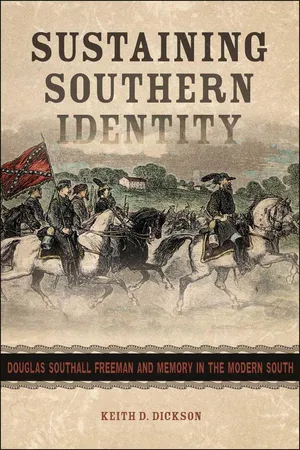
eBook - ePub
Sustaining Southern Identity
Douglas Southall Freeman and Memory in the Modern South
- 336 pages
- English
- ePUB (mobile friendly)
- Available on iOS & Android
eBook - ePub
Sustaining Southern Identity
Douglas Southall Freeman and Memory in the Modern South
About this book
Information
Subtopic
American Civil War HistoryIndex
History 1
“Who Meet the Responsibility and Do Their Whole Duty”
ON MAY 30, 1862, a young Confederate soldier made preparations as best he could for his first battle. He belonged to Company E of the 34th Virginia volunteer regiment, a part of Gen. Henry Wise’s brigade, which in turn was part of the infantry division commanded by Gen. D. H. Hill. The 34th Virginia was encamped on this day near the Williamsburg Road, less than ten miles from the Confederate capital of Richmond. The eighteen-year-old volunteer had just returned to camp after several weeks on furlough to recover from a bad case of the mumps. Now, as he observed the frenetic activities of general officers and their staffs around the camp, he knew a battle was imminent. The name of this young untried soldier was Walker B. Freeman, born on August 28, 1843, in Bedford County, Virginia, where his father, Garland H. Freeman, was a farmer. His earliest descendants had arrived at Plymouth in 1625, and the family could boast of a long line of ministers, among them the Rev. James Freeman, who came to Virginia on a missionary mission and settled in Bedford County. Walker Freeman had left his studies at the University of Virginia in August 1861 to enlist in his hometown unit after his brother had been killed at the battle of Manassas a month earlier.1
Walker Freeman returned to his unit to discover that the Confederate army, under the command of Gen. Joseph E. Johnston, had been steadily retreating all month under pressure from superior Union forces. Now, with Richmond at its back, the Confederate army could retreat no further without abandoning the capital to the enemy. Johnston decided upon a bold plan to attack the isolated and exposed left wing of the Union army, which had established defensive positions south of the Chickahominy River, near a crossroads called Seven Pines. Johnston’s plan of battle called for a coordinated attack on the morning of May 31, with nearly two-thirds of his army advancing rapidly along three parallel roads to strike the enemy positions at Seven Pines simultaneously in the front, flank, and rear. General Hill’s division (which included Freeman’s 34th Virginia) would be responsible for the attack on the center of the Union line. Hill’s assault, scheduled to begin at eight in the morning, would be the signal for the flank assaults to begin. Johnston briefed his commanders on the plan on the thirtieth, which resulted in the flurry of activity Private Freeman observed throughout the day.
The young soldier had no sleep that night. The anticipation of battle was bad enough, but a violent thunderstorm accompanied by torrential rain added to Freeman’s misery. Valuable time was lost in the morning as Walker’s unit, one among many hundreds, could not move into their attack positions on time due to the deep standing water, swollen streams, and thick, churned-up mud. As the Confederate units foundered in the morass, Johnston’s closely timed, coordinated battle plan became irrelevant in the confusion and turmoil as Confederate units arrived on the battlefield piecemeal. Freeman’s unit finally arrived at its proper position hours after it was supposed to be in place, and, as a result, the initial Confederate attack did not begin until one o’clock in the afternoon. The soldiers found the Union infantry alert and waiting, protected by log breastworks and supported by artillery. The Confederates would have to cross about 1,700 yards of open, water-soaked ground to reach the enemy position. Despite the daunting conditions that faced the attackers, the order to advance was given, and Freeman’s unit emerged from the woodline and began a clumsy charge across the sodden field. The intense enemy fire caused the line to waver and stall, but, spurred on by their officers, the Confederates pushed forward. Walker saw scores of men fall around him. The Confederate line had just begun to pass over the bodies of dead and wounded enemy skirmishers when Freeman suddenly noticed blood streaming out of his left shoe. He had been hit in the thigh with a minié ball, but in the excitement of battle Freeman felt no pain, and he continued to advance. Suddenly, his right leg went numb, and he fell to the ground unable to stand or even sit up. Another bullet had struck his right knee, glanced off the bone, and lodged in his calf. In the short time that Freeman lay stunned on the muddy field, the battle had already been decided. The Confederates could not overwhelm the heavily defended position. Hampered by the mud, shocked by the heavy casualties, and betrayed by inexperience, the Confederates wavered at the critical time, unable to overcome the fear that now captured them. Those who were left standing began a rapid retreat for the protection of the woodline. By a stroke of luck, Freeman spotted two of his friends running toward the rear and called to them for help. As bullets flew about them, the two soldiers ran to Freeman, and, with each taking an arm, they half-dragged and half-carried him to safety. The battle of Seven Pines was over. More than six thousand southerners had been killed or wounded for nothing more than a stalemate. Freeman’s brigade of two thousand men suffered over 50 percent casualties in the attack.2
For the individual soldier in the ranks, there was the fear of being afraid; to be seen showing fear or displaying cowardice was to be avoided at all costs, even death. A soldier could avoid any possible hint of such dishonor by building a reputation for personal courage on the battle line. This kind of courage was highly esteemed among soldiers, equal to both godliness and manliness. Early in the war, soldiers endeavored to overcome their fear through exposure to physical danger on the battlefield. By accepting this trial, soldiers submitted themselves to an individual as well as collective test of manhood and courage. The most significant opportunity for Civil War soldiers to prove their qualities as courageous and worthy men was during a charge. In the charge, the men advanced alongside their comrades, shoulder to shoulder, exposed to enemy artillery and rifle fire. But at times during such assaults, there was a psychological tipping point, where the well of courage was drained and the men as a unit could no longer face forward and advance. Here personal safety overtook everything and men as a group could leave the field with their honor intact as long as they could reform as a unit in relative safety and return to battlefield discipline. Individuals who broke and ran and avoided further danger were excoriated as dishonorable cowards. Walker Freeman has passed his first test of courage and had suffered wounds that were a testament to his manliness.3
In a letter to his son Douglas years later, Walker Freeman provided a vivid description of the aftermath of that day when he was evacuated from the battlefield and arrived in the city of Richmond, one of thousands of wounded men who now sought assistance wherever they could find it. It is interesting to note in this letter how Walker Freeman moves effortlessly from this one specific unpleasant memory to another, more general and satisfying memory of a soldier in the ranks experiencing the spur of battle:
The big brick factory at the corner of 28th and Main St … was known as the Bellevue Hospital and it was up at the front of the same building that we halted the morning of June 1st 1862, the day after the battle of Seven Pines, and knocked for entrance, to find the hospital full to overflowing … I flat on my back with the sun shining into my face. I was bloody, muddy, unkempt and haggered [sic] looking generally. My but I can almost smell the blood and see the old cloth covered canteen covered with gray cloth now … My medicine and surgical attention had consisted up to this time (and much later), in water, not cool, being poured by my comrade, on the wounds, two of them. I will be able to see very plainly in my minds [sic] eye again the columns just like they looked on the march, how the tents (when we had any), were pitched even to a missing peg on the northwest corner … see the smoke of the campfires and see how the boys used to jump … when the long roll would beat. Ah I can hear the first popping of the muskets to this day, how they would thrill everybody and how quick the real work would begin.4
Freeman’s wounds were not crippling, and after a year’s recuperation at his mother’s home, he returned to duty. He rejoined his unit in Charleston, South Carolina, which was defending that important port city from a possible Union seaborne invasion. In May of 1864 the brigade reinforced Gen. Robert E. Lee’s Army of Northern Virginia. Lee’s soldiers were engaged in a bloody and indecisive overland campaign to defend Richmond against the advance of the Union Army of the Potomac. The campaign had weakened Lee’s still dangerous army, but Union forces, supported by logistics bases and reinforcements, continued their tenacious attacks combined with aggressive offensive maneuver that forced Lee closer and closer to the Confederate capital.
In June, general-in-chief of the Union armies Ulysses S. Grant, attempted to flank Lee’s defensive line around Richmond from the southeast and force the Confederates to abandon the capital. Part of the plan involved detaching a sizable Union force to seize the city of Petersburg, which lay south of Richmond. The capture of Petersburg would sever Lee’s main supply line and force him to abandon both Richmond and the strong defensive position he had chosen north of the capital. The Union flanking movement toward Petersburg forced Lee to react quickly, sending whatever troops he had in the vicinity to reinforce Petersburg’s militia and the Confederate reserve garrison responsible for the city’s defense. Walker Freeman’s brigade arrived as a timely reinforcement, and, together with the local defenders, they withstood the repeated assaults of Union infantry and dismounted cavalry. The desperate and determined defense stalled the Union attack and allowed Lee the opportunity to shift the bulk of his forces into blocking positions around the city. After the battle, General Lee passed on his personal thanks and congratulations to the exhausted defenders who had saved the city, and in doing so, had kept the Confederate cause alive.5
Although Lee had saved Richmond for the time being, he had failed to accomplish his goal to destroy Grant’s forces north of the James River. Once the Union army crossed the James, Lee knew the Army of Northern Virginia would most likely be limited to nothing more than maintaining a stalemate. Although stalemate was not his desired outcome, it did have some advantages for the small Confederate army. His soldiers were very potent when protected by breastworks, and the Union infantry was reluctant to make large-scale assaults, having previously faced the Confederate defenses at Cold Harbor and Spotsylvania and suffered enormous losses. The extensive entrenchments protecting Richmond and Petersburg allowed Lee to operate along interior lines, rapidly shifting forces where he needed them in reaction to Grant’s attacks. The static position of the two armies actually allowed Lee to dispatch part of his forces under Gen. Jubal Early into the Shenandoah Valley to harass Union forces and threaten Washington, D.C., and perhaps draw the enemy away from its focus on Petersburg. But Lee’s primary problem was stretching his small army along miles of entrenchments, attempting to defend the rail lines that the army relied on for supply. In Lee’s words, the outcome of the entire war now had largely devolved into “a mere question of time.” For both Grant and Lee, the overriding question was how to make time work in his favor. The two armies settled into the grim, desultory business of trench warfare. The days wore on, and soldiers on both sides suffered in the oppressive heat and humidity of a Virginia summer. Enemy sniper fire, flies, mosquitoes, sickness, poor food, and even worse sanitation took their toll on the common soldier, among them Walker Freeman, who endured equally the sickness, misery, and the boredom in the trenches outside Petersburg.6
Not content to accept Lee’s determination to outlast him, Grant displayed his own determination to end the war by destroying the Army of Northern Virginia’s capability to resist. Now that Lee was pinned with limited capability to maneuver, Grant sought a way to strike an overwhelming and fatal blow that would shatter the Confederate defenses and force Lee to fight at a disadvantage, outnumbered and in the open. A group of Pennsylvania miners appeared to have the solution—a tunnel dug beneath a Confederate redoubt defending one of the main roads into Petersburg. The mine at the end of the tunnel would be packed with enough explosives to blast a massive hole in the defender’s line. After the explosion, specially prepared assault troops would charge through the undefended gap and seize the city, forcing Lee’s army into open terrain where it was vulnerable to capture or destruction by Grant’s numerically superior forces. Grant approved the plan and ordered troops to be readied to serve as the assault force.
The Pennsylvanians succeeded far beyond any estimate. On the morning of July 30, 1864, the explosives were detonated, creating a crater two hundred feet long and thirty feet deep in the Confederate line. The way to Petersburg and ultimate victory lay open. The assault force now only had to move forward aggressively. But it was not to be. The ill-led Union troops stood by the crater for more than four hours, fixated on the massive destruction wrought by the explosion. A patchwork of Confederate defenders thrown together to block the Union advance kept up a steady fire that pinned the attackers behind the protection afforded by the earth surrounding the huge crater. Although more and more Union reinforcements poured into the crater and the surrounding trenches, no one gave the order to move forward. The Union delay gave the Confederates enough time to organize a counterattack. Freeman’s brigade was among the units ordered to throw back the enemy. The southern soldiers knew fully the seriousness of the situation. Unless they drove the Union forces back and reestablished the line, the army and the cause it fought for were lost. To reinforce the importance of their task, the soldiers were ordered to fix bayonets. This was an order rarely given, especially in the latter stages of the war, but it had its intended effect to stir within these veterans a sense that everything depended on them. The act of fixing bayonets figured prominently in every survivor’s recollection. At the order, the Confederates charged over two hundred yards of open ground to close with the enemy and drive him out of the crater. A Union soldier recalled the moment: “I saw a splendid line of gray coming up the ravine on the run … They were coming, and coming with a rush.”7
Walker Freeman again found himself charging over open ground, with artillery and musket fire roaring all around him. This time, he was unscathed and reached the Union defenses only to find himself in the midst of a confused and dispirited mass of men in blue jumbled together inside and around the edges of the crater and milling about in the ruined trenches. Most shocking for the southern soldiers was the completely unexpected sight of large numbers of black troops mixed with whites. The Confederate charge forced the collapse of the Union assault force. What followed was a daylong bloodbath in oppressive July heat, as the Union commanders poured additional forces into the crater in a vain attempt to salvage some advantage from the morning’s debacle. The southerners defended with savage determination, meeting the attackers with massed rifle fire and engaging the survivors in hand-to-hand combat. By evening, the Confederate line had been restored. The price of failure for the Union forces had been high. About 3,800 Union troops were killed, wounded, or missing and nearly 1,500 Confederates were listed as casualties. The stalemate at Petersburg continued, but the victory at the crater strengthened the army’s faith in its ability to stop any Union attack. The notion of conquering fear through facing danger on the battlefield had long since disappeared by 1864, especially among veterans who fully understood that fear in combat was never conquered. Nevertheless, Walker Freeman, who had fought and survived his second pitched battle in two months, had again demonstrated to his fellow soldiers those all-important and still highly respected qualities of personal courage and manhood.8
The siege continued through the summer and moved into winter of 1864 with no appreciable change, although the armies were engaged in almost constant skirmishing and entrenching. A familiar routine emerged, with periodic sharpshooting, informal truces, and long periods of inactivity. As time dragged on from summer into fall, Confederate troops began grumbling about lack of pay and adequate rations, as well as the lack of shoes and decent clothing. Soldiers sometimes made protests to the press, seeking some stimulus to prod the government into action. Lee was concerned about the morale of the men, and some time after the battle of the Crater, as it came to be known, Freeman and a comrade were in the rear seeking respite from the dull routine of trench duty. They encountered General Lee himself, mounted on his favorite horse, Traveller. Lee asked the privates how they were getting along and expressed the hope that they were not too discomforted in the lines.9
Freeman would see Lee again several months later in April of 1865. But this time, no pleasantries were exchanged. The Army of Northern Virginia was marching for its very life. Lee had been forced to leave Petersburg and abandon Richmond only a few days earlier in the face of an overwhelming Union attack that had broken the thin Confederate line in several places on April 2. The springtime retreat soon turned from a retrograde maneuver to a bitter and vain search for refuge from Grant’s untiring pursuit. Under this strain, the army began to dissolve; many soldiers saw no need for further sacrifice and left for home. But many other soldiers stood by Lee, despite extreme hunger and fatigue reaching to the point of exhaustion. Freeman was one of these soldiers who remained in the ranks. His regiment reached the Southside town Farmville on April 7 and had the opportunity to get food for the first time since leaving Petersburg four days earlier. As the men lined up for their rations, they received the order to form a rear guard. Union troops were closing in on the Confederates; reinforcements were urgently needed to block the advance so that the rest of the army could move north across the Appomattox River toward Cumberland Church. The order to form a line of battle and face the Yankees again, just when they were within sight of food and rest, pushed the soldiers near to their breaking point. Then Lee appeared in their midst and spoke to them: “Men, you must hold this bridge until I get the army out of Farmville.” In an act of discipline that displayed their unwavering faith in Lee, the hungry men turned away from the rations and formed up to take up defensive positions near the bridge. Douglas Southall Freeman recalled that it was one of his father’s proudest war memories.10
In the early morning hours of April 9, Freeman’s undersized brigade provided support as Gen. John B. Gordon’s men attempted to drive Union cavalry off the Lynchburg Stage Road just outside of Appomattox Court House. The Confederate infantry succeeded in pushing the cavalry aside and wheeled to secure the road for the supply trains to pass. It was the Army of Northern Virginia’s last advance on the battlefield. Almost immediately, large numbers of Union infantry deployed to the front and flank of the thin Confederate battle line. Completely outnumbered, Gordon retired to favorable defensive terrain in the fields behind the courthouse and reported that the army’s main line of retreat was blocked. Within two hours, sixteen Union brigades of the powerful Army of th...
Table of contents
- Cover Page
- Title Page
- Copyright Page
- Dedication
- Contents
- Preface
- Introduction
- 1. “Who Meet the Responsibility and Do Their Whole Duty”
- 2. “Stainless Honor”
- 3. “The Idealism of Faith”
- 4. “All That Is Valorous and True”
- 5. “I’ve Done a Little Something to Keep Alive His Fame!”
- 6. “To Make Vocal with History”
- 7. “A Bloody Bond of Brotherhood”
- 8. “It Is History That Teaches Us Hope”
- 9. “In Spite of Din, Contest, and Chaos”
- 10. “With Eyes Wide Open and with Minds Alive”
- 11. “Our Communion with the Past”
- Appendix: A Diagram of Collective Identity
- Notes
- Bibliography
- Index
Trusted by 375,005 students
Access to over 1.5 million titles for a fair monthly price.
Study more efficiently using our study tools.
Frequently asked questions
Yes, you can cancel anytime from the Subscription tab in your account settings on the Perlego website. Your subscription will stay active until the end of your current billing period. Learn how to cancel your subscription
No, books cannot be downloaded as external files, such as PDFs, for use outside of Perlego. However, you can download books within the Perlego app for offline reading on mobile or tablet. Learn how to download books offline
Perlego offers two plans: Essential and Complete
- Essential is ideal for learners and professionals who enjoy exploring a wide range of subjects. Access the Essential Library with 800,000+ trusted titles and best-sellers across business, personal growth, and the humanities. Includes unlimited reading time and Standard Read Aloud voice.
- Complete: Perfect for advanced learners and researchers needing full, unrestricted access. Unlock 1.5M+ books across hundreds of subjects, including academic and specialized titles. The Complete Plan also includes advanced features like Premium Read Aloud and Research Assistant.
We are an online textbook subscription service, where you can get access to an entire online library for less than the price of a single book per month. With over 1.5 million books across 990+ topics, we’ve got you covered! Learn about our mission
Look out for the read-aloud symbol on your next book to see if you can listen to it. The read-aloud tool reads text aloud for you, highlighting the text as it is being read. You can pause it, speed it up and slow it down. Learn more about Read Aloud
Yes! You can use the Perlego app on both iOS and Android devices to read anytime, anywhere — even offline. Perfect for commutes or when you’re on the go.
Please note we cannot support devices running on iOS 13 and Android 7 or earlier. Learn more about using the app
Please note we cannot support devices running on iOS 13 and Android 7 or earlier. Learn more about using the app
Yes, you can access Sustaining Southern Identity by Keith D. Dickson in PDF and/or ePUB format, as well as other popular books in History & American Civil War History. We have over 1.5 million books available in our catalogue for you to explore.