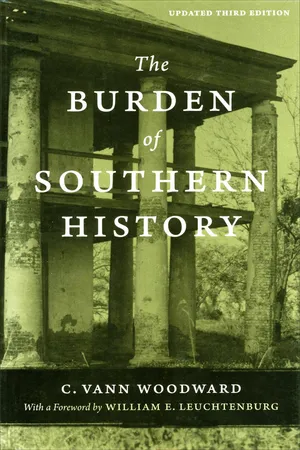
C. Vann Woodward's The Burden of Southern History remains one of the essential history texts of our time. In it Woodward brilliantly addresses the interrelated themes of southern identity, southern distinctiveness, and the strains of irony that characterize much of the South's historical experience. First published in 1960, the book quickly became a touchstone for generations of students. This updated third edition contains a chapter, "Look Away, Look Away, " in which Woodward finds a plethora of additional ironies in the South's experience. It also includes previously uncollected appreciations of Robert Penn Warren, to whom the book was originally dedicated, and William Faulkner. This edition also features a new foreword by historian William E. Leuchtenburg in which he recounts the events that led up to Woodward's writing The Burden of Southern History, and reflects on the book's -- and Woodward's -- place in the study of southern history. The Burden of Southern History is quintessential Woodward -- wise, witty, ruminative, daring, and as alive in the twenty-first century as when it was written.
eBook - ePub
The Burden of Southern History
The Emergence of a Modern University, 1945--1980
- 336 pages
- English
- ePUB (mobile friendly)
- Available on iOS & Android
eBook - ePub
About this book
Information
1
The Search for Southern Identity
THE TIME IS COMING, IF INDEED IT HAS NOT ALREADY arrived, when the Southerner will begin to ask himself whether there is really any longer very much point in calling himself a Southerner. Or if he does, he might well wonder occasionally whether it is worth while insisting on the point. So long as he remains at home where everybody knows him the matter hardly becomes an issue. But when he ventures among strangers, particularly up North, how often does he yield to the impulse to suppress the identifying idiom, to avoid the awkward subject, and to blend inconspicuously into the national pattern—to act the role of the standard American? Has the Southern heritage become an old hunting jacket that one slips on comfortably while at home but discards when he ventures abroad in favor of some more conventional or modish garb? Or is it perhaps an attic full of ancestral wardrobes useful only in connection with costume balls and play acting—staged primarily in Washington, D.C.?
Asking himself some similar questions about the New England heritage, Professor George W. Pierson of Yale has come forth with some disturbing concessions about the integrity of his own region. Instead of an old hunting jacket, he suggests that we call New England “an old kitchen floor, now spatter-painted with many colors.” He points out that roughly six out of every ten Connecticut “Yankees” are either foreign-born or born of foreign or mixed parentage, while only three have native forebears going as far back as two generations, and they are not necessarily New England forebears at that. “Like it or not,” writes Pierson, “and no matter how you measure it—geographically, economically, racially or religiously, there is no New England Region today.” It has become instead, he says, “an optical illusion and a land of violent contrast and change.” And yet in spite of the wholesale and damaging concessions of his essay, which he calls “A Study in Denudation,” he concludes that, “as a region of the heart and mind, New England is still very much alive.”
One wonders if the Southerner, for his part, can make as many damaging admissions of social change and cultural erosion as our New England friend has made and come out with as firm a conclusion about the vitality of his own regional heritage. More doubt than assurance probably comes to mind at first. The South is still in the midst of an economic and social revolution that has by no means run its course, and it will not be possible to measure its results for a long time to come. This revolution has already leveled many of the old monuments of regional distinctiveness and may end eventually by erasing the very consciousness of a distinctive tradition along with the will to sustain it. The sustaining will and consciousness are also under the additional strain of a moral indictment against a discredited part of the tradition, an indictment more uncompromising than any since abolitionist times.
The Southerner may not have been very happy about many of those old monuments of regional distinctiveness that are now disappearing. He may, in fact, have deplored the existence of some—the one-horse farmer, one-crop agriculture, one-party politics, the sharecropper, the poll tax, the white primary, the Jim Crow car, the lynching bee. It would take a blind sentimentalist to mourn their passing. But until the day before yesterday there they stood, indisputable proof that the South was different. Now that they are vanished or on their way toward vanishing, we are suddenly aware of the vacant place they have left in the landscape and of our habit of depending upon them in final resort as landmarks of regional identification. To establish identity by reference to our faults was always simplest, for whatever their reservations about our virtues, our critics were never reluctant to concede us our vices and shortcomings.
It is not that the present South has any conspicuous lack of faults, but that its faults are growing less conspicuous and therefore less useful for purposes of regional identification. They are increasingly the faults of other parts of the country, standard American faults, shall we say. Many of them have only recently been acquired—could, in fact, only recently be afforded. For the great changes that are altering the cultural landscape of the South almost beyond recognition are not simply negative changes, the disappearance of the familiar. There are also positive changes, the appearance of the strikingly new.
The symbol of innovation is inescapable. The roar and groan and dust of it greet one on the outskirts of every Southern city. That symbol is the bulldozer, and for lack of a better name this might be called the Bulldozer Revolution. The great machine with the lowered blade symbolizes the revolution in several respects: in its favorite area of operation, the area where city meets country; in its relentless speed; in its supreme disregard for obstacles, its heedless methods; in what it demolishes and in what it builds. It is the advance agent of the metropolis. It encroaches upon rural life to expand urban life. It demolishes the old to make way for the new.
It is not the amount of change that is impressive about the Bulldozer Revolution so much as the speed and concentration with which it has come and with which it continues. In the decade of the forties, when urbanization was growing at a swift pace in the country as a whole, the cities of the South’s fifty-three metropolitan areas grew more than three times as fast as comparable cities in the rest of the country, at a rate of 33.1 per cent as compared with 10.3 per cent elsewhere. For every three city dwellers in the South at the beginning of that decade there were four at the end, and for every five farm residents there were only four. An overwhelmingly rural South in 1930 had 5.5 millions employed in agriculture; by 1950, only 3.2 millions. A considerable proportion of these Southerners were moving directly from country to suburb, following the path of the bulldozer to “rurbanization” and skipping the phase of urbanization entirely. Rural Negroes, the most mobile of all Southerners, were more likely to move into the heart of the urban areas abandoned by the suburban dwellers. In the single decade of the forties the South lost a third of its rural-farm Negro population. If the same trend were continued through the present decade, it would reduce that part of the colored population to about one-fifth of the Negroes living in the region.
According to nearly all of the indices, so the economists find, economic growth of the South in recent years greatly exceeds the rate maintained in the North and East. The fact is the South is going through economic expansion and reorganization that the North and East completed a generation or more ago. But the process is taking place far more rapidly than it did in the North. Among all the many periods of change in the history of the South it is impossible to find one of such concentration and such substantive impact. The period of Reconstruction might appear a likely rival for this distinction, but that revolution was largely limited to changes in legal status and the ownership of property. The people remained pretty much where they were and continued to make their living in much the same way. All indications are that the bulldozer will leave a deeper mark upon the land than did the carpetbagger.
It is the conclusion of two Southern sociologists, John M. Maclachlan and Joe S. Floyd, Jr., that the present drive toward uniformity “with national demographic, economic, and cultural norms might well hasten the day when the South, once perhaps the most distinctively ‘different’ American region, will have become in most such matters virtually indistinguishable from the other urban-industrial areas of the nation.”
The threat of becoming “indistinguishable,” of being submerged under a national steamroller, has haunted the mind of the South for a long time. Some have seen it as a menace to regional identity and the survival of a Southern heritage. Premonitions of the present revolution appeared during the industrial boom that followed the First World War. Toward the end of the twenties two distinctive attempts were made by Southerners to dig in and define a perimeter of defense against further encroachment.
One of these entrenchments was that of the twelve Southerners who wrote I’ll Take My Stand. They sought to define what they called “a Southern way of life against what may be called the American or prevailing way,” and they agreed “that the best terms in which to represent the distinction are contained in the phrase, Agrarian versus Industrial.” Agrarianism and its values were the essence of the Southern tradition and the test of Southern loyalty. Their credo held that “the whole way in which we live, act, think, and feel,” the humanist culture, “was rooted in the agrarian way of life of the older South.” They called for “anti-industrial measures” which “might promise to stop the advances of industrialism, or even undo some of them.”
Even in 1930 the agrarians were prepared to admit “the melancholy fact that the South itself has wavered a little and shown signs of wanting to join up behind the common or American industrial ideal.” They admonished waverers among the younger generation that the brave new South they contemplated would “be only an undistinguished replica of the usual industrial community.”
Three decades later the slight “wavering” in the Southern ranks that disturbed the agrarians in 1930 would seem to have become a pell-mell rout. Defections came by the battalion. Whole regiments and armies deserted “to join up behind the common or American industrial ideal.” In its pursuit of the American Way and the American Standard of Living the South was apparently doing all in its power to become what the agrarians had deplored as “only an undistinguished replica of the usual industrial community.” The voice of the South in the 1950’s had become the voice of the chamber of commerce, and Southerners appeared to be about as much absorbed in the acquirement of creature comforts and adult playthings as any other Americans. The twelve Southerners who took their stand in 1930 on the proposition that the Southern way stands or falls with the agrarian way would seem to have been championing a second lost cause. If they were right, then our questions would have already been answered, for the Southerner as a distinctive species of American would have been doomed, his tradition bereft of root and soil. The agrarian way contains no promise of continuity and endurance for the Southern tradition.
Two years before the agrarian pronouncement appeared, another attempt was made to define the essence of the Southern tradition and prescribe the test of Southern loyalty. The author of this effort was the distinguished historian, Professor Ulrich B. Phillips. His definition had no reference to economic institutions but was confined to a preoccupation with race consciousness. The essential theme of continuity and unity in the Southern heritage, wrote Professor Phillips, was “a common resolve indomitably maintained” that the South “shall be and remain a white man’s country.” This indomitable conviction could be “expressed with the frenzy of a demagogue or maintained with a patrician’s quietude,” but it was and had been from the beginning “the cardinal test of a Southerner and the central theme of southern history.”
Professor Phillips’ criterion of Southernism has proved somewhat more durable and widespread in appeal than that of the agrarians. It is not tied so firmly to an ephemeral economic order as was theirs. Nor does it demand—of the dominant whites, at least—any Spartan rejection of the flesh pots of the American living standard. Its adherents are able to enjoy the blessings of economic change and remain traditionalists at the same time. There are still other advantages in the Phillipsian doctrine. The traditionalist who has watched the Bulldozer Revolution plow under cherished old values of individualism, localism, family, clan, and rural folk culture has felt helpless and frustrated against the mighty and imponderable agents of change. Industrialism, urbanism, unionism, and big government conferred or promised too many coveted benefits. They divided the people and won support in the South, so that it was impossible to rally unified opposition to them.
The race issue was different. Advocates and agents of change could be denounced as outsiders, intruders, meddlers. Historic memories of resistance and cherished constitutional principles could be invoked. Racial prejudices, aggressions, and jealousies could be stirred to rally massive popular support. And with this dearly bought unity, which he could not rally on other issues, the frustrated traditionalist might at last take his stand for the defense of all the defiled, traduced, and neglected values of the traditional order. What then is the prospect of the Phillipsian “cardinal test” as a bulwark against change? Will it hold fast where other defenses have failed?
Recent history furnishes some of the answers. Since the last World War old racial attitudes that appeared more venerable and immovable than any other have exhibited a flexibility that no one would have predicted. One by one, in astonishingly rapid succession, many landmarks of racial discrimination and segregation have disappeared, and old barriers have been breached. Many remain, of course—perhaps more than have been breached—and distinctively Southern racial attitudes will linger for a long time. Increasingly the South is aware of its isolation in these attitudes, however, and is in defense of the institutions that embody them. They have fallen rapidly into discredit and under condemnation from the rest of the country and the rest of the world.
Once more the South finds itself with a morally discredited Peculiar Institution on its hands. The last time this happened, about a century ago, the South’s defensive reaction was to identify its whole cause with the one institution that was most vulnerable and to make loyalty to an ephemeral aspect which it had once led in condemning the cardinal test of loyalty to the whole tradition. Southerners who rejected the test were therefore forced to reject the whole heritage. In many cases, if they were vocal in their rejection, they were compelled to leave the South entirely and return only at their peril. Unity was thus temporarily achieved, but with the collapse of the Peculiar Institution the whole tradition was jeopardized and discredited for having been so completely identified with the part abandoned.
Historical experience with the first Peculiar Institution ought strongly to discourage comparable experiments with the second. If Southernism is allowed to become identified with a last ditch defense of segregation, it will increasingly lose its appeal among the younger generation. Many will be tempted to reject their entire regional identification, even the name “Southern,” in order to dissociate themselves from the one discredited aspect. If agrarianism has proved to be a second lost cause, segregation is a likely prospect for a third.
With the crumbling of so many defenses in the present, the South has tended to substitute myths about the past. Every self-conscious group of any size fabricates myths about its past: about its origins, its mission, its righteousness, its benevolence, its general superiority. But few groups in the New World have had their myths subjected to such destructive analysis as those of the South have undergone in recent years. While some Southern historians have contributed to the mythmaking, others have been among the leading iconoclasts, and their attacks have spared few of the South’s cherished myths.
The Cavalier Legend as the myth of origin was one of the earlier victims. The Plantation Legend of ante bellum grace and elegance has not been left wholly intact. The pleasant image of a benevolent and paternalistic slavery system as a school for civilizing savages has suffered damage that is probably beyond repair. Even the consoling security of Reconstruction as the common historic grievance, the infallible mystique of unity, has been rendered somewhat less secure by detached investigation. And finally, rude hands have been laid upon the hallowed memory of the Redeemers who did in the Carpetbaggers, and doubt has been cast upon the antiquity of segregation folkways. These faded historical myths have become weak material for buttressing Southern defenses, for time has dealt as roughly with them as with agrarianism and racism.
Would a hard-won immunity from the myths and illusions of Southern sectionalism provide some immunity to the illusions and myths of American nationalism? Or would the hasty divestment merely make the myth-denuded Southerner hasten to wrap himself in the garments of nationalism? The danger in the wholesale rejection of the South by the modern Southerner bent on reaffirming his Americanism is the danger of affirming more than he bargains for.
While the myths of Southern distinctiveness have been waning, national myths have been waxing in power and appeal. National myths, American myths have proved far more sacrosanct and inviolate than Southern myths. Millions of European immigrants of diverse cultural backgrounds have sought and found identity in them. The powerful urge among minority groups to abandon or disguise their distinguishing cultural traits and conform as quickly as possible to some national norm is one of the most familiar features in the sociology of American nationalism. European ethnic and national groups with traditions far more ancient and distinctive than those of the South have eagerly divested themselves of their cultural heritage in order to conform.
The conformist is not required nor expected to abandon his distinctive religion. But whether he remains a Protestant, a Catholic, or a Jew, his religion typically becomes subordinate or secondary to a national faith. Foreign observers have remarked that the different religions in America resemble each other more than they do their European counterparts. “By every realistic criterion,” writes Will Herberg in his study of American religious sociology, “the American Way of Life is the operative faith of the American people.” And where the mandates of the American Way of Life conflict with others, they take undisputed sway over the masses of all religions. Herberg describes it as “a faith that has its symbols and its rituals, its holidays and its liturgy, its saints and its sancta,” and it is common to all Americans. “Sociologically, anthropologically, if one pleases,” he writes, the American Way of Life “is the characteristic American religion, under-girding American life and overarching American society despite all indubitable differences of region, section, culture, and class.” Differences such as those of region and section, “indubitable” though he admits them to be, he characterizes as “peripheral and obsolescent.”
If the American Way of Life has become a religion, any deviation from it has become a sort of heresy. Regionalism in the typical American view is rather like the Turnerian frontier, a section on the move—or at least one that should keep moving, following a course that converges at not too remote a point with the American Way. It is a season’s halt of the American caravan, a temporary encampment of an advancing society, eternally on the move toward some undefined goal of progress. If the encampment of regionalism threatens to entrench or dig in for a permanent stand, it comes to be regarded as “peripheral and obsolescent,” an institutionalized social lag.
The same urge to conformity that operates upon ethnic or national minorities to persuade them to reject identification with their native heritage or that of their forebears operates to a degree upon the Southerner as well. Since the cultural landscape of his native region is being altered almost beyond recognition by a cyclone of social change, the Southerner may come to feel as uprooted as the immigrant. Bereft of his myths, his peculiar institutions, even his familiar regional vices, he may well reject or forget his regional identification as completely as the immigrant.
Is there nothing about the South that is immune from the disintegrating effect of nationalism and the pressure for conformity? Is there not something that has not changed? There is only one thing that I can think of, and that is its history. By that I do not mean a Southern brand of Shintoism, the worship of ancestors. Nor do I mean written history and its interpretation, popular and mythical, or professional and scholarly, which have changed often and will change again. I mean rather the collective experience of the Southern people. It is in just this respect that the South remains the most distinctive region of the country. In their unique historic experience as Americans the Southerners should not only be able to find the basis for continuity of their heritage but also make contributions that balance and complement the experience of the rest of the nation.
At this point the risks of our enterprise multiply. They are the risks of spawning new myths in place of the old. Awareness of them demands that we redouble precautions and look more cautiously than ever at generalizations.
To start with a safe one, it can be assumed that one of the most conspicuous traits of American life has been its economic abundance. From early colonial days the fabulous riches of America have been compared with the scarcity and want of less favored lands. Immense differentials in economic welfare and living standards between the United States and other countries still prevail. In an illuminating book called People of Plenty, David Potter persuasively advances the thesis that the most distinguishing traits of national character have been fundamentally shaped by the abundance of the American living standard. He marshals evidence of the effect that plenty has had upon such decisive phases of life as the nursing and training of babies, opportunities for education and jobs, ages of marriage and childbearing. He shows how abundance has determined characteristic national attitudes between parents and children, husband and wife, superior and subordinate, between one class and another, and how it has molded our mass culture and our consumer oriented society. American national character would indeed appear inconceivable without this unique experience of abundance.
The South at times has shared this national experience and, in very recent years, has enjoyed more than a taste of it. But the history of the South includes a long and quite un-American experience with poverty. So recently as 1938, in fact, the South was characterized by the President as “The Nation’s Economic Problem No. 1.” And the problem was poverty, not plenty. It was a poverty emphasized by wide regional discrepancies in living standard, per capita wealth, per capita income, and the good things that money buys, such as education, health, protection, and the many luxuries that go to make up the celebrated American Standard of Living. This striking differential was no temporary misfortune of the great depression but a continuous and...
Table of contents
- Cover
- Title Page
- Copyright Page
- Dedication
- Contents
- Foreword
- Preface to the Third Edition
- Preface to the First Edition
- Acknowledgments
- 1: The Search for Southern Identity
- 2: The Historical Dimension
- 3: John Brown’s Private War
- 4: Equality: The Deferred Commitment
- 5: The Political Legacy of the First Reconstruction
- 6: A Southern Critique for the Gilded Age
- 7: The Populist Heritage and the Intellectual
- 8: What Happened to the Civil Rights Movement
- 9: The Irony of Southern History
- 10: A Second Look at the Theme of Irony
- 11: Look Away, Look Away
- 12: The Burden for William Faulkner
- 13: The Burden for Robert Penn Warren
- Index
Trusted by 375,005 students
Access to over 1.5 million titles for a fair monthly price.
Study more efficiently using our study tools.
Frequently asked questions
Yes, you can cancel anytime from the Subscription tab in your account settings on the Perlego website. Your subscription will stay active until the end of your current billing period. Learn how to cancel your subscription
No, books cannot be downloaded as external files, such as PDFs, for use outside of Perlego. However, you can download books within the Perlego app for offline reading on mobile or tablet. Learn how to download books offline
Perlego offers two plans: Essential and Complete
- Essential is ideal for learners and professionals who enjoy exploring a wide range of subjects. Access the Essential Library with 800,000+ trusted titles and best-sellers across business, personal growth, and the humanities. Includes unlimited reading time and Standard Read Aloud voice.
- Complete: Perfect for advanced learners and researchers needing full, unrestricted access. Unlock 1.5M+ books across hundreds of subjects, including academic and specialized titles. The Complete Plan also includes advanced features like Premium Read Aloud and Research Assistant.
We are an online textbook subscription service, where you can get access to an entire online library for less than the price of a single book per month. With over 1.5 million books across 990+ topics, we’ve got you covered! Learn about our mission
Look out for the read-aloud symbol on your next book to see if you can listen to it. The read-aloud tool reads text aloud for you, highlighting the text as it is being read. You can pause it, speed it up and slow it down. Learn more about Read Aloud
Yes! You can use the Perlego app on both iOS and Android devices to read anytime, anywhere — even offline. Perfect for commutes or when you’re on the go.
Please note we cannot support devices running on iOS 13 and Android 7 or earlier. Learn more about using the app
Please note we cannot support devices running on iOS 13 and Android 7 or earlier. Learn more about using the app
Yes, you can access The Burden of Southern History by C. Vann Woodward in PDF and/or ePUB format, as well as other popular books in History & North American History. We have over 1.5 million books available in our catalogue for you to explore.