Early modernists turned to theories of consciousness and aestheticism to combat what they saw as the hostility of naturalism and to find new ways of thinking about reality. This consciousness took various forms, including a Jamesian sense of moral ambiguity, Proustian time spots, and B ergsonian intuition, but the Nietzschean theory that reality depends on perception connected them all. This modernist movement reached a distinguished level of achievement with novelists Thomas Mann, Marcel Proust, and James Joyce, but a succession of counterinfluences transformed it after World War II, when elitism and a desire for a homogeneous culture gave way to diversity and elements of mass culture. In Literary Modernism and Beyond, Richard Lehan tracks the evolution of the movement from its emergence in the late nineteenth century to its recent incarnations.
In this wide-ranging study, Lehan demonstrates how and why the "originary vision" of modernism changed radically after it gained prominence. With critical discussions on a wide variety of major modernist writers, intellectuals, and artists and their works -- including Virginia Woolf, Gertrude Stein, T. S. Eliot, Wallace Stevens, Andre Gide, Franz Kafka, Zora Neale Hurston, Ian Fleming, and J. K. Rowling -- Lehan examines the large-scale changes that came as critical authority moved from one generation to another. Both popular culture and literary criticism -- especially "critical theory" -- acted as key agents of change, and structuralism, poststructuralism, and concerns with gender and race also greatly influenced the movement. Along with a process of decline and a nihilism that emerged from the modernist movement, these changes created a new literary reality and with it a new textuality.
Literary Modernism and Beyond treats modernism's major innovations of myth, symbol, and structure not as individual pieces but as interrelated contributions to a historical process, the product of three generations of transformations. Lehan's analysis provides a more complete understanding than ever before of the movement itself.
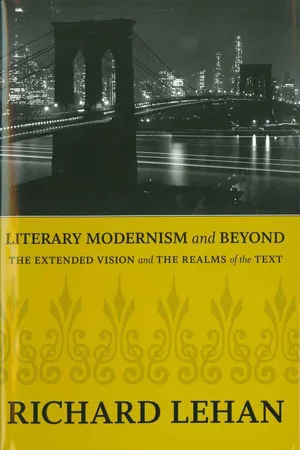
eBook - ePub
Literary Modernism and Beyond
The Extended Vision and the Realms of the Text
- 336 pages
- English
- ePUB (mobile friendly)
- Available on iOS & Android
eBook - ePub
About this book
Information
[1]
A CHRONOLOGY OF LITERARY MODERNISM
| 1853–74 | Der Ring des Nibelungen, by Richard Wagner |
| 1857 | Les fleurs du mal, by Charles Pierre Baudelaire Madame Bovary, by Gustave Flaubert |
| 1862 | Salammbo, by Gustave Flaubert |
| 1869 | A Sentimental Education, by Gustave Flaubert |
| 1870–71 | France declares war on Prussia on 19 July. On 2 September, France is defeated at Sedan, ending the Second Empire. The Third Republic is proclaimed on 4 September. |
| 1871 | The Paris Commune (21–28 May) The Descent of Man, by Charles Darwin |
| 1871–93 | Rougan-Macquart novels, by Émile Zola |
| 1872 | Erewhon, by Samuel Butler |
| 1873 | The Renaissance, by Walter Pater |
| 1874 | First impressionist exhibition in Paris. Impressionists exhibited their work outside official salons: Monet (1840–1926), Renoir (1841–1919), and Pissarro (1830–1903) worked outdoors, often painting urban settings. Manet (1832–1883), Degas (1834–1917), and Cézanne (1839–1906) joined the group. The Temptation of Saint Anthony, by Gustave Flaubert |
| 1877 | The American, by Henry James |
| 1878 | Life and Habit, by Samuel Butler |
| 1879 | “Daisy Miller,” by Henry James Evolution, Old and New, by Samuel Butler |
| 1880 | Le roman expérimental, by Émile Zola |
| 1881 | Bouvard et Pécuchet, by Charles Flaubert The Portrait of a Lady, by Henry James |
| 1884 | À rebours, by Joris-Karl Huysmans Thus Spake Zarathustra, by Friedrich Nietzsche |
| 1885 | Leopold II, king of Belgium, takes possession of the Congo Marius the Epicurean, by Walter Pater |
| 1886 | Van Gogh (1853–1890) and Gauguin (1848–1903) settle in France, marking the rise of expressionism The Bostonians and The Princess Casamassima, by Henry James Dr. Jekyll and Mr. Hyde, by Robert Louis Stevenson, introduces the theme of the double She, by Rider Haggard |
| 1890 | The Golden Bough, by Sir James George Frazer Principles of Psychology, by William, James The Tragic Muse, by Henry James |
| 1891 | The Picture of Dorian Gray, by Oscar Wilde |
| 1892 | “The Yellow Wallpaper,” by Charlotte Perkins Gilman |
| 1893 | Degeneration, by Max Nordau |
| 1894 | Dreyfus affair divides France |
| 1895 | The Time Machine, by H. G. Wells |
| 1896 | The Crowd: A Study of the Popular Mind, by Gustave Le Bon The Island of Dr. Moreau, by H. G. Wells Matter and Memory, by Henri Bergson |
| 1898 | The Nigger of the Narcissus, by Joseph Conrad |
| 1899 | The Awakening, by Kate Chopin The Symbolist Movement in Literature, by Arthur Symons Theory of the Leisure Class, by Thorstein Veblen When the Sleeper Wakes, by H. G. Wells. Youth and Heart of Darkness, by Joseph Conrad, are published together as a single volume by Blackwells |
| 1900 | Buddenbrooks, by Thomas Mann Lord Jim, by Joseph Conrad Sister Carrie, by Theodore Dreiser |
| 1902 | Heart of Darkness, by Joseph Conrad, appears as a single volume The Immoralists, by André Gide The Varieties of Religious Experience, by William James |
| 1903 | The Ambassadors, by Henry James Tonio Kröger, by Thomas Mann The Way of All Flesh, by Samuel Butler |
| 1904 | Nostromo, by Joseph Conrad |
| 1905 | The House of Mirth, by Edith Wharton A Modern Utopia, by H. G. Wells |
| 1906–11 | The Making of Americans, by Gertrude Stein |
| 1907 | Creative Evolution, by Henri Bergson The Education of Henry Adams, by Henry Adams Pragmatism, by William James The Secret Agent, by Joseph Conrad |
| 1907–11 | Cours de linguistique générale, by Ferdinand de Saussure |
| 1907–19 | À la recherche du temps perdu, by Marcel Proust |
| 1908 | Picasso experiments with cubism |
| 1909 | Three Lives, by Gertrude Stein |
| 1911 | Exhibition of postimpressionist paintings Under Western Eyes, by Joseph Conrad |
| 1912 | Chance, by Joseph Conrad Death in Venice, by Thomas Mann |
| 1913 | The Custom of the Country, by Edith Wharton O Pioneers! by Willa Cather St Petersburg, by Andrei Bely |
| 1914 | Assassination of Archduke Francis Ferdinand on 24 June, leading to the outbreak of World War I. On 3 August, the Battle of the Marne. Four years of trench warfare follow. Tender Buttons, by Gertrude Stein |
| 1914–18 | Reflections of a Nonpolitical Man, by Thomas Mann |
| 1915 | The Good Soldier, by Ford Madox Ford “The Metamorphosis,” by Franz Kafka The Rainbow, by D. H. Lawrence “Sunday Morning,” by Wallace Stevens Victory, by Joseph Conrad |
| 1916 | The Portrait of the Artist as a Young Man, by James Joyce |
| 1917 | America enters World War I on 2 April. In October, Lenin gets control of industrial and military soviets, an event followed by three years of civil war. |
| 1918 | Dada Manifesto, by Tristan Tzara My Antonia, by Willa Cather |
| 1918–22 | The Decline of the West, by Oswald Spengler |
| 1919 | Treaty of Versailles ends World War I Winesburg, Ohio, by Sherwood Anderson |
| 1920 | Main Street, by Sinclair Lewis The Rescue, by Joseph Conrad This Side of Paradise, by F. Scott Fitzgerald Women in Love, by D. H. Lawrence |
| 1921 | The Age of Innocence, by Edith Wharton |
| 1922 | A Lost Lady, by Willa Cather Ulysses, by James Joyce The Waste Land, by T. S. Eliot |
| 1923 | Cane, by Jean Toomer Spring and All, by William Carlos Williams Studies in Classic American Literature, by D. H. Lawrence |
| 1924 | The Magic Mountain, by Thomas Mann The Principles of Literary Criticism, by I. A. Richards We, by Yevgeny Ivanovich Zamyatin |
| 1924–28 | Parade’s End, by Ford Madox Ford |
| 1925 | An American Tragedy, by Theodore Dreiser The Counterfeiters, by André Gide Mrs. Dalloway, by Virginia Woolf Dark Laughter, by Sherwood Anderson The Great Gatsby, by F. Scott Fitzgerald In the American Grain, by William Carlos Williams The Trial,... |
Table of contents
- COVER
- TITLE PAGE
- COPYRIGHT PAGE
- DEDICATION
- CONTENTS
- PREFACE
- ACKNOWLEDGMENTS
- I MODERNISMS
- II EARLY MODERNISM
- III THE REALMS OF THE TEXT
- IV TIME AND SPACE
- V FROM ROMANCE TO NIHILISM
- VI POSTMODERNISM AND MASS CULTURE
- [1] A CHRONOLOGY OF LITERARY MODERNISM
- [2] FROM EMPIRE TO WAR: A RETROSPECTIVE OF LITERARY MODERNISM
- [3] BIBLIOGRAPHICAL ESSAY
- NOTES
- SELECTED BIBLIOGRAPHY
- INDEX
Trusted by 375,005 students
Access to over 1.5 million titles for a fair monthly price.
Study more efficiently using our study tools.
Frequently asked questions
Yes, you can cancel anytime from the Subscription tab in your account settings on the Perlego website. Your subscription will stay active until the end of your current billing period. Learn how to cancel your subscription
No, books cannot be downloaded as external files, such as PDFs, for use outside of Perlego. However, you can download books within the Perlego app for offline reading on mobile or tablet. Learn how to download books offline
Perlego offers two plans: Essential and Complete
- Essential is ideal for learners and professionals who enjoy exploring a wide range of subjects. Access the Essential Library with 800,000+ trusted titles and best-sellers across business, personal growth, and the humanities. Includes unlimited reading time and Standard Read Aloud voice.
- Complete: Perfect for advanced learners and researchers needing full, unrestricted access. Unlock 1.5M+ books across hundreds of subjects, including academic and specialized titles. The Complete Plan also includes advanced features like Premium Read Aloud and Research Assistant.
We are an online textbook subscription service, where you can get access to an entire online library for less than the price of a single book per month. With over 1.5 million books across 990+ topics, we’ve got you covered! Learn about our mission
Look out for the read-aloud symbol on your next book to see if you can listen to it. The read-aloud tool reads text aloud for you, highlighting the text as it is being read. You can pause it, speed it up and slow it down. Learn more about Read Aloud
Yes! You can use the Perlego app on both iOS and Android devices to read anytime, anywhere — even offline. Perfect for commutes or when you’re on the go.
Please note we cannot support devices running on iOS 13 and Android 7 or earlier. Learn more about using the app
Please note we cannot support devices running on iOS 13 and Android 7 or earlier. Learn more about using the app
Yes, you can access Literary Modernism and Beyond by Richard Lehan in PDF and/or ePUB format, as well as other popular books in Literature & Literary Criticism. We have over 1.5 million books available in our catalogue for you to explore.