Because Texas emerged from the western frontier relatively late in the formation of the antebellum nation, it is frequently and incorrectly perceived as fundamentally western in its political and social orientation. In fact, most of the settlers of this region were emigrants from the South, and many of these people brought with them their slaves and all aspects of slavery as it had matured in their natives states.
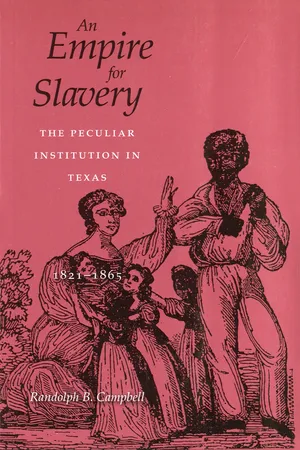
In An Empire for Slavery, Randolph B. Campbell examines slavery in the antebellum South's newest state and reveals how central slavery was to Texas history. The "peculiar institution" was perhaps the most important factor in determining the economic development and ideological orientation of the state in the years leading to the Civil War. Campbell points out that although the area of slaveholding in Texas covered only two-fifths of the state by 1860, this area alone was as large as Alabama and Mississippi combined and constituted "a virtual empire for slavery." By the outbreak of the Civil War, the proportion of slaveholders and slaves in Texas was comparable to that of Virginia, the oldest slaveholding state in the Union.
Utilizing records such as federal censuses, wills and other probate papers, and the WPA slave narratives, Campbell raises a number of questions concerning the nature of slavery in Texas. What factors encouraged the adoption of slavery? Under what conditions did the Texas slaves exist? What was the societal impact of slavery in this new state? How did the Civil War itself affect slavery in the state?
Campbell also reviews the proslavery argument put forward by many early Texas statesmen. What emerges is a picture of a state whose political future was sen as dependent upon the continuance of slavery and whose role in the Civil War was determined by this choice. As a result of this study, Texas is revealed as a state not unlike those of the older South. An Empire for Slavery is the first examination of the "peculiar institution" as it existed in Texas. Historians and general readers alike will find it an essential examination of the region, the period, and the phenomenon of slavery.
- 320 pages
- English
- ePUB (mobile friendly)
- Available on iOS & Android
eBook - ePub
About this book
Information
ONE
The Colonial Period, 1821–1835
“TEXAS MUST BE A SLAVE COUNTRY”
Slavery as an institution of significance in Texas came with Anglo-American settlers during the 1820s, but the first slave arrived there nearly three hundred years earlier. Among the survivors of the Pánfilo de Narváez expedition shipwrecked on the coast of Texas in November, 1528, was a black man called Estevanico, the personal servant of Andrés Dorantes de Carranza. Estevanico survived nearly six years of servitude to the Indians before escaping with Dorantes, Alvar Núñez Cabeza de Vaca (the most famous member of this expedition), and Alonso Castillo Maldonado and wandering hundreds of miles through Texas and northern Mexico to the outpost of Culiacán near the Gulf of California. After reaching Culiacán in April, 1536, and then journeying to Mexico City, he was sold (or perhaps loaned) by Dorantes to the viceroy of New Spain, Antonio de Mendoza. Estevanico never returned to Texas, but he remained an adventurer. In 1539, he served as a guide for Fray Marcos de Niza, a trailblazer for the Coronado expedition. Exploring ahead of the main party and acting against instructions from de Niza, he entered Háwikuh, an Indian village in western New Mexico, and was killed by the natives.1
Negro slavery was permitted and protected from the early sixteenth century onward in New Spain, but the institution was relatively unimportant outside Veracruz and the limited areas suitable for plantation agriculture. Certainly it had little opportunity to gain a foothold in Texas, for the Spanish themselves barely settled and controlled the northernmost reaches of their American empire. By the last quarter of the eighteenth century, in spite of continuing efforts to establish missions and presidios across the region, Spanish Texas had only three settlements large enough to be called towns—San Antonio, Nacogdoches, and La Bahia (now Goliad). The first reliable census of the province, taken in 1777, reported a sparse population of 3,103, including inhabitants of the missions. Of these settlers, only 20, less than 1 percent, were classified as Negroes and probably were slaves. Another census in 1785 enumerated 2,919 persons, 43 of whom were identified specifically as slaves (24 in San Antonio, 16 in Nacogdoches, and 3 in La Bahia). Five years later, officials reported that the province had 37 slaves in a total population of 2,417. During the next thirty years, as the Spanish period drew to a close, Texas’ slave population remained small. Nacogdoches in east Texas reported 33 bondsmen in an 1809 census while slaves virtually disappeared from San Antonio and La Bahia, which together had only 9 persons of “African origin” in 1819. Obviously, then, although Negro slavery existed, the number of bondsmen in Spanish Texas was always far too small to give the institution a significant hold on the province.2
After 1800, as Spain’s grasp on her American colonies weakened rapidly, the mother country’s attention to Texas, always limited at best, diminished even further. This circumstance provided an opportunity for revolutionaries and pirates (it was often difficult to tell the difference) to carry on a slave trade from Texas into the United States. In 1816, Manuel Herrera, would-be representative to the United States of a revolutionary Mexican republic, created a government at Galveston with a Frenchman, Louis d’Aury, as governor and commander of the fleet. D’Aury began busily capturing Spanish vessels, including slave ships. No market for the captured slaves existed in Mexico or Texas, so they were smuggled into Louisiana in violation of United States law against the international slave trade. In August, 1817, the customs collector at New Orleans complained to the secretary of state that he could not stop “the most shameful violation of the slave act, … by a motley mixture of freebooters and smugglers, at Galveston, under the Mexican flag.”3
D’Aury left Galveston in August, 1817, to pursue the revolution against Spain, but he was quickly replaced by the notorious Jean Laffite who continued to capture Spanish slavers. Laffite’s slaves reached buyers in the United States through agents who arranged purchases and deliveries. The most famous of these agents were the Bowie brothers, Jim, John J., and Rezin R The Bowies bought slaves at Galveston for one dollar a pound (the average cost was $140) and then took them to the nearest customs house in Louisiana where they turned in their property for being smuggled into the United States. Louisiana law, which applied since Congress had never acted on the matter, provided for sale of confiscated property and payment of half the price to those who were informers in the case. The Bowies promptly bought back their slaves, received half of the purchase price as an informers’ fee, and were off to sell their now legally held property to planters in Louisiana and Mississippi, at times for as much as $1,000 per bondsman. It is said that the brothers made $65,000 in the three years before Laffite was forced by the United States to leave Galveston.4
Even as Laffite was being put out of the slave trading business, Texas stood on the threshold of settlement by Anglo-Americans, many of whom would have been good customers for the pirate’s slaves. In fact, slaveholders had begun to settle at Pecan Point on the south side of the Red River as early as 1816. A census of Miller County, Arkansas—a territory of vaguely defined boundaries extending from Arkansas into present-day Oklahoma and Texas—showed a population of 999 people, including 82 slaves, in 1820. Most of these bondsmen lived north of the Red River, but some resided south of the river in Texas. Between 1810 and 1820, other settlers from the United States began drifting across the border into the area of east Texas between Nacogdoches and Louisiana. Undoubtedly, a few of these settlers brought bondsmen with them. Jane Long, the wife of the filibusterer James Long who planned to conquer Texas after the Adams-Onís Treaty in 1819 proposed to “give away” the territory west of the Sabine River, spent the winter of 1821–22 at Bolivar Point opposite Galveston accompanied only by two children and a young slave woman named Kiamatia.5
These early settlers had no legal right to be in Texas and certainly no assurances that they could hold slaves there. But they represented the first trickle of a flood that Spanish and Mexican authorities would be unable to stem. Americans would soon pour into Texas legally, and no rule or regulation would deny them their slaves.
Moses Austin opened the way for legal settlement by Anglo-Americans in Texas when he traveled to San Antonio de Béxar in 1820 and received permission from Spanish authorities (on January 17, 1821) to settle a colony on the Brazos and Colorado rivers. He was accompanied, fittingly enough, by a slave named Richmond, the property of his son, Stephen F. Austin. As Negro slavery was legal in Spain’s American empire, the subject did not arise in either Moses Austin’s petition or the Spanish grant. Richmond became ill on the trip home and was left with Douglas Forsythe at the Sabine River. He soon recovered and worked for Forsythe to pay his doctor’s bills and board. Moses Austin was less fortunate. After going home to Missouri, he died on June 1o, 1821. His colonizing enterprise in Texas then fell to his twenty-eight-year-old son, Stephen F. Austin.6
During the summer of 1821, Stephen F. Austin retraced his father’s steps to San Antonio, where he was confirmed as heir to the grant. Austin claimed and sold the slave, Richmond, as he entered Texas, but he was by no means unconcerned with the role of slavery in his colonizing efforts. His first proposal for the distribution of land in Texas provided generous grants for household heads, their wives, and children, and then called for the granting of fifty acres per slave. After gaining approval of the colonizing contract and returning to the United States to recruit settlers, Austin persuaded authorities in San Antonio to increase the grant per slave to eighty acres.7
Stephen F. Austin thus had no difficulty in proving himself heir to Moses Austin’s grant and in the process established terms that accepted and actually encouraged the migration of slaveholders to Texas. However, just as he reached San Antonio in August, 1821, word came that the revolution against Spain was finally successful. Mexican independence raised questions about slavery because Mexican revolutionaries had always voiced strong opposition to the institution. Father Miguel Hidalgo, the first leader of the revolt against Spain, issued several decrees in late 1810 demanding immediate manumission of all slaves on pain of death. And José Maria Morelos’ “Sentimientos de la Nación” of September 14, 1813, proclaimed that “slavery is forbidden forever.” Given the relative unimportance of Negro slavery in New Spain, these revolutionary sentiments were more theoretical than practical. But antislavery idealism continued after 1821 and soon cast a shadow over the future of slavery in Texas, where the institution was far more than just a theoretical matter.8
Settlers from the United States began to move into Austin’s colony during late 1821 and early 1822, and they brought slaves. Josiah H. Bell, for example, received a grant from Austin for himself, his wife, two sons, and three slaves. Jared E. Groce, who arrived in January, 1822, from Georgia, brought ninety bondsmen and established a plantation called “Bernardo” on the Brazos River near the present-day site of Hempstead. Groce could not occupy all the land to which he was entitled (7,200 acres for his slaves alone). “Bernardo” consisted of “only” one league of land (4,428 acres) on which his slave craftsmen built a plantation home and cabins for themselves. Groce immediately demonstrated the promise of Texas lands and slave labor by producing cotton crops that were sold to neighbors and even in the interior of Mexico. It is said that he used his slaves to transport the cotton by mule train.9
Shortly after these first settlers began to arrive, Austin and his colonists, especially the slaveholders, ran into difficulties with Mexican authorities. The provisional government at Monterrey refused to approve the contract awarded Austin at San Antonio in 1821 and indicated that his colonists could occupy land only provisionally. At the same time, the new national government in Mexico City was formulating a general colonization policy that would be critical to Texas. Austin, convinced that under these circumstances he needed to protect his interests in person, went to Mexico City, arriving on April 29, 1822, just as Agustin de Iturbide became constitutional emperor of Mexico. Austin remained in the capital city for more than a year, learning a great deal about Mexico and building for himself a reputation that would eventually greatly benefit Texas and the interests, including slavery, of its settlers.10
Austin found that the wheels of Mexican government turned slowly, especially, it seemed, in the passage of a colonization law. He sent memorial after memorial to the constituent congress and, in spite of the fact that slavery was obviously controversial, made it clear that his colonists expected to bring their bondsmen to Texas and receive land for them. Austin himself, he told congress on May 13, had slaves in his own “familia.”11
The Mexican leaders found it extremely difficult to choose between the revolutionary ideal of liberty and the practical need to protect property interests and encourage settlement of their nation. Therefore, on August 20 the majority of the committee charged with formulating a bill reported a compromise proposal allowing settlers to bring in their slaves but ordering that the children born to those bondsmen in Mexico be freed at age fourteen. José Antonio Gutiérrez de Lara, the spokesman for this bill, deplored slavery and the slave trade but spoke also of the rights of property and the need for progress. A minority bill, reported at the same time, provided for immediate abolition and permanent prohibition of slavery. Following debate, both bills were recommitted. The minority bill was reported again a month later, but it was sent back to committee for further revision. Before any other action could be taken, Iturbide disbanded congress and created a forty-five man legislative junta to govern with him. This junta passed the original colonization bill in November, 1822, and Iturbide signed it into law on January 4, 1823. Article 30 of this so-called Imperial Colonization Law read as follows: “There shall not be permitted, after the promulgation of this law, either purchase or sale of slaves that may be introduced into the empire. The children of such slaves, who are born within the empire, shall be free at fourteen years of age.”12
Austin, as he anxiously watched the progress of this colonization law during 1822, feared that congress would not pass any bill permitting slavery. Therefore he probably was relieved when Iturbide disbanded the legislative body in October. Even then, the emperor’s junta proposed at first to free all slaves after ten years residence in Texas, and Austin had to talk to each member of the legislative body and convince them collectively to adopt the terms stated in Article 30. It was more than he had expected. Austin would later express doubts concerning slavery in Texas, yet he, more than any other individual, was responsible for gaining the approval of Mexican authorities for introducing the institution there.13
Emperor Iturbide was overthrown in February, 1823, and the Imperial Colonization Law was then annulled. Austin delayed his departure for Texas long enough to appeal successfully to the new constituent congress to approve his grant under the terms of the old law. His was the only colony in Texas settled according to the law of January 4, 1823. Upon his return to Texas, Austin found that his long absence and rumors concerning the attitude of Mexican authorities had greatly slowed immigration. He was able, however, to publicize the Imperial Colonization Law and reassure colonists so successfully that by the end of 1824 nearly all of his allotted three hundred families settled in Texas.14
Austin and his original settlers thus weathered the first Mexican threat to slavery, but this was by no means the end of the issue. A new constituent congress met in Mexico City in November, 1823, and on July 13, 1824, expressed its attitude toward slavery in a decree prohibiting the slave trade. Unfortunately, while the attitude of congress was clear, the meaning of this decree was not. “Commerce and traffic in slaves,” it read, “proceeding from any country and under any flag whatsoever, is forever prohibited in the territory of the United Mexican States.” Slaves brought into Mexico in violation of this decree were to be freed. Did congress, however, mean to prohibit even the introduction of slaves by their owners, or did it mean only to stop the importation of bondsmen as merchandise? Mexican officials themselves did not know. Lucas Alamán, one of the most important leaders in the shaping of Mexico’s policy toward Texas during the 1820s and 1830s, insisted later that the July 13, 1824, decree had outlawed any introduction of slaves. But the Congress of Coahuila and Texas, which wrote a state constitution for that portion of the Mexican federation in 1827, stated specifically that slaves could be brought in for six months after adoption of the state’s fundamental law. Obviously, if the 1824 decree had prohibited all importations, the state congress was in violation of a national law. American settlers were greatly troubled, both for the slaves they had in Texas and for the future of the institution, but they were able to take advantage of the law’s lack of clarity and continue to develop slavery in Texas.15
The constituent congress proceeded to adopt a new national colonization law on August 18, 1824, and a federal constitution on October 4, 1824. Neither mentioned slavery, so the institution appeared to have survived revolutionary Mexico’s liberal sentiments.16 Slaves could not be imported as merchandise, but no other constitutional or statutory prohibitions restricted bringing bondsmen into the province. Settlers in Austin’s Colony were subject to the restrictions in Iturbide’s Imperial Colonization Law that children born to their bondsmen be freed at age fourteen; other colonists would not face even that limitation.
Developments in 1822–24 were typical of Texas’ experience with slavery during the entire period of Mexican rule. Mexican leaders showed disapproval of slavery but did nothing effective to abolish it. Anglo-Americans in Texas frequently expressed anxiety about the future of their institution, and the issue hindered the settlement of Texas because potential immigrants from the United States feared for the safety of their slave property once they came under the jurisdiction of Mexico. Austin received letter after letter expressing these fears. James A. E. Phelps, for example, wrote from Mississippi to voice concern about the meaning of the July 13, 1824, decree against the slave trade. “Nothing appears at present,” he wrote, “to prevent a portion of our wealthy planters from emigrating immediately to the province of Texas but the uncertainty now prevailing with regard to the subject of slavery.” Charles Douglas from Alabama expressed the same feelings to Austin. “Our most valuable inhabitants here own negroes,” he wrote, and they are not willing to move without assurances that slaves will be “secured to them by the laws of your Govt.” Austin responded to such letters with renewed appeals to Mexican authorities. In a letter of April 4, 1825, to Rafael Gonzales, governor of Coahuila and Texas, for example, he explained that the protection of slavery was “a matter of greatest importance.” Without slavery, he wrote, Texas could not attract the people to make it a land of sugar and cotton plantations and would instead be populated by shepherds and the poor.17
During the years from 1822 to 1825, in spite of uncertainty about the future of slavery, many of Austin’s colonists brought bondsmen with them and began to establish the institution just as it existed in the United States. Most basic was the definition of slaves as private property and their treatment as such. Stephen F. Austin demonstrated this in October, 1823, when he hired three slaves from Jared E. Groce for a year beginning on November 1. “The said negros are to be well treated by me,” the contract read, “and the said Groce is to clothe them—should they run away or die the loss is to be Groces—sickness to be my loss—.”18
Slavery, wherever it existed, needed protective laws, and Austin instituted such legal support in Texas. In January, 1824, he promulgated a set of Civil and Criminal Regulations for his colony and instructed the alcaldes—the most important local political and judicial authorities under Mexican law—to enforce...
Table of contents
- Cover
- Title Page
- Copyright Page
- Dedication
- Contents
- Illustrations
- Preface
- Introduction
- 1 / The Colonial Period, 1821-1835: “Texas Must Be a Slave Country”
- 2 / Slavery in the Texas Revolution, 1835–1836: “A Dull, Organic Ache”
- 3 / Growth and Expansion, 1836–1861: “The Empire State of the South”
- 4 / The Economics of Slavery in Texas: “We Want More Slaves, We Need Them”
- 5 / The Law of Slavery in Texas: “Negroes Are, in This Country, Prima Facie Slaves”
- 6 / Work and Responsibility: “From Can See to Can’t See”
- 7 / Material Conditions and Physical Treatment: “A Tight Fight”
- 8 / Family, Religion, and Music: “The Strength to Endure”
- 9 / Behavioral Patterns and the Desire for Freedom: “The Best We Could”
- 10 / Texas Slaveholders: “Working Negroes to an Advantage”
- 11 / A Slaveholding Society: “Those Who Are Not For Us, Must Be Against Us”
- 12 / The Civil War and “Juneteenth,” 1861–1865: “Free, Free My Lord”
- Conclusions
- Appendix 1. The Federal Writers’ Project Slave Narratives as a Historical Source
- Appendix 2. Slave Populations of Texas Counties in Selected Years, 1837–1864
- Appendix 3. County Records as a Source of Information on Slavery in Texas
- Appendix 4. Texas’ Largest Slaveholders in 1860
- Bibliography
- Index
Trusted by 375,005 students
Access to over 1.5 million titles for a fair monthly price.
Study more efficiently using our study tools.
Frequently asked questions
Yes, you can cancel anytime from the Subscription tab in your account settings on the Perlego website. Your subscription will stay active until the end of your current billing period. Learn how to cancel your subscription
No, books cannot be downloaded as external files, such as PDFs, for use outside of Perlego. However, you can download books within the Perlego app for offline reading on mobile or tablet. Learn how to download books offline
Perlego offers two plans: Essential and Complete
- Essential is ideal for learners and professionals who enjoy exploring a wide range of subjects. Access the Essential Library with 800,000+ trusted titles and best-sellers across business, personal growth, and the humanities. Includes unlimited reading time and Standard Read Aloud voice.
- Complete: Perfect for advanced learners and researchers needing full, unrestricted access. Unlock 1.5M+ books across hundreds of subjects, including academic and specialized titles. The Complete Plan also includes advanced features like Premium Read Aloud and Research Assistant.
We are an online textbook subscription service, where you can get access to an entire online library for less than the price of a single book per month. With over 1.5 million books across 990+ topics, we’ve got you covered! Learn about our mission
Look out for the read-aloud symbol on your next book to see if you can listen to it. The read-aloud tool reads text aloud for you, highlighting the text as it is being read. You can pause it, speed it up and slow it down. Learn more about Read Aloud
Yes! You can use the Perlego app on both iOS and Android devices to read anytime, anywhere — even offline. Perfect for commutes or when you’re on the go.
Please note we cannot support devices running on iOS 13 and Android 7 or earlier. Learn more about using the app
Please note we cannot support devices running on iOS 13 and Android 7 or earlier. Learn more about using the app
Yes, you can access An Empire for Slavery by Randolph B. Campbell in PDF and/or ePUB format, as well as other popular books in History & North American History. We have over 1.5 million books available in our catalogue for you to explore.