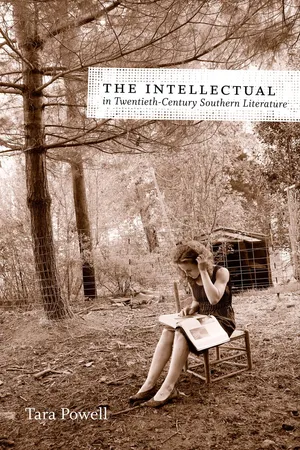
Never in its long history has the South provided an entirely comfortable home for the intellectual. In this thought-provoking contribution to the field of southern studies, Tara Powell considers the evolving ways that major post--World War II southern writers have portrayed intellectuals -- from Flannery O'Connor's ironic view of "interleckchuls" to Gail Godwin's southerners striving to feel at home in the academic world.
Although Walker Percy, like his fellow Catholic writer O'Connor, explicitly rejected the intellectual label for himself, he nonetheless introduced the modern novel of ideas to southern letters, Powell shows, by placing sympathetic, non-caricatured intellectuals at the center of his influential works.
North Carolinians Doris Betts and her student Tim McLaurin made their living teaching literature and creative writing in academia, and Betts's fiction often includes dislocated academics while McLaurin's superb memoirs, often funny, frequently point up the limitations of the mind as opposed to the heart and the spirit.
Examining works by Ernest Gaines, Alice Walker, and Randall Kenan, Powell traces the evolution of the black American literacy narrative from a stress on the post-Emancipation conviction, which saw formal education as an essential means of resisting oppression, to the growing suspicion in the post--civil rights era of literacy acts that may estrange educated blacks from the larger black community.
Powell concludes with Godwin, who embraces university life in her fiction as she explores what it means to be a southern female intellectual in the modern world -- a world in which all those markers inscribe isolation.
eBook - ePub
The Intellectual in Twentieth-Century Southern Literature
The Secret Diary of Robert Patrick, 1861--1865
- 280 pages
- English
- ePUB (mobile friendly)
- Available on iOS & Android
eBook - ePub
The Intellectual in Twentieth-Century Southern Literature
The Secret Diary of Robert Patrick, 1861--1865
About this book
Information
Topic
Littérature1
The Beleaguered Intellectual
in Southern Literature
THE SOUTH HAS NEVER BEEN NOTED for its deference to the intellectual. This disrespect is not the fault of Erskine Caldwell, or of Jeff Foxworthy, but rather has a time-honored place in southern literature that is more overt, unrelieved, and abiding than anywhere else in the American literary canon. This is also not because every last intellectual got run out on a rail by an uneducated yeoman class. Rather, it is because southern intellectuals, especially writers, have, for a complex set of salutary and not-so-salutary reasons, themselves embraced public positions over time that draw attention to the limitations of intellect and privilege Man Doing, Feeling, and Believing over Ralph Waldo Emerson’s “Man Thinking.” In some ways, this was a simple corollary of the Old South’s being a largely rural society, in which wealth, respect, and even spiritual life were tied far more to the land and the collective work of bodies than to an individual’s mental life producing ideas that could not be seen, touched, woven, or tasted. As I argue in the coming pages, the agrarian tradition combined in distinctive ways with the peculiar institution of slavery and the southern literary tradition to promote the stereotype of southerners and even southern literature being notably, even fiercely, “anti-intellectual.” Though recent scholarship in intellectual history and southern studies encourages reconsidering the historical and ideological conditions under which that stereotype has been and continues to be constructed in imaginative literature, it is nonetheless a pervasive trope that appears to have resisted revision in part owing to the willful participation of scholars, editors, and writers who have shaped what the designation “southern” has come to mean in both the local and national imaginations.
Despite this apparent resistance to revision, however, the southern anti-intellectual trope has never been facile, singular, or static. Its most persistent iterations in southern self-portraits from the beginnings of the region’s literary tradition respond to and are ultimately complicated by the region’s political and educational history. Though it is possible to view most representations of intellectuals and intellectual labor in presently studied southern literature from before the mid-twentieth century in the context of a handful of distinct caricatures, the entries in my card catalog of contemporary southern writers exploring the life of the mind not only proliferate exponentially in the decades after 1954 but also undergo qualitative changes that cannot be laid simply at the door of the changing taste of the editors of southern literature anthologies. Rather, more than a century’s evolution in thinking about English language education, driven by regional interests, combined in the twentieth century with the material exigencies of the expansion of American higher education after World War II to produce a new academic discipline called “creative writing” that made an uneasy home for southern writers in academic institutions. The contentious conditions under which that happened and the mere fact of writers across the United States engaged in carving out niches for themselves in intellectual institutions made for a dramatic upswing in representations of intellectual labor in American literature in general. Though the number of academic satires in contemporary American letters testifies that transition has been anxious across the board, the centrality of the anti-intellectual trope to earlier understandings of southern literature and the fact that imaginative portrayals of the life of the mind in southern literature became over the next few decades more serious and complex than ever before invite the close look this project takes at intellectual life in southern literature. Among other things, this study suggests that late twentieth-century southern authors, writing in the intersection of academic and regional modes tending to oppose one another, began to play on the older southern anti-intellectual trope in new ways, making this new literature a textured, distinctive place to think not only about the life of the mind but also the effects of creative writing in the academy and literary ways of inhabiting regional identity.
A HISTORY OF THE ANTI-INTELLECTUAL TROPE
IN SOUTHERN LITERATURE TO 1954
IN SOUTHERN LITERATURE TO 1954
South-watcher John Shelton Reed argues in My Tears Spoiled My Aim (1993) that a person can “do worse” than to ask a southerner what southern means (53). Though the nature of any canon is to invite resistance to its boundaries and scrutiny of its architects, since my interest is in finding a place from which to begin my study of an alleged anti-intellectual trope in southern literature, I have found it useful to consider first the literature that has alleged this trope—that is, the imaginative writing and scholarship about the literary history of the South on which observers in the latter part of the twentieth century themselves depended. Surveying this body of work with one eye on its treatment of intellectual life and one eye on its limitations, I identify three significant variations on the anti-intellectual trope prior to the second half of the twentieth century both in the biographies of public figures associated with southern literature and in the various works that constitute the evolving canon of this tradition: the masked southern intellectual, the exiled southern intellectual, and the dysfunctional southern literary intellectual.
First, our image of the intellectual life that did exist in the antebellum South is characterized by classicism and the backward gaze to Europe of the gentleman-farmer, an educated man engaged in celebrating a rural-oriented lifestyle, where “letters” were something in which one dabbled. The biographical myths of early elites most responsible for the contemporary understanding of the mind of the Old South suggest that intellectualism for the antebellum southern gentleman was a hobby, while the farm and civic duty were his actual work. According to John Pulliam, the nation’s early planters fortunate enough to be educated in fact used their wealth to devote significant time to “intellectual pursuits,” in particular the “art of writing letters,” which was “highly developed” (23), and Michael O’Brien points out that letter writing was especially important in the South because the intelligentsia were so widely dispersed (Conjectures 1:439). Men like William Byrd II remained aloof from their intellectual accomplishments, however, masking their intellectuality by being scientists, artists, and philosophers by avocation only. As O’Brien observes, “gentility [was] adduced as evidence of intellectuality and vice versa.” He offers articulate testimony from Frederick Porcher, who wrote, “Whatever might be the character of the boy at school or college, however aspiring after literary honours, as soon as he reached the charmed circle of Pineville he laid aside his books and his pen, he sought reputation only as a planter … seemed desirous of forgetting and of having forgotten that he had ever been greedy of academic honors” (390–91). Lorri Glover goes further, arguing that universities were not “havens of intellectualism or contemplation, universities served a vital social function for southern elites: they were the setting for young men to begin the arduous, protracted process of acquiring the reputation of gentlemen” (83). Richard Weaver draws the same conclusion: “The situation of Southern men of letters points to the broader truth that in every aristocracy the artist tends to be déclassé.” Though “members of the aristocracy have themselves dabbled in art and letters … it will be found virtually without exception that they have regarded such employments as elegant exercises, to be pursued for diversion, or to be exhibited as evidence of versatility” (55). The closest most of these men came to being public intellectuals was in their political work, which even H. L. Mencken, who admired antebellum Virginia’s intellectual life, refers to as these thinkers’ “chief diversion,” rather than their vocation (137).1 The life of the mind was a private avocation, not real work.
Byrd was never a professional man of letters. The posthumously published version of his histories highlights his sense of literature and intellectual life as the cultured indulgences of his leisure time. Percy Adams observes in his introduction to one of the early complete editions of Byrd’s The History of the Dividing Line betwixt Virginia and North Carolina and The Secret History of the Line, “That he made good use of his library is evident when we inspect his own writing, for although William Byrd II was first a gentleman, statesman, and businessman, pretending to write with his left hand only, he has come to be recognized as one of the three or four best American authors before the Revolution” (x). Despite longing in letters for the intellectual life of Europe, Byrd nonetheless celebrated America, and especially Virginia, as places of Edenic plenty and opportunity where a man could enjoy his library and garden in his copious leisure time. If that leisure tempted some to dissipation, it could also be used to intellectual advantage. Byrd supposedly wrote daily, read Greek before breakfast, and took pride in having one of the largest colonial libraries; all the same, his was essentially a private intellectual life.
Byrd creates himself as an eighteenth-century literary figure in his histories, but the lack of integration between his intellectual and everyday life can be seen as a precursor of vocational paradox in southern letters to come. If Byrd may be said to typify the southern gentleman for whom letters seemed to be a leisure pursuit rather than a life’s work, dwarfing all such historical figures in the popular imagination is Thomas Jefferson, the exemplary southern intellectual of his age, a thinker who brought learned reflection to all his roles as scientist, philosopher, farmer, and politician. Although Notes on the State of Virginia (1787) was the only book of his own he set out to publish, in many ways Jefferson sets the standard as a southern man of letters. O’Brien points out, “Jefferson, who published only one book in his lifetime, exerted much of his intellectual influence and spent most of his waking hours, especially in retirement, in the writing of letters. Thereby, he did not think he was contributing less to the life of the mind than he had by publishing his Notes on the State of Virginia” (Conjectures 1:439). O’Brien goes on to suggest, with the support of those letters, that Jefferson deliberately avoided “notoriety” as a publishing intellectual (563). Though our myth of Jefferson includes Byrd’s agrarian vocation, his persona is more public and complex. Here was a powerful mind harboring a simultaneous optimism in man’s perfectibility through intellect and an abiding sense of the darkness of his heart. Jefferson’s vision for the nation hinges upon sophisticated intellectual freedom meant somehow to exist within an incorruptible agrarian society. If he was among the South’s most forward-looking, idealistic thinkers, it was alongside a long backward glance.
A developing recognition of some of the ways this vision is problematic, perhaps incoherent, is at the heart of the treatment of Jefferson in Robert Penn Warren’s long poem Brother to Dragons: A Tale in Voice and Verse (1953). The ambivalence of the president’s intellectual legacy is also the subject of biographical studies, including Merrill Peterson’s The Jefferson Image in the American Mind (1960), in which Peterson opines, “As [Jefferson’s] character was somewhat labyrinthian, so his mind was bewildering in its range and complexity. Later generations comprehended his thought only in fragments … until it seemed that the protean figure, if ever he had genuine historical existence, must never be rediscovered” (9). In Jefferson’s Demons: Portrait of a Restless Mind (2003), Michael Knox Beran concludes that the nation is “between Jeffersons. Older editions of the man have been put aside. No new volume has yet been issued to take its place” (xvii). Joyce Oldham Appleby implicates Jefferson “in the central tensions in Americans’ self-understanding” (3), arguing that his “great contribution was not intellectual … but ideological—the fusion of emotionally charged convictions into a single discursive grid” (4). Appleby’s verdict reflects the popular sentiment on southerners articulated by Henry Adams—that the South has more of a temperament than a mind as such (57).
The twentieth-century incarnation of the conflicted intellectual wearing a farmer mask is the composite author of I’ll Take My Stand (1930). Though numerous biographies and intellectual histories make it clear that the essayists contributing to the volume were different men with different social and intellectual agendas, the agrarian program behind which they briefly united in the early 1930s earned them a group biography as conservative reactionaries and, in a sense, anti-intellectual intellectuals. By responding with what Fred Hobson calls “a defense of Southern provincialism” (Serpent 148) to the intellectual ferment galvanized in the 1920s by Mencken’s public assault on the South as being “almost as sterile, artistically, intellectually, culturally, as the Sahara Desert” (136), the Agrarians effaced their own intellectualism. At the same time, Byrd’s ideal of private intellectual life was turned on its head as the Agrarians used their scholarship, art, and university pulpits to preach their gospel. These latter-day gentleman-farmers were neither farmers nor aristocrats but intellectuals engaged in a project that promoted precisely the kind of life that was opposite the one most of them were leading. Michael O’Brien, Louis Rubin Jr., Lewis Simpson, and others concur that, in O’Brien’s words, it is a “legend—partly fostered by the Agrarians themselves—that they were but simple country boys, possessed of the old values and writing out of a shocked dismay at the modern world. They did not have an identity so much as they asserted one” (Rethinking 158). Further, though their at times ahistorical definition of the South as an Edenic agrarian community acknowledged the import of intellectual pursuits, just as their essays revised the Old South into a myth of itself, selective reading has revised the Agrarian project into a metaphor as well, emphasizing its embrace of the legacies of Jefferson’s abstracted agrarian ideal and Byrd’s privileging of his public planter self over his private scholar self. The program of the Agrarian movement, as specific in the 1930s as the programs of the sociologists it opposed, has become less important in memory than the movement’s humanistic elements. Rubin’s 1962 introduction to I’ll Take My Stand: The South and the Agrarian Tradition by Twelve Southerners makes no mention of the programmatic war that followed the book’s publication and concludes, “One should read this prophetic book, then, not as a treatise on economics and politics, not as a guide to regional social structuring, but as a commentary on the nature of man—man as Southerner, as American, as human being” (xviii). Though Michael Kreyling and others criticize this injunction, it provides context for considering the deliberate literary construction of southern thinkers as romantics, not intellectuals.
O’Brien, whose Conjectures of Order: Intellectual Life and the American South, 1810–1860 (2004) has made him the foremost contemporary scholar of southern intellectual history, points out more ways twentieth-century southern intellectuals, including creative writers and literary scholars, have masked themselves, perpetuating their anti-intellectual image by declining to regard themselves as an intelligentsia. According to O’Brien, the anti-intellectual stereotype is most to be laid at the door of “the South itself, which is much attracted to the idea that it is a place hostile to abstraction” (Rethinking 165). One finds evidence of this attraction in the work of not just the Agrarians but the generations of scholars and writers they would influence. For example, John Crowe Ransom’s student Weaver asserts, “One could … say that the South has a deep suspicion of all theory, perhaps of intellect. It has always been on the side of blood and soil, of instinct, of vitalism. Something in its climate, in its social life predisposes it to feel that ‘gray is all theory, and green … life’s golden tree’” (26). Another mid-twentieth-century example of this reading of the southern mind comes from C. Vann Woodward, who dedicates his influential work The Burden of Southern History (1968) to his friend Warren, who had alleged a southern “fear of abstraction.” Woodward offers this fear as an “example of a definition of the national character to which the South proves an exception” (130–31). O’Brien’s later assessment, a bit more even handed, is that “Southerners opted for a cautious version of Romanticism, less receptive to disorder, more interested in hierarchy” (Conjectures 1:24).
Although O’Brien ultimately concludes that the idea of the South’s much-touted hostility to abstraction is “half-baked” in light of the romanticism that has characterized its history (Rethinking 165), he does agree that “a self-conscious intellectual class is the product of an affluent and self-assured society … precisely the society the South since 1865 has lacked” (213). Further, O’Brien allows that there is some truth to the belief that intellectuals have at the very least had an unusually hard go of it in the South. He suggests, “The anti-intellectualism characteristic of American culture in general has been amplified in the South by the social exigencies of poverty, only of late lessened, and by the demonology of evangelicalism,” and he argues that we may look to that history, at least to some extent, to understand why southern intellectuals have had a tendency to distinguish between their kind of thinking and the gray world of theory they supposedly eschew (213). O’Brien writes, “The Southern intellectual has had to look over his shoulder; he has often been poor; he has been fired for critical independence; he has been pilloried by press or pulpit; he has been harried by state legislatures more interested in corn than poetry…. One consequence is clear: the Southern intellectual has masked his intellectuality in order to survive” (213). If Byrd is among the South’s earliest “masked” literary intellectuals, he is hardly the last. From Jefferson to the Agrarians and their students to even William Faulkner fabricating war wounds and shooting the breeze down by the general store, the South’s most visible public intellectuals have maintained a certain casual (O’Brien uses the word “folksy”) veneer. To whatever extent the Old South was or was not truly hostile to the life of the mind—a discussion still playing out among intellectual historians today—hostility to thinking became engraved on the South, albeit obliquely, in the contributions of the Agrarians and other eminent white southern male scholars and writers, who have celebrated provincialism and avoided claiming the title “intelligentsia” as compensation for their intellectual work.
Two well-known incarnations of the self-denying white southern intellectual in twentieth-century imaginative literature are Caroline Gordon’s Aleck Maury in her novel of the same name and William Alexander Percy’s version of himself in his memoir, Lanterns on the Levee: Recollections of a Planter’s Son (1941). Gordon’s novel, Aleck Maury, Sportsman (1934), a thinly veiled semibiography of her father, records the life of a southern professor whose main passions in life are hunting and fishing. Ideas permit Maury to make a good living while pursuing his sport, but they are just that, economic commodities that are otherwise useless. From childhood to old age, he willingly throws over intellectual projects in favor of encounters with the outdoors. Maury’s neglect of his family and reluctance to grapple with serious issues of intimacy and loss are mirrored in the way he makes his living with ideas without truly engaging them. When changes in American education render his beloved classics obsolete, he accepts their death, teaches rhetoric, and eventually just retires. He escapes the library as eagerly as he does his familial responsibilities, going outside to make serious exploration of the secrets of nature instead. For example, it is worth noting that Maury’s daughter is a writer and his son-in-law a scholar when, in the novel’s closing pages, the protagonist abandons them one more time to go fishing—underscoring that his intellectual life is, as it was made to seem for Byrd, an elegant but dispensable exercise. If Byrd has his twentieth-century counterpart in Maury, Jefferson has his in Percy. Though Percy’s memoir presents a far more self-conscious, engaged, indeed Jeffersonian intellectual than does Gordon’s novel, Lanterns on the Levee still resists openly privileging the author’s life as an intellectual. In his memoir, Percy portrays himself primarily as a man running an extensive plantation and very much involved in contemporary civic life—and only secondarily as a renowned intellect and wit, a man of letters to whose dinner table and tennis courts flocked the literati of his time. Despite the richness of Percy’s private intellectual life, his most important work is clearly his public life as a businessman and civic leader—the same view Porcher described in the boys returning from school to Pineville to seek reputations as planters.
The second anti-intellectual strain in southern literature before 1954 is the exiled intellectual, an image with its roots in the conditions that produced the perceived hostility to intellectualism to which O’Brien attributes the tendency of southern intellectuals to “mask” themselves. The popular wisdom is that it is not possible to be an intellectual in the Old or the New South because of a lack of intellectual freedom. As opposed to the intellectual ferment regarding the new American scholar characterizing American intellectual history of the 1800s, the southern “solidification before the Yankee” (78) during this period as described by W. J. Cash in The Mind of the South (1941) and others was hardly friendly to the free exchange of ideas, whatever the Jeffersonian ideal may have intended. Cash writes, “Definitely … the South was en route to the savage ideal: to that ideal whereunder dissent and variety are completely suppressed and men become, in all their attitudes, professions, and actions, virtually replicas of one another” (90–91). Cash juxtaposes the developing intellectual sophistication of the Northeast, under the influence of transcendentalism and Unitarianism, with the South’s “movement … to the opposite quarter” (130–31), in part as a result of “the South’s … repudiation of Yankee thought and, with it, the thought of the world” (139).2 Willard Thorp points out that, as the Northeast trumpeted the need for a distinct American literature, the South had “considerable hostility for this Yankee notion” (13). Later, as sectional tensions increased, southern intellectuals began to call for a southern literature reflecting southern culture, values, and interests (24). Lewis Simpson in particular has extended Thomas Nelson Page’s diagnosis that the conscription of the southern mind into a political defense of slavery “impoverished” southern intellectual life for much of the nineteenth century. Further, the proslavery writer receiving the most twentieth-century a...
Table of contents
- Cover
- Title Page
- Copyright Page
- Dedication
- Contents
- Preface
- 1: The Beleaguered Intellectual in Southern Literature
- 2: Flannery O’Connor’s Interleckchul Distress
- 3: The Dear Life of Walker Percy
- 4: Dislocated Academics and the New South Writer of Ideas
- 5: Intellectual Labor and Race Consciousness in Southern Fiction and Memoir
- 6: Reading the Right Books: Gail Godwin’s Odd Women
- 7: A Southern Intellectual for the Twenty-First Century
- Notes
- Works Cited
- Index
Trusted by 375,005 students
Access to over 1.5 million titles for a fair monthly price.
Study more efficiently using our study tools.
Frequently asked questions
Yes, you can cancel anytime from the Subscription tab in your account settings on the Perlego website. Your subscription will stay active until the end of your current billing period. Learn how to cancel your subscription
No, books cannot be downloaded as external files, such as PDFs, for use outside of Perlego. However, you can download books within the Perlego app for offline reading on mobile or tablet. Learn how to download books offline
Perlego offers two plans: Essential and Complete
- Essential is ideal for learners and professionals who enjoy exploring a wide range of subjects. Access the Essential Library with 800,000+ trusted titles and best-sellers across business, personal growth, and the humanities. Includes unlimited reading time and Standard Read Aloud voice.
- Complete: Perfect for advanced learners and researchers needing full, unrestricted access. Unlock 1.5M+ books across hundreds of subjects, including academic and specialized titles. The Complete Plan also includes advanced features like Premium Read Aloud and Research Assistant.
We are an online textbook subscription service, where you can get access to an entire online library for less than the price of a single book per month. With over 1.5 million books across 990+ topics, we’ve got you covered! Learn about our mission
Look out for the read-aloud symbol on your next book to see if you can listen to it. The read-aloud tool reads text aloud for you, highlighting the text as it is being read. You can pause it, speed it up and slow it down. Learn more about Read Aloud
Yes! You can use the Perlego app on both iOS and Android devices to read anytime, anywhere — even offline. Perfect for commutes or when you’re on the go.
Please note we cannot support devices running on iOS 13 and Android 7 or earlier. Learn more about using the app
Please note we cannot support devices running on iOS 13 and Android 7 or earlier. Learn more about using the app
Yes, you can access The Intellectual in Twentieth-Century Southern Literature by Tara Powell in PDF and/or ePUB format, as well as other popular books in Littérature & Critique littéraire nord-américaine. We have over 1.5 million books available in our catalogue for you to explore.