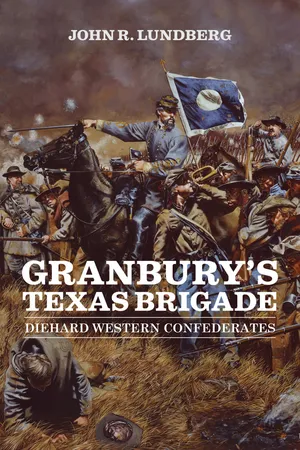
John R. Lundberg's compelling new military history chronicles the evolution of Granbury's Texas Brigade, perhaps the most distinguished combat unit in the Confederate Army of Tennessee. Named for its commanding officer, Brigadier General Hiram B. Granbury, the brigade fought tenaciously in the western theater even after Confederate defeat seemed certain. Granbury's Texas Brigade explores the motivations behind the unit's decision to continue to fight, even as it faced demoralizing defeats and Confederate collapse. Using a vast array of letters, diaries, and regimental documents, Lundberg offers provocative insight into the minds of the unit's men and commanders. The caliber of that leadership, he concludes, led to the group's overall high morale.
Lundberg asserts that although mass desertion rocked Granbury's Brigade early in the war, that desertion did not necessarily indicate a lack of commitment to the Confederacy but merely a desire to fight the enemy closer to home. Those who remained in the ranks became the core of Granbury's Brigade and fought until the final surrender. Morale declined only after Union bullets cut down much of the unit's officer corps at the Battle of Franklin in 1864.
After the war, Lundberg shows, men from the unit did not abandon the ideals of the Confederacy -- they simply continued their devotion in different ways. Granbury's Texas Brigade presents military history at its best, revealing a microcosm of the Confederate war effort and aiding our understanding of the reasons men felt compelled to fight in America's greatest tragedy.
- 344 pages
- English
- ePUB (mobile friendly)
- Available on iOS & Android
eBook - ePub
About this book
Information
CHAPTER ONE
OFF TO WAR
As the various regiments that became Granbury’s Brigade came together and headed for the front, their very organization and demographics demonstrated the early strength of Confederate nationalism. In recent years, several studies have outlined the Confederate nationalism inherent in Texans in the early months of the Civil War. In his study “Victory Is Our Only Road to Peace,” Andrew Lang demonstrates that Confederate nationalism on the Texas home front peaked in 1861 but stayed strong throughout the war. This nationalism impelled many of the men in the regiments that became Granbury’s Brigade to join in the first place. Lang also points out that Texas occupied a unique position among the Confederate states because of its history of nationalism during the Republic of Texas era. Lang argues that Texans took this identity from the Republic era and easily reshaped it into loyalty to the South and the Confederacy. The accounts of many of the men of Granbury’s Brigade early in the war bear out this thesis. In addition, some historians have attempted to portray the Confederate war effort as a “rich man’s war and a poor man’s fight,” but authors such as Richard Lowe, in his Walker’s Texas Division, C.S.A., demonstrate beyond a shadow of a doubt that all classes of Texans joined to defend the Confederacy. The demographics of Granbury’s Brigade also bear this out.1
Stark differences existed in the demographics and loyalty between the infantry and cavalry regiments that later became Granbury’s Brigade. The infantry regiments tended to contain younger, more unattached men, often from more affluent families, increasing their idealism and propensity toward loyal service to their original regiments. Meanwhile, the cavalry regiments tended to contain older, married men, who were often reluctant to fight dismounted or, even more serious, to fight far from their families or from the boundaries of Texas. The fact that many of the cavalrymen signed up ahead of the enactment of the Confederate Conscription Act of 1862 indicates that they were more than willing to serve their country, but perhaps held back because they wanted to serve close to home, rather than being forwarded to Virginia or Tennessee. The demographics of the various regiments and the chronology in which they came into Confederate service laid the groundwork for their later contributions to the Confederate cause.
Within the Civil War armies, the company was the basic unit of a regiment. Each company, ideally consisting of about a hundred men, formed gradually as volunteers congregated at a common mustering point, usually the nearest county seat. Prominent local citizens generally provided the impetus for forming these companies. In the case of Granbury’s Brigade, lawyers, judges, and planters comprised this group—in short, the wealthier and more educated individuals of the community. From the mustering points the leaders loosely organized these companies and shuttled them to camps of instruction, where the regiments began to take shape. Ten companies formed a regiment, organized by a prominent citizen armed with a commission from the governor or the Confederate government. The government then eventually ordered these regiments to the front, where generals organized them into brigades of three to five regiments.
Leading citizens organized all the regiments of Granbury’s Brigade before the passage of the Confederate Conscription Act in April 1862. Because of this, the state considered them volunteer regiments. Infantry provided the core of armies based on the Napoleonic model. Texan leaders soon found it extremely difficult, though, to persuade men to volunteer as foot soldiers. In 1863, British observer Lieutenant Colonel Arthur Fremantle noted, after watching a cavalry regiment in Galveston, “At the outbreak of the war it was found very difficult to raise infantry in Texas, as no Texan walks a yard if he can help it. Many mounted regiments were therefore organized, and afterwards dismounted.”2 While trying to raise a company of infantry in 1862, Oran Roberts of Hopkins County noted, “If it was cavalry I could succeed better as Texans dislike to walk.” James H. Jones of the same regiment wrote, “We have some good material for the service yet in our country—men of position and good moral characters—who are willing to go as infantry. We will have some prejudices to remove against walking.”3 Because infantry formed the backbone of nineteenth-century armies, the Confederate government sought to raise foot soldiers in any manner possible, and their zeal in this endeavor ultimately led to problems among the Texas cavalrymen when the authorities dismounted these regiments. The transformation of cavalry to infantry led to a great deal of dissatisfaction that dealt a mortal wound to any loyalty these men felt to their original regiments. They still wanted to serve the Confederacy, but closer to home and on their own terms.
For the most part, each company of Granbury’s Brigade hailed from a single county. This shared locality often provided a name for the company. For example, the “Travis Rifles” of Travis County became Company G, 6th Texas Infantry. In this company, of those whose residency could be verified, 71 percent of the members came from Travis County. The other 29 percent hailed from Hays, Burnet, Bastrop, or Williamson counties, all contiguous with Travis. Only one member of the company came from a county not contiguous with Travis County.4 The companies in the other regiments of Granbury’s Brigade had similar patterns of residency.
Early indications of Confederate nationalism abounded in Texas during the early months of the war. Robert Collins, a clerk in a dry goods store in Decatur, Texas, wrote that in February 1862 “the idea of the Yankees heading for Texas soil to despoil our fair homes, insult our women and eat up the substance of the people was just a little more than we proposed to submit to.” Wise County, which Decatur served as seat, had only about two hundred voters, and according to Collins all those who were not teachers or clerks occupied themselves as “cowboys.” George Sweet commissioned George Pickett to raise a company for his regiment then assembling near McKinney, north of Dallas. Collins wrote that once Pickett received his commission he “then commenced the rushing to and fro getting things in shape to enlist, go to the wars and get honor, glory and some immortality. The day was set Saturday for the enrolling of names and organization of the company, and in they came on their little fingertail, frosty-necked, calico Spanish ponies, all clamorous to get into the cavalry service.” He continued, “After the organization of our company until the order to march was received all hands were busy getting things in shape to take the field, and the people either from pure patriotism, or fear of the consequences of resistance, opened their doors to the boys.”

Members of Pickett’s new company fashioned themselves the “Wise Yankee Catchers.” Collins reported that patriotic sentiment predominated, and all the women of the town went about their business humming “Dixie” or “The Bonnie Blue Flag.” The Texans armed themselves with whatever firearms they could get. Most had shotguns, double-barreled and single-barreled, used for hunting in the days before the war. Around the first of March, Pickett, whom the company had elected captain, received orders to report his company immediately to Dallas.5
The presentation of a flag by the ladies of the town and accompanying patriotic fanfare became a common feature of these companies that enlisted in the early days of the war. Private Jim Turner of the Travis Rifles recounted the experience of his company in Austin:
During the forenoon of Saturday, November 2, 1861 the company assembled at the armory and loaded our baggage and tents into the wagons.… We were then marched up Congress Avenue to the corner of Ninth Street where the company was presented by the ladies with a beautiful silk flag, the Stars and Bars of the Confederacy, in the presence of a large crowd of people. Patriotic speeches of presentation and acceptance were made, and after giving three hearty cheers, the company marched down the street amidst cheers and waving of handkerchiefs by the people who thronged the sidewalks. At noon we crossed the Colorado River at the ferry which was then near the foot of Colorado Street, just above the old Glasscock Mill, and proceeded on our way to the war.6
Turner’s description certainly did not stand alone. Most if not all companies had a flag presentation of some sort. Later the regiments put away these individual company flags in favor of one regimental flag.
These volunteers soon took part in another ritual, the election of company and regimental officers. At an early hour on April 19, 1861, the “‘neigh of the war horse’ and the assembling of the Cavalry” disturbed the quiet of Marshall, wrote William Heartsill. The best men from Harrison, Panola, and Marion counties assembled in the Marshall town square. The new cavalrymen possessed everything necessary for service except weapons, which they expected to get from the arsenal at Austin. Heartsill recounted, “At 3 o’clock we proceeded to the organization of the company; which was consummated as follows; tickets had been previously prepared with the names of aspirants, and in some instances unauthorized; but as all are willing to serve in any capacity that their friends may desire; consequently there was a full ticket, and considerable stir among the friends of the respective candidates. The ballots were deposited in a ballot box, and while the officers of the election were counting out the vote—the Company was called together in the Courthouse, and the oath administered by Judge Frazer.” The soldiers elected Samuel J. Richardson captain of the company, which styled itself the “W. P. Lane Rangers,” after William P. Lane, a prominent citizen of Marshall.7 After their organization the Rangers served as an independent company of cavalry until captured at the Arkansas Post. Thereafter most of the company served in Granbury’s Brigade as dismounted cavalry.
The demographics of these various companies reveal something of the type of men who served in Granbury’s Brigade. Eight companies will serve as a representative sample, one from each regiment in the brigade. These particular eight had diverse geographic origins within Texas and give a good cross-sample of differences based on locality. In some companies heads of households in their twenties and thirties predominated, while in others dependents between the ages of fourteen and nineteen comprised almost the whole command.
Taking the results from the several companies together, a picture emerges of an average member of Granbury’s Brigade in 1860. The average soldier tended to be twenty-five years old, six years older than the average Civil War soldier, and a little less likely (69 percent) than the average Texan to be a farmer. A relatively high percentage (38 percent) had married before the war, with most of the married men claiming children as dependents. Roughly 35 percent of the brigade hailed from the Upper South, 45 percent came from the Lower South, while about one in five men came from the North or Europe. About 37 percent of the brigade reported net assets on the 1860 census, with a holding of about $3,518 apiece.8 (See Appendix 1.)
The average member of Granbury’s Brigade owned only a little over half the total wealth of the average Texas head of household in 1860, but proved almost exactly as wealthy as the average member of Walker’s Texas Division.9 As for age, Granbury’s men were comparable, if not a bit younger, than Walker’s or the members of the 13th Texas Cavalry, which mustered at about the same time. In terms of occupations, the percentage of Granbury’s men who were farmers coincided almost exactly with the percentage of farmers in Texas as a whole, while the states of origin for the men of Granbury’s Brigade also coincided almost exactly with Texas as a whole. This clearly backs up assertions of authors such as Richard Lowe, who claim that members of all economic classes in Texas signed up in proportional numbers to defend their new country. This runs directly contrary to any claims of class conflict, or of a “rich man’s war and a poor man’s fight.”
After the raising and organizing of the companies, the governor ordered them to come together at a designated camp of instruction for their regiment. The 6th Texas Infantry was one of the first regiments to organize. On June 12, 1861, Adjutant and Inspector General of the Confederacy Samuel Cooper ordered Brigadier General Earl Van Dorn, commander of the Confederacy’s Department of Texas, to raise twenty companies of infantry for Confederate service. Van Dorn instructed the volunteers to organize themselves, elect their own officers, and report to two camps of instruction designated by the governor. Less than three weeks later Confederate Secretary of War Leroy Pope Walker instructed Governor Edward Clark to establish three camps of instruction. Meanwhile Colonel Henry McCulloch had replaced Van Dorn as Confederate commander of the Department of Texas. McCulloch suggested to Clark that he select Victoria as one of the sites. Clark agreed, and designated Millican, Texas, as the second camp of instruction.10
In September 1861, Major Alexander Haskell chose Nunner’s Mott, four miles north of Victoria as the specific site for the first camp of instruction. The location was central and punctuated by large oak trees, but some complained that insects infested the site and made it an unhealthy environment. Nevertheless, Nunner’s Mott became the staging area for what would become the 6th Texas Infantry. The volunteers named the encampment Camp Henry E. McCulloch in honor of the commander of the Department of Texas.11
The Lavaca Guards, a company from Calhoun County, became the first men to arrive at Nunner’s Mott. Alexander Hamilton Phillips Jr., a Port Lavaca attorney, led the company. On September 27, 1861, Confederate officials mustered Phillips and his men into service as Company A. Three days later the Lone Star Rifles from Victoria County, led by James Rupley, arrived and became Company B. Rupley had previously served in the Mexican War and proved one of the more experienced company commanders in the newly forming regiment. The third group of men, under Captain Alonzo Bass, hailed from Gonzales County. They took the oath of allegiance to the Confederacy on October 3, 1861, and became Company C. The next day Dr. A. E. Pearson oversaw the mustering in of his Matagorda Coast Guards as Company D.12
The next three companies moved a little slower in arriving at Camp McCulloch. On October 30 a company from Guadalupe County arrived under the command of Seguin lawyer John P. White, and officials mustered the group in as Company E. Four days later Captain Henry E. Bradford’s company from Bell County, the “Bell County Invincibles,” mustered in as Company F. On November 12, 1861, Captain Rhoads Fisher, Austin attorney and son of Texas pioneer Samuel Fisher, arrived at the head of his Travis Rifles, who became Company G.13
In contrast to its treatment of most of the other volunteer regiments that flocked to the colors in 1861, the Confederate Congress authorized President Jefferson Davis to appoint the field officers of the 6th Texas. For colonel of the new regiment, Davis selected Robert R. Garland. Garland had served a captain in the 7th U.S. Infantry Regiment before the war. Prior to secession Garland found himself stationed at Fort Fillmore, New Mexico. He hailed from Virginia and considered his loyalty to the Old Dominion more important than his loyalty to the United States. When Garland resigned from the U.S. Army, Davis appointed him to an equal rank in the Confederate Army as inspector general to the Department of Texas. When Davis chose him to command the 6th Texas, he elevated Garland to colonel, effective December 12, 1861, and instructed him to proceed to Nunner’s Mott. Davis chose Thomas S. Anderson, a former Texas secretary of state and practicing attorney in Austin, as the regiment’s lieutenant colonel. Davis selected Alexander Haskell, the man who had selected Nunner’s Mott, as major, and Samuel J. Garland, nephew of Colonel Garland, as adjutant. The next month Walker reassigned Haskell and promoted Captain Alexander Phillips to lieutenant colonel in his stead.14 (See Appendix 2, “The 6th Texas Infantry.”)
The steady stream of volunteers for infantry service began to dry up by the end of 1861. Things became so critical that in February 1862 Governor Francis Lubbock made an impassioned plea to the citizens of Texas to volunteer for Confederate service. The impetus from this appeal allowed Garland to fill out his regiment with the last three companies. On March 27, 1862, a company-sized group of volunteers from Calhoun and Lavaca counties arrived at Camp McCullo...
Table of contents
- COVER
- TITLE PAGE
- COPYRIGHT PAGE
- DEDICATION
- CONTENTS
- MAPS
- ACKNOWLEDGMENTS
- INTRODUCTION
- CHAPTER ONE: OFF TO WAR
- CHAPTER 2: FORT DONELSON
- CHAPTER THREE: SOJOURN IN ARKANSAS
- CHAPTER FOUR: ARKANSAS POST
- CHAPTER FIVE: FIGHTING FOR VICKSBURG
- CHAPTER SIX: PRISON
- CHAPTER SEVEN: A NEW START
- CHAPTER EIGHT: CHICKAMAUGA
- CHAPTER NINE: CHATTANOOGA
- CHAPTER TEN: CAMP LIFE
- CHAPTER ELEVEN: FROM DALTON TO PICKETT’S MILL
- CHAPTER TWELVE: STUCK IN THE THICKETS OF NORTH GEORGIA
- CHAPTER THIRTEEN: HOOD TAKES COMMAND
- CHAPTER FOURTEEN: THE FALL OF ATLANTA
- CHAPTER FIFTEEN: THE INTERLUDE
- CHAPTER SIXTEEN: FLANKING SHERMAN
- CHAPTER SEVENTEEN: SPRING HILL AND FRANKLIN
- CHAPTER EIGHTEEN: NASHVILLE
- CHAPTER NINETEEN: THE END OF THE WAR
- AFTERWORD: REMINISCENCES, REUNIONS, AND THE LOST CAUSE
- APPENDIXES
- NOTES
- BIBLIOGRAPHY
- INDEX
Trusted by 375,005 students
Access to over 1.5 million titles for a fair monthly price.
Study more efficiently using our study tools.
Frequently asked questions
Yes, you can cancel anytime from the Subscription tab in your account settings on the Perlego website. Your subscription will stay active until the end of your current billing period. Learn how to cancel your subscription
No, books cannot be downloaded as external files, such as PDFs, for use outside of Perlego. However, you can download books within the Perlego app for offline reading on mobile or tablet. Learn how to download books offline
Perlego offers two plans: Essential and Complete
- Essential is ideal for learners and professionals who enjoy exploring a wide range of subjects. Access the Essential Library with 800,000+ trusted titles and best-sellers across business, personal growth, and the humanities. Includes unlimited reading time and Standard Read Aloud voice.
- Complete: Perfect for advanced learners and researchers needing full, unrestricted access. Unlock 1.5M+ books across hundreds of subjects, including academic and specialized titles. The Complete Plan also includes advanced features like Premium Read Aloud and Research Assistant.
We are an online textbook subscription service, where you can get access to an entire online library for less than the price of a single book per month. With over 1.5 million books across 990+ topics, we’ve got you covered! Learn about our mission
Look out for the read-aloud symbol on your next book to see if you can listen to it. The read-aloud tool reads text aloud for you, highlighting the text as it is being read. You can pause it, speed it up and slow it down. Learn more about Read Aloud
Yes! You can use the Perlego app on both iOS and Android devices to read anytime, anywhere — even offline. Perfect for commutes or when you’re on the go.
Please note we cannot support devices running on iOS 13 and Android 7 or earlier. Learn more about using the app
Please note we cannot support devices running on iOS 13 and Android 7 or earlier. Learn more about using the app
Yes, you can access Granbury's Texas Brigade by John R. Lundberg in PDF and/or ePUB format, as well as other popular books in History & American Civil War History. We have over 1.5 million books available in our catalogue for you to explore.