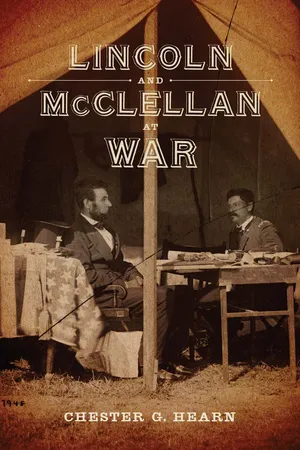
At the beginning of the Civil War, President Abraham Lincoln and his highest-ranking general, George B. McClellan, agreed that the United States must preserve the Union. Their differing strategies for accomplishing that goal, however, created constant conflict. In Lincoln and McClellan at War, Chester G. Hearn explores this troubled relationship, revealing its complexity and showing clearly why the two men -- both inexperienced with war -- eventually parted ways. A staunch Democrat who never lost his acrimony toward Republicans -- including the president -- McClellan first observed Lincoln as an attorney representing the Illinois Central Railroad and immediately disliked him. This underlying bias followed thirty-five-year-old McClellan into his role as general-in-chief of the Union army. Lincoln, a man without military training, promoted McClellan on the advice of cabinet members and counted on "Little Mac" to whip the army into shape and end the war quickly. McClellan comported himself with great confidence and won Lincoln's faith by brilliantly organizing the Army of the Potomac. Later, however, he lost Lincoln's trust by refusing to send what he called "the best army on the planet" into battle. The more frustrated Lincoln grew with McClellan's inaction, the more Lincoln studied authoritative works on military strategy and offered strategic combat advice to the general. McClellan resented the president's suggestions and habitually deflected them. Ultimately, Lincoln removed McClellan for what the president termed "the slows." According to Hearn, McClellan's intransigence stemmed largely from his reluctance to fight offensively. Thoroughly schooled in European defensive tactics, McClellan preferred that approach to fighting the war. His commander-in-chief, on the other hand, had a preference for using offensive tactics. This compelling study of two important and diverse figures reveals how personality and politics prolonged the Civil War.
- 272 pages
- English
- ePUB (mobile friendly)
- Available on iOS & Android
eBook - ePub
Lincoln and McClellan at War
About this book
Information
Subtopic
American Civil War HistoryIndex
History1
“It is impossible for him to lead”
THE CIVIL WAR BEGAN DISASTROUSLY for Abraham Lincoln. He hoped to reunify the country without an armed conflict, but measures he took after becoming president hurried the war. Lincoln did not understand warfare. His only military experience traced back to April 16, 1832, when Governor John Reynolds of Illinois called for volunteers to repel an incursion of Black Hawk’s so-called British Band into the Rock River area, located in the northwestern part of the state. The force consisted of about five hundred Sauk and Fox warriors and a thousand old men, women, and children.
Lincoln joined the Sangamon County militia company as a volunteer because Denton Offutt’s general store, where he clerked, was closing, thus depriving him of a job. He had also put himself before the public as a candidate for the state legislature and believed a war record would increase his popularity at the polls. Friends from Sangamon elected him as their leader, and the unit became “Captain Abraham Lincoln’s Company of the [Fourth] Regiment of the Brigade of Mounted Volunteers commanded by Brigadier-General Samuel Whiteside.” The Mounted Volunteers had no horses, so at first they walked. They knew nothing about fighting Indians, but state law compelled every able-bodied man between the ages of eighteen and forty-five to drill twice a year or pay a one-dollar fine. Nobody had a dollar to spare, so everyone drilled.1
Captain Lincoln had no experience giving orders, nor had he become handy with firearms. His first official order, given to an independent-minded volunteer, drew the response “Go to hell.” As an officer, Lincoln carried a pistol and a sword. He accidently fired the weapon in camp, which was forbidden, and served one day under arrest for violating regimental rules. A few days later hungry men from his company raided the officers’ supply tent, stole several few jugs of whiskey, and went to bed dead drunk. When they appeared intoxicated at morning roll call, Abe paid the price for his men’s misconduct. General Whiteside held court-martial proceedings, stripped Lincoln of his weapons, and ordered him to carry a wooden sword for two days. Colonel Zachary Taylor arrived to take command of the regiment and in a speech told sixteen hundred volunteers, including the Sangamon men, that as citizens of Illinois there “would probably be congressmen [among them who would] go to Washington” someday. Lincoln took notice and decided to become a better soldier.2
On May 27, because of poor discipline in General Whiteside’s command, Governor Reynolds mustered the Sangamon men out of the service. With no job waiting at home, and because Colonel Taylor’s words suggested a possible political career for men who served, Lincoln and his friends reenlisted for thirty days in General Robert Anderson’s brigade as privates. Anderson would later become distinguished as the Union officer who defended Fort Sumter in 1861. He assigned Lincoln to Captain Elijah Iles’s company of Independent Rangers, a mounted unit engaged in carrying messages and reconnoitering Black Hawk’s movements. Because the volunteers had no camp duties and drew rations as they pleased, Lincoln found serving as a private more agreeable than shouldering a captain’s responsibilities.3
On June 16 Lincoln reenlisted for another thirty days and joined Captain Jacob M. Early’s Independent Spy Corps. A Methodist minister from Springfield, Illinois, Early had previously been a private serving under Lincoln. The nearest Lincoln came to participating in a skirmish occurred on June 25 at Kellogg’s Grove on the upper Rock River, where he arrived in time to bury five men who had been scalped during a surprise attack. The company pursued Black Hawk into the Michigan Territory (later Wisconsin), which Lincoln recalled as the hardest march of his life. When provisions gave out on July 10, three weeks before the last battle, Early disbanded the company and sent the volunteers home. Someone stole Lincoln’s horse, so he walked with friends as far as Peoria, bought a canoe, paddled down the Illinois River to Havana, and walked the rest of the way home to New Salem. Years later he joked about his seminal military experience as thrashing about in swamps and sinkholes and recounted bloody struggles with mosquitoes while leading dashing assaults on onion patches.4
By all accounts Lincoln survived the short campaign without ever seeing action. He learned nothing of tactical value from his experience, and his war record failed to launch his career as a Whig. On Election Day, August 6, Lincoln won his hometown vote but lost his bid for the state legislature, finishing seventh among a field of twelve. The defeat did not wrench Lincoln from politics. Six weeks later he filled a local post as clerk of the September election.5
Although Lincoln may have heard of General Winfield Scott, who arrived with U.S. Army regulars to participate in the Black Hawk War, or of Jefferson Davis, who conducted Black Hawk to prison, he learned nothing about fighting or military leadership. He did learn something about sloppy logistics because he and his friends sometimes went days without rations. Lincoln never intended to become a military man, but after becoming president in 1861 and suffering several avoidable military disasters, he developed rapidly into a strategist.
DURING THE TWENTY-EIGHT YEARS between the Black Hawk War and the presidential election in 1860, Lincoln became a lawyer, a politician, but never again a soldier. Elected in 1834 to the state legislature, he served continuously for four terms as a Whig and became the unelected but accepted speaker of the lower house by caucus affirmation. In 1841 he left office to concentrate on law, but five years later Illinois voters sent him to Congress. He served one term, from 1847 to 1849, but never took part in the great 1850 debates over slavery. While serving as a U.S. representative he did work on the Wilmot Proviso, which prohibited slavery in the territories acquired from Mexico, and he backed the prohibition of slavery in the District of Columbia, a piece of legislation that came to the floor for a vote during his term. Lincoln’s efforts were among his first toward emancipation on a limited scale and were radically different from those of Democrats, who sanctioned slavery, and Republican radicals, who demanded immediate abolition. Lincoln believed masters should be paid for freeing their slaves, and he still felt the same way when he became president. Had legislation passed in 1849, following Lincoln’s statesmanlike approach to applying gradual solutions to the slave problem, the South might have retained confidence in Lincoln as president, and South Carolina might not have been so hasty to secede from the Union on December 20, 1860.6
Lincoln’s congressional term brought him no particular distinction, and with Democrats running Illinois, he returned to Springfield with few aspirations of a political career and resumed his practice of law. As Whigs gradually lost power in the North, Lincoln observed the early formation of the Republican Party while remaining circumspect. He refused to join the Know-Nothings, an emerging political coalition promoting prejudice against non-American racial groups, which in 1856 nominated former president Millard Fillmore as their candidate. Democrats nominated James Buchanan of Pennsylvania, partly because he abhorred abolition and partly because he disliked the divisive antislavery policies espoused by the emerging Republican Party. Republicans nominated John C. Frémont, the nationally acclaimed “Pathfinder” who during the Mexican War once contrived to become dictator of California. Senator and former governor William H. Seward of New York would have been a better choice for the ticket, but Seward’s mentor, Thurlow Weed, restrained him from seeking the nomination until 1860.7
In 1856 Lincoln suddenly found himself back in politics when he discovered his name had been placed on the ballot as Frémont’s running mate during the Republican National Convention in Philadelphia. Although he personally distrusted Frémont and never intended to run for vice president, Lincoln received 110 votes during an informal ballot. Senator William L. Dayton of New Jersey won the nomination with 259 votes. Lincoln received the news while attending court in Urbana, Illinois. He brushed off the information, remarking that the votes were probably meant for “the other great man of the same name from Mass [achusetts].” That his name had been put forward at the national convention served as a stimulant, and Lincoln began to reconsider a political career more seriously.8
In 1854 Lincoln had already begun easing back into politics by making speeches on issues of national interest, such as the Kansas-Nebraska Act. He had been reelected to the Illinois legislature but resigned his seat to run for the U.S. Senate. After failing in 1854, he waited until 1858 to run against Senator Stephen Douglas, an Illinois Democrat with whom he had differentiated himself politically through four years of public speaking appearances. Although the famous Lincoln-Douglas debates took place in 1858, they actually began in 1854, when the two rivals first took opposing positions on state and national issues. On June 16, 1858, the Republican State Convention at Springfield granted Lincoln’s wish by nominating him as their candidate for the Senate. Lincoln responded to the honor by delivering his famous “House Divided” speech, which differentiated him from Douglas’s “popular sovereignty” doctrine. The speech launched Lincoln’s Senate campaign and made him a contender for the presidential nomination in 1860.9
The 1858 debates with Douglas took place during a time when Lincoln represented the Illinois Central Railroad in several legal cases. At the time former U.S. Army captain George Brinton McClellan served as the railroad’s vice president. As a conservative Democrat, McClellan staunchly supported Douglas and admitted having nothing in common with Lincoln. During the summer and fall campaign of 1858 he made his private car available to Douglas. On one occasion he accompanied the senator to a debate and tidied him up after a night of hard drinking. According to a statement in Stephen W. Sears’s biography, McClellan wrote, “Douglas’ speech was compact, logical & powerful—Mr. Lincoln’s disjointed, & rather a mass of anecdotes instead of arguments. I did not think there was any approach to equality in the oratorical powers of the two men.” McClellan’s handiwork also appeared on Election Day, when he issued orders to the railroad’s superintendent to have a specially chartered locomotive filled with Lincoln voters break down in some remote area until the polls closed. The two incidents marked McClellan’s first encounters with Lincoln. He never changed his political views or his early impressions of Lincoln. Both men would one day work together to save the Union, each in his own way, but in 1858 Lincoln had no inkling that McClellan had lurked in the background manipulating the outcome of the election and stigmatizing him as inferior. After Lincoln became the president-elect, McClellan did not disagree when in January 1861 he received a letter from John M. Douglas, a fellow director on the Illinois Central, who wrote, “I tell you it is impossible for him to lead,” a conviction they shared and one that McClellan accepted without reservation.10
Douglas won the Senate race, but Lincoln won national visibility by defining the differences between Democrats and Republicans. Without the debates Lincoln would not have become a presidential candidate. He espoused a mild antislavery position because he believed the institution would, over time and with gentle nudges, self-destruct. He managed to convince northern moderates without repelling radical abolitionists. Douglas paid dearly for his stand on popular sovereignty, which favored freedom only where people wanted it. Oddly enough, Lincoln did not fundamentally disagree with Douglas but made it seem so.
The debates put Lincoln before the public. Invitations to speak on national issues came from other states, in particular New York and Ohio. He promoted his position of resisting popular sovereignty as a means of appeasing slave interests as he done during the Douglas debates. In 1859 friends began urging Lincoln to consider running for the Republican presidential nomination, but it was not until April 29, 1860, that he admitted to Senator Lyman Trumbull, “The taste is in my mouth a little.” By then he had finished a tour of the East, made his Cooper Union speech on February 27, 1860, and began to differentiate himself from Seward, the Republican frontrunner from New York, and Ohio governor Salmon P. Chase, Seward’s main competitor.11
When delegates to the Republican National Convention met in Chicago on May 16, 1860, Lincoln had established himself as a serious presidential contender. Although he did not directly participate in the convention, his political handlers, Judge David Davis and Leonard Swett, made several deals to bolster his nomination. After Lincoln won the presidential election in November 1860, one of those deals brought Simon Cameron, a corrupt powerbroker from Pennsylvania, into the cabinet as secretary of war. Cameron knew nothing about running the War Department and filled it with political friends. On military matters he relied on seventy-five-year-old Brevet Lieutenant General Winfield Scott, a venerable general-in-chief smitten by age, gout, dropsy, and vertigo. When young, Scott had distinguished himself during the War of 1812 and again during the Mexican War. He still carried two British bullets in his ponderous frame, but age had sapped his energy and blunted his interest in the expansion of military technology. Having lately acquired the sobriquet “Old Fuss and Feathers” because of his passion for red tape, Scott could no longer mount a horse, though he continued to be the most celebrated soldier in America. When not asleep on a sofa at army headquarters, he spent his wakeful hours conducting business from a huge armchair. In early 1861 Scott still functioned as the foremost military authority in the country, and Edwin McMasters Stanton, who had previously served as President James Buchanan’s attorney general, wrote, “He is, in fact, the Government.”12
Lincoln also created problems for himself in attempting to balance his cabinet by filling it with four former Democrats and three former Whigs, with himself as the fourth Whig. Of the seven cabinet members only Postmaster General Montgomery Blair, who had graduated from West Point in 1835, had military training. After serving one year fighting Seminoles, he had resigned to study law. Seward occupied the top post in the cabinet as secretary of state and espoused strong views on running the administration, which irritated other members of the cabinet. As secretary of the Treasury, Chase reigned over the number-two post in the pecking order. Seward and Chase had been competing presidential candidates in 1860. They held different views on abolition and secession and disliked each other. Their personal rivalry created two mini–political factions in the cabinet, which provided Lincoln with little help, either militarily or politically. Gideon Welles, the secretary of the navy and a former Democrat, disliked Seward’s efforts to upstage Lincoln and remained one of the president’s staunchest supporters. Welles’s involvement with naval affairs during the Mexican War gave him a small amount of helpful administrative experience. Edwin Bates, also a presidential candidate and former Democrat, provided reliable legal advice as attorney general and on occasion sound political advice. Caleb Smith of Indiana became secretary of the interior because of another deal made by Lincoln’s managers during the presidential nominating convention. Smith sided with Seward on every issue and, next to Secretary of War Cameron, contributed no useful political or military advice. With seven of eleven southern states having already seceded when Lincoln took office on March 4, 1860, rifts within the cabinet provided the president with little consensus and many months of frustration.
During the first weeks of his presidency Lincoln invited comments from the cabinet on the relief of Fort Sumter. Major Robert Anderson, who had first appeared in Lincoln’s life during the Black Hawk War, commanded the fort. Sumter represented the only fully functional Federal fort still in Union possession in Charleston, South Carolina’s harbor, and no provisions or supplies had been delivered to the isolated garrison for several months. On requesting opinions from cabinet members, Lincoln said he was anxious to avoid offensive measures and to forbear suggesting acts of aggression. Seward opposed relieving the fort because he erroneously believed a strong pro-Union sentiment still existed in the South. General-in-Chief Scott, an old Whig, sided with Seward, but with a standing army of only sixteen thousand regulars, mainly on duty in the West, he hoped to avoid war. Cameron agreed with Seward because Scott did. This became one of the rare moments when Chase agreed with Seward and suggested the South should be allowed to go its separate way. Bates and Smith also agreed with Seward and said an expedition would be unwise. Only Postmaster Blair advocated the immediate relief of Fort Sumter.13
Lincoln eventually turned the majority of the cabinet’s thinking toward provisioning rather than abandoning the fort and ordered Welles to do it. Although Seward opposed the relief of Sumter, he urged the reinforcement of Fort Pickens in Florida. He never explained why strengthening Pickens would not provoke war while the relief of Sumter would. Meanwhile, South Carolina batteries fired on the fort a few hours before Union relief ships appeared offshore. In the first official military engagement of the Civil War, Major Anderson surrendered Fort Sumter on April 13, 1861. Although some said the president provoked the South into starting the war, Lincoln insisted the Sumter expedition was purely humanitarian. He also claimed that no reinforcements reached shore at Fort Pickens until after Sumter surrendered, therefore implying the South had started the war.14
FOLLOWING THE SURRENDER OF FORT SUMTER, Lincoln issued a proclamation on April 15 calling for 75,000 ninety-day militia for national defense. He also called for a special session of Congress to convene on July 4. Four more souther...
Table of contents
- Cover
- Title Page
- Copyright Page
- Dedication
- Contents
- Introduction
- 1 “It is impossible for him to lead”
- 2 “Come hither without delay”
- 3 “The people trust him”
- 4 “I can do it all”
- 5 “All quiet on the Potomac”
- 6 “He doesn’t intend to do anything”
- 7 “McClellan seems not to value time especially”
- 8 “The stride of a giant”
- 9 “But you must act”
- 10 “I shall aid you all I can”
- 11 “I almost begin to think we are invincible”
- 12 “I have no reinforcements to send you”
- 13 “He is troubled with the ‘slows’”
- 14 “If I cannot whip Bobbie Lee …”
- 15 “It is the people’s business”
- Notes
- Bibliography
- Index
Trusted by 375,005 students
Access to over 1.5 million titles for a fair monthly price.
Study more efficiently using our study tools.
Frequently asked questions
Yes, you can cancel anytime from the Subscription tab in your account settings on the Perlego website. Your subscription will stay active until the end of your current billing period. Learn how to cancel your subscription
No, books cannot be downloaded as external files, such as PDFs, for use outside of Perlego. However, you can download books within the Perlego app for offline reading on mobile or tablet. Learn how to download books offline
Perlego offers two plans: Essential and Complete
- Essential is ideal for learners and professionals who enjoy exploring a wide range of subjects. Access the Essential Library with 800,000+ trusted titles and best-sellers across business, personal growth, and the humanities. Includes unlimited reading time and Standard Read Aloud voice.
- Complete: Perfect for advanced learners and researchers needing full, unrestricted access. Unlock 1.5M+ books across hundreds of subjects, including academic and specialized titles. The Complete Plan also includes advanced features like Premium Read Aloud and Research Assistant.
We are an online textbook subscription service, where you can get access to an entire online library for less than the price of a single book per month. With over 1.5 million books across 990+ topics, we’ve got you covered! Learn about our mission
Look out for the read-aloud symbol on your next book to see if you can listen to it. The read-aloud tool reads text aloud for you, highlighting the text as it is being read. You can pause it, speed it up and slow it down. Learn more about Read Aloud
Yes! You can use the Perlego app on both iOS and Android devices to read anytime, anywhere — even offline. Perfect for commutes or when you’re on the go.
Please note we cannot support devices running on iOS 13 and Android 7 or earlier. Learn more about using the app
Please note we cannot support devices running on iOS 13 and Android 7 or earlier. Learn more about using the app
Yes, you can access Lincoln and McClellan at War by Chester G. Hearn in PDF and/or ePUB format, as well as other popular books in History & American Civil War History. We have over 1.5 million books available in our catalogue for you to explore.