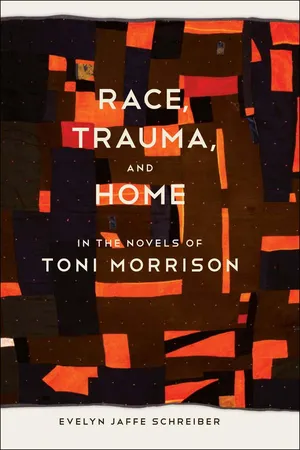
In this first interdisciplinary study of all nine of Nobel Laureate Toni Morrison's novels, Evelyn Jaffe Schreiber investigates how the communal and personal trauma of slavery embedded in the bodies and minds of its victims lives on through successive generations of African Americans. Approaching trauma from several cutting-edge theoretical perspectives -- psychoanalytic, neurobiological, and cultural and social theories -- Schreiber analyzes the lasting effects of slavery as depicted in Morrison's work and considers the almost insurmountable task of recovering from trauma to gain subjectivity.
With an innovative application of neuroscience to literary criticism, Schreiber explains how trauma, whether initiated by physical abuse, dehumanization, discrimination, exclusion, or abandonment, becomes embedded in both psychic and bodily circuits. Slavery and its legacy of cultural rejection create trauma on individual, familial, and community levels, and parents unwittingly transmit their trauma to their children through repetition of their bodily stored experiences. Concepts of "home" -- whether a physical place, community, or relationship -- are reconstructed through memory to provide a positive self and serve as a healing space for Morrison's characters. Remembering and retelling trauma within a supportive community enables trauma victims to move forward and attain a meaningful subjectivity and selfhood.
Through careful analysis of each novel, Schreiber traces the success or failure of Morrison's characters to build or rebuild a cohesive self, starting with slavery and the initial postslavery generation, and continuing through the twentieth century, with a special focus on the effects of inherited trauma on children. When characters attempt to escape trauma through physical relocation, or to project their pain onto others through aggressive behavior or scapegoating, the development of selfhood falters. Only when trauma is confronted through verbalization and challenged with reparative images of home, can memories of a positive self overcome the pain of past experiences and cultural rejection.
While the cultural trauma of slavery can never truly disappear, Schreiber argues that memories that reconstruct a positive self, whether created by people, relationships, a physical place, or a concept, help Morrison's characters to establish subjectivity. A groundbreaking interdisciplinary work, Schreiber's book unites psychoanalytic, neurobiological, and social theories into a full and richly textured analysis of trauma and the possibility of healing in Morrison's novels.
- 236 pages
- English
- ePUB (mobile friendly)
- Available on iOS & Android
eBook - ePub
Race, Trauma, and Home in the Novels of Toni Morrison
About this book
Information
Index
LiteratureINDEX
abandonment, 2, 8, 28, 29, 31, 35, 39, 48, 49, 57, 58, 60, 61, 70, 75, 77, 79, 82, 86, 88–92, 99, 107, 109, 111–16, 118, 120, 128, 129, 131, 133, 134, 140, 143–47, 149–53, 155, 161, 163, 165, 167, 168, 171–74, 188n28, 192nn3–4, 193n11
trauma, 86, 88, 90, 109, 114, 118, 131, 144, 147, 150, 151, 152, 174
abuse, 4, 12, 27, 29, 32, 36, 37, 47, 72, 94, 95, 96, 98, 119, 128, 143, 145, 155
and Beloved, 42
and The Bluest Eye, 71, 72
and children, 14, 136, 188n15, 190n42, 196n34
labor, 96
and Love, 143, 145
memory of, 181n12
and Paradise, 58, 61
parental, 126, 133, 187n14
physical, 2, 145
racial, 71, 91, 98
sexual, 48, 58
and slavery 37, 155
and Song of Solomon, 95, 96, 98
and Sula, 91
and Tar Baby, 122, 124, 133, 135, 136
and trauma, 63, 113, 124, 125, 154, 181n12
victims, 125, 154, 185n44
Adell, Sandra, 178n8
African, 36, 137, 177n2, 178n8, 180n25, 183n29, 193n11, 197n43
African ancestors, 36, 26
Africanis...
Table of contents
- Cover Page
- Title Page
- Copyright Page
- Dedication
- Contents
- Acknowledgments
- INTRODUCTION Trauma, Memory, and Subjectivity The Healing Power of “Home”
- ONE Shared Memory Slavery and Large-Group Trauma in Beloved and Paradise
- TWO Inherited and Generational Trauma Coming of Age in The Bluest Eye, Sula, and Song of Solomon
- THREE Searching for Safety The Persistence of Slave Trauma in Jazz and Tar Baby
- FOUR Bodies of Trauma Memory, Home, and Subjectivity in Love
- FIVE Echoes of “The Foreigner’s Home” in A Mercy
- NOTES
- WORKS CITED
- INDEX
Trusted by 375,005 students
Access to over 1.5 million titles for a fair monthly price.
Study more efficiently using our study tools.
Frequently asked questions
Yes, you can cancel anytime from the Subscription tab in your account settings on the Perlego website. Your subscription will stay active until the end of your current billing period. Learn how to cancel your subscription
No, books cannot be downloaded as external files, such as PDFs, for use outside of Perlego. However, you can download books within the Perlego app for offline reading on mobile or tablet. Learn how to download books offline
Perlego offers two plans: Essential and Complete
- Essential is ideal for learners and professionals who enjoy exploring a wide range of subjects. Access the Essential Library with 800,000+ trusted titles and best-sellers across business, personal growth, and the humanities. Includes unlimited reading time and Standard Read Aloud voice.
- Complete: Perfect for advanced learners and researchers needing full, unrestricted access. Unlock 1.5M+ books across hundreds of subjects, including academic and specialized titles. The Complete Plan also includes advanced features like Premium Read Aloud and Research Assistant.
We are an online textbook subscription service, where you can get access to an entire online library for less than the price of a single book per month. With over 1.5 million books across 990+ topics, we’ve got you covered! Learn about our mission
Look out for the read-aloud symbol on your next book to see if you can listen to it. The read-aloud tool reads text aloud for you, highlighting the text as it is being read. You can pause it, speed it up and slow it down. Learn more about Read Aloud
Yes! You can use the Perlego app on both iOS and Android devices to read anytime, anywhere — even offline. Perfect for commutes or when you’re on the go.
Please note we cannot support devices running on iOS 13 and Android 7 or earlier. Learn more about using the app
Please note we cannot support devices running on iOS 13 and Android 7 or earlier. Learn more about using the app
Yes, you can access Race, Trauma, and Home in the Novels of Toni Morrison by Evelyn Jaffe Schreiber in PDF and/or ePUB format, as well as other popular books in Literature & North American Literary Criticism. We have over 1.5 million books available in our catalogue for you to explore.