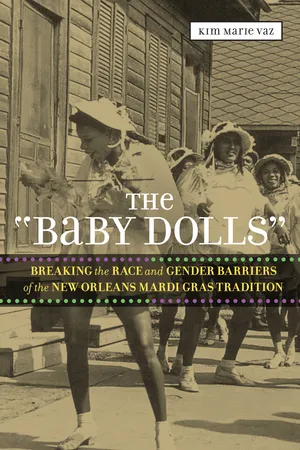
One of the first women's organizations to "mask" in a Mardi Gras parade, the "Million Dollar Baby Dolls" redefined the New Orleans carnival tradition. Tracing their origins from Storyville brothels and dance halls to their re-emergence in post-Katrina New Orleans, author Kim Vaz uncovers the fascinating history of the "raddy-walking, shake-dancing, cigar-smoking, money-flinging" ladies that strutted their way into a predominantly male establishment.
The Baby Dolls formed around 1912 as an organization for African American women who used their profits from working in New Orleans's red-light district to compete with other black women in their profession on Mardi Gras. Part of this competition involved the tradition of masking in which carnival groups create a collective identity through costuming. Their baby doll costumes—short satin dresses, stockings with garters, and bonnets—set against their bold and provocative public behavior not only exploited stereotypes but also empowered and made visible an otherwise marginalized demographic of women.
In addition to their subversive presence at Mardi Gras, the Baby Dolls helped shape the sound of jazz in the city. The Baby Dolls often worked in and patronized dance halls and honky-tonks, where they introduced new dance steps and challenged house musicians to keep up the beat. The entrepreneurial Baby Dolls also sponsored dances with live jazz bands, effectively underwriting the advancement of an art form now inseparable from New Orleans's identity.
Over time, the Baby Doll's members diverged as different neighborhoods adopted the tradition. Groups such as the Golden Slipper Club, the Gold Diggers, the Rosebud Social and Pleasure Club, and the Satin Sinners stirred the creative imagination of middle-class Black women and men across New Orleans, from the downtown Tremé area to the uptown community of Mahalia Jackson.
Vaz follows the Baby Doll phenomenon through one hundred years of photos, articles, and interviews to conclude with the birth of contemporary groups such as the modern day Antoinette K-Doe's Ernie K-Doe Baby Dolls, the New Orleans Society of Dance's Baby Doll Ladies, and the Tremé Million Dollar Baby Dolls. Her book celebrates these organizations' crucial contribution to Louisiana's cultural history.
eBook - ePub
The 'Baby Dolls'
Breaking the Race and Gender Barriers of the New Orleans Mardi Gras Tradition
- 200 pages
- English
- ePUB (mobile friendly)
- Available on iOS & Android
eBook - ePub
The 'Baby Dolls'
Breaking the Race and Gender Barriers of the New Orleans Mardi Gras Tradition
About this book
Information
Subtopic
Cultural & Social AnthropologyIndex
Social Sciences1
Gender, Race, and Masking in the Age of Jim Crow
How to enjoy it [Mardi Gras] best? Most New Orleanians would suggest that you be up early, about eight or so to see Zulu at the New Basin Canal and follow him for a time.… For early afternoon masking, the Orleanian will recommend the Canal Street business section.… You might try North Claiborne Ave. for the remarkable “Indians”—Negros in ornate and lavish disguise; or the “Baby Dolls”—dark girls of more than good will.
— Harnett Kane, Queen New Orleans: City by the River, 1949
AT THE TURN OF THE twentieth century, and well before, Af rican Americans in New Orleans were barred by segregation from participating in White Mardi Gras balls and parades. African Americans were confined to servant-class activity in White krewes and clubs. In response, African Americans formed their own Mardi Gras traditions and festivities, which continue to the present day. These include, most notably, the Zulu Social Aid and Pleasure Club, the Black Indians of New Orleans, the Skull and Bones Gangs, and a distinct Carnival music tradition. The Baby Doll masking tradition is a Mardi Gras custom that started around 1912 and was carried out predominantly by African American women, but with participation from men. In 1939, the Million Dollar Baby Dolls were identified as one of the oldest masking groups by the African American–owned newspaper the Louisiana Weekly.
Most of what has been documented regarding African American vernacular culture comes from research, interviews, and exhibitions about largely male-dominated art and culture, such as jazz musicians, Black Indians, and the second-line parades of the social and pleasure clubs. Important as these expressive arts are, they have overshadowed the stories of African American women’s participation in Carnival.1
The colorfully costumed Million Dollar Baby Doll maskers wore short satin dresses, stockings with garters, and bonnets. They were sexy and sometimes raunchy. The Baby Dolls paraded in their neighborhoods, singing bawdy lyrics to vaudeville show tunes and Creole songs, playing tambourines and cowbells, chanting, and dancing. They were fiercely independent in refusing invitations to join male African American masking groups. For example, John Metoyer, a founding member of the Zulu Social Aid and Pleasure Club, asked the Baby Dolls to mask with them, but the women preferred to have their own gang and go their own way. Later in the day, they would eventually follow the Zulu Parade or wind up in the midst of the Black Indians, or with the variously attired members of the Skull and Bones Gangs. If they were not making a scene, Baby Dolls were where the scene was happening.
The Baby Doll practice is reported to have begun in the quasi-legal red-light district, the area of “vice” for African Americans in a section called Back o’ Town. It was quasi-legal because the ordinance that established Storyville as the legal red-light district a short distance away also established the Perdido Street area, but then held that section’s sanctioning in abeyance. Back o’ Town was a back swamp, a low-lying area that separated the city from Lake Pontchartrain and was home to the city’s first cemetery. After the Civil War, freed slaves moved into the area, as did immigrants from southern Italy who also left the nearby river plantations. By the turn of the century, Back o’ Town was an ethnically mixed community.2 Despite its reputation, there was more to the Back o’ Town area than prostitution and gambling.
Residents raised children in the area, earned a living, and created cultural traditions that have endured. A portion of the section was referred to as the Battlefield, where people would come to show off, settle scores, and enjoy life. Carnival activities that were popular in Back o’ Town were repeated in other parts of the city. In the 1920s, even a young Mahalia Jackson left the protection of her neighborhood to venture some distance to Sixth and Willow streets to see the Mardi Gras Indians and perhaps a Baby Doll or two. Mahalia’s strict and devout Aunt Duke would have been furious if she had known. Mahalia’s biographer explains the allure:
The tribe of Indian Chiefs and Baby Dolls (top-echelon whores) were widely sought as the most splendid in the City, bar none—the costumes usually scrimped for penny by penny, year-round. The black Zulu parade was topped only by Rex, to white eyes; by none, to black, who on this one day couldn’t care less what any white thought. It was Mardi Gras! Masks were encouraged not to come off ’til sundown. The law looked the other way (it couldn’t have coped anyway).

Map by Sam Rykels of vice-district boundaries defined by Ordinance 13485. Reproduced with permission from Alecia Long, The Great Southern Babylon: Sex, Race, and Respectability in New Orleans, 1865–1920 (Baton Rouge: Louisiana State University Press, 2004).
As the city blinked awake, its children knew they were unloved if they weren’t hurried into costume and painted and put into position early to watch the parades and all the big “Mardi Graws”—strange beings today, mystifying friends and encircling strangers,… the air electric, miming made easy as beer and liquor coursed their channels.3
Just who were these Baby Dolls, and how did their behavior become famous, even infamous? The difficulties involved in tracking down credible scholarly information have been mind-boggling. Facing a similar problem, Pulitzer Prize–winning historian Stacy Schiff captured the dilemmas involved in writing about women’s accomplishments while facing the challenges of male hegemonic practices and discourses. She found the research for her book about the Greek-born Egyptian ruler Cleopatra to be exceptionally challenging.
Women’s lives are very difficult to write about.… [I]t’s piecing together a life from the tiniest of Mosaic tiles.… [B]iography is always puzzle making to some extent; but this was just of the tiniest little pieces.… [Y]ou’re left with very tendentious sources, with very scant sources. You’re reading in the margins, basically, and you’re having to somehow read the silences, really, is what it comes down to.… I felt I was always… walking on egg shells. You’re always piecing together things, trying not to jump to a conclusion in any way and, you know, you’re reading people like Cicero, who you know are by definition biased. You know, Cicero writing about a foreign woman who’s rich and has a better library than he has is not going to give you a particularly objective view of the person in question.4
As with Schiff’s experience, men have written about the Baby Dolls largely from a decidedly non-feminist stance. Such perspectives have left us with only the most salacious details, emphasizing the titillation of uninhibited sexual display over the collective activities of which these women were so capable. My purpose here is to exemplify the artistic value and to clarify the diverse practices of the masking tradition for the women in Back o’ Town as well as to reveal their sociopolitical struggles to realize their own passions, imaginations, historic understandings, and joie de vivre.
THE MILLION DOLLAR BABY DOLLS
The popular picture of the Baby Doll tradition stems from a single source that has been duplicated in the scholarly and tourist literature about New Orleans. The information was collected by Louisiana Writers’ Project field-worker Robert McKinney, an African American journalist whose writings could be found in the African American papers the Chicago Defender and the Louisiana Weekly. McKinney served as a case manager for the Federal Works Project before joining Lyle Saxon’s Louisiana Project in 1935.5 McKinney’s characterization was edited and published in its final form by three White men: Lyle Saxon, Edward Dreyer, and Robert Tallant.6 There is little evidence that any of these men directly interviewed the Baby Dolls; they seem to have relied solely on the material collected by McKinney. McKinney’s interviews with a variety of Black New Orleanians were included in the various works edited by Saxon and Tallant, including Gumbo Ya-Ya: Folktales of Louisiana, a book still in print and in wide circulation, notably at many tourist spots in Louisiana. The book is in the public domain, allowing the entire contents to be available online. McKinney has never been properly acknowledged for his critical role in reaching African Americans in the Depression, who opened up to him because they trusted him. His interviews and journalism are at the heart of Gumbo Ya Ya’s Black folk material.
ROBERT JOSEPH MCKINNEY
What I have been able to piece together is that Robert Joseph McKinney may have been born to Robert McKinney Jr. and Leontine Bartholomew on April 7, 1909. Robert Jr., in turn, was born to Robert McKinney (1850–1922) and Hannah Scott (born 1851) in August 1880 in Louisiana. Robert Jr.’s parents were from Mississippi but had married in Orleans Parish in February 1878. According to the 1900 census, they were renting their home at 2911 South Rampart Street, near the hub of African American commercial districts in the Central City. In 1900 Hannah and Robert had been married twenty-one years. Hannah had given birth to three children, only one of whom was living, and that was Robert Jr. The adults in Robert Jr.’s home performed manual labor. Hannah reported her occupation as cook; Robert Sr. was a laborer. In 1900 Robert Jr. was nineteen years old and could read and write, the only person in his home that could, but he worked as a servant. By 1920, Robert Jr. was living with his parents at 2125 Foucher Street. His parents were working for private families as yardman and cook, and Robert Jr., now thirty-nine, was listed as a hotel porter. By 1940, Robert Jr. was a porter at the Metairie Golf Club and resided at 1907 Fern, where he had lived since at least 1938. Robert Jr. died on January 9, 1958, at the age of seventy.
Leontine Bartholomew married Robert McKinney Jr. on December 17, 1908. The bride was twenty and the groom twenty-eight.7 Leontine Bartholomew was the daughter of Louis and Alice Bartholomew. At the time of the 1900 census, Leontine was fourteen years old and had an older sister and two younger brothers. The family resided at 7505 Esther Street in the Sixteenth Ward. Her parents had been married sixteen years by then, and all four of her mother’s children were living. Leontine’s father worked as a laborer. All children were listed as attending school, and the entire family was literate. Leontine was a 1906 graduate of Leland University with a Normal and College Preparatory Diploma.8 Leontine’s coursework began with an elementary school curriculum. She completed Leland’s high-school curriculum to prepare for their teacher-training class. Leontine died on February 9, 1915, at the age of twenty-seven. Robert Joseph was six.
Robert Joseph attended McDonogh Thirty-five, the first public high school in New Orleans for African Americans. He was active in co-curricular pursuits such as writing comic dialogue and selling ads for the yearbook, The Roneagle. Robert Joseph was president of the 1929 graduating class and circulation manager of the yearbook. He was one of the directors in the boy’s section of the Decorum Club and a writer for the Hi Smile student newspaper. In 1933 he graduated from Xavier University of Louisiana, where he had been president of the Athletic Association, business manager for The Annual and the Herald Newspaper, and played on the football team. He was an athletics delegate and a member of the Negro History Club. He was in the Dramatics Club and in the school orchestra.
Robert Joseph went on to work as a case manager for the Federal Works Project and then transitioned into the Louisiana Writers’ Project in 1935. Between 1935 and 1938 he wrote articles that appeared in the nationally syndicated African American newspaper the Chicago Defender on topics largely pertaining to New Orleans culture and arts.9 In working for the Louisiana Writers’ Project, he interviewed a wide range of African Americans, harvesting the folk culture, underworld practices, and spiritual traditions then flourishing. New Deal historian David Taylor described McKinney’s contribution as having written “the manuscript on black life and canvassed the restaurants, hotels, and taxi companies that were available to black residents and visitors.”10
In 1938, Polk’s New Orleans City Directory listed Robert Joseph at a rooming house run by Mrs. Louise Bartholemew Bonner (ca. 1888–1943) of 257 Cherokee Street, his maternal aunt. Robert Joseph McKinney may have died on January 21, 1948, at the age of thirty-nine.11 Aside from being mentioned in Gumbo Ya-Ya, Robert Joseph was consigned to obscurity along with the hundreds of anonymous fieldworkers whose community knowledge was essential in bringing to America awareness of its hidden cultures. His personal motto selected to accompany his photograph in the 1933 Xavier University yearbook, The Lighthouse, was one penned by Oliver Wendell Holmes in The Autocrat of the Breakfast Table: “It is faith in something and enthusiasm for something that makes life worth looking at.”

Robert Joseph McKinney, 1933, from The Lighthouse, the Xavier University yearbook. Courtesy Xavier University Archives.
Robert Joseph lived his life accordingly. Because of his keen eye for detail, classical education, work ethic, interpersonal skills, sense of humor, and belief in the essential dignity of all classes of Black New Orleanians, we are left with an invaluable record of the ordinary and extraordinary customs lived out by a cross-section of the city’s citizens, traditions continued to the present day by their descendants.
WHO WERE THE MILLION DOLLAR BABY DOLLS?
The Million Dollar Baby Dolls were women who paraded on the street together wearing short pleated skirts, bloomers with ruffles and bows, waists or halters, poke bonnets, and socks or stockings held up by garters for securing dollar bills. They donned wigs of corkscrew curls in various colors, including blonde, and they made extensive use of makeup. Their dresses were made of pink or blue satin to achieve the goal of looking as innocent as possible.
Dressing up as Baby Dolls was reported to have begun when a group of uptown (that is, above Canal Street) prostitutes decided to show up a group of downtown (below Canal Street) prostitutes on Mardi Gras. Each woman had to put up her own money to make her costume, including “green money” overflowing from the garter belt that rested snugly on her thigh. During Carnival, these women smoked cigars, flung money at men, and challenged other groups of masked “sportin’” women. They were known for “walking raddy” (a kind of strut that would end with the steps needed to “shake on down”), “shake dancing,” singing traditional Creole songs and blues, turning tricks, drinking, smoking reefers, and “starting and causing” street fights complete with brick throwing and razor flashing. The name they adopted for themselves, “Baby Dolls,” was based on what their pimps called them. Like the Mardi Gras In...
Table of contents
- Cover
- Title Page
- Copyright Page
- Dedication
- CONTENTS
- ILLUSTRATIONS
- PRELUDE: On Being an Example of Hope
- FOREWORD: Black Storyville
- Introduction: A New Orleans Mardi Gras Masking Tradition
- 1. Gender, Race, and Masking in the Age of Jim Crow
- 2. Women Dancing the Jazz
- 3. “Oh You Beautiful Doll”
- 4. A New Group of Baby Dolls Hits the Streets
- 5. “We Are No Generation” Resurrecting the Central Role of Dance to the Creation of New Orleans Music
- ACKNOWLEDGMENTS
- APPENDIXES
- NOTES
- BIBLIOGRAPHY
- INDEX
Trusted by 375,005 students
Access to over 1.5 million titles for a fair monthly price.
Study more efficiently using our study tools.
Frequently asked questions
Yes, you can cancel anytime from the Subscription tab in your account settings on the Perlego website. Your subscription will stay active until the end of your current billing period. Learn how to cancel your subscription
No, books cannot be downloaded as external files, such as PDFs, for use outside of Perlego. However, you can download books within the Perlego app for offline reading on mobile or tablet. Learn how to download books offline
Perlego offers two plans: Essential and Complete
- Essential is ideal for learners and professionals who enjoy exploring a wide range of subjects. Access the Essential Library with 800,000+ trusted titles and best-sellers across business, personal growth, and the humanities. Includes unlimited reading time and Standard Read Aloud voice.
- Complete: Perfect for advanced learners and researchers needing full, unrestricted access. Unlock 1.5M+ books across hundreds of subjects, including academic and specialized titles. The Complete Plan also includes advanced features like Premium Read Aloud and Research Assistant.
We are an online textbook subscription service, where you can get access to an entire online library for less than the price of a single book per month. With over 1.5 million books across 990+ topics, we’ve got you covered! Learn about our mission
Look out for the read-aloud symbol on your next book to see if you can listen to it. The read-aloud tool reads text aloud for you, highlighting the text as it is being read. You can pause it, speed it up and slow it down. Learn more about Read Aloud
Yes! You can use the Perlego app on both iOS and Android devices to read anytime, anywhere — even offline. Perfect for commutes or when you’re on the go.
Please note we cannot support devices running on iOS 13 and Android 7 or earlier. Learn more about using the app
Please note we cannot support devices running on iOS 13 and Android 7 or earlier. Learn more about using the app
Yes, you can access The 'Baby Dolls' by Kim Marie Vaz,Kim Vaz-Deville in PDF and/or ePUB format, as well as other popular books in Social Sciences & Cultural & Social Anthropology. We have over 1.5 million books available in our catalogue for you to explore.