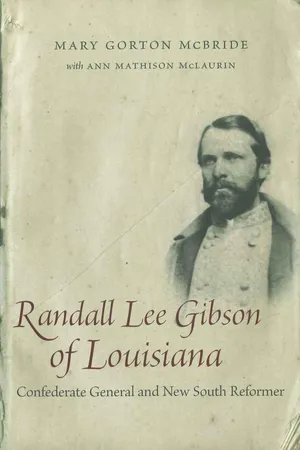
Randall Lee Gibson of Louisiana offers the first biography of one of Louisiana's most intriguing nineteenth-century politicians and a founder of Tulane University. Gibson (1832--1892) grew up on his family's sugar plantation in Terrebonne Parish and was educated at Yale University before studying law at the University of Louisiana in New Orleans. He purchased a sugar plantation in Lafourche Parish in 1858 and became heavily involved in the pro-secession faction of the Democratic Party. Elected colonel of the Thirteenth Louisiana Volunteer Regiment at the start of the Civil War, he commanded a brigade in the Battle of Shiloh and fought in all of the subsequent campaigns of the Army of Tennessee, concluding in 1865 with the Battle of Spanish Fort.
As Gibson struggled to establish a law practice in postwar New Orleans, he experienced a profound change in his thinking and came to believe that the elimination of slavery was the one good outcome of the South's defeat. Joining Louisiana's Conservative political faction, he advocated for a postwar unification government that included African Americans. Elected to Congress in 1874, Gibson was directly involved in the creation of the Electoral Commission that resulted in the Compromise of 1877 and peacefully solved the disputed 1876 presidential election. He crafted legislation for the Mississippi River Commission in 1879, which eventually resulted in millions of federal dollars for flood control.
Gibson was elected to the U.S. Senate in 1880 and became Louisiana's leading "minister of reconciliation" with his northern colleagues and its chief political spokesman during the highly volatile Gilded Age. He deplored the growing gap between the rich and the poor and embraced a reformist agenda that included federal funding for public schools and legislation for levee construction, income taxes, and the direct election of senators. This progressive stance made Gibson one of the last patrician Democrats whose noblesse oblige politics sought common middle ground between the extreme political and social positions of his era. At the request of wealthy New Orleans merchant Paul Tulane, Gibson took charge of Tulane's educational endowment and helped design the university that bears Tulane's name, serving as the founding president of the board of administrators.
Highly readable and thoroughly researched, Mary Gorton McBride's absorbing biography illuminates in dramatic fashion the life and times of a unique Louisianan.
eBook - ePub
Randall Lee Gibson of Louisiana
Confederate General and New South Reformer
- 336 pages
- English
- ePUB (mobile friendly)
- Available on iOS & Android
eBook - ePub
About this book
Information
CHAPTER 1
In Conscience Opposed
I am in conscience opposed to slavery—I don’t like it, and the older I get the worse it seems—& to entail it upon my children is not very agreeable to think of—but [it] is quite as bad in Ky. as here [Louisiana]—in many respects worse.
TOBIAS GIBSON, 1846
Few public figures in nineteenth-century Louisiana history possessed more natural advantages—including superb family connections, great wealth, intelligence, and the political campaign lagniappe of a mother named Louisiana—than Randall Lee Gibson. He was born on September 10, 1832, at Spring Hill, the home of his maternal grandparents near Versailles, Woodford County, Kentucky, into the plantation culture based on slave labor that would result in tragedy for him and his generation. A large and supportive extended family, with its resultant web of complex relationships, enveloped this second surviving child and first son of an eventual family of ten children, eight of whom lived to adulthood. Tobias Gibson, his thirty-two-year-old father, was a member of a pioneer Mississippi family, while his twenty-nine-year-old mother, Louisiana Breckinridge Hart, was descended from one of frontier Kentucky’s first families. Randall’s achievements as a Confederate brigadier general, United States congressman and senator from Louisiana, and founding president of the board of administrators of Tulane University were prefigured in the aggressive energy of his ambitious and rugged family. These Harts and Gibsons emigrated from England, Scotland, and Ireland in the early eighteenth century; traveled later from Virginia, Maryland, and the Carolinas across the Appalachian Mountains and down the Natchez Trace; fought Indians, renegades, and British soldiers; survived a primitive existence in the wilderness; established churches and schools; made agricultural innovations; and founded villages and towns. Randall’s forebears treasured their participation in the American Revolution, but the revolutionary ideology expressed in the Declaration of Independence and in the concepts of liberty and equality highlighted their dilemma as slave owners.
Randall was born just as the southern states were becoming more and more self-consciously aware of their minority status within the federal union, a condition dramatically manifested in the debates surrounding the Missouri Compromise (1820), which banned slavery in the Louisiana Purchase territory west of the Mississippi River and north of the latitude of 36°30′, with slavery allowed as an exception in Missouri. Committed to both democracy and slavery, the southern system of democracy rested upon the equality of white men and the repression of black slaves, upon racism and white supremacy. In the year of Randall’s birth South Carolina challenged the power of the majority to legislate against the interests of a minority, and the Whig Henry Clay was defeated by the Democrat Andrew Jackson for the presidency. During his boyhood and youth he observed the initial clashes between Jacksonians and Whigs in both Kentucky and Louisiana on such issues as internal improvements, protective tariffs, public schools, and the currency and banking systems. From 1832 until 1848, when Randall left the South for New England, his region had evolved from ardent nationalism to defensive sectionalism in all aspects of life. The South had become a distinct region increasingly embittered and unified by the abolitionist crusade against its “peculiar institution” of slavery.1
Henry Clay described the Kentucky of 1832 as an expanse of neat and thriving villages, with numerous hemp, cotton, and wool “manufactories,” surrounded by natural parks, thinned forests, and large herds and flocks grazing in luxuriant pastures near comfortable, sometimes elegant, mansions. Only some sixty years earlier, however, this land had been a part of the vast wilderness known as Transylvania, when the Hart family was among the first to open it to settlement. Randall’s great-grandfather, Capt. Nathaniel Hart, was born in 1734, the son of Thomas Hart and Susanna Rice of Hanover, Virginia. Captain Hart and his wife, Sarah Simpson Hart, daughter of Col. Richard Simpson of Alexandria, Virginia, and their several children settled in Transylvania in 1779. The Harts amassed a large amount of desirable land and raised corn on a contract basis for the Boonesborough settlement and other forts. Nathaniel Hart Jr., Captain Hart’s son and Randall Gibson’s grandfather, was born on September 30, 1770, in Caswell County, North Carolina. When Nathaniel came of age, he became executor of the Hart estate and was involved in complex litigation over the Hart land claims until his own death in 1844. He participated in several expeditions against the Indians, served in 1794 for six months as aide-de-camp to Gen. Joshua Barbee in Gen. Anthony Wayne’s campaign, and fought in the Battle of Fallen Timbers. In 1797 he married twenty-five-year-old Susanna Preston, the daughter of Col. William Preston and Susanna Smith Preston of Smithfield, Virginia, and they lived in Lexington and Franklin County, Kentucky, before moving to Woodford County in 1807, where Colonel Preston had made them a wedding gift of land. Nathaniel built a log cabin for his young family in which they lived until their large and comfortable home, Spring Hill, was completed. Like other settlers, the Harts left the cabin standing on the grounds of Spring Hill as a memorial to their pioneer days. Perhaps Clay had Spring Hill in mind when he described the rude cabins and comfortable stone houses standing side by side on the same farms, denoting “the several stages of the condition of the same occupant” and tangibly symbolizing for these sturdy Whigs the material progress that resulted from hard labor.2
The Harts certainly needed a large house, for Louisiana was only the fourth of nine children: Susan Smith Preston, Sarah Simpson, Letitia Preston, Louisiana Breckinridge, Nathaniel, William Preston, Virginia Hart, Susanna M., and Mary Howard were born in rapid succession. Louisiana was given her unusual name by a cousin, Senator John Breckinridge, who had sponsored enabling legislation for Thomas Jefferson’s Louisiana Purchase in the United States Congress in 1803, the year she was born. After serving in the Virginia House of Delegates, Breckinridge, the grandson of the family’s founder in America, moved to Kentucky in 1793. He was elected to the Kentucky legislature in 1797, where he introduced the Kentucky Resolutions that his friend Jefferson had secretly written to counter John Adams’s Alien and Sedition laws. Given Randall’s future opposition to Jeffersonian ideas, it was ironic that Jefferson’s doctrine of states’ rights was introduced into American politics by the man who gave his mother her name. The Harts, Shelbys, Breckinridges, and other pioneer Bluegrass settlers attempted to recreate the leisurely, aristocratic, southern lifestyle of their Virginia origins. For the most part they were successful in achieving this objective, and life in the countryside around Lexington was comfortable and prosperous.3
The Gibsons came to the Mississippi Territory near the end of the eighteenth century in several waves with other South Carolina families to take advantage of the liberal land grants distributed by the Spanish authorities. Although the English settlers were apprehensive when Spain took control of the region during the war with Great Britain from 1779 to 1783, the Spanish regime was popular because of its liberal immigration laws and religious toleration, in addition to the generous land policy. Many of these settlers were tough and illiterate yeoman whose backbreaking labor resulted in prosperity in one or two generations. According to one account, Randall Gibson’s great-grandfather Gideon Gibson emigrated to America from England with one sister and several brothers, settled first in Middlesex County, Virginia, and then moved on to the neighborhood of Sandy Bluff on the Great Pedee River in South Carolina before coming to the Mississippi Territory around 1781. In another account written by Gibson’s cousin William Preston Johnston, Gibson’s first ancestor in America was John Gibson, who emigrated from England in 1706. A third account of the family’s origins has revealed an intriguing mixed racial background of a slaveholding family named Gibson who went from Virginia to mid-eighteenth century South Carolina seeking the available land grants. Governor Robert Johnson in 1731 described this family, headed by a carpenter named Gideon Gibson, as “not Negroes nor Slaves but Free people,” and he awarded them a land grant. The family soon achieved such status, the historian Winthrop D. Jordan has written, that by 1765 there was “no evidence that Gibson himself was regarded by his neighbors as anything but white,” although he was probably a mulatto. There also seems to be no evidence in Mississippi records that the extensive Gibson family knew much more about their lineage than that the South Carolina Gibsons were “stout Whigs & served in the Revolutionary Army” with “the Murphys and Saunders and the Pegues, who were Gibsons on their mother’s side.”4
Randall, Randall Lee’s grandfather, was just fifteen in 1781, when the Gideon and Mary O’Connell Gibson family moved to the Mississippi Territory, one of three branches of the Gibsons who settled there. Randall Gibson’s name first appeared in the Natchez Court Records in 1786, when he and his younger brother David purchased two Negroes from John Bis-land for 4,744 pounds of tobacco. Although not as cosmopolitan as New Orleans, the Natchez region was the home of an elite circle of “nabobs” who made this area of the Southwest frontier a cultural oasis. The Randall Gibsons never sought nor did they achieve the social prominence of these nabobs, and their wealth was more modest, although the Gibson neighborhood was prosperous and harmonious. In 1792 Randall Gibson, then twenty-six, married twenty-one-year-old Harriet McKinley, the daughter of Irish immigrants Capt. John McKinley and Mary Connelly. As Randall and Harriet began their married life, Gideon Gibson deeded his son 335 arpents of land (an arpent is about 1.28 acres) on St. Catherine’s Creek for $400 as well as an eight-year-old Negro boy, Harry, for $150. The first of their eventual family of five boys and three girls was born in 1793. Randall provided good educational opportunities for Claudius, Tobias, Ambrose, Gibeon, William, Martha, Ann, and Eliza. Although the nature and extent of Randall’s own education is unknown, it was thorough enough to fit him for a leadership role in the political, religious, and educational life of the Natchez District.5
Randall and Harriet were caught up in the religious fervor of the “Great Awakening” that swept across the frontier at the beginning of the nineteenth century. After the Reverend Tobias Gibson came to the Mississippi Territory in 1799 as the first missionary of the Methodist Episcopal Church in the Southwest, Randall discussed various doctrinal matters with him and resolved to enter the Methodist Church. Randall and Harriet led a group of six relatives and neighbors, including one black couple, into the initial congregation of the first Methodist-Episcopal Church in the Mississippi Territory. William and Rachel Foster, Edna Bullen, Caleb Worley, and a black couple (who belonged either to Randall or William) became members of the Methodist Society and worshiped together with Reverend Tobias. William Foster remarked to his wife that Tobias prayed as if he were “right up close to God,” quite different from the mumbling of priests in Natchez. Slaves found a measure of equality in the church, and there was more nearly a biracial community in the Protestant churches than in society generally. Randall was appointed class leader and steward and was eventually licensed to preach. The Reverend J. G. Jones, an intimate associate of Randall Gibson in the church, described him as being gifted in “extemporaneous prayer and exhortation.” His aristocratic appearance, agreeable manners, and pleasing personality reminded Jones of the Reverend Tobias Gibson. When a son was born to Randall and Harriet on October 27, 1800, it was only fitting that they name him Tobias, honoring the kinsman who was also their spiritual mentor.6
Tobias worked in a store in Natchez, and by 1823 operated his own mercantile business in Port Gibson, where he also traded in real estate. He was a partner with his brother Claudius in a cotton plantation near Port Gibson in the early 1820s, when John F. H. Claiborne first knew them. Claiborne later described the Gibson brothers as being “handsome, dressy, of refined manners and exceedingly popular.” Having just returned from college in Virginia, Claiborne often met the Gibson brothers and their sister Martha at his mother’s home in Natchez. His acquaintance with Martha Gibson and Miss Vick, daughter of the founder of Vicksburg, induced him to purchase a plantation in Warren County in the heart of the “Gibson neighborhood,” where he frequently visited with the Gibson family during his trips to oversee his property. Claiborne served with another of Tobias’s brothers, Gibeon, in the Mississippi legislature in 1825. He noted that Tobias seemed to be the only Whig in an otherwise Democratic clan of men who were “numerous, intelligent, generally esteemed, wealthy and most of them members of the church.” Historian Christopher Morris has commented on this description as an illustration of the importance of the patriarchal family in the Southwest. Noting that Claiborne based his description of the entire Gibson family on his knowledge of its leaders, Morris concludes that “if family and name carried some special meaning in the Old South it was because the wealth, power, and respect given the patriarch extended in no small way to all who shared his name, for it was they who, collectively, made him what he was.”7
Although the surviving student records of Transylvania University in Lexington are inconclusive, Tobias probably joined his elder brother Claudius at school there. Tobias, his brother Ambrose, and his sister Ann spent enough time in Kentucky to meet, court, and marry Kentucky residents. None of his siblings, however, made as brilliant a match as Tobias did in his union with Louisiana Breckinridge Hart. The Harts presided over the marriages of two of their daughters on June 14, 1827, when To-bias and Louisiana were married in a double ceremony with Louisiana’s younger sister Virginia Hart and Alfred Shelby, the son of Governor Isaac Shelby, who had himself married into the Hart family during its years in the fort at White Oak Spring. Alfred had managed his father’s plantation, Traveller’s Rest, since leaving Transylvania University in 1820, when he was only sixteen years old. Alfred and Tobias were close friends as well as brothers-in-law. When Tobias was away from Kentucky, Alfred and Virginia looked after Louisiana, and the two young husbands shared the joy of the births of their first children, trips to nearby springs, talk about politics, and their dreams and plans for the future until Alfred’s untimely death from a hunting accident in 1832.8
Well-known Kentucky artist Matthew Harris Jouett painted portraits of Tobias and Louisiana in 1826, just before their marriage. Tobias had the same “piercing” eyes that were attributed to the Reverend Tobias Gibson, and he looked steadily from the portrait, his neck encased in a tall white stock rising from a double-breasted dark coat. His high forehead and sharply defined nose were softened by a slight smile. Louisiana was a woman of handsome features, her dark hair and gown classically simple. Each had a patrician demeanor: an aura of determined confidence and self-assurance radiated from both faces. Family legend has it that Louisiana was six feet tall; while the portrait, of course, gives no proof of that claim, the quiet authority of her face supports her elder daughter’s later description of her as “a woman of masculine intellect, unusual culture, and great force of character,” qualities that would stand her in good stead as she and her husband embarked upon a strenuous “migratory life,” as Tobias later described it, a life that encompassed long separations and difficult travel among estates in Louisiana, Mississippi, and Kentucky. At age twenty-seven Tobias was about the same age as most grooms of comparable social and economic status in the South and Northeast. Louisiana was twenty-four, however, which was older than the average bride in the South, whose age was closer to that of her eighteen-year-old sister, Virginia. Louisiana’s age was identical to that of the average upper-class Boston bride, whose intellectual and cultural interests would have matched her own more than those of the younger brides on the southwestern frontier.9
Just as Tobias entered manhood, in the 1820s, sugar was becoming the favored staple crop in Louisiana. Although Tobias’s 1828 cotton crop was promising, he was convinced that in the long run sugar planting would be more lucrative. The price of cotton was falling from 1818 to 1830, and the sugar tariffs of 1816 and 1828 made cane farming an attractive industry. Also important in the massive shift of Louisiana capital from cotton to sugar planting was a new species of ribbon cane better adapted to the climate of Louisiana. Hungry for the “white gold” of a sugar plantation, To-bias decided to buy undeveloped land in southern Louisiana that had only recently begun to attract the attention of settlers. In 1827 he bought 37.5 arpents of land in Terrebonne Parish from James Bowie (of later Alamo fame); the next year he purchased an additional 533 acres from Bowie on Bayou Black. Many other planters agreed with Tobias’s assessment of the future of cane farming, and the number of sugar plantations in Louisiana grew by leaps and bounds: 193 in 1824, 308 in 1827, and 691 in 1830. Several of the pioneer sugar families of Terrebonne came from the Natchez region: the Winders, the Minors, the Bislands, the Quitmans, the Walkers, and the Shields. Some were absentee owners, but most lived on their estates (except for brief summer respites from the heat) and soon formed a close-knit and supportive group of neighbors.10
Tobias had great hopes for the future of the sugarcane business. What was derided as the “tariff of abominations” of 1828 was actually a boon to sugar planters. When Alfred Shelby considered going into sugar planting for himself in 1828, Tobias encouraged him and explained that he did not think that existing sugar land could meet the increasing demand. He figured that an acre of land would produce two thousand pounds of sugar and about one-third of its value of molasses. He calculated that “one hand may ‘roll’ as it is called, cane for five or six hogsheads but may cultivate at least five acres.” He believed that a fully developed operation would yield an annual income of 33 to 50 percent on the investment. Tobias thought that the operation and maintenance of a successful sugarcane business would not require his constant presence on the plantation and planned to live only a part of each year in Terrebonne. He also took for granted the importance of a slave labor system—including women and children—to the profitability of the enterprise. Over the next twenty years, however, Tobias changed his opinion about the hard work required of the planter, describing planting as the most laborious and responsible occupation on earth and requiring his full-time attention.11
The economic system of the plantation that Tobias entered was centuries in development. As sugar production evolved in the Mediterranean between the thirteenth and sixteenth centuries, sugar was identified with the highly capitalized production unit of slaves, some of whom came from Africa, working on plantations under European overlords. Ira Berlin has called these early plantations a peculiar social order whose distinguishing mark was that it conceded everything to the planters and nothing to the slaves. The slaves on sugar plantations worked more hours a day and more days a year than those producing any other crop. The profits that sugar produced in the Americas reinforced its tie with the slave plantation, and almost two-thirds of all the Africans transported to the Americas worked on sugar plantations. Slavery grew rapidly in the Louisiana sugar region from 1840 to 1860, when slaves composed about 60 percent of the population. The plantation system came to dominate every aspect of southern life, including settlement patterns, transportation, and location of towns and cities. It prevented the development of a strong middle class and fostered a loose and open social structure in which individualism thrived.12
Frequent separations from his family were inevitable as Tobias worked to establish his plantation in Louisiana. The Gibsons’ first child, Susanna Hart, was born in Kentucky on May 30, 1828, while Tobias was at Oakley in Mississippi making preparations to move to Louisiana. He did not see his new daughter until late August or September. Tobias spent two lonely years clearing his Louisiana land and preparing it for planting cane. The young couple weathered the death of two-...
Table of contents
- Cover
- Title Page
- Copyright Page
- Contents
- Acknowledgments
- Introduction
- Chapter 1. In Conscience Opposed
- Chapter 2. A Southerner at Yale
- Chapter 3. Sailing before the Mast
- Chapter 4. The Rawest and Greenest Recruits
- Chapter 5. Tragedy and Farce
- Chapter 6. The Bitter Cup
- Chapter 7. Prelude to Redemption
- Chapter 8. A Wise Statesmanship
- Chapter 9. Gibson for Choice
- Chapter 10. A Relentless War
- Chapter 11. Self-Respect and Honest Elections
- Epilogue: A Minister between South and North
- Abbreviations
- Notes
- Index
Trusted by 375,005 students
Access to over 1.5 million titles for a fair monthly price.
Study more efficiently using our study tools.
Frequently asked questions
Yes, you can cancel anytime from the Subscription tab in your account settings on the Perlego website. Your subscription will stay active until the end of your current billing period. Learn how to cancel your subscription
No, books cannot be downloaded as external files, such as PDFs, for use outside of Perlego. However, you can download books within the Perlego app for offline reading on mobile or tablet. Learn how to download books offline
Perlego offers two plans: Essential and Complete
- Essential is ideal for learners and professionals who enjoy exploring a wide range of subjects. Access the Essential Library with 800,000+ trusted titles and best-sellers across business, personal growth, and the humanities. Includes unlimited reading time and Standard Read Aloud voice.
- Complete: Perfect for advanced learners and researchers needing full, unrestricted access. Unlock 1.5M+ books across hundreds of subjects, including academic and specialized titles. The Complete Plan also includes advanced features like Premium Read Aloud and Research Assistant.
We are an online textbook subscription service, where you can get access to an entire online library for less than the price of a single book per month. With over 1.5 million books across 990+ topics, we’ve got you covered! Learn about our mission
Look out for the read-aloud symbol on your next book to see if you can listen to it. The read-aloud tool reads text aloud for you, highlighting the text as it is being read. You can pause it, speed it up and slow it down. Learn more about Read Aloud
Yes! You can use the Perlego app on both iOS and Android devices to read anytime, anywhere — even offline. Perfect for commutes or when you’re on the go.
Please note we cannot support devices running on iOS 13 and Android 7 or earlier. Learn more about using the app
Please note we cannot support devices running on iOS 13 and Android 7 or earlier. Learn more about using the app
Yes, you can access Randall Lee Gibson of Louisiana by Mary Gorton McBride in PDF and/or ePUB format, as well as other popular books in History & Historical Biographies. We have over 1.5 million books available in our catalogue for you to explore.