Published first in Brazil as Suástica sobre o Brasil, this examination of the rise and fall of German espionage in that country spent months on the best-seller list there and generated a national furor as former spies and collaborationists denounced it as a CIA ploy. Here, for the first time, are the colorful stories of such German agents as "Alfredo," probably the most important enemy operative in the Americas; "King," who was decorated for his daring exploits but who carelessly mentioned the real names of his collaborators in secret radio messages; the bumbling Janos Salamon; and the debonair Hans Christian von Kotze, who ultimately betrayed the Abwehr (German Military Intelligence).
Eminently readable, Hitler's Secret War in South America resembles, but is not, fiction. It describes in detail the Allies' real battle against the Abwehr, a struggle highlighted by the interception and deciphering of German radio transmissions.
eBook - ePub
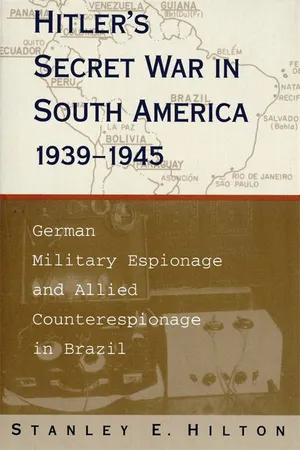
Hitler's Secret War In South America, 1939–1945
German Military Espionage and Allied Counterespionage in Brazil
- 384 pages
- English
- ePUB (mobile friendly)
- Available on iOS & Android
eBook - ePub
Hitler's Secret War In South America, 1939–1945
German Military Espionage and Allied Counterespionage in Brazil
About this book
Information
Subtopic
World War IIIndex
History1 Target: Brazil
“AMID THE TORRENT of violent events, one anxiety reigned supreme,” wrote Winston Churchill, reflecting on the grim years 1940–41. What was this “mortal danger” that “gnawed” at the indomitable British leader during those somber times? What was the only thing, including the RAF’s desperate battle against the Luftwaffe in the skies over Great Britain, that “ever really frightened” Churchill during the war? That “awe-striking problem” that claimed his thoughts “day and night” was the German submarine threat to shipping to the British Isles. “Battles might be won or lost, enterprises might succeed or miscarry, territories might be gained or quitted,” he recalled, “but dominating all our power to carry on the war, or even keep ourselves alive, lay our mastery of the ocean routes and the free approach and entry to our ports.”1
British dependency upon the Empire and the Western Hemisphere for vital raw materials, foodstuffs, and equipment was indeed the weak link in Great Britain’s military posture; and Churchill’s enemies were well aware of that fact. Grossadmiral Erich Raeder, head of the Kriegsmarine until 1943, impressed upon Adolf Hitler during the winter of 1938–39 that, short of building a fleet comparable in strength to the Royal Navy, the Reich should emphasize the construction of submarines and medium battleships with the aim of hammering away at British commerce, “the very life-blood of the island kingdom.” When a badly outnumbered Kriegsmarine found itself unwillingly and prematurely at war in 1939 with the world’s greatest maritime power, there was no doubt among German naval planners about the immediate task: “Seaborne imports were England’s one vulnerable spot, and that was where we had to strike,” Raeder recalled. Admiral Karl Dönitz, then chief of the U-boat arm and future commander-in-chief of the German navy, vigorously argued the point in ensuing months. Germany’s best hope of defeating England lay not in Operation Sea Lion—Hitler’s chimerical plan for the invasion and occupation of Great Britain—but in disrupting Britain’s maritime communications. “On them directly depended the very life of the British nation,” he ceaselessly pointed out. “On them, immediately, depended Britain’s whole conduct of the war, … and if they were really threatened British policy would be bound to react.”2
The damage inflicted on Allied shipping by U-boats and surface raiders was severe. From the outbreak of war until March, 1940, when Dönitz was ordered to withdraw his units from the Atlantic and focus on preparations for the imminent Norwegian campaign, the Kriegsmarine sank 199 ships representing over 700,000 tons. During the last eight months of the year, nearly 750 additional Allied and neutral ships were destroyed with a loss of almost 3.1 million tons. “North Atlantic transport remains the prime anxiety,” a distraught Churchill wrote to Franklin Roosevelt in December, 1940. The extraordinary feature of the German maritime onslaught was that it was conducted by a surprisingly small number of submarines. Indeed, Dönitz never had at his disposal sufficient units for the maximum exploitation of his effective fighting arm. Total U-boat strength in September, 1940, was only thirty-nine vessels, exactly what it had been a year earlier at the onset of hostilities, but the actual number of units available for operations against the British had declined since more submarines had been diverted to training purposes. And over the next half year that number dropped still further, reaching only twenty-two. New submarines had been delivered at the rate of only two a month during the first six months of 1940, and during the second semester it was still a meager six boats a month—a far cry from the figure of twenty-nine envisaged in the naval construction plan defined at the beginning of the war. Furthermore, only one-third of the number of submarines available could actually be engaged in operations against the enemy at one time, since typically one-third of the force was in port and the remainder was on the way to the attack areas.3
Given the strategic importance of the Battle of the Atlantic and the relative lack of submarines, it was vital to German naval planners to have the best possible intelligence on ship movements to the British Isles. As Dönitz explained, the major impediment to effective deployment of the U-boats was simply not being able to find enemy convoys. The admiral, in fact, resisted pressure from his advisers to despatch units to the South Atlantic in 1940 largely because tracking the convoys there was so difficult.4 The ultimate success or failure in the sea contest, therefore, might depend on the quality and quantity of information that could be obtained about ships servicing the enemy.
The man responsible for German military intelligence during the greater part of the Nazi period was the enigmatic Admiral Wilhelm Canaris, said to have been the lover of the famed Mata Hari during World War I. In January, 1935, when he became chief of the Abwehr, Canaris was forty-eight years old. An ardent nationalist and combative anti-Communist, but not a Nazi, the diminutive Canaris—he was only five feet four inches tall—had traveled extensively, was familiar with both South America and the Iberian Peninsula, could speak Spanish, English, and French well and handled three other languages, including Portuguese. His appointment to his new post supposedly was kept so secret that the British Admiralty, after having accompanied his career closely since the first war, lost track of him until the beginning of the European conflict in 1939. That does not seem quite accurate, however, since his involvement in classified work was known in diplomatic circles in Berlin at least as early as 1936, although the exact nature of his work may have remained hazy. The Brazilian ambassador at that time had him supervising the Gestapo!5
Canaris’ work of building up his organization was hampered considerably by the intense rivalry and jealousy of the Nazi party security apparatus—the Reichssicherheitshauptamt (RSHA), headed by Reinhard Heydrich, who in turn was subordinate to Heinrich Himmler. It was the Sicherheitsdienst (SD) or Security Service of the RSHA that dealt with intelligence matters, and it was AMT VI of the SD that conducted espionage operations in foreign countries, primarily in Europe. Heydrich and Heinrich Müller of the dreaded Gestapo (AMT IV of the RSHA) were fierce competitors with Canaris for authority and control in the fields of espionage and counterespionage, and much of the admiral’s time in his new post was taken up by efforts to prevent interdepartmental jurisdictional conflict from impeding operations. Some peace was finally secured at the end of 1936 through a modus vivendi—called the Zehn Gebote (Ten Commandments) in German intelligence circles—between the Abwehr and the SD that gave the Abwehr exclusive responsibility for military intelligence.6
One of the striking characteristics of the military intelligence process under Canaris was its essentially unglamorous, bureaucratic nature. As a leading student of the subject has noted, “the Abwehr was, in fact, a plodding, utilitarian and rather mild-mannered organization whose plots and stratagems seemed—and often were—naive and diffident.” The difference between Canaris and the Abwehr on the one hand, and Walter Schellenberg and the Foreign Intelligence Section of the SD on the other, was suggested by the physical environments in which the two men liked to work. A slight man of dignified bearing, Canaris insisted on a sparsely furnished office: a large map covered one wall, the other held a painting of the devil and a photograph of the admiral’s favorite dog, while on a cluttered desk sat the famous statue of the three monkeys who neither hear, see, nor speak evil. Schellenberg, who headed AMT VI of the SD from 1941 to 1944, was a man who relished intrigue and power, and who epitomized Nazi suspicion and cunning. His office, an ingenious trap for the unsuspecting or foolhardy, reflected his personality: “Microphones were hidden everywhere, in the walls, under the desk, even in one of the lamps, so that every conversation and every sound was automatically recorded,” Schellenberg later commented. “My desk was a small fortress. Two automatic guns were built into it which could spray the whole room with bullets. These guns were pointed at the visitor.… All I had to do in an emergency was to press a button and both guns would fire simultaneously.” Whereas Schellenberg thrived on dreams of the grand coup and bold adventure—as head of counterespionage for the Gestapo he took personal part in the famous Venlo Incident (i.e., the kidnapping of two British agents in Holland) early in the war—Canaris’ approach to intelligence was bureaucratic, and the work of the Abwehr seemed to bear his personal stamp. “It is indeed not an exaggeration to say that the Abwehr was Canaris and Canaris was the Abwehr,” wrote one of his subordinates,7
The job of revitalizing the Abwehr, which included internal reorganization and the establishment of a far-flung chain of espionage cells abroad, was one that Canaris turned to with intensity and perseverance. Under him, the Abwehr came to consist of three main operational sections responsible for espionage, counterespionage, and sabotage. Section I (Abwehrabteilung I), headed by Colonel Hans Piekenbrock, a close friend of the admiral, was in charge of intelligence operations in foreign countries. It was comprised of three subsections, I-H, I-M, and I-L, which derived their initials from the German words for army (Heer), navy (Marine), and air force (Luftwaffe), and five groups. Three of the groups were responsible for the gathering and collation of information; one (I-G) handled the development of secret techniques of transmitting information and the fabrication of documents that the Vertrauensmann (secret agent or V-Mann) needed to complete his mission abroad; and the fifth group (I-1) dealt with radio communications.8
Canaris’ headquarters were in Berlin, adjacent to the navy building on the Tirputzufer, but the Abwehr also had branches, so-called Abwehrstellen (Asts), in the twenty-one military districts of Germany. Typically, an Ast was located in the district army headquarters. The larger and more important Asts, such as Hamburg—which was responsible for intelligence operations against the British Isles and the Western Hemisphere—had subposts in nearby cities. In Hamburg’s case, there was such a Nebenstelle at Bremen and at Flensburg. The organizational structure of the Asts and subposts was the same as that of Abwehr headquarters. By the time the war broke out in Europe, Canaris reportedly commanded an organization of over ten thousand permanent employees, in addition to hundreds, if not thousands, of agents and informants in other countries.9
The function of Abwehrabteilung I was simple: to collect information that might be of military value to the Third Reich. To execute that task, agents on the ground were vital. “Without them we are reduced to collecting bits and pieces, looking through the press, and waiting at our desks for intelligence to be handed to us on a silver platter,” said Canaris. The admiral and his staff therefore launched a vigorous recruiting campaign long before the war began, concentrating primarily on those European countries likely to be adversaries of Germany in case of conflict, but later on probable neutrals in Europe and in North and South America as well. A consistent effort was made to tap loyal Germans who were engaged in business and commerce in foreign countries, since such individuals tended to have the knowledge, contacts, and sources of information necessary for the establishment of an effective local intelligence network. The “best and most reliable” agents came from business circles, Nikolaus Ritter, a department head at Hamburg, recalled. And great emphasis was placed on numbers. As a V-Mann sent to Brazil later testified, “German officials hold the belief that it is better to send out many agents with some training for espionage work than to send out a few agents who have been highly trained. The German system,” he explained, “operates on the idea that it is better to receive larger amounts of information, part of which will be inaccurate, than to have so few agents that the volume of information they send is inadequate.” The Abwehr counted on losses, he added, “but they intend to send so many it is impossible to capture them all.”10
Agents in the field clearly needed secure methods of communication with Germany, and Abwehr technicians, with the assistance of other experts, came up with three means of long-distance communication. One was the time-honored use of secret inks for written reports; Abwehr agents used three different kinds of secret inks, the most common made by dissolving a headache tablet called pyramidon in alcohol. An ingenious technical breakthrough—“the enemy’s masterpiece of espionage,” J. Edgar Hoover called it—was the development of the famous Mikropunkt (microdot) by the Institute of Technology in Dresden. With the proper equipment, the Germans could photograph a sheet of paper and reduce it to the size of a postage stamp, and then, using a special microscope, photograph it again and reduce it to the minute size of the dot of a typed letter i. This microdot could then be hidden in a letter or other document or simply placed on the outside of an envelope.11
The heart of the Abwehr information system, however, was wireless radio communication. Canaris wanted a global network of clandestine radio stations that could rapidly convey information to Abwehr stations in Germany and, subsequently, in Occupied Europe. The brains behind the Abwehr’s radio communications with the Western Hemisphere was Major (later Colonel) Werner Trautmann, who set up his center in a Renaissance-style house in an undeveloped suburb of Hamburg in 1939. The receiving section of the center, consisting of some forty-three sets, was installed on the second floor of the house, while the Abwehr transmitters were set up a kilometer away in an open area, each set operated by remote control from the receiving station. With assistance from the electronics firm Telefunken, the Abwehr developed a special transceiver, the Agenten-Funk (agent radio or Afu for short). The set weighed only about thirteen kilos and could easily be carried in a small suitcase, making it ideal for the agent who had to avoid attention. This Afu, or Klamotten (junk) in Abwehr slang, would become the chief weapon of many Abwehr operatives in the New World. Consequently, as one of Canaris’ assistants recalled, “in the schools for agents as much emphasis was laid on wireless training as on training in the principal tasks of the acquisition of military information.”12
Abwehr planners understandably focused primarily on Germany’s probable European adversaries, but the Western Hemisphere also received early attention from Canaris and his staff. The lesson of American intervention in World War I had not been forgotten, and they knew that in case of conflict with Great Britain the Western Hemisphere would be a key source of vital supplies for the enemy. It was no accident that the Hamburg branch of the Abwehr was considered one of the key cogs in the German intelligence wheel; and although the major non-European target of the military intelligence agency was the United States, neighboring Latin America—and particularly Brazil—also became important theaters of clandestine activity.
From a political standpoint, Berlin regarded Brazil as a basically friendly country. President-dictator Getúlio Vargas, a short, cigar-smoking politician from Rio Grande do Sul who had come to power by armed revolt in 1930, had proven himself to be a shrewd, calculating leader whose appraisal of national and international realities was devoid of emotion. An enlightened conservative, Vargas had survived a civil war in 1932 and a Communist-led revolt in 1935 and was famous for his statement: “I never had a friend that couldn’t become an enemy or an enemy that couldn’t become a friend.” Maintenance of intimate relations with the United States had become an axiom of Brazilian foreign policy, but Vargas demonstrated considerable independence in foreign affairs. The sympathies of his anti-Communist government were openly on the side of Italy during the Ethiopian adventure, and Rio de Janeiro clearly favored Franco in the Spanish civil conflict. Toward the Third Reich itself, Vargas demonstrated systematic cordiality and eagerness to expand commercial relations. Brazil became the Reich’s leading trade partner in South America after 1934; in 1937 and 1938 the Brazilian government signed important armaments contracts with Krupp, and the Brazilian security police established liaison with the Gestapo for the purpose of coordinating anti-Communist measures. Late in 1937, after Vargas and the army high command closed congress, jettisoned the liberal constitution of 1934, and set up a military dictatorship known as the Estado Novo, Berlin even played briefly with the idea of getting Rio de Janeiro to sign the Anti-Comintern Pact.13
Vargas and the army high command, on the other hand, made clear their intention to brook no interference in Brazil’s domestic affairs by launching a vigorous campaign in 1938 against the activities of Nazi party agents and against the cultural isolation of the German community in southern Brazil. But although this led to friction between Vargas’ friend, Oswaldo Aranha, a tall, handsome, and popular ambassador to Washington (1934–37) who became foreign minister that year, and the German embassy, then headed by Karl Ritter, culminating in a mutual removal of ambassadors by the two governments in October, the only group on either side that wanted to push the issue was the Foreign Department (Auslandsor-ganisation) of the Nazi party. Diplomatic, economic, and military agencies in Germany were willing to cede ground on an issue that paled in significance compared to that of protecting valuable economic ties; and in Rio de Janeiro there was little inclination to press a dispute with an important trade partner that apparently was destined to become even more powerful, as long as that country respected Brazilian sovereignty. The result was that on the eve of the outbreak of war in Europe, a full diplomatic reconciliation between the two countries was effected. On September 1, 1939, Cyro Freitas-Valle, Aranha’s cousin who, as acting foreign minister earlier in the year, had done much to still the diplomatic waters, presented his credentials to Adolf Hitler as Brazil’s new envoy. Soon thereafter, Dr. Kurt Prüfer, a fifty-eight-year-old career diplomat, sailed for Brazil to take charge of the German embassy.14
Over the next two years, the period of hemispheric neutrality, intense rivalry between the Reich and the United States created a classic opportunity for a Machiavellian leader such as Vargas. Washington’s interest in Brazil was keen, since American military planners had agreed months before the onset of hostilities in Europe that northeastern Brazil should be included in the defense sphere of the United States and that the establishment of bases in that region was therefore vital to American security. The strategic raw materials that Brazil possessed in abundance contributed to the priority that it received in Washington’s hemispheric policy, which also had as a goal the prevention of possible disruptive action by the large Germanic community in Brazil. The Franklin Roosevelt government, consequently, made a concerted effort to enlist Vargas’ goodwill and cooperation. It promised military aid; agreed in the late summer of 1940 to finance a national steel plant for Brazil at Volta Redonda; set up preferential purchasing programs for Brazilian products; negotiated a price-support agreement for coffee; opened secret negotiations for the use of bases in the Northeast; repeatedly invited Vargas to Washington for a goodwill ...
Table of contents
- Cover
- Title Page
- Copyright Page
- Dedication
- Contents
- List of Illustrations
- Introduction to the American Edition
- 1 Target: Brazil
- 2 “Alfredo” and the “Bolívar” Network
- 3 The Bolívar Tangents
- 4 “King” and the Message Center Brazil
- 5 Swastika and Sigma
- 6 The Hungarian Connection
- 7 The São Paulo Listening Post
- 8 The Starziczny Case
- 9 Pearl Harbor and Its Consequences
- 10 The Allied Counterattack
- 11 The Collapse
- 12 “Captain Garcia” and the Greenshirts
- 13 The Buenos Aires-São Paulo-Toronto Circuit
- 14 The Abwehr’s Last Salvo in Brazil
- List of Abbreviations
- Notes
- Bibliography
- Index
Trusted by 375,005 students
Access to over 1.5 million titles for a fair monthly price.
Study more efficiently using our study tools.
Frequently asked questions
Yes, you can cancel anytime from the Subscription tab in your account settings on the Perlego website. Your subscription will stay active until the end of your current billing period. Learn how to cancel your subscription
No, books cannot be downloaded as external files, such as PDFs, for use outside of Perlego. However, you can download books within the Perlego app for offline reading on mobile or tablet. Learn how to download books offline
Perlego offers two plans: Essential and Complete
- Essential is ideal for learners and professionals who enjoy exploring a wide range of subjects. Access the Essential Library with 800,000+ trusted titles and best-sellers across business, personal growth, and the humanities. Includes unlimited reading time and Standard Read Aloud voice.
- Complete: Perfect for advanced learners and researchers needing full, unrestricted access. Unlock 1.5M+ books across hundreds of subjects, including academic and specialized titles. The Complete Plan also includes advanced features like Premium Read Aloud and Research Assistant.
We are an online textbook subscription service, where you can get access to an entire online library for less than the price of a single book per month. With over 1.5 million books across 990+ topics, we’ve got you covered! Learn about our mission
Look out for the read-aloud symbol on your next book to see if you can listen to it. The read-aloud tool reads text aloud for you, highlighting the text as it is being read. You can pause it, speed it up and slow it down. Learn more about Read Aloud
Yes! You can use the Perlego app on both iOS and Android devices to read anytime, anywhere — even offline. Perfect for commutes or when you’re on the go.
Please note we cannot support devices running on iOS 13 and Android 7 or earlier. Learn more about using the app
Please note we cannot support devices running on iOS 13 and Android 7 or earlier. Learn more about using the app
Yes, you can access Hitler's Secret War In South America, 1939–1945 by Stanley E. Hilton in PDF and/or ePUB format, as well as other popular books in History & World War II. We have over 1.5 million books available in our catalogue for you to explore.