During the Civil War, traditional history tells us, Afro-Christianity proved a strong force for slaves' perseverance and hope of deliverance. In Slavery, Civil War, and Salvation, however, Daniel Fountain raises the possibility that Afro-Christianity played a less significant role within the antebellum slave community than most scholars currently assert. Bolstering his argument with a quantitative survey of religious behavior and WPA slave narratives, Fountain presents a new timeline for the African American conversion experience.
Both the survey and the narratives reveal that fewer than 40 percent of individuals who gave a datable conversion experience had become Christians prior to acquiring freedom. Fountain pairs the survey results with an in-depth examination of the obstacles within the slaves' religious landscape that made conversion more difficult if not altogether unlikely, including infrequent access to religious instruction, the inconsistent Christian message offered to slaves, and the slaves' evolving religious identity. Furthermore, he provides other possible explanations for beliefs that on the surface resembled Christianity but in fact adhered to traditional African religions.
Fountain maintains that only after emancipation and the fulfillment of the predicted Christian deliverance did African Americans more consistently turn to Christianity. Freedom, Fountain contends, brought most former slaves into the Christian faith. Provocative and enlightening, Slavery, Civil War, and Salvation redefines the role of Christianity within the slave community.
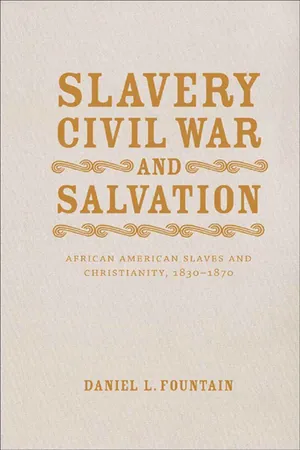
eBook - ePub
Slavery, Civil War, and Salvation
African American Slaves and Christianity, 1830-1870
- 176 pages
- English
- ePUB (mobile friendly)
- Available on iOS & Android
eBook - ePub
Slavery, Civil War, and Salvation
African American Slaves and Christianity, 1830-1870
About this book
Information
1
AFRO-CHRISTIANITY BY THE NUMBERS
The Negroes sobbed and shouted and swayed backward and forward, some with aprons to their eyes, most of them clapping their hands and responding in shrill tones: “Yes God!” “Jesus!” “Savior!” “Bless de Lord, amen,” etc.
—MARY BOYKIN CHESNUT, A Diary from Dixie
At times I would go to hear preaching among the slaves, not to be converted however, but mainly to hear the moaning and hear the preacher quote the Scriptures. Often, while at work, I tried to go through the motions and intonations of the preacher. I was pretty good at heart but considered a devil by those around me.
—UNIDENTIFIED FREEDMAN IN RAWICK, American Slave
Mary Chesnut’s description of a nineteenth-century African American worship service is a familiar image for students of antebellum slave religion. Indeed, the works of scholars such as Albert J. Raboteau and Mechal Sobel effectively use such images to paint vivid portraits of what transpired during Christian slaves’ public and private worship. However, despite the considerable progress that historians have made in describing how Christian slaves worshiped, there is a tendency to apply evidence pertaining to a few slave Christians to the general population of slaves. For instance, both Sobel’s Trabelin’ On: The Slave Journey to an Afro-Baptist Faith and Raboteau’s Slave Religion: The “Invisible Institution” in the Antebellum South treat Christianity as the single most important belief system of mid-nineteenth-century African American slaves. Yet Sobel’s own study identifies only 14.3 percent (634,000 of 4,441,830) of antebellum African Americans, north and south, as members of Baptist and Methodist churches. These two religious groups easily claimed the lion’s share of the United States’ black communicants. Certainly nineteenth-century standards for church membership, which were more stringent than those of later periods, limited the number of slave Christians who were actual church members. Nevertheless, the fact that so very few were members suggests that the claim that Christianity dominated the slaves’ worldview rests on shaky statistical ground at best, even when significant undercounting is taken into consideration.1
Recently, this discrepancy between statistical evidence and interpretive emphasis has drawn the attention of religion and slavery historians. In the introductory essay of the Encyclopedia of African-American Religions, Larry G. Murphy argues that a complete religious history of African Americans has not been written yet, specifically because the current historiography overwhelmingly focuses on Christianity. Michael A. Gomez and Sylviane A. Diouf both agree with Murphy by pointing out that Islam is a much-neglected aspect of the early African American religious experience. Similarly, John C. Willis reminds historians that nonreligious belief systems are also worthy of study. In “From the Dictates of Pride to the Paths of Righteousness: Slave Honor and Christianity in Antebellum Virginia,” Willis suggests that honor often surpassed Christianity as a slave belief system. Finally, Peter Kolchin sums up such criticism of the current historiography of slave religion in his well-received synthesis, American Slavery, 1619–1877. Kolchin writes that “historians have recently been so impressed by the force of slave religion that they may well have exaggerated its universality and slighted some of its contradictory implications.”2
Since antebellum church records do not even begin to support the conclusion that a majority of the slaves converted to Christianity, the current emphasis on this segment of the slave population needs examining. In defense of earlier scholarship, several reasons exist as to why historians might generalize about most slaves converting to Christianity during the antebellum period. The foremost reason is that nineteenth-century sources often suggest such a transformation. For instance, nineteenth-century traveler Thomas Nichols wrote that “[t]he Southern people are eminently religious, and their negroes follow their example.” Frederick Law Olmsted, a noted skeptic of the depth and breadth of Christian beliefs within the slave community, went so far as to describe slave participation in and enthusiasm for religious services as “striking and general characteristics.” Former Tennessee slave James Thomas even boldly asserted that when traveling among the African Americans of antebellum St. Louis “you won’t find an Atheist.”3
Another explanation for generalizations about Afro-Christianity is that slave and integrated worship services were probably, next to work, the most visible public behavior exhibited by members of the slave population. Therefore, Christian worship services were some of the most documented accounts of individual and collective slave behavior of the antebellum period. Furthermore, given the dramatic differences between many slaves’ and their observers’ worship styles, these occasions most likely represent the most memorable public slave behavior for those recording their experiences in the Old South. In addition, many antebellum slave narratives were a means to further the abolitionist cause. Authors and publishers sought to conjure feelings of sympathy as well as empathy for the slaves in the hearts and minds of their readers. An example of such an appeal appears in the narrative of Thomas Jones, where the author exclaims, “Oh that all true Christians knew just how the slave feels in view of the religion of this country, by whose sanction men and women are bound, branded, bought and sold!”4 In writing such lines authors sought to connect their subject and audience via the concept of Christian suffering and thereby draw the reader into their cause. Accordingly, few witnesses, especially those seeking publication for their recollections, could pass up the opportunity to describe their memories of slaves at worship.
Despite these explanations, this chapter’s epigraph from an unidentified freedman provides ample evidence for skepticism of such a broad assessment of slave Christianity. The freedman indicates having participated in Christian services and even publicly imitating preachers while he was a slave, yet he did so at the time without a sincere interest in being converted. Furthermore, the former slave admits that Christian slaves considered him “a devil.” The speaker’s claim that nonbelievers attended slave worship services is reinforced by former slaves Louis Hughes and Thomas Johnson. Hughes recalled that slave prayer meetings “were the joy and comfort of the slaves, and even those who did not profess Christianity were calm and thoughtful while in attendance.” As a child, Johnson remembered that “the slaves would sing many religious songs … [a]nd I often joined in the singing.” It would only be later at the age of sixteen that Johnson “resolved to seek religion.”5 These statements demonstrate that there could be a great disparity between an individual’s public participation in worship and his or her acceptance of Christianity. After all, if all slaves in attendance were Christians then who was getting converted or “finding religion” at these meetings? The statements also reveal that Christian slaves distinguished between those whom they considered true believers and mere pretenders. Given the social tensions that demanded extreme discretion between the closest of white and black confidants in the antebellum South, it is not surprising that even the most astute observers of slavery were unaware of the disparity between a slave’s public participation in worship services and his or her private belief.
Nonetheless, this does not mean that the division between Christian and non-Christian slaves went undetected. In fact, the identification of Christian and non-Christian elements within the slave community appears in numerous antebellum sources. Frances Kemble hints at such a division when describing the events of an evening walk on the Butler plantation of Georgia. “I went out into the clear starlight to breathe the delicious mildness of the air, and was surprised to hear, rising from one of the houses of the settlement, a hymn sung apparently by a number of voices. The next morning I inquired the meaning of this and was informed that those Negroes on the plantation who were members of the Church were holding a prayer meeting.”6
Caroline Seabury, a teacher on a Mississippi cotton plantation, reported to her diary that during a festive plantation barbecue she also heard hymns emerging from one of the slave cabins. Upon her further investigation and inquiry, Seabury was informed that the “Christians was havin’ meetin’.” Allen Parker recalled a similar dichotomy by pointing out that “while the young people were dancing, the old ones would be holding a prayer ‘meetin’.” Reverend W. H. Robinson described Saturday nights as the time when “the slaves would slip off to church and frolics.” Former slave Henry Bibb, in describing Sundays among the slaves, stated that “[t]hose who make no profession of religion, resort to the woods in large numbers on that day to gamble, fight, get drunk, and break the Sabbath.” Elizabeth, a former Maryland slave, similarly complained to a slave patrol that while they were breaking up her prayer meeting, “the ungodly are dancing and fiddling till midnight.” Elizabeth may have been complaining about the likes of future Bishop M. F. Jamison, who admitted that before his conversion “instead of my enlisting with the Christians, under the leadership of Uncle Chris and O. C. Ola, I followed Eli, the leader of the dances.”7
Peter Randolph revealed the division between Christian and non-Christian slaves when he described slave funerals. According to Randolph, “If the slave who died was a Christian, the rest of the Christians among them feel very glad, and thank God that brother Charles, or brother Ned, or sister Betsey, is at last free, and gone home to heaven,—where bondage is never known.” As with Henry Bibb, Randolph also noted that on Sundays “that portion of them belonging to the church ask of the overseer permission to attend meeting.… Others of the slaves, who do not belong to the church, spend their Sabbath in playing with marbles, and other games, for each other’s food, &c. Some occupy the time in dancing to the music of a banjo, made out of a large gourd.” Fugitive slave John Thompson found the ability to differentiate between Christians and non-Christians useful in his flight to freedom. Upon reaching Washington, DC, he recognized a man “with whom I was acquainted, we having been raised on the same farm.” He entrusted the man with his plans for escape and was rewarded with information regarding a safe house. Thompson did so because “I knew this man was a Christian, and therefore that it was safe to trust him, which is not true of all, since there are as many treacherous colored, as white men.”8
The split between Christians and the “ungodly” was even perceptible among families and larger affiliated groups. Friday Jones described his father as a “desperate wicked man” and noted further that his father’s “associates were all wicked.” Mary McCray “was the only one in the family who was a Christian,” and because her father “was a very wicked man, and her mother was a wicked woman,” she spent most of her days “among the old Christians.” James Smith recalled that his father lamented on his deathbed that in regard to his children “not one of us professed religion.” During the Civil War, Reverend Elijah Marrs found resisting temptation “an up-hill business” because “[i]n the company I belonged to there were only two professed Christians beside myself.” Marrs reported that he was not alone in this difficulty, as fellow Christian and African American soldier Swift Johnson complained that “in his company he was the only man who would own Christ.” Finally, another former slave, James Williams, attempted to quantify the religious division of a newly arrived group of Alabama slaves when he wrote that “[o]ut of the two hundred and fourteen slaves who were brought out from Virginia, at least a third of them were members of the Methodist and Baptist churches in that State.”9
Based on the preceding evidence, it is clear that slaves made a definite distinction between those who were Christians and those who were not. In light of the importance that historians assign to the role of Christianity within the slave community, it is equally important to have some understanding of how many slaves were believers. In addition to James Williams’s early effort to quantify the number of slave Christians on a given plantation, there is further evidence concerning the approximate proportion and demographic characteristics of Christians and non-Christians within the South’s antebellum slave population. The primary means of analysis of this evidence employed here is a quantitative survey of religious data from the Works Progress Administration (WPA) slave narratives and post-1830 slave autobiographies and interviews for all southern slave states with the exception of Delaware.10 The following questions and categories constituted the survey of these sources.
1. Was the slave/freedperson a Christian while enslaved?
2. If he or she was a Christian during slavery, what was the age at conversion?
3. Did he or she become a Christian following emancipation/attaining freedom?
4. Age at postbellum conversion
5. Sex of slave convert
6. State of birth
7. State of residence when converted (if Christian)
8. Urban or rural slave
9. Occupation (field, house, skilled, other)
10. Did the master(s) allow or prohibit slave worship?
11. Did the master(s) provide access to worship (plantation chapel, etc.)?
12. Did the slave attend independent slave services in the quarters or brush arbors?
Each of these questions provided a measurement of key aspects of the slave religious experience. Questions 1 and 4 produced evidence of whether most slave conversions to Christianity occurred before or after emancipation/freedom and thereby, along with questions 10 and 11, yielded some measure of the effectiveness of the master class’s espoused effort to evangelize the slaves. Question 12 quantified the degree of the slaves’ independent Christian activities and helped to suggest the extent of the slaves’ satisfaction with the form of Christianity whites offered them as well as the degree of slave participation in secret religious proceedings. Questions 2 and 5 helped determine whether a person’s age or sex influenced the likelihood of conversion. Questions 6 and 7 measured whether certain regions had unique religious characteristics, such as greater rates of conversion. Finally, questions 8 and 9 revealed whether the work environment of the slave had any special influence on an individual’s likelihood to convert.
The information compiled from this survey appears below. Brief explanatory notes or general observations on important findings accompany the data from each question or interrelated group of questions. Explanations for the calculations appear within the notes. At the end of this chapter appear ten tables that accompany text for survey data including multiple categories or detailed comparisons. A synthesis of the findings and a possible interpretation of their meaning follow the completed overviews of the individual data sets.
SURVEY CRITERIA
This survey of slave religious experiences represents an analysis of over four thousand slave narratives, autobiographies, and interviews from 1830 to the mid-twentieth century. These sources, particularly the WPA narratives, are the most significant collection of materials existing for the study of antebellum slave life and, according to Mechal Sobel, are “the richest sources for the social history of Black Christians.”11 The same sources have been used extensively by Albert J. Raboteau, Mechal Sobel, Charles W. Joyner, Eugene D. Genovese, John B. Boles, and Lawrence W. Levine, to n...
Table of contents
- Cover Page
- Title Page
- Copyright Page
- Dedication
- Contents
- Preface
- Introduction
- 1 Afro-Christianity by the Numbers
- 2 Christ in Chains
- 3 Alternatives to Christianity within the Antebellum Slave Community
- 4 Christ Unchained
- Conclusion
- Notes
- Selected Bibliography
- Index
Trusted by 375,005 students
Access to over 1.5 million titles for a fair monthly price.
Study more efficiently using our study tools.
Frequently asked questions
Yes, you can cancel anytime from the Subscription tab in your account settings on the Perlego website. Your subscription will stay active until the end of your current billing period. Learn how to cancel your subscription
No, books cannot be downloaded as external files, such as PDFs, for use outside of Perlego. However, you can download books within the Perlego app for offline reading on mobile or tablet. Learn how to download books offline
Perlego offers two plans: Essential and Complete
- Essential is ideal for learners and professionals who enjoy exploring a wide range of subjects. Access the Essential Library with 800,000+ trusted titles and best-sellers across business, personal growth, and the humanities. Includes unlimited reading time and Standard Read Aloud voice.
- Complete: Perfect for advanced learners and researchers needing full, unrestricted access. Unlock 1.5M+ books across hundreds of subjects, including academic and specialized titles. The Complete Plan also includes advanced features like Premium Read Aloud and Research Assistant.
We are an online textbook subscription service, where you can get access to an entire online library for less than the price of a single book per month. With over 1.5 million books across 990+ topics, we’ve got you covered! Learn about our mission
Look out for the read-aloud symbol on your next book to see if you can listen to it. The read-aloud tool reads text aloud for you, highlighting the text as it is being read. You can pause it, speed it up and slow it down. Learn more about Read Aloud
Yes! You can use the Perlego app on both iOS and Android devices to read anytime, anywhere — even offline. Perfect for commutes or when you’re on the go.
Please note we cannot support devices running on iOS 13 and Android 7 or earlier. Learn more about using the app
Please note we cannot support devices running on iOS 13 and Android 7 or earlier. Learn more about using the app
Yes, you can access Slavery, Civil War, and Salvation by Daniel L. Fountain in PDF and/or ePUB format, as well as other popular books in Social Sciences & North American History. We have over 1.5 million books available in our catalogue for you to explore.