The children of Philip III of Spain (1578--1621) and Margarita de Austria (1584--1611) inherited great potential power: the abilities to declare war or make peace, to advocate religious doctrine, and to exert lasting influence over art, culture, and taste. The leadership provided by this generation raises the question of how royal families learned the roles they played in court, country, and on the international stage. In Raised to Rule, Hoffman presents a deeply researched and stimulating study of the formative experiences of children in the royal households of early modern Spain.
Five of the eight children born to the royal couple survived to adulthood: the future king Philip IV; the future queen regent of France, Anne of Austria; the Cardinal-Infante Fernando, who rose to international fame as a general during the Thirty Years' War; the future Empress María, briefly known as the princess of England during Charles Stuart's 1623 pursuit of a "Spanish match"; and the Infante Carlos, the constant companion of Philip IV and his heir-presumptive for nearly a decade, who was named governor of Portugal but died before he could serve. Hoffman elucidates the formal instruction and informal training that prepared these individuals to shape the history of their country and influence all of Europe.
For the heirs of Philip and Margarita, developmental experiences took place within the social structures and patronage systems of the royal court -- a place that proved to be influential and precarious, where public and private relationships overlapped and political metaphors of family relationships reflected the reality of public service based on personal ties. Drawing on a wide variety of sources, including palace rulebooks, chronicles, household accounts, a journal of the royal chapel, diplomatic and personal correspondence, published and unpublished advice to kings, and treatises on the education of princes, Hoffman illustrates the formation of the leadership of Spain and early modern perceptions of the proper education and function of royalty.
Hoffman's Raised to Rule provides an insightful account of the education of the Spanish Habsburgs from 1601 to 1634. Her work fills a significant historiographical gap and offers new revelations into a previously neglected aspect of royal life.
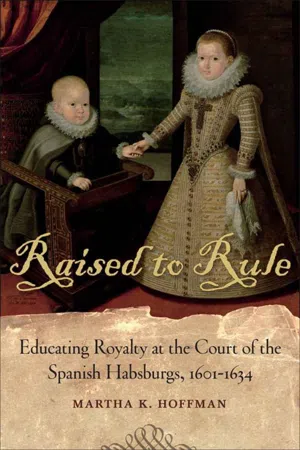
eBook - ePub
Raised to Rule
Educating Royalty at the Court of the Spanish Habsburgs, 1601–1634
- 288 pages
- English
- ePUB (mobile friendly)
- Available on iOS & Android
eBook - ePub
About this book
Information
Subtopic
Historical BiographiesIndex
History1
AT THE CENTER OF THEIR WORLD
On September 22, 1601, the first of the eight children of Philip III of Spain and Margarita de Austria was born in the Castilian city of Valladolid. Ten years later, also on September 22, their last child was born. The king and queen thus fulfilled an essential duty of early modern royalty: they provided a generation of individuals who, by their very existence, embodied the structure and stability of society. In the next few decades, Spanish observers described, idealized, and advised these children and watched them grow into adulthood with an avid concern that reflects the position of royal families at the very center of the early modern world.
Five of these children survived to adulthood. Of most interest to historians has been the eldest daughter, Ana, mother of Louis XIV and regent of France during several years of his youth. In addition to numerous evaluations contained in more general histories, recently she has received two scholarly biographies.1 The infante Fernando, who was made an archbishop at age ten but later became a general and a governor of the Netherlands, has also found a biographer, although the author completed only half of his intended project.2 A full biography of Philip IV has not emerged, although R. A. Stradling and J. H. Elliott, while not focusing on the person of the king, present considerable detail concerning his life.3 The infanta María has made cameo appearances in various accounts of the attempt of the Prince of Wales to woo a Spanish bride, while the infante Carlos has garnered even less mention in historical accounts of the court. None of these works provides significant insight into the childhoods of these individuals, the ways in which the court responded and accommodated itself to the presence of children, or the process by which they were prepared for their proper roles in the world.
Literature concerning the education of princes abounded but did not, for the most part, address the needs of children. Early modern concepts of education more generally provided that a child learn skills through imitation of a master and gradually increased participation in the activities of a workshop. Members of the royal family can be seen to have learned their craft in this manner, both through exposure to others, including their parents, who held the types of positions the children would eventually hold, and through learning about the lives and actions of earlier royal persons, both ancestors and other outstanding historical examples. Royal life was, in a sense, made up of the stories they told one another about themselves, their ancestors, the places they visited, and the buildings they built. Royal identity and ideals were conveyed through books and in person, through paintings, monuments, royal foundations, daily activities, and even the palace rulebooks, which occasionally described particular events and choices.
Maturing within contexts of family and court, the royal children interacted with relatives, members of the royal households, teachers, and confessors and other religious, all of whom played a role in shaping these future leaders. As they began to take on adult responsibilities, decisions concerning their households, marriages, military and church appointments, and instruction in government took place within domestic and international political contexts. Their careers were largely chosen for them on the basis of rank and tradition, described in terms of family and duty and illustrated for them with examples drawn both from written history and from the personal experience of their parents and guardians. Despite the general lack of choice in determining their own careers, they did not function as simple figureheads but instead actively used concepts of royalty, family, and precedent to shape their own roles within a seemingly fixed structure.
Royal Childhood
Philip III and Margarita de Austria named their eldest child Ana Mauricia, after her paternal grandmother and the saint on whose day she was born.4 Prince Philip, named for his grandfather as much as for his father, also carried the impressive secondary name Domingo Victor de la Cruz—Dominic Victor of the Cross—a name R. A. Stradling describes as “a blue-print for a life of leadership.”5 A contemporary considered the name fair game for the joke that the prince might have been named Sabado (Domingo meaning “Sunday,” and Sabado, “Saturday”) if he had been baptized a day earlier. That observer did not include de la Cruz as part of the name but instead considered Victor to have been chosen in honor of the Prince of Piedmont, Vitorio Amadeo, who served as godparent, although he also connected the name to Spain’s desire to bring England back to the Catholic Church.6
At the birth of their second daughter, in 1603, Philip and Margarita honored her maternal grandmother, and perhaps also the king’s aunt and grandmother, who died that same year, by naming the child María. This child lived only a few weeks, however, and the name was again chosen for the daughter born in 1606, with the second name Ana. The infante Carlos, born in the following year, was also conveniently named for both Philip III’s grandfather, Emperor Charles V, and the queen’s father, Karl of Styria. Fernando, the name given the next infante, was also a name common on both sides of the family, having passed from Fernando (Ferdinand) the Catholic to his grandson, Emperor Ferdinand I, and thus to the Austrian side of the family. More recently, both parents had brothers named Fernando or Ferdinand, although Philip III’s brother of that name had died the year Philip was born. If either Carlos or Fernando was given a second name, these names were so rarely used as to be virtually nonexistent.
Philip and Margarita named their youngest daughter Margarita Francisca, after her mother and, it has been speculated, after the favorite of the king, Francisco Gómez de Sandoval y Rojas, the Duke of Lerma, thus capturing in a name the resolution of a central conflict at court. The queen’s decision to give birth in the town of Lerma may also have signaled a better understanding between her and the duke.7 But if Margarita was calling a truce, that was not her only motive: the baptism of the infanta took place in the chapel of a Franciscan convent, and the queen probably thought of herself as paying tribute to Saint Francis, whom she had already honored in her religious patronage and later honored in her request to be buried in the habit of the female Franciscans. Honoring Francis in such a way would have been a fitting parallel to choosing Philip’s second name in honor of Saint Dominic. In addition, choosing the name Margarita may have expressed the queen’s intention that this daughter would carry out her own dream of becoming a nun, a probability underlined by the mother’s penchant for dressing the child in a miniature habit of a Franciscan nun.8
In naming their final child, Philip and Margarita reached deeper into Spanish history and their own inclinations in choosing a name. He was named Alfonso (or Alonso), perhaps after the great medieval lawgiver Alfonso the Wise of Castile, and his second name, Mauricio, matched his eldest sister’s, since they were born on the same saint’s day. Popularly, however, he was known primarily as Alfonso el Caro, or “the Dear,” meaning both cherished and costly, for his birth cost his mother her life. Even the most casual mention of the child was thus imbued with an air of melancholy, as if no one could look at him without being reminded of the price his mother had paid.
While their very names tied the royal children to family and Spanish history, they also began to learn their place in the world and within the structure of court through the titles used to address them. The firstborn traditionally held the title of prince or princess, which indicated his or her position as heir to the crown, with subsequent children called infanta or infante, a princess reverting to the title of infanta when a brother was born. Philip III and Margarita’s first child was a girl, and it was a sign of optimism on their part that from the beginning they called her not princess but infanta, expressing their hope that a more appropriate heir, a son, would be born.9 Checking precedents for the treatment of infantes, a report compiled by the Council of State in 1620 noted that until the year 1558 the prince had been styled ilustríssima alteza, or “most illustrious highness,” but after that year the styling sereníssima alteza, or “most serene highness,” became the standard usage. By the reign of Philip III, all Spanish royalty other than the king bore the honorific sereníssima. In recognition, therefore, that although they did not call her princess, Ana was more than an infanta, Philip III himself, in “the year[s] 1603 and 1604, since the prince our lord had not been born, styled [her] as heiress, [by calling] her Most Illustrious Infanta.”10
The titles attached to members of the royal family also signaled the condition of matters of state and their attendant personal status at court. Once Ana was engaged to the young king of France in 1612, official usage styled her “queen of France” and “Her Majesty” rather than “Her Highness”—on rare occasions adding the French honorific “most Christian”—clearly raising her status at court and preparing her for later life. Court chronicles and relaciones referred to her rooms as the queen’s rooms and her servants as the queen of France’s servants. The new title also resulted in amusing (to our ears) descriptions of events, such as that of the king of Spain giving the “most Christian queen of France” permission to put on a play.11
Years later, Philip IV’s reaction to titles proposed for his sister María during negotiations for her marriage to the king of Hungary, later Ferdinand III, suggests additional significance of granting titles. When the Council of State discussed how María would be treated after her betrothal, the king noted that when she had been engaged to the Prince of Wales “no novelty was done with my sister,”12 that is, no change had been made in the form of addressing her. Even though a marriage treaty had been signed and she was very briefly called Princess of England, the lack of change in her treatment indicated the still precarious nature of the alliance. In considering the marriage to Ferdinand, Philip looked to the Wales precedent but also apparently considered the question of María’s title a negotiating stance and felt that addressing his sister differently early in the process would deprive him of leverage.
The importance of using a proper title also emerges in the Council of State’s discussion of how Fernando should be addressed when he became cardinal and archbishop of Toledo. The king himself had asked the council to investigate precedents of usage so that he would know how to address his son properly. Although the council replied that “it would be well [that] Your Majesty not address the lord infante except as a son” and felt it sufficient that “Your Majesty treat your son as infantes of Castile are treated,” the king insisted that the council investigate how his cousin Archduke Albert had been addressed when he was cardinal of Toledo.13 Albert, it turned out, had been called “the most illustrious lord Cardinal of Toledo.” The council noted, however, that the superscript “His Highness” accorded infantes should also be used for Fernando, because he could potentially inherit the throne, while Albert could not.14 Thus it appears that treating Fernando simply as a son endowed him with greater stature than did addressing him with the full titles of cardinal and archbishop, although the honorific illustrious taught him the respect due his office in addition to that due his rank.
Titles clearly reflected the prince’s rank above his siblings. The infanta Ana may have experienced some difficulty adjusting to the precedence given to her brother in court matters. Having enjoyed the undivided attention of her mother’s servants for almost four years, she reportedly questioned her ladies and servants closely concerning where her brother had been before he was born and warned her servants not to associate with those of her brother.15 This little incident, presented with gentle humor by Luis Cabrera de Córdoba, who had written a history of Philip II and was assembling notes and descriptions of events during the reign of Philip III, provides a nice contrast to the stereotypical presentations of affectionate relationships between members of the royal family.
Recognition of the prince’s more exalted rank evidently was not an easy lesson for the infante Carlos to learn. Cabrera de Córdoba gives us a glimpse of unusual interactions between the eight-year-old prince and his six-year-old brother in 1613: “Indeed one begins to see the ill-feeling that the infante Don Carlos bears the prince, since with slight provocation, and when he finds him alone, he hits him, and the aya does not improve the situation nor reprimand him … and he cannot suffer that all do greater honor and give more preference to the prince, and other matters that are expected to improve when they increase in age.” The chronicler professed himself mystified by these events, noting, as if in explanation, that “they affirm that they have never seen [Carlos] laugh or cry,” as if a young boy would have to be abnormal to act in such a manner toward his brother.16
While in some countries the practice of educating a child by breaking his will extended to royal children,17 Philip IV gives us insight into his childhood that suggests a lack of discipline rather than an excess. Among the problems of teaching royalty, the king noted in the epilogue to his translation of Guicciardini’s history of Italy, was the impossibility of anyone’s properly disciplining a royal child. Children in general, he noted, are given to pleasure and mischief rather than studying:
These considerations hold true even more in princes and great persons, because although their parents give them learned and virtuous teachers, and order them to study with care and vigilance, if perhaps they are not inclined to the work or do not undertake lessons with pleasure, it is very difficult to instruct them, since the teachers never dare, nor are they even allowed, to use great rigor in the instruction of such persons, which is what alone works at that age to pursue clear ends. I am myself an example of what I mean.18
This lenience is reflected both in Philip IV’s description of his childhood and in the account of blows exchanged between the prince and Carlos, which their caretaker made no attempt to stop. No available evidence suggests that the Spanish royal children experienced physical punishment, although if the infanta Ana’s mothering reflected her own experience, they may have been sent to their rooms for misbehaving.19 What other households achieved with harsh discipline, the Spanish court tried to accomplish through gentleness and the repetition of example and treatises calling the royal children to duty. Raising a royal child was a delicate task, not to be achieved by violence, noted one writer in discussing the duties of the prince’s guardian. This sentiment appears to have been echoed in the practices of the royal family.20
Ceremony and Play
A royal child made his or her first public appearance at baptism. In the late summer of 1601 Philip III’s cousin Ranuccio Farnese, Prince of Parma, arrived at court for the specific purpose of serving as godfather for the expected royal child, thus demonstrating the international stature of this event; the Duchess of Lerma served as godmother. Although there may have been some disappointment that the child born the following month was not a boy, Ana’s identity as firstborn was nonetheless celebrated by having the eldest sons of several great noble houses serve as meninos at the ceremony, carrying the regalia and objects necessary for the occasion.21
The baptism ceremony and godparentage served as opportunities to bind the royal children even more closely together. In the spring of 1605, shortly after the birth of the prince, the king solicited opinions from various clergymen concerning the propriety of the not yet four-year-old infanta Ana’s serving as her brother’s godparent.22 One of the respondents, Fray Francisco de Castroverde felt, and Padre Hieronimo de Acosta concurred, that it was inappropriate for Ana to be a godparent if that meant there would be no others. Although the tone of Dr. Pedro Gonçalez de Castillo’s response was both more positive and more flattering, he gave essentially the same opinion: that while, of course, the infanta could be the godmother, there ought to be an older, male godparent as well. Both of these men quoted great authorities and referred to the decrees of the Council of Trent on the matter. A final decision, endorsed by the three aforementioned and five additional clergy, simply cited the need for a second godparent of competent age.
The designation of Ana as ...
Table of contents
- Cover Page
- Title Page
- Copyright Page
- Contents
- Acknowledgments
- 1. At the Center of Their World
- Part One. Childhood
- Part Two. Transitions to Adulthood
- Notes
- Bibliography
- Index
Trusted by 375,005 students
Access to over 1.5 million titles for a fair monthly price.
Study more efficiently using our study tools.
Frequently asked questions
Yes, you can cancel anytime from the Subscription tab in your account settings on the Perlego website. Your subscription will stay active until the end of your current billing period. Learn how to cancel your subscription
No, books cannot be downloaded as external files, such as PDFs, for use outside of Perlego. However, you can download books within the Perlego app for offline reading on mobile or tablet. Learn how to download books offline
Perlego offers two plans: Essential and Complete
- Essential is ideal for learners and professionals who enjoy exploring a wide range of subjects. Access the Essential Library with 800,000+ trusted titles and best-sellers across business, personal growth, and the humanities. Includes unlimited reading time and Standard Read Aloud voice.
- Complete: Perfect for advanced learners and researchers needing full, unrestricted access. Unlock 1.5M+ books across hundreds of subjects, including academic and specialized titles. The Complete Plan also includes advanced features like Premium Read Aloud and Research Assistant.
We are an online textbook subscription service, where you can get access to an entire online library for less than the price of a single book per month. With over 1.5 million books across 990+ topics, we’ve got you covered! Learn about our mission
Look out for the read-aloud symbol on your next book to see if you can listen to it. The read-aloud tool reads text aloud for you, highlighting the text as it is being read. You can pause it, speed it up and slow it down. Learn more about Read Aloud
Yes! You can use the Perlego app on both iOS and Android devices to read anytime, anywhere — even offline. Perfect for commutes or when you’re on the go.
Please note we cannot support devices running on iOS 13 and Android 7 or earlier. Learn more about using the app
Please note we cannot support devices running on iOS 13 and Android 7 or earlier. Learn more about using the app
Yes, you can access Raised to Rule by Martha K. Hoffman in PDF and/or ePUB format, as well as other popular books in History & Historical Biographies. We have over 1.5 million books available in our catalogue for you to explore.