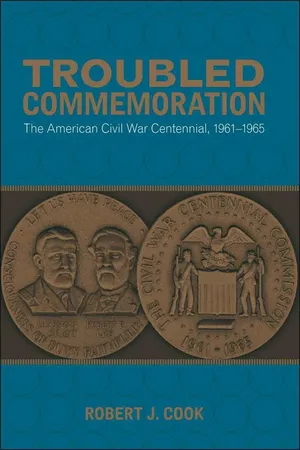
In 1957, Congress voted to set up the United States Civil War Centennial Commission. A federally funded agency within the Department of the Interior, the commission's charge was to oversee preparations to commemorate the one-hundredth anniversary of the central event in the Republic's history. Politicians hoped that a formal program of activities to mark the centennial of the Civil War would both bolster American patriotism at the height of the cold war and increase tourism in the South. Almost overnight, however, the patriotic pageant that organizers envisioned was transformed into a struggle over the historical memory of the Civil War and the injustices of racism. In Troubled Commemoration, Robert J. Cook recounts the planning, organization, and ultimate failure of this controversial event and reveals how the broad-based public history extravaganza was derailed by its appearance during the decisive phase of the civil rights movement.
Cook shows how the centennial provoked widespread alarm among many African Americans, white liberals, and cold warriors because the national commission failed to prevent southern whites from commemorating the Civil War in a racially exclusive fashion. The public outcry followed embarrassing attempts to mark secession, the attack on Fort Sumter, and the South's victory at First Manassas, and prompted backlash against the celebration, causing the emotional scars left by the war to resurface. Cook convincingly demonstrates that both segregationists and their opponents used the controversy that surrounded the commemoration to their own advantage. Southern whites initially embraced the centennial as a weapon in their fight to save racial segregation, while African Americans and liberal whites tried to transform the event into a celebration of black emancipation.
Forced to quickly reorganize the commission, the Kennedy administration replaced the conservative leadership team with historians, including Allan Nevins and a young James I. Robertson, Jr., who labored to rescue the centennial by promoting a more soberly considered view of the nation's past. Though the commemoration survived, Cook illustrates that white southerners quickly lost interest in the event as it began to coincide with the years of Confederate defeat, and the original vision of celebrating America's triumph over division and strife was lost.
The first comprehensive analysis of the U.S. Civil War Centennial, Troubled Commemoration masterfully depicts the episode as an essential window into the political, social, and cultural conflicts of America in the 1960s and confirms that it has much to tell us about the development of the modern South.
- 320 pages
- English
- ePUB (mobile friendly)
- Available on iOS & Android
eBook - ePub
About this book
Information
1
Organizing a Cold War Pageant
THE IDEA FOR a national commemoration of the Civil War originated with private American citizens, primarily “buffs” who belonged to amateur discussion groups called Civil War round tables, and a body of interested professionals, many of them historians, who founded the Civil War Centennial Association in New York in 1953. However, efforts to encourage the creation of a federal agency to oversee the four-year event were strongly supported by the National Park Service (NPS), and these bore fruit in September 1957 when President Dwight D. Eisenhower signed into law a congressional joint resolution setting up the U.S. Civil War Centennial Commission (CWCC). In the late 1950s the new agency labored to make the planned commemoration a weapon of the cultural cold war—a popular heritage bonanza that would reinforce government calls for civic activism and vigilance by educating Americans about the brave deeds and deeply held values of their nineteenth-century precursors. The task proved to be a difficult one. Some people worried that any attempt to mark the Civil War would inflame sectional tensions at a time when racial issues were moving to the forefront of the nation’s political agenda or feared that the centennial was just an excuse for arrogant Yankees to laud it over the white South once again. Others simply had no interest in the American past, whether it was intended for use as popular education or entertainment. But by January 1961 the federal commission’s considerable efforts seemed to have paid off. Most states had set up their own centennial bodies which in turn had begun to encourage the development of local committees. Even though the marginalization of African Americans was a cause of concern to some observers, the prospects for a successful and genuinely grassroots commemoration seemed bright.
ORIGINS
Proposals for an official commemoration of the Civil War centennial had their origins in a discernible increase in popular interest in the conflict during the late 1930s and 1940s. It was no coincidence that the birth of the modern Civil War industry coincided with the final passing of the veterans themselves. Although a quarter of a million Americans assembled to watch the dedication of the Eternal Light Peace Memorial on the field on July 3, fewer than 1,400 former Union and Confederate soldiers actually attended the emotional seventy-fifth anniversary of the battle of Gettysburg in 1938. The average age of the veterans was 94.1 By 1950 only a handful of the original protagonists were left alive, and Americans with a keen interest in the war cast around rather desperately to make contact with the survivors. A southern journalist, William D. Workman Jr., called at the home of 106-year-old General Howell, South Carolina’s only living veteran, in June 1952. Hoping to record an authentic Rebel yell before it was too late, Workman, a committed segregationist, found the old soldier “too ill to make any effort other than a feeble ‘hello.’” He subsequently discovered that the folklore section of the Library of Congress had made a previous assault on the general’s vocal chords only to find its way barred by Howell’s wife, who “refused to permit him to attempt the yell on the grounds that he might drop dead on the spot.”2
Tragicomic though it was, this unsuccessful effort to recover the Civil War through the medium of one of its few survivors was symptomatic of a profound human desire to recapture a past event before all direct contact with that event vanishes with the remorseless passage of time. But William Workman was already too late. By the middle of the twentieth century, rapid modernization and the passing of the veterans had rendered the Civil War what Pierre Nora has labeled a lieu de mémoire. Most Americans had become so divorced from their past as a result of industrialization, urbanization, and mass immigration that the bitter conflict was no longer a genuinely felt memory—except perhaps for those in the South where, for reasons linked to the trauma of defeat, the relatively slow pace of economic development, and the desire to maintain segregation, the war continued to exert a greater pull on individuals. To a large extent the Civil War was now a value-laden memory site to be commemorated in official ritual or commodified by publishers and film studios rather than unselfconsciously remembered by ordinary people in their daily routines.
After surging in the late nineteenth and early twentieth centuries, popular interest in the Civil War waned in the 1920s as a consequence of the mass killing on the western front during World War I. However, in the next decade the nation’s past offered Americans both a source of inspiration in the difficult present and a means of legitimizing the kind of change deemed necessary for a better future. Margaret Mitchell’s novel, Gone with the Wind, an adept fusion of the plantation myth and Lost Cause advocacy, sold a million copies within six months of its publication in June 1936.3 Readers identified with the central character, Scarlett O’Hara, a compound of Old South belle and New (South) Woman whose struggles mirrored not only those of her war-torn homeland but also those of Depression-era Americans. The book’s message of deliverance through adversity reached an even wider domestic audience after Metro-Goldwyn-Mayer (MGM) released David O. Selznick’s more racially liberal film version in 1939.4 The book and the movie contributed to a growing audience for Civil War-era history, as did Douglas Southall Freeman’s magisterial four-volume biography of Robert E. Lee (1934–38) and Carl Sandburg’s widely read Abraham Lincoln: The War Years (1939), which depicted the martyred president as a model leader for a democracy in troubled times.
It is likely that the country’s involvement in modern conflicts also stimulated grassroots interest in the events of the 1860s. Viewed as a positive experience by some Americans, the “good war” of 1941–45 against Germany and Japan fueled the popularity of military history in the United States. The concomitant impulse during the early stages of the cold war toward domestic consensus and 100-percent Americanism intensified the popular thirst for knowledge about the Blue and the Gray. Renewed prosperity not only helped to increase the readership for Civil War literature of all kinds but also contributed to the growth of automobile tourism in the late 1940s and 1950s. During this period growing numbers of American families visited the country’s national parks to immerse themselves in scenic grandeur and authentic representations of their past. Civil War battlefields such as Gettysburg, Shiloh, and Vicksburg administered by the National Park Service witnessed an unprecedented surge in visitors—so strong, in fact, that by the mid-1950s Conrad L. Wirth, a former landscape architect who headed the NPS, responded to the new demand by seeking substantial increases in his agency’s budget.5
Americans who wanted to sustain their interest in the Civil War could do more than simply read a book or visit battlefields. They could attend a meeting of their nearest Civil War round table. These lecture and discussion groups provided much of the impetus for an official centennial commemoration. The first chapter was founded in Chicago in 1940. The members were professionals who came from as far away as Texas and New Mexico to attend monthly meetings at the city’s venerable University Club. By 1948 the group numbered 150 enthusiasts.6 They included Ralph G. Newman, a dapper Chicago bookdealer; Carl Haverlin, a Lincoln buff who headed Broadcast Music Inc. in New York City; a local chemist-businessman and iconoclastic author, Otto Eisenschiml; the Lincoln bard Carl Sandburg; and several prominent historians including Lee’s biographer Douglas Southall Freeman, Frank E. Vandiver of Rice Institute in Houston, and the leading revisionist Avery O. Craven of the University of Chicago.7 Most rank-and-file members were not academics but professional businessmen (such as Monroe F. Cockrell of the Continental Illinois Bank) with an interest in the Civil War. The round table movement expanded rapidly throughout the United States after World War II. Around forty groups existed by 1958, three-quarters of them in the South and Midwest.8 Like the Chicago original, they were predominantly urban and proved especially attractive to white male professionals, many of whom had served recently in the U.S. armed forces. Typically, members would meet every month to hear a Civil War lecture (normally one with a military emphasis) and discuss recent books on the conflict. The New York round table, founded in 1950, proclaimed itself open to “everyone who shares an appreciation of and respect for the singular American qualities of conviction, rugged determination, and loyalty which so marked the majority of Union and Confederate soldiers during the furious tides of a Civil War.” Active members who paid the requisite $10 fee ($5 for out-of-town residents) were presented in 1956–57 with a program that included talks by two of its own: Professor Allan Nevins of Columbia University on “A Realistic View of the Civil War Soldier as a Fighter” and Bruce Catton, a fellow historian, on “New Thoughts on the Civil War.”9
Other evidence of what Edward Tabor Linenthal has called “a distinct Civil War subculture” was not hard to find.10 The North-South Skirmish Association, an early battle reenactment group, was set up in 1950.11 Five years later Ralph Newman founded the Civil War Book Club to give readers expert guidance on the rapidly growing output of relevant historical scholarship and provide authors with an even larger constituency for their work. “Popular interest in the Civil War, the Confederacy and the colorful personalities of the period,” contended an early press release for the book club, “has been accelerated as new literature continues to appear, and even ardent enthusiasts are sometimes uncertain which books to buy.”12 Within a year Newman could boast some of America’s most famous names among his 2,142 members, the most eye-catching being President Dwight D. Eisenhower, former presidents Harry S. Truman and Herbert Hoover, and Democratic idol Adlai E. Stevenson.13 Whether any of these political grandees subscribed to Civil War History, the first specialized academic journal of its kind which also made its debut in 1955, is unclear.
Given the abundance of interest in the Civil War manifested by these initiatives, it was hardly surprising that the approaching centenary of secession led many people to invoke the need for a formal commemoration. Prominent among those calling for such an event were the Civil War Centennial Association (CWCA) and the Civil War Round Table of the District of Columbia.
Incorporated in 1953 and based at an address on New York’s Fifth Avenue, the CWCA was a small, nonprofit organization designed to function as “a vehicle for properly celebrating” the Civil War centennial.14 Its avowed aim was not to control centennial proceedings but to act as “a general forum” for coordination in some fields and stimulation in others. Although little was heard of this group until Carl Haverlin announced its plans at the annual conference of the Southern Historical Association in Memphis in November 1955, the membership was a select one.15 Important figures in the Chicago round table numbered among its leading lights, notably Haverlin (who served as president), Ralph Newman, and Carl Sandburg.16
Well-known historians of “the middle period” also belonged to the CWCA. They included Allan Nevins, Bruce Catton, and Bell Irvin Wiley, each of whom would play a major role in subsequent events. Significantly, the three men shared an interest in the wider dissemination of what they regarded as good scholarly history. Nevins, a gray-haired journalist-turned-academic, was one of the most distinguished historians of his generation. Born in Illinois and an active member of the Democratic party, he remained a prolific writer despite the fact that he was now approaching retirement from his position at Columbia University. His commitment to the development of an educated public in the United States prompted his decision to chair the Society of American Historians (SAH), a group of around 400 professional historians and writers dedicated to this end. The cold war import of the SAH was evident in its plans for a history agency to pool and disseminate historical scholarship for the majority of Americans seeking meaning and stability in their lives. “An enlightened citizenry,” proclaimed a draft prospectus in March 1953, “is democracy’s greatest strength. In this country, with its unparalleled facilities for mass communication, adult education is possible on a large scale; moreover, there is an increasing demand for books, articles and programs with depth and quality. Above all, many people are hungry for guidance, for orientation, since the very confusion of these times leads to the asking of questions and a search for understanding.”17
Fifty-five-year-old Bruce Catton, like Nevins a midwesterner by birth and a journalist by training, was a thoughtful, gifted communicator and perhaps the country’s best-known chronicler of the Civil War in the mid-twentieth century. He was better placed than any college professor to garner public attention for his writings, being senior editor of American Heritage, a magazine of popular history founded in 1954 under the partial sponsorship of the SAH. His reputation was cemented the same year when A Stillness at Appomattox, the final elegiac volume of his “Army of the Potomac” trilogy, won a Pulitzer Prize and the National Book Award for nonfiction.
The tall, bespectacled southern academic Bell Wiley possessed a lower national profile than Nevins and Catton, but he shared the two northerners’ passion for good, accessible history. Born in rural west Tennessee in 1906 and reared by strict Methodist parents in straitened economic circumstances, he had spent his youth picking cotton and absorbing stories of the Civil War told by Union and Confederate veterans (his own maternal grandfather had fought against Sherman in the Atlanta campaign).18 After a short period as a schoolteacher, he entered higher education, eventually completing a Yale Ph.D. under Ulrich B. Phillips, then the leading authority on slavery. Subsequently, he taught at several southern colleges before being appointed to a post at Emory University in Atlanta in 1949. Wiley’s hardscrabble upbringing gave him a genuine empathy for common folk. He was a popular teacher who believed that “[m]any people of lowly background potentially are great people and if given an opportunity through education can reach their potential.”19 His published work was characterized by an attention to the role that ordinary Americans, black as well as white, had played in the nation’s history.
Rivaling the CWCA as a source of centennial planning, the District of Columbia round table made up in energy what it lacked in academic prestige. One of the most successful discussion groups of its kind, with a membership composed largely of metropolitan businessmen and federal employees, the 500-member Washington organization owed much of its dynamism to Karl Sawtelle Betts. A leading figure in centennial affairs, Betts was born in smalltown Kansas in April 1892. Having attended high school in Abilene and St. Louis and received an A.B. degree from the University of Michigan in 1914, he briefly taught journalism back home in Kansas and, after being wounded while serving in the American Expeditionary Force during World War I, forged a career in public relations. In 1933 he moved to suburban Maryland as an employee of the National Association of Dyers and Cleaners and from 1936 onward was a freelance writer engaged in publicity and advertising as well as the representative of investment firms in Baltimore and New York. His relocation to the Upper South appears to have spurred his interest in the Civil War, for he was a founding member of Washington’s round table in January 1951. He quickly established himself as one of the most prominent and effective leaders of the drive for a government body that would take charge of centennial proceedings—his efforts aided by the fact that he was a boyhood friend of President Eisenhower and a conservative Republican with a proven record of corporate fundraising. He regarded himself as a “can-do” businessman capable of marketing the centennial to the American people in the service of cold war nationalism. “His idealism was simply indigenous patriotism,” remarked one sympathetic observer after his death, “—patriotism not for a State, not for a section, but for the concept of America as a whole.”20
Betts was no less eager to mark the hundredth anniversary of the Civil War than the historians belonging to the CWCA. On August 17, 1956, he was present with several other District of Columbia round table members, including Ulysses S. Grant III, at a meeting to create a special committee to press for the establishment of a federal centennial agency. Betts...
Table of contents
- Cover Page
- Title Page
- Copyright Page
- Dedication
- Contents
- Preface
- Abbreviations
- Introduction
- 1. Organizing a Cold War Pageant
- 2. The White South Commemorates the Civil War
- 3. Let’s Call the Whole Thing Off: The Charleston Crises of 1961
- 4. The Historians Take Control
- 5. African Americans and the Civil War Centennial
- 6. Winding Down: The Forgotten Centennial, 1962–1965
- 7. An Opportunity for Warmth: The Civil War Centennial as an Exercise in Consensus Culture
- Conclusion
- Bibliography
- Index
- Footnotes
Trusted by 375,005 students
Access to over 1.5 million titles for a fair monthly price.
Study more efficiently using our study tools.
Frequently asked questions
Yes, you can cancel anytime from the Subscription tab in your account settings on the Perlego website. Your subscription will stay active until the end of your current billing period. Learn how to cancel your subscription
No, books cannot be downloaded as external files, such as PDFs, for use outside of Perlego. However, you can download books within the Perlego app for offline reading on mobile or tablet. Learn how to download books offline
Perlego offers two plans: Essential and Complete
- Essential is ideal for learners and professionals who enjoy exploring a wide range of subjects. Access the Essential Library with 800,000+ trusted titles and best-sellers across business, personal growth, and the humanities. Includes unlimited reading time and Standard Read Aloud voice.
- Complete: Perfect for advanced learners and researchers needing full, unrestricted access. Unlock 1.5M+ books across hundreds of subjects, including academic and specialized titles. The Complete Plan also includes advanced features like Premium Read Aloud and Research Assistant.
We are an online textbook subscription service, where you can get access to an entire online library for less than the price of a single book per month. With over 1.5 million books across 990+ topics, we’ve got you covered! Learn about our mission
Look out for the read-aloud symbol on your next book to see if you can listen to it. The read-aloud tool reads text aloud for you, highlighting the text as it is being read. You can pause it, speed it up and slow it down. Learn more about Read Aloud
Yes! You can use the Perlego app on both iOS and Android devices to read anytime, anywhere — even offline. Perfect for commutes or when you’re on the go.
Please note we cannot support devices running on iOS 13 and Android 7 or earlier. Learn more about using the app
Please note we cannot support devices running on iOS 13 and Android 7 or earlier. Learn more about using the app
Yes, you can access Troubled Commemoration by Robert J. Cook in PDF and/or ePUB format, as well as other popular books in History & American Civil War History. We have over 1.5 million books available in our catalogue for you to explore.