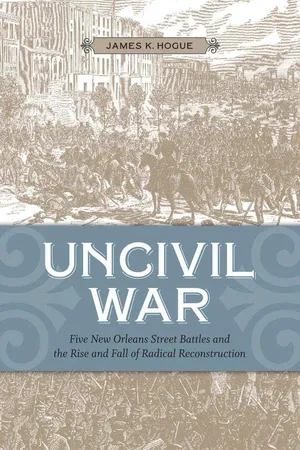
No other Reconstruction state government was as chaotic or violent as Louisiana's, located in New Orleans, the largest southern city at the time. James K. Hogue explains the unique confluence of demographics, geography, and wartime events that made New Orleans an epicenter in the upheaval of Reconstruction politics and a critical battleground in the struggle for the future of southern society. No other Reconstruction state government was as chaotic or violent as Louisiana's, located in New Orleans, the largest southern city at the time. James K. Hogue explains the unique confluence of demographics, geography, and wartime events that made New Orleans an epicenter in the upheaval of Reconstruction politics and a critical battleground in the struggle for the future of southern society.
Hogue characterizes Reconstruction in Louisiana as a continuation of civil war, waged between well-organized and well-armed forces vying to control the state's government. He details five key New Orleans street battles, in which elite Confederate veterans played central roles, and gives an in-depth account of how the Republican state government raised militias and a state police force to defend against the violence. In response, a white supremacist movement arose in the mid-1870s and finally overthrew the Republicans. The occupation of Louisiana by federal troops from 1862 to 1877 was the longest of its kind in American history. Not coincidentally, Hogue argues, one of the longest unbroken periods of one-race, one-party dominance in American history followed, lasting until 1972.
Uncivil War reveals that the long-term military impact of the South's occupation included twenty-five years of crippled War Department budgets inflicted by southern congressmen who feared another Reconstruction. Within Louisiana, the biracial Republican militias were dismantled, leaving blacks largely unarmed against future atrocities; at the same time, the nucleus of the state's White Leagues became the Louisiana National Guard, which defended the "Redeemer" government's repressive labor policies. White supremacist victory cast its shadow over American race relations for almost a century.
Moving between national, state, and local realms, Uncivil War demystifies the interplay of force and politics during a complex period of American history.
eBook - ePub
Uncivil War
Five New Orleans Street Battles and the Rise and Fall of Radical Reconstruction
- 248 pages
- English
- ePUB (mobile friendly)
- Available on iOS & Android
eBook - ePub
Uncivil War
Five New Orleans Street Battles and the Rise and Fall of Radical Reconstruction
About this book
Information
Table of contents
- Cover Page
- Title Page
- Copyright Page
- Dedication
- Contents
- Acknowledgments
- Introduction: The Problem of War and Politics in Reconstruction
- 1. The Politics of Louisiana Civil War Veterans in 1865
- 2. The Street Battle of 1866: A Massacre of Union Veterans
- 3. The Street Battle of 1872: Carpetbaggers under Siege
- 4. The Street Battle of 1873: The Battle of the Cabildo and the Spread of Paramilitary Insurrection
- 5. The Street Battle of 1874: The White Leagues Seize Power
- 6. The Statehouse Incident of 1875: The U.S. Army Returns to New Orleans
- 7. The Street Battle of 1877: A Perfect Coup d’Etat
- Conclusion: The Military Legacies of Reconstruction
- Appendix 1. The Louisiana State Militia, 1871 and 1874
- Appendix 2. The White Leagues, 1874
- Appendix 3. General Officers Commanding in Reconstruction Louisiana
- Bibliography
- Index
- Footnotes
Trusted by 375,005 students
Access to over 1.5 million titles for a fair monthly price.
Study more efficiently using our study tools.
Frequently asked questions
Yes, you can cancel anytime from the Subscription tab in your account settings on the Perlego website. Your subscription will stay active until the end of your current billing period. Learn how to cancel your subscription
No, books cannot be downloaded as external files, such as PDFs, for use outside of Perlego. However, you can download books within the Perlego app for offline reading on mobile or tablet. Learn how to download books offline
Perlego offers two plans: Essential and Complete
- Essential is ideal for learners and professionals who enjoy exploring a wide range of subjects. Access the Essential Library with 800,000+ trusted titles and best-sellers across business, personal growth, and the humanities. Includes unlimited reading time and Standard Read Aloud voice.
- Complete: Perfect for advanced learners and researchers needing full, unrestricted access. Unlock 1.5M+ books across hundreds of subjects, including academic and specialized titles. The Complete Plan also includes advanced features like Premium Read Aloud and Research Assistant.
We are an online textbook subscription service, where you can get access to an entire online library for less than the price of a single book per month. With over 1.5 million books across 990+ topics, we’ve got you covered! Learn about our mission
Look out for the read-aloud symbol on your next book to see if you can listen to it. The read-aloud tool reads text aloud for you, highlighting the text as it is being read. You can pause it, speed it up and slow it down. Learn more about Read Aloud
Yes! You can use the Perlego app on both iOS and Android devices to read anytime, anywhere — even offline. Perfect for commutes or when you’re on the go.
Please note we cannot support devices running on iOS 13 and Android 7 or earlier. Learn more about using the app
Please note we cannot support devices running on iOS 13 and Android 7 or earlier. Learn more about using the app
Yes, you can access Uncivil War by James K. Hogue in PDF and/or ePUB format, as well as other popular books in History & American Civil War History. We have over 1.5 million books available in our catalogue for you to explore.