During the post--World War II era, American foreign policy prominently featured direct U.S. military intervention in the Third World. Yet the cold war placed restraints on where and how Washington could intervene until the collapse of the former Soviet Union removed many of the barriers to -- and ideological justifications for -- American intervention. Since the end of the cold war, the United States has completed several military interventions that may be guided by motives very different from those invoked before the collapse of the Berlin Wall. Likewise, such operations, now free from the threat of counterintervention by any other superpower, seem governed by a new set of rules.
In this readily accessible study, political scientist Glenn J. Antizzo identifies fifteen factors critical to the success of contemporary U.S. military intervention and evaluates the likely efficacy of direct U.S. military involvement today -- when it will work, when it will not, and how to undertake such action in a manner that will bring rapid victory at an acceptable political cost. He lays out the preconditions that portend success, among them a clear and attainable goal; a mission that is neither for "peacekeeping" nor for "humanitarian aid within a war zone"; a strong probability the American public will support or at least be indifferent to the effort; a willingness to utilize ground forces if necessary; an operation limited in geographic scope; and a theater commander permitted discretion in the course of the operation.
Antizzo then tests his abstract criteria by using real-world case studies of the most recent fully completed U.S. military interventions -- in Panama in 1989, Iraq in 1991, Somalia in 1992--94, and Kosovo in 1999 -- with Panama, Iraq, and Kosovo representing generally successful interventions and Somalia an unsuccessful one. Finally, he considers how the development of a "Somalia Syndrome" affected U.S. foreign policy and how the politics and practice of military intervention have continued to evolve since the terrorist attacks of September 11, 2001, giving specific attention to the current war in Afghanistan and the larger War on Terror.
U.S. Military Intervention in the Post--Cold War Era exemplifies political science at its best: the positing of a hypothetical model followed by a close examination of relevant cases in an effort to provide meaningful insights for future American international policy.
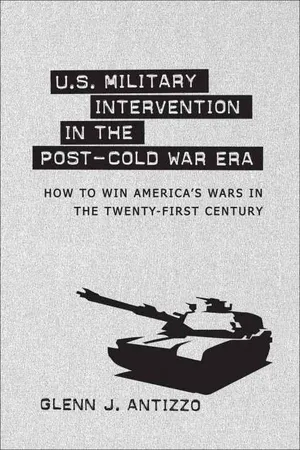
eBook - ePub
U.S. Military Intervention in the Post-Cold War Era
How to Win America's Wars in the Twenty-first Century
- 280 pages
- English
- ePUB (mobile friendly)
- Available on iOS & Android
eBook - ePub
U.S. Military Intervention in the Post-Cold War Era
How to Win America's Wars in the Twenty-first Century
About this book
Information
1
A BRIEF HISTORY OF U.S. DIRECT MILITARY INTERVENTION
Military intervention has long been a prominent feature of U.S. foreign policy. It may be recalled that one of the first acts of the Second Continental Congress was to authorize an invasion of Quebec in order to foment an uprising there and perhaps gain an ally—a “fourteenth colony”—in the rebellion against the British crown.
The purpose of this chapter is to give a broad overview of the historical development of American military intervention. The present discussion will illustrate the types of such actions, official U.S. attitudes toward the use of force, the legacy of the cold war tradition, and the resultant postVietnam mind-set.
EARLY INTERVENTIONS
United States foreign policy, from the founding of the republic, has relied on a resort to the sword. In the late 1790s, President John Adams waged an undeclared naval war against France. His successor, Thomas Jefferson, dispatched the navy and marines to deal with marauding Barbary pirates. Furthermore, in 1818 Andrew Jackson was given unofficial approval to conduct an expedition into Spanish Florida (Congressional Quarterly Weekly Report [cited hereafter as CQWR], January 5, 1991, article by Ronald D. Elving: 37–38). Modern U.S. military intervention, however, finds its origins in the 1898 Spanish-American War. Prior to that conflict, U.S. foreign policy was largely guided by the principle of nonintervention. Americans, concerned with fulfilling their Manifest Destiny, for the most part ignored the outside world. Conflicts, when they did come, were aimed at expanding the new republic’s frontiers.
The organizing principle of U.S. foreign policy was the Monroe Doctrine. Promulgated in 1823, this policy was aimed at European colonial powers that were contemplating the reclamation of their recently liberated colonies in Latin America. While warning European powers from attempting to interfere in Latin American affairs, it also had the effect of demarcating a U.S. sphere of interest in the Western Hemisphere. It bears noting that these bold words were unenforceable without the British Navy guaranteeing compliance. Nevertheless, the Monroe Doctrine, in one form or another, has been invoked into the twenty-first century (Gardiner, 1992: 27).
The Spanish-American War, although a comic-opera affair in its pursuit, was a watershed event in the history of U.S. military intervention. Using the destruction of the USS Maine in Havana Harbor (allegedly by the Spanish) as a pretext, the United States invaded Cuba in support of an anticolonial uprising. The Pacific Fleet, under Admiral George Dewey, engaged the Spanish in the Philippines as well.
The war was short, barely longer than three months, and with surprisingly few combat fatalities. This “splendid little war” is significant not so much on its own merits, but rather because of what resulted from it (Musicant, 1990: 6). With the cessation of hostilities, the United States acquired a small empire. Added to U.S. territory were such far-flung locales as Puerto Rico, Guam, and the Philippine Islands. The United States was now a world power and jingoists were eager to extend American interests to the four corners of the earth. President William McKinley, however, believed that American security and interests did not require the addition of Cuba to American territory. Rather, Washington chose to exercise a European-style “protectorate” over the island. That is to say that Cuba would maintain its official independence, but Havana’s freedom in foreign policy would be limited by the United States. This policy was codified by the Platt Amendment, which, in addition, allowed the United States both basing rights in Cuba as well as carte blanche to intervene under specific circumstances (Musicant, 1990: 50–51).
Cuba would become a model for American military intervention throughout the Caribbean basin in the first third of the twentieth century. Such intervention was virtually institutionalized by President Theodore Roosevelt. Roosevelt added a “corollary” to the Monroe Doctrine which asserted that the United States could engage in unilateral military intervention anywhere within the Americas where conditions might otherwise entice a European armed response (Musicant, 1990: 3). As Roosevelt himself declared: “Brutal wrongdoing, or an impotence which results in a general loosening of the ties of a civilized society, may finally require intervention by some civilized nation, and in the Western Hemisphere the United States cannot ignore this duty” (Chessman, 1969: 97).
This broadened interventionist policy is largely associated with the 1904 debt default crisis of the Dominican Republic, when the Santo Domingo government defaulted on loans made by European creditors. Roosevelt, fearing a European “repossession” of the Dominican Republic in violation of the Monroe Doctrine, sent U.S. troops to head off such a possibility. By the following year, the situation had stabilized. With Washington acting as a loan collector, payments to European creditors resumed (Musicant, 1990: 242–44).
The most enduring legacy of Roosevelt’s policy of hemispheric intervention, however, was his simultaneous construction of both a new nation and a new canal in Panama. In 1903, a treaty that would have granted the United States the right to build a canal across the isthmus in Panama province was rejected by the Colombian Senate. An enraged Roosevelt took advantage of an uprising in Panama. By sending American warships, most notably the USS Nashville, to waters off the Panamanian coast, Roosevelt was able to prevent Colombian troops from suppressing the rebellion. With Panamanian independence thus secured, the United States and the new government entered into negotiations.
These efforts culminated with the signing of the Hay-Bunau-Varilla Treaty on November 18, 1903. This compact provided for a ten-mile-wide zone, stretching from coast-to-coast, which would be leased in perpetuity to the United States for the purposes of canal construction, maintenance, and defense (Musicant, 1990: 136). In addition, the treaty “provided a clear and specific legal basis for . . . U.S. intervention in the event of disorder,” making subsequent U.S. intervention in Panama unique in that it would be “based on treaty rights” (Scranton, 1992: 344–45).
Woodrow Wilson, perhaps best known for his post-World War I policy of national self-determination in Europe, was not above invoking Roosevelt’s corollary in hemispheric affairs. Under the earlier Taft administration, Washington had engaged in “dollar diplomacy,” under which American businessmen were encouraged to invest in the Caribbean basin by guaranteeing their loans with the full diplomatic and, if necessary, military support of the U.S. government. As such, U.S. loans were made to a number of Latin and Caribbean states (Steward, 1980: 14–17). In 1912, this policy was put to the test when U.S. troops invaded and occupied Nicaragua in order to safeguard U.S. lives and interests.
Over time, Wilson refined this interventionist policy. He sought political and economic stability in the Caribbean basin so as to engender “sustained economic growth and [help] to insure the prompt payment of foreign debts,” which would keep U.S. (and European) bankers happy while keeping foreign troops out of the Western Hemisphere (Steward, 1980: 17).
In keeping with his established policy, in 1917 Wilson sent 2,600 marines to prop up the corrupt Menocal regime in Cuba (Steward, 1980: 17). Likewise, Haiti was invaded in 1915 in order to “prevent anarchy”—or perhaps more accurately, to establish a government capable of maintaining a stable environment for foreign investment (Gardiner, 1992: 30). The Dominican Republic was invaded the following year, and both it and Haiti were placed under U.S. military rule (Steward, 1980: 17).
Indigenous government was not allowed in either Haiti or the Dominican Republic until 1924. It should, however, be noted that the U.S. trained paramilitary forces to maintain order. It has been asserted that these groups were the forerunners of the Haitian secret police, the Tonton Macoutes (Steward, 1980: 18).
American intervention during this period was not limited to Caribbean island republics. Wilson ordered U.S. troops into Mexico twice. First, in 1914, American forces occupied Vera Cruz as part of an attempt to overthrow Mexican military dictator Victoriano Huerta. Again, in 1916, the president dispatched General John “Black Jack” Pershing on a punitive expedition to capture the bandit Pancho Villa, who had killed several U.S. citizens during raids into the American Southwest (Steward, 1980: 17; Gardiner, 1992: 30). Villa eluded his pursuer and was never apprehended.
Intervention in the Caribbean basin continued into the 1920s, most notably in Nicaragua. U.S. Marines stationed there to protect the Nicaraguan regime were thought to be no longer needed and were withdrawn in the mid-1920s. However, a new uprising in 1926 prompted the marines’ return. By 1927, U.S. forces deposed the incumbent regime and installed a new one. The rebels, labeled “Bolshevists” by Secretary of State Frank Kellogg and armed by Mexico, were pursued by the marines until the mid-1930s. In 1934, rebel leader Cesar Augusto Sandino was ambushed and killed by U.S.trained National Guardsmen led by future Nicaraguan dictator Anastasio Samoza (Steward, 1980: 24–25). (It may be interesting to note that Sandino’s name was appropriated by a group—the “Sandinistas”—who ironically overthrew the dictatorship of Samoza’s namesake son.)
ISOLATIONISM
The election of Herbert Hoover marked a change in the direction of U.S. foreign policy. Going from interventionism to restraint, this policy during the 1930s would evolve into isolationism. The Hoover policy was most clearly articulated in 1930 with the issuance of the so-called Clark Memorandum. This document, while not completely disavowing all possible future intervention, did renounce the Roosevelt corollary of the Monroe Doctrine. In the future, Washington would be more guarded in the utilization of military diplomacy. President Hoover, when confronted with opportunities to intervene in Panama, Haiti, and El Salvador in the latter years of his term, declined to do so (Steward, 1980: 26). In 1933, Hoover withdrew all U.S. forces from Nicaragua.
This “retreat from overt interventionism in Central America” lasted beyond Hoover’s administration. Later, it led the way to “the Good Neighbor policy” during President Franklin D. Roosevelt’s administration (Gardiner, 1992: 32). During the 1930s, isolationism, a term usually associated with American policy toward European affairs, was the word that best characterized both the political policies and practices of the decade (Gardiner, 1992: 32). The U.S. government largely declined to use American troops in hemispheric affairs, while the strange political bedfellows of communists, fascist sympathizers, and the apathetic majority managed to forestall any U.S. intervention in Europe.
1947–1957: THE ERA OF CONTAINMENT
The ordeal of World War II, and the circumstances leading to it, tremendously reshaped the political landscape, especially with regard to American foreign policy. With victory, there was a renewed interest in how events beyond America’s shoreline affected national security. This reassessment was fueled by a number of factors. First among these was the belief by many in both government and the public that American noninvolvement in European affairs had left the democracies no choice but appeasement, and that appeasement had necessarily led to war.
Second, throughout the nineteenth and early twentieth centuries U.S. policies were, as a practical matter, frequently enforced by British naval power. World War II, however, brought this arrangement to an end. The United States, as an emerging superpower and heir to the British position of “benevolent hegemon,” perceived the Soviet Union as “a distinctive challenge” to both American interests and global stability (Gardiner, 1992: 33).
Third, these suspicious views of the USSR’s ambitions, especially when taken with hostile Soviet conduct in the immediate post-war era, as well as the evil nature of Stalin himself, combined to create what would be called the cold war: “an intense ideological competition” between the superpowers. It was a challenge that American leaders were eager to confront (Gardiner, 1992: 33).
A war-weary public supported the initial demobilization of U.S. forces that accompanied the immediate post-World War II period. This view had not changed substantially by the time the Greek Civil War erupted. President Harry Truman, however, thought it important to stop the spread of communism, a menace that he believed, sooner or later, would more directly threaten the West if not halted in Greece. The result was the Truman Doctrine.
In a speech before Congress on March 12, 1947, Truman sought $500 million in aid to Greece and Turkey in order to help those countries fend off communism (Gardiner, 1992: 33). Truman justified his request by arguing: “I believe that it must be the policy of the United States to support free peoples who are resisting attempted subjugation by armed minorities or by outside pressures.” The clear implication of the Truman Doctrine was that the Soviets needed to be contained within Eastern Europe. Although this policy was originally intended simply to apply to the defense of Western Europe, Truman made it clear that it could be applied in other regions where communism threatened American interests (Woods and Jones, 1991: 145).
The first major expansion of the Truman Doctrine beyond Europe was not long delayed. In 1949, Chiang Kai-shek’s Nationalist armies were defeated by communist forces and driven off the mainland to Taiwan. This was a jolt to the United States. Congress, alarmed by the loss of China, became acutely concerned over the “rising Red tide” and what it perceived as its Soviet source.
On June 25, 1950, communist North Korean forces stormed across the 38th parallel into South Korea. They rapidly captured Seoul, driving United States and South Korean forces back to the port city of Pusan. Until this invasion, Korea had not been perceived as “a major strategic interest of the United States.” The president, however, “immediately invoked the Truman Doctrine and ordered” American troops to repel the North Korean assault (Klare, 1992: 40). UN forces (about 90 percent American) under General Douglas MacArthur counterattacked at Inchon and swept the North Koreans up the peninsula to the Chinese border. With the success of the intervention, there was broad support for the “liberation of Korea” (MacDonald, 1986: 57–58). However, much of this support dissipated with the entry of China into the conflict. The war eventually bogged down into a bloody stalemate and produced “considerable public discontent in the United States” (Klare, 1992: 40). In 1953, shortly after the election of President Dwight D. Eisenhower, an armistice was signed that ended the conflict. The result has been an enduring, if uneasy, peace on the peninsula.
Eisenhower took a scaled-down defensive posture, which greatly relied on the new doctrine of “massive retaliation,” with its implied threat of resort to nuclear weapons, in order to discourage Soviet adventures in the Third World. Emphasis was placed on getting “more bang for the buck” from defense spending. As such, conventional military capabilities were reduced in favor of increased procurement of, and reliance on, nuclear weapons. This “New Look” defense saved money by cutting land forces and the surface fleet. Defense planning during this period was concerned primarily with the Soviet threat and, as such, really did not contemplate the need for force projection into the Third World until the late 1950s. Only at the end of President Eisenhower’s tenure, “with the 1958 U.S. landing in Lebanon and the accompanying Eisenhower Doctrine (authorizing U.S. military action to prevent a communist takeover of Middle Eastern countries), did he envision a direct U.S. military role in regional, nonnuclear conflicts” (Klare, 1992: 40).
1957–1973: THE ERA OF HIGH INTERVENTION
By the early 1960s, the Dullesian doctrine of massive retaliation was under attack. It was criticized as irresponsible in a nuclear age, as well as ineffective in fighting communist “liberation movements” in the Third World. Therefore, after 1960, the Kennedy administration sought a new doctrine that would not require engaging in brinkmanship as a response to all provocations, regardless of how small.
The solution to this policy dilemma was found in the doctrine of “flexible response.” Its major advocate, General Maxwell Taylor, believed that while the United States was in a position to deter a general war, it should be prepared to defeat smaller-scale, local aggression. Therefore, “in order to provide a credible, realistic response” to challenges arising in the Third World, there should be a significant expansion of U.S. conventional capabilities. This buildup would enable the president to choose from a wide variety of alternatives, ranging from nonnuclear to tactical nuclear options, the type of forces that would constitute the optimal response to any challenge (Klare, 1992: 41; Kinnard, 1991: 42; Taylor, 1989: 206, 211, 214–15).
A key component of these expanded options was Kennedy’s special emphasis on the creation of counterinsurgency forces to respond to communist challenges in the Third World. Modeled on the British experience in Malaya, counterinsurgency’s central purpose was to thwart communist rebels by “winning the hearts and minds” of potentially receptive peasants, while energetically engaging the rebels themselves with direct military force. In the early 1960s, Kennedy found a laboratory where it would be possible to try out these new ideas on low-intensity warfare: Vietnam.
American interest in Indochina dated back to the early part of the Eisenhower administration. It was President Kennedy, however, who authorized a substantial increase in the U.S. military presence in South Vietnam. Despite its initial role as a laboratory for newly developed weapons and counterinsurgency tactics, Vietnam rapidly generated its own inertia, becoming increasingly important as a symbol. “For, having designated Vietnam as a proving ground for counterinsurgency, it became essential for the United States to avoid defeat lest U.S. failure in Indochina encourage revolutionaries in other countries to undertake guerilla campaigns of their own” (Klare, 1992: 41–42).
There were also other international implications that developed along with such policy concerns. As George C. Herring points out in America’s Longest War, during the Johnson administration Vietnam evolved into a showcase of U.S. resolve and credibility to honor its security commitments to current and potential allies. Herring observed that “The United States intervened in Vietnam to block the apparent march of a Soviet-directed Communism across Asia, enlarged its commitment to halt a presumably expansionist Communist China, and eventually made Vietnam a test of its determination to uphold world order” (Herring, 1986: 279).
The test of American resolve that Vietnam represented was fought on a scale unprecedented for an undeclared war/intervention. Although air sorties started earlier, the first American ground forces, a pair of marine battalions, were landed at Danang in March 1965. Within a month, the Johnson administration decided to increase the U.S. presence by 40,000 troops (Herring, 1986: 131–32). At the peak of U.S. involvement, 543,000 service personnel were present in Vietnam (Lomperis, 1984: 82).
The style of combat ranged from guerrilla/counterinsurgency to strategic bombing to conventional warfare. Although U.S. forces never lost a major engagement against the enemy (even the 1968 Tet offensive was a U.S. military victory), by the early 1970s the situation had become stalemated. American troops maintained their secure points, yet were unable to fully stop communist activity in the countryside or traffic along the Ho Chi Minh trail (Herring, 1986: 147–48, 190–92). The cost, however, was staggering. Between 1969 and 1973, 20,553 American soldiers were killed (Herring, 1986: 256).
While U.S. troops were able to fend off communist forces, the South Vietnamese regime was largely ineffective in its efforts to engender any degree of effective governance or loyal...
Table of contents
- Cover
- Title Page
- Copyright Page
- Dedication
- Contents
- Acknowledgments
- Introduction
- 1. A Brief History of U.S. Direct Military Intervention
- 2. Preconditions Favoring the Success of Military Intervention in the Post-Cold War Era A Typology
- 3. Operation Just Cause the Invasion of Panama
- 4. Operation Desert Storm Iraq and the Liberation of Kuwait
- 5. Operation Restore Hope Humanitarian Relief in Somalia
- 6. Operation Allied Force The Air War in Kosovo
- 7. Evaluating the Interventionist Typology
- Epilogue the “Somalia Syndrome” And the War on Terror
- Bibliography
- Index
Trusted by 375,005 students
Access to over 1.5 million titles for a fair monthly price.
Study more efficiently using our study tools.
Frequently asked questions
Yes, you can cancel anytime from the Subscription tab in your account settings on the Perlego website. Your subscription will stay active until the end of your current billing period. Learn how to cancel your subscription
No, books cannot be downloaded as external files, such as PDFs, for use outside of Perlego. However, you can download books within the Perlego app for offline reading on mobile or tablet. Learn how to download books offline
Perlego offers two plans: Essential and Complete
- Essential is ideal for learners and professionals who enjoy exploring a wide range of subjects. Access the Essential Library with 800,000+ trusted titles and best-sellers across business, personal growth, and the humanities. Includes unlimited reading time and Standard Read Aloud voice.
- Complete: Perfect for advanced learners and researchers needing full, unrestricted access. Unlock 1.5M+ books across hundreds of subjects, including academic and specialized titles. The Complete Plan also includes advanced features like Premium Read Aloud and Research Assistant.
We are an online textbook subscription service, where you can get access to an entire online library for less than the price of a single book per month. With over 1.5 million books across 990+ topics, we’ve got you covered! Learn about our mission
Look out for the read-aloud symbol on your next book to see if you can listen to it. The read-aloud tool reads text aloud for you, highlighting the text as it is being read. You can pause it, speed it up and slow it down. Learn more about Read Aloud
Yes! You can use the Perlego app on both iOS and Android devices to read anytime, anywhere — even offline. Perfect for commutes or when you’re on the go.
Please note we cannot support devices running on iOS 13 and Android 7 or earlier. Learn more about using the app
Please note we cannot support devices running on iOS 13 and Android 7 or earlier. Learn more about using the app
Yes, you can access U.S. Military Intervention in the Post-Cold War Era by Glenn J. Antizzo in PDF and/or ePUB format, as well as other popular books in Politics & International Relations & Military & Maritime History. We have over 1.5 million books available in our catalogue for you to explore.