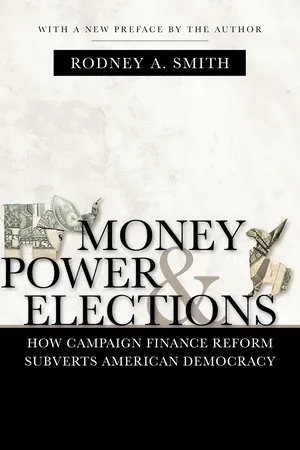
Have campaign finance reform laws actually worked? Is money less influential in electing candidates today than it was thirty years ago when legislation was first enacted? Absolutely not, argues Rodney A. Smith in this passionately written, fact-filled, and provocative book. According to Smith, the laws have had exactly the opposite of their intended effect. They have increased the likelihood that incumbents in the House and Senate will be reelected, and they have greatly diminished the chances that candidates who are not wealthy will be elected. Smith's claims are supported by convincing data; he collected and analyzed information about all federal elections since 1920. These data show clearly that money matters now more than ever. Smith thinks that reform legislation has created a new inequality for candidates that, if left unchecked, threatens to destroy the American electoral process by obliterating the foundational principle of free speech. He argues that "money buys speech" and when candidates lack money to buy media time and space they are effectively silenced. Their inability to "speak freely" violates the most significant intentions of our nation's founders: that a sovereign citizenry elect its own leaders based on a free exchange of ideas. For Smith, campaign finance reform has unwittingly unbalanced the checks and balances created by the Framers of the Constitution.After presenting a detailed historical overview of how we have reached the present crisis, Smith proposes a simple solution: institute a process that completely discloses relevant information about campaign donors and recipients of donations. All disclosures would be available to the media, which would be able to investigate and report them fully. Only then, Smith believes, will the United States have the opportunity to be the democratic republic that its founders intended.
eBook - ePub
Money, Power, and Elections
How Campaign Finance Reform Subverts American Democracy
- 208 pages
- English
- ePUB (mobile friendly)
- Available on iOS & Android
eBook - ePub
About this book
Information
Subtopic
Politics1 THE FOLLY OF REFORM
To err is natural; to rectify error is glory.
George Washington
George Washington
As I recall it, Thursday, April 6, 1972, was a picture-perfect spring day in Washington, DC. The cherry blossoms had just lost their dazzling brilliance, the many flower gardens scattered throughout the city were beginning to stir, and the air was fresh and mild. It was a wonderful moment to be alive and living in our nation’s capital.
Unaware of the beauty of the day, a small, dedicated group of staffers in a downtown office were frantically working on an emergency project behind locked doors that absolutely, without fail, had to be finished prior to midnight.
The office was located at 1701 Pennsylvania Avenue, NW, catercorner to the White House. In 1972, Financial General Bankshares, Inc., owned the building. The company was a bank and insurance conglomerate controlled by General George Olmstead. At that time Olmstead was an internationally known financier with considerable political clout who was particularly proud of his brief army career serving as a brigadier general during the Second World War.
Once I had the fortune to stand on his twelfth floor balcony and gaze down on the White House. It is the only office in the city with this view. I was suddenly seized by a tingling sense of “Potomac Fever”—a lust for power. I had a glimpse of what drives politicians. I won’t forget that moment; the lust for power is the most dangerous ingredient in politics, not money.
Oblivious to the grandeur of the view nine floors above, the clerks on the third floor were busy sorting and counting stacks of cash. There were some checks. But most of the money was raw cash, and lots of it. It was their charge to get several million dollars deposited in Olmstead’s bank located on the first floor before midnight. To help accomplish this task, the bank had agreed to stay open late.
Much of the money was neatly lined up in columns on the floor, reminiscent of military formations. Other stacks of cash were piled on tables. Once the record keeping had been completed, a deposit slip was filled out and double-checked. Periodically, a clerk or two would slip down the back stairs with several bags full of deposits. The bank had set up a separate room to help expedite the depositing process.
Just before midnight, the last deposit was made. The clerical staff had met their deadline. At midnight a new law would take effect making it illegal to add further undisclosed deposits into this secret account. The clerical staff and their boss, Maurice Stans, were elated that they had beaten the clock. Stans was then the finance chairman of the Committee to Re-Elect the President (CREEP) and, prior to resigning in December 1971, had been secretary of commerce under President Richard Nixon. Tragically, their success that day in filling the coffers of a clandestine bank account helped set the stage for funding a series of illicit acts that would forever alter the nature of American politics.
The next morning, Friday, April 7, 1972, at 12:01 A.M., the Federal Election Campaign Act (FECA) of 1971 officially became law. Among other things, FECA, for the first time in American history, required the meaningful reporting of campaign contributions and expenditures by political organizations and candidate committees. While it was by no means a perfect law, FECA was a significant step in the right direction. It enabled the American public to better understand how political campaigns and organizations were funded. If they so desired, citizens could use this new information to adjust their voting behavior.
It had taken America nearly two hundred years to come to grips with the fact that full disclosure of political contributions and expenditures was important. The electorate has the right—and the need—to know how campaigns and political committees are funded and by whom.
Full disclosure of information, including amounts given, names, addresses, and other such relevant information about political donors and vendors, is consistent with the intent of the Framers of the Constitution and the principles imbedded in it. Yet for most of our country’s history, such information had seldom, if ever, been available in any meaningful way. The passage of FECA was an important step toward correcting this deficiency.
Had Nixon’s reelection campaign in 1972 honorably and openly complied with the spirit and intent of this new law, the Watergate tragedy might never have happened. If CREEP had reported the more than $20 million in contributions it had collected prior to April 6, it would have been obligated it to report any expenditure from those funds. Given this level of public disclosure, no one at CREEP would have given a free-wheeling character like G. Gordon Liddy, or anyone else, signature control over a separate, segregated bank account.
The people running CREEP may not have been overly endowed with moral sensitivities, but they had plenty of political savvy. With the press looking over their shoulder as a result of these newly required public disclosure reports, there is simply no way they would have allowed anyone to have autonomous control over a large sum of money. Additionally, the internal control systems that are inherently necessary to run a fully disclosed financial operation effectively would have provided CREEP a reasonably efficient safeguard against illegal expenditures of the type involved in the Watergate scandal. CREEP, unfortunately, chose a different approach.
On Saturday, June 17, 1972, a little over two months after the last slush fund deposit was made, five men were arrested at the Watergate complex at 600 New Hampshire Avenue NW. Initially, this break-in seemed like a petty burglary hardly deserving of media coverage. However, there was an odd twist that made the story particularly interesting. One of the people taken to jail that day was a man by the name of James McCord, who happened to be the security director for CREEP. He was also a close associate of G. Gordon Liddy, another security consultant retained by CREEP. The fuse had been lit. A chain reaction of events had begun. The whole sordid mess would eventually ignite the biggest and most famous political scandal in American history.
In retrospect, the Watergate fiasco proved that the Founders’ constitutional handiwork was fundamentally sound. A president was forced to resign. Months earlier a vice president had also been forced to resign because of criminal behavior committed when he had served as governor of Maryland. Before the Watergate debacle ended, more than forty government officials would be indicted, and some would serve time in jail. The constitutional system of checks and balances, the freedom of the press, and, ultimately, citizen sovereignty along with full disclosure of financial records proved stronger than the dishonesty of a few power-hungry officials, no matter how highly placed. Democracy, as defined by our Constitution, prevailed.
Had the saga of Watergate ended there, the whole episode might have strengthened confidence in America’s unique system of government. Unfortunately that is not what happened. Instead, Watergate gave birth to a new sense of suspicion and distrust. Seemingly overnight, our country’s confidence in the political processes devised by the constitutional Framers was undermined as never before.
More than thirty years later, the negative impact of Watergate on our competitive election process is now unmistakable. Tragically, the slush fund created by CREEP prior to April 6, 1972, the criminal break-in that that secret bank account funded, the massive coverup orchestrated by the president himself, and the unprecedented and prolonged media and press barrage all fused together to create an emotionally charged animosity toward money in politics. Over time it has evolved into paranoia.
Indeed, this negative mind-set has gained considerable strength nationwide and has created a frenzy for campaign finance reform. In reaction to Watergate, Congress passed the Federal Election Campaign Act of 1974, which imposed contribution limits on all political entities.1
But other, more recent controversies have also added fuel to the fires for reform. For example, the fund-raising improprieties in the Clinton administration in the mid-1990s, including the acceptance of foreign contributions that had long been illegal, again put the issue of campaign finance reform on the front page of every newspaper in the country. But it was the sleaziness of the Enron debacle and its management’s perceived (not proven) attempts to buy government favors with campaign contributions that finally forced the passage of the Bipartisan Campaign Reform Act of 2002 (BCRA). Most Americans believe this innocent-sounding act of Congress and related Supreme Court decisions to be little more than benevolent tinkering with our election process—the closing of a few “loopholes.” However, the sobering truth is that these actions have revolutionary consequences that adversely affect every American.2
In the months before BCRA passed, the Gallup Poll Monthly reported that among people who said they were following the Enron story closely, 80 percent believed new campaign finance laws were necessary, compared with just 55 percent who were not following the story closely.3 The resulting laws that Congress passed in the emotional aftermath of these watershed events and the subsequent court decisions handed down have altered the foundation of American democracy.
In addition, this obsession with reform has spawned a cottage industry of elected officials, lawyers, academics, political activists, media personalities, and columnists dedicated to purging the American political process of money. It is as if money itself were somehow the root of all political evil.
Among the newspapers with the ten highest circulations in America, eight largely espoused proreform views. Only one, the Wall Street Journal, consistently opposed the type of campaign finance reform that has become the law of the land.
Unfortunately, many of these well-intentioned reformers in the press, in Congress, and elsewhere have rushed to support campaign finance reform without first carefully and scrupulously considering any of its unintended consequences. In their zeal to correct a perceived problem, they have unwittingly created a new inequality, which, left unchecked, threatens to destroy our competitive election process and ultimately our survival as a free people.
Physics says that a thing set in motion stays in motion until something stops it. In physics that “something” might be friction or gravity; in history, a misguided notion might be brought to rest by truth. I hope this book provides that truth. My purpose in writing is to call attention to the destructive consequences of campaign finance reform, and I hope it helps initiate a counterforce that puts an end to those consequences. Specifically to be addressed is what I believe is now undeniable fact: however noble their goal, these campaign finance laws and court decisions have imposed a monetary straightjacket that is literally shutting down our competitive two-party election process.
For most of my adult life I have been a political fund-raiser, a vocation that is regarded by many as slightly less respectable than pool hall hustler, cardsharp, or tax collector. Further, I was part of CREEP back in 1972. Since that time, I have raised hundreds of millions of dollars for political party committees and candidates. Despite the perception of some, I believe that what I do is essential to the survival of American democracy.
In an age dominated by mass media, money buys speech, the kind specifically protected by the First Amendment to the United States Constitution. When candidates lack the money to buy space and time in the media, they are politically paralyzed. Silent, unable to speak, they and their invisible campaigns are totally at the mercy of journalists who may or may not choose to covey their message fairly.
Anyone or anything that deprives candidates of the means to carry their message to the electorate abridges their freedom of speech. And that is precisely what I think so-called campaign finance reform is doing. I firmly believe that when Americans know the facts and understand their implications, they will agree.
When the Founding Fathers set about constructing our democracy, they knew that they were creating a system of government that had to have both the safeguards and the vision to make it applicable to a future they could not begin to imagine. They mined their knowledge of history and philosophy for precedent and guidance, but in some ways it was their understanding of human nature that inspired much of the architecture of the new government. In addition to their idealism, their intellects, and their leadership ability, the Founders had one other important quality. They were realists. They knew about men and their lust for power. They knew about the messiness and the dark side of politics. They knew that two viewpoints could be held in violent opposition while both sides fought with the best intentions for the public good.
While the Founders could never have envisioned the technological advances of our modern world, they would probably not have been at all surprised by what transpires politically in our country. The games of modern-day politics are probably not too different from the compromises and deal-making that occurred in their time. Campaigns could be just as ugly, and information just as distorted, in their time as in ours. But something else is also the same. Many, perhaps even the vast majority, of our elected leaders are in office because they have deeply held beliefs about what is good for our society. They want to have a positive impact on our world. They are interested in the public good. While their lust for power is very real, it is often driven by the desire to have the power to implement an agenda based on ideals.
It is in this no-man’s-land between the idealism of leadership and the reality of politics where we get confused and disoriented. We want leaders we look up to, admire, and respect. Yet to gain and hold office, our elected officials must be agile, slick, and shrewd enough to navigate the shark-infested electoral waters of cutthroat politics successfully.
It is out of this clash of idealism and reality that campaign finance reform originates. We want to see our government and our political campaigns run in a gentlemanly (or ladylike) fashion. We want to elect people based on their merits and viewpoints without having to wade through negative campaign ads that may or may not be distortions. We want politics, and especially campaigns, to be polite and courteous.
It isn’t going to happen.
As I explain in a later chapter, elections have evolved as an alternative to armed force and war—ballots instead of bullets. And warfare is anything but polite or considerate. It is a tough, vicious conflict in which the stakes are very high. So, too, are the stakes in elections. There is no consolation prize for the runners-up. You win or you lose. And unlike a sporting event, a loss in a campaign can have a profound effect not only on the candidate but on the nation and, in some cases, even on the world. Where ideals and vision and the public good are at stake, people seeking power are going to play to win. Period.
So what did the Founders have to say about elections and campaigns? As we’ll see in the chapters that follow, they had quite a bit to say, and they wouldn’t be at all happy with the present highly restrictive campaign finance laws.
But this book isn’t just about federal campaigns, federal elections, and money. It is about something much more fundamental. It is about our sovereignty. It is about who is going to hold the reins of power. The Founders designed a system to ensure that “the People” would be sovereign—the ultimate authority. Citizen sovereignty is the foundation and the very guarantor of our liberty. It is the cornerstone of our Constitution. If we lose our citizen sovereignty, we have lost our democracy. And that is exactly what is happening.
Through a series of campaign reform laws and Supreme Court decisions, which in combination fly in the face of the intent and language of the Founders’ constitutional guarantees, we are on the brink of an age in which only members of a small, highly select group of wealthy individuals and incumbents can successfully run for office. Once there, they are virtually guaranteed to stay in office for life if they choose.
I don’t think any Americans, especially the reformers, would desire to have a small, privileged ruling class in America, yet as the data that follow indisputably show, we are practically there. No American would want our ability to oust a politician from office to be hampered. If incumbents cannot, except in extreme cases, be unseated, where is their accountability? What is there to keep them from becoming intoxicated with ...
Table of contents
- Cover
- Title Page
- Copyright Page
- Dedication
- Contents
- Tables
- Figures
- Preface
- Acknowledgments
- 1 The Folly of Reform
- 2 The Rise and Fall of Citizen Sovereignty
- 3 Rome: A Flawed Model
- 4 Citizen Sovereignty: The Dearest Thing of All
- 5 The Constitution and America’s First Political Campaign
- 6 American Democracy and Political Parties
- 7 What Is an Election, Anyway?
- 8 Political Campaigns and Money
- 9 The Perceived Corruption of Money versus the Real Corruption of Power
- 10 We the Sovereigns, Not We the Subjects
- 11 The Crux of the Problem
- 12 Supreme Court Mandates Run Amok
- 13 Empirical Evidence
- 14 Freedom of the Press
- 15 Political Fund-Raising: The Current Reality
- 16 The Twenty-Eighth Amendment
- Epilogue
- Notes
- Bibliography
Trusted by 375,005 students
Access to over 1.5 million titles for a fair monthly price.
Study more efficiently using our study tools.
Frequently asked questions
Yes, you can cancel anytime from the Subscription tab in your account settings on the Perlego website. Your subscription will stay active until the end of your current billing period. Learn how to cancel your subscription
No, books cannot be downloaded as external files, such as PDFs, for use outside of Perlego. However, you can download books within the Perlego app for offline reading on mobile or tablet. Learn how to download books offline
Perlego offers two plans: Essential and Complete
- Essential is ideal for learners and professionals who enjoy exploring a wide range of subjects. Access the Essential Library with 800,000+ trusted titles and best-sellers across business, personal growth, and the humanities. Includes unlimited reading time and Standard Read Aloud voice.
- Complete: Perfect for advanced learners and researchers needing full, unrestricted access. Unlock 1.5M+ books across hundreds of subjects, including academic and specialized titles. The Complete Plan also includes advanced features like Premium Read Aloud and Research Assistant.
We are an online textbook subscription service, where you can get access to an entire online library for less than the price of a single book per month. With over 1.5 million books across 990+ topics, we’ve got you covered! Learn about our mission
Look out for the read-aloud symbol on your next book to see if you can listen to it. The read-aloud tool reads text aloud for you, highlighting the text as it is being read. You can pause it, speed it up and slow it down. Learn more about Read Aloud
Yes! You can use the Perlego app on both iOS and Android devices to read anytime, anywhere — even offline. Perfect for commutes or when you’re on the go.
Please note we cannot support devices running on iOS 13 and Android 7 or earlier. Learn more about using the app
Please note we cannot support devices running on iOS 13 and Android 7 or earlier. Learn more about using the app
Yes, you can access Money, Power, and Elections by Rodney A. Smith in PDF and/or ePUB format, as well as other popular books in Politics & International Relations & Politics. We have over 1.5 million books available in our catalogue for you to explore.