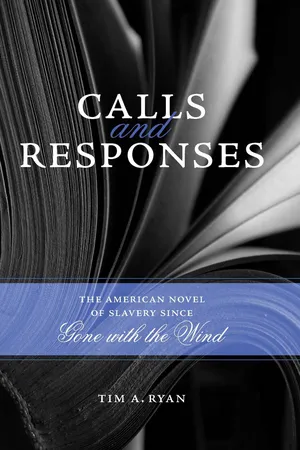
In this comprehensive, groundbreaking study, Tim A. Ryan explores how American novelists since World War I have imagined the institution of slavery and the experience of those involved in it. Complicating the common assumption that authentic black-authored fiction about slavery is starkly opposed to the traditional, racist fiction (and history) created by whites, Ryan suggests that discourses about American slavery are -- and have always been -- defined by connections rather than disjunctions. Ryan contends that African American writers didn't merely reject and move beyond traditional portrayals of the black past but rather actively engaged in a dynamic dialogue with white-authored versions of slavery and existing historiographical debates. The result is an ongoing cultural conversation that transcends both racial and disciplinary boundaries and is akin to the call-and-response style of African American gospel music.
Ryan addresses in detail more than a dozen major American novels of slavery, from the first significant modern fiction about the institution -- Margaret Mitchell's Gone with the Wind and Arna Bontemps's Black Thunder (both published in 1936) -- to recent noteworthy novels on the topic -- Edward P. Jones's The Known World and Valerie Martin's Property (both published in 2003). His insistence upon the necessity of interpreting novels about the past directly in relation to specific historical scholarship makes Calls and Responses especially compelling. He reads Toni Morrison's Beloved not in opposition to a monolithic orthodoxy about slavery but in relation to specific arguments of controversial historian Stanley Elkins. Similarly, he analyzes William Styron's The Confessions of Nat Turner in terms of its rhetorical echoes of Frederick Douglass's famous autobiographical narrative. Ryan shows throughout Calls and Responses how a variety of novelists -- including Alex Haley, Octavia Butler, Ishmael Reed, Margaret Walker, and Frances Gaither -- engage in a dynamic debate with each other and with such historians as Herbert Aptheker, Charles Joyner, Eugene and Elizabeth Genovese, and many others.
A substantially new account of the development of American slavery fiction in the last century, Calls and Responses goes beyond merely exalting the expression of black voices and experiences and actually reconfigures the existing view of the American novel of slavery.
- 272 pages
- English
- ePUB (mobile friendly)
- Available on iOS & Android
eBook - ePub
About this book
Information
Subtopic
HistoriographyIndex
Literature1
Designs against Tara
REPRESENTING SLAVERY IN AMERICAN CULTURE, 1936–1944
In 2001, Alice Randall’s The Wind Done Gone—a parodic rejoinder to Margaret Mitchell’s perennially popular 1936 melodrama, Gone with the Wind—reignited cultural debates about representations of race and slavery in American fiction, as well as legal controversies about the acceptable limits of postmodern intertextuality. Some critics made grandiose claims for The Wind Done Gone, one asserting that “Randall has achieved what some might have deemed impossible: She has burst the bubble of a cherished American myth, exposing the inherent racism and injustice of a chunk of Americana that has loomed over the landscape of our popular fiction for 65 years” (Goss 1). The trust that owns the copyright to Gone with the Wind was rather less impressed, however, and promptly brought suit against Randall for unauthorized use of Mitchell’s creations.1 At the hearing, Judge Charles A. Pannell Jr. refused to consider debates about unequal access to historical discourse. “The question before the court,” he proclaimed, “is not who gets to write history, but rather whether Ms. Randall can permeate most of her new critical work with the copyrighted characters, plot, and scenes from Gone with the Wind” (quoted in Miller 1).
Both the legal wrangling and the critical praise for Randall’s puncturing of racist myths suggest that The Wind Done Gone stages an innovative challenge to a once-hegemonic discourse about slavery and race in American culture. Conventional wisdom suggests that such counternarratives to the official historical record are very much a product of contemporary culture and postmodernism. According to such a view, there is little that is subversive in the traditional historical novel. This critical orthodoxy has diverted literary scholars from a full appreciation and proper examination of dissenting historical counternarratives produced by novelists in the first half of the twentieth century.
In his comprehensive study, Slavery and Race in American Popular Culture, William Van Deburg provides a sharp critique of Gone with the Wind as both book and film, but he refers only in passing to a powerful and subversive novel about slavery by an African American writer published the very same year as Mitchell’s opus—Arna Bontemps’s Black Thunder, a dramatic recreation of the Richmond slave rebellion of 1800. Van Deburg also glosses over a striking fictional portrayal of slavery and insurrection produced by a white writer in this era: he buries in his footnotes a single passing reference to Frances Gaither’s impressive tale of an 1835 slave revolution in Mississippi, The Red Cock Crows (1944) (104–6, 125–27, 206). While largely neglected by literary scholarship, Black Thunder and The Red Cock Crows vividly demonstrate that both black and white writers in the 1930s and 1940s challenged romanticized representations of slavery and racist constructions of slave psychologies long before the emergence of postmodernism or the modern civil rights movement.2
Both Black Thunder and The Red Cock Crows oppose the unashamedly white southern view of slavery presented in such works of history as Ulrich B. Phillips’s American Negro Slavery (1918) and later popularized by Mitchell’s novel. Contrary to his late-nineteenth-century New England predecessors and his African American contemporaries in the discipline of history, Phillips argues that American slaves were “by racial quality submissive rather than defiant, light-hearted instead of gloomy, amiable and ingratiating instead of sullen, and whose very defects invited paternalism rather than repression.” For Phillips, the authority of the slaveholder was “benevolent in intent and on the whole beneficial in effect,” and relations between masters and slaves “on both sides were felt to be based on pleasurable responsibility” (341–42, 328, 329). The fictions of Bontemps and Gaither dispute that slavery was such a harmonious system and that enslaved African Americans were loyal and content. Instead, their novels present slave populations that actively desire freedom and whose members are prepared to take daring and revolutionary steps to achieve it.
If Black Thunder and The Red Cock Crows persuasively critique the Phillips view of slavery, they are, unfortunately, insufficient as counternarratives to his famous literary successor. Gone with the Wind’s construction of slavery is rather more complex than the traditional white southern paternalist racism of Phillips’s historical study. Bontemps’s and Gaither’s novels fail to rival the mythic power of Gone with the Wind partly because they do not adequately critique Mitchell’s depiction of slavery as a system oriented around class rather than race. Neither do Black Thunder and The Red Cock Crows address gender roles and relations within slavery in ways that sufficiently challenge the orthodoxies of Mitchell’s portrayal of antebellum southern society. There was an influential shift in slavery historiography in the 1930s and 1940s, which saw the racist platitudes of Phillips supplanted by a leftist interpretation of slavery—epitomized by the vision of militant slave resistance presented in Herbert Aptheker’s American Negro Slave Revolts (1943). In fiction of this period, however, neither black nor white writers constructed narratives about slavery that constitute a sufficiently radical departure from the world of Gone with the Wind.
Conflicting Visions of Slavery and Class in Gone with the Wind and American Negro Slave Revolts
The popular success of Mitchell’s fiction, both as literary bestseller and Hollywood phenomenon, provided widespread legitimization for the traditional white southern view of slavery—just as it was becoming anachronistic in historiography. Gone with the Wind encapsulates the moonlight-and-magnolias image of the antebellum South in its idyllic portrait of life on the Tara plantation in Georgia, with its benign slavery and contentedly loyal slaves. Mitchell’s novel also provides a mournful portrait of the destruction of this society by the Civil War. Yet Gone with the Wind also modifies this myth in an unusual way. While the novel is often openly racist, it obfuscates the nature of slavery and consequent divisions in American society by constructing them as issues of social class rather than race. Mitchell’s approach has confounded her critics and potential challengers ever since.
Mitchell’s frequent white supremacist editorializations in her novel often obscure the fact that the world of Gone with the Wind is organized fundamentally along class lines, not racial ones. The admirable characters and primary protagonists of the novel are either members of the white southern planter aristocracy or the black house servant class. All of Mitchell’s famous characters—Scarlett O’Hara, Rhett Butler, Ashley and Melanie Wilkes, Mammy, Prissy, and Uncle Peter—belong to one of these elite groups. The peripheral, largely anonymous, and often villainous masses in the book— alongside the Yankees—are disreputable poor southern whites and the dis-loyal lower class of slaves: the field hands.3
Gone with the Wind presents a slave population that is split dramatically between the exceptional class of house slaves—which is vividly dramatized in the novel—and the lowly caste of field hands—which is utterly invisible during the novel’s antebellum scenes and which remains faceless and anonymous throughout the remainder of the narrative. Mitchell’s book argues that slavery operated as a fair and just meritocracy for African Americans by providing a system in which the talented, responsible, and industrious earned liberal rewards: “[P]lantation mistresses throughout the South had put the pickaninnies through courses of training and elimination to select the best of them for the positions of greater responsibility. Those consigned to the fields were the ones least willing or able to learn, the least energetic, the least honest and trustworthy, the most vicious and brutish” (654). Gone with the Wind thus suggests that people became field hands in slavery not because of an oppressive labor system organized around race, but because they proved incapable of fulfilling higher social occupations and roles despite the opportunities supposedly given them. Mitchell’s text presents those slaves who successfully passed these training courses as a monolithic group: a black upper class, whose members, without exception, utterly identify with the South’s white aristocrats rather than with lower-class members of their own race. Mammy, for example, is proud that she was born in the “great house, not in the quarters, and had been raised in Ole Miss’ bedroom” (454).
Lower-class blacks only assume significance (and then only as a group rather than as individuals) in Gone with the Wind’s second half, which is set after the Civil War. Like its portrayal of slavery, however, the novel’s white southern propagandist portrayal of Reconstruction—in which “the negroes were living in leisure while their former masters struggled and starved”—is articulated specifically in terms of class rather than race. After Appomattox, the narrative claims, “[t]housands of house servants, the highest caste in the slave population, remained with their white folks…. [B]ut the hordes of ‘trashy free issue niggers,’ who were causing most of the trouble, were drawn largely from the field-hand class” (657, 654).
As the loyal black butler, Pork, points out, it is only “dem trashy niggers” that choose to follow the Yankees and assert their freedom rather than to stay behind to help their defeated masters. The novel explicitly identifies those blacks who are audacious enough to want to vote, who insolently push whites off sidewalks, and who supposedly perpetrate a “large number of outrages” against white women as being members of the lower class (407, 656). Scarlett O’Hara is shocked at reports of black “impudence” because “she had never seen an insolent negro in her life.” Scarlett, of course, has known only well-bred house slaves, not the vulgar lower class that is capable of “outrages” against whites. Mammy, although black, is herself scathing toward the “impident lookin’ ” and “trashy” “[f]ree issue country niggers” who flood Atlanta after the war (521, 555, 598). While loyal former house slaves like Uncle Peter are “far too well bred to want to vote” (561), the “former field hands found themselves suddenly elevated” to positions of power in the Georgia state legislature: “There they conducted themselves as creatures of small intelligence might naturally be expected to do. Like monkeys or small children turned loose among treasured objects whose value is beyond their comprehension, they ran wild—either from a perverse pleasure in destruction or simply because of their ignorance” (654). While Mitchell’s racial prejudices are palpable in this passage, the novel always rhetorically constructs those prejudices in terms of class: in Gone with the Wind, it is specifically lower-class blacks who are ignorant, childlike creatures of little intelligence.
Similarly, Mitchell’s novel identifies black sexual assault of white women as a crime perpetrated exclusively by lower-class African Americans. In one scene, Scarlett is menaced by a black rapist from the sinister Shantytown, the population of which consists of “outcast negroes, black prostitutes and a scattering of poor whites of the lowest order” (777–78). She is saved from assault only by the sudden reappearance of Sam, the loyal Tara driver. Again and again, Gone with the Wind distinguishes between decent, three-dimensional, elite African Americans—who play a positive and constructive role in southern society—and brutish, anonymous, lower-class blacks, who are ill-equipped for the responsibilities of freedom and who threaten social stability.
Occasionally, the text obfuscates the degree to which it has constructed a rigid division between slave classes. When Sam rescues Scarlett from the Shantytown rapist, he tells his former mistress of his experiences in the North. He reports being particularly shocked by the inability of Yankees to distinguish between house servants and a mere field hand like himself (780). The fact remains, however, that Sam was not an average slave but the driver at Tara. As Eugene Genovese observes, drivers “acted as foremen of the labor gangs and supervisors of the decorum of the quarters” and frequently “became the most important slaves on the place and often knew more about management than did the whites” (Roll 365–66). Sam may not be a house servant, but he is still as much a part of the black upper class as Mammy or Pork. In short, the one decent “field hand” in the novel is socially quite distinct from his supposed fellows. Like the house servants, Sam, too, identifies with the white aristocracy, not with members of his own race.
It is not simply that black house servants consider themselves superior to lower-class people of color in Gone with the Wind. In the novel’s ante-bellum scenes, the elite slaves of Tara fervently believe that their association with the white master class places them higher in the social hierarchy than such nonslaveholding whites as the Wilkerson and Slattery families: “The house negroes of the County considered themselves superior to white trash, and their unconcealed scorn stung [Tom Slattery], while their more secure position in life stirred his envy. By contrast with his own miserable existence, they were well-fed, well-clothed and looked after in sickness and old age. They were proud… to belong to people who were quality, while he was despised by all” (49–50). Mammy even objects to the philanthropic devotion of Scarlett’s mother, Ellen O’Hara, to the local poor whites, opining that “Dey is de shiflesses, mos’ ungrateful passel of no-counts livin’. An’ Miss Ellen got no bizness weahin’ herseff out waitin’ on folks dat did dey be wuth shootin’ dey’d have niggers ter wait on dem” (65). The narrative, furthermore, validates Mammy’s judgment, for it is through nursing the typhoid-ridden Slatterys that Ellen contracts the disease herself and dies.
Few lower-class white characters play a significant role in the novel, and the book’s rhetoric demonizes those few to the same extent that it demonizes the black field hand class. Early in the narrative, Ellen discharges Jonas Wilkerson, the Tara plantation’s Yankee overseer, for casually impregnating the unmarried lower-class Emmie Slattery. Wilkerson re-emerges during Reconstruction as a grasping carpetbagger with ambitions to extort Tara from its rightful owners. The lower-class white characters who are introduced in the novel’s second half are even less appealing. An enigmatic brute named Archie, who briefly serves as Scarlett’s coachman, has an irrational, obsessive hatred of all blacks, women, and northerners. Johnnie Gallegher, the foreman at Scarlett’s mill, exploits its convict laborers so cruelly that even the ruthless Scarlett is shocked (750, 783–87). The only working-class white character to emerge from the novel with any integrity and decency is the Confederate veteran Will Benteen, who—like the elite blacks in the book—dedicates himself to helping Tara’s struggling aristocrats after the Civil War, and who wins the hand of Scarlett’s sister in marriage as a reward for his loyalty. What bestows virtue and nobility upon a lower-class person in Gone with the Wind, whether white or black, is dedication to the cause of the aristocracy and the social status quo. Benteen, Mammy, Uncle Peter, and their ilk become honorary members of the white upper class by committing themselves to its welfare and its status.
For all her overt racism, then, Mitchell constructs her romanticized portrait of slavery and her demeaning portrayal of African Americans in Gone with the Wind chiefly in terms of class. Mitchell’s racial prejudices are undeniable, but the rhetoric of her novel judges particular classes, not races of people.4 It is thus not sufficient for a critique of the novel merely to challenge its idealized portrayal of the institution of slavery and its patronizing depictions of African Americans. A true counternarrative to Gone with the Wind must dismantle, and provide alternatives to, the constructions of class that undergird the book’s conceptualization of southern society.
One of the key historical studies of slavery published before the 1950s, Herbert Aptheker’s American Negro Slave Revolts (1943), is just such a counternarrative. Aptheker’s central purpose was to challenge the view of slavery, propounded by Phillips and his supporters, which claimed that African Americans were “easily intimidated [and] incapable of deep plots” (quoted in Aptheker, American 12). Indeed, the very title of Aptheker’s work echoes and subverts the title of Phillips’s most famous study, American Negro Slavery. In answer to the assertions of Phillips and his followers, American Negro Slave Revolts provides an extensive catalog of slave rebellions and establishes the existence of a significant tradition of collective resistance by American slaves. Furthermore, Aptheker’s subsidiary theses explicitly address the class dimensions of slave insurrection: “Two additional facts of particular interest appear from the study. These are, first, that occasionally the plans or aspirations of the rebels were actually reported as going beyond a desire for personal freedom and envisioning, in addition, a property redistribution; and, second, that white people were frequently implicated—or believed to be implicated—with the slaves in the plans or efforts to overthrow the master class by force” (American 162–63). Aptheker’s qualification of this second point—“believed to be implicated”—indicates a significant tension in his argument. As a card-carrying Communist, Aptheker aims to demonstrate that African American slaves and working-class whites often united across racial lines because of a sense of shared class interests. Throughout his study, Aptheker emphasizes the contributions of proletarian whites to acts of slave resistance. At the same time, however, Aptheker challenges the prevalent idea that slave rebellions were rare and that when they did occur they were usually instigated and led by white abolitionists. Consequently, then, in order to assert that slaves were autonomously militant and did not depend upon white aid and inspiration to revolt, Aptheker’s text frequently disputes alleged connections between white abolitionists and slave insurrections. “It is simple,” he argues, “to find any number of statements intimating or boldly affirming that the Abolitionists were responsible for slave unrest… but is far from simple to find substantiation for these assertions” (American 105). In short, Aptheker found himself in the complicated position of attempting to demonstrate, on one hand, that reports of slave revolts planned by white conspirators are erroneous, whereas, on the other hand, reports of insurrections organized by slaves themselves, but which involved white allies as equals, are genuine.
This may sound like a torturous argument, but recent historiography tends to confirm its accuracy. While even sympathetic scholars have concluded that Aptheker significantly overstated the number of slave rebellions, several contemporary historians substantiate his characterization of slave insurrections as being often class-oriented and sometimes interracial in nature—with whites involved as equal allies, not leaders. In Gabriel’s Rebellion (1993), Douglas Egerton argues that the 1800 Richmond slave conspiracy was as much a class rebellion as it was a racial one. From his analysis of the trial testimony, Egerton concludes that Gabriel, the insurrection’s leader, defined his enemy as the merchants who dominated Richmond’s economy, not whites in general. In addition, Gabriel ordered that all those “friendly to liberty”—Quakers, Methodists, Frenchmen, and poor white women—should be spared during the planned assault on Richmond, and he apparently even recruited several working-class whites to his campaign, with the hope that others would join when the revolution began. Furthermore, a white ship’s captain almost transported Gabriel to safety after the failure of the plot (28, 51, 56, 49, 104–6, 177). Egerton also finds compelling evidence that two mysterious Frenchmen—Charles Quersey and Alexander Beddenhurst (who becomes Biddenhurst in Arna Bontemps’s Black Thunder)— played a significant role in the uprising (182–85). Gabriel’s insurrection is far from the only American slave rebellion that seems to have possessed a class dimension as well as a racial one. Recent studies of Denmark Vesey’s 1822 conspiracy suggest that the former slave who aimed to burn Charleston to the ground also had his white sympathizers. According to Edward Pearson, in the aftermath of the abortive Vesey plot, one white man told a group of free blacks that there should be an attempt to rescue the imprisoned black conspirators (145–47). Finally, Stephen B. Oates notes that even the messianic Nat Turner spared one white household when he blazed his trail of destruction through rural Virginia, apparently “because he believed the poor white inhabitants ‘thought no better of themselves than they did of negroes’ ” (88).
The feasibility of such active interracial sympathies and even alliances among the lower classes is something that Gone with the Wind essentially denies. While repeatedly asserting the common values and interests of aristocratic whites and black house servants, Mitchell’s novel resolutely refuses to address the corresponding possibility that lower-class whites and blacks...
Table of contents
- COVER
- TITLE PAGE
- COPYRIGHT PAGE
- CONTENTS
- PREFACE
- Introduction: CALLS AND RESPONSES
- 1. Designs against Tara: REPRESENTING SLAVERY IN AMERICAN CULTURE, 1936–1944
- 2. From Tara to Turner: SLAVERY AND SLAVE PSYCHOLOGIES IN AMERICAN FICTION AND HISTORY, 1945–1968
- 3. You Shall See How a Slave Was Made a Woman: THE DEVELOPMENT OF THE CONTEMPORARY NOVEL OF SLAVERY, 1976–1987
- 4. Scarlett and Mammy Done Gone: COMPLICATIONS OF THE CONTEMPORARY NOVEL OF SLAVERY, 1986–2003
- 5. Mapping the Unrepresentable: SLAVERY FICTION IN THE NEW MILLENNIUM
- Conclusion: BEYOND BL ACK AND WHITE
- APPENDIX: Major Historical Studies, Fiction, Drama, Films, and TV Presentations since 1918 concerning Slavery in the United States
- NOTES
- WORKS CITED
- INDEX
Trusted by 375,005 students
Access to over 1.5 million titles for a fair monthly price.
Study more efficiently using our study tools.
Frequently asked questions
Yes, you can cancel anytime from the Subscription tab in your account settings on the Perlego website. Your subscription will stay active until the end of your current billing period. Learn how to cancel your subscription
No, books cannot be downloaded as external files, such as PDFs, for use outside of Perlego. However, you can download books within the Perlego app for offline reading on mobile or tablet. Learn how to download books offline
Perlego offers two plans: Essential and Complete
- Essential is ideal for learners and professionals who enjoy exploring a wide range of subjects. Access the Essential Library with 800,000+ trusted titles and best-sellers across business, personal growth, and the humanities. Includes unlimited reading time and Standard Read Aloud voice.
- Complete: Perfect for advanced learners and researchers needing full, unrestricted access. Unlock 1.5M+ books across hundreds of subjects, including academic and specialized titles. The Complete Plan also includes advanced features like Premium Read Aloud and Research Assistant.
We are an online textbook subscription service, where you can get access to an entire online library for less than the price of a single book per month. With over 1.5 million books across 990+ topics, we’ve got you covered! Learn about our mission
Look out for the read-aloud symbol on your next book to see if you can listen to it. The read-aloud tool reads text aloud for you, highlighting the text as it is being read. You can pause it, speed it up and slow it down. Learn more about Read Aloud
Yes! You can use the Perlego app on both iOS and Android devices to read anytime, anywhere — even offline. Perfect for commutes or when you’re on the go.
Please note we cannot support devices running on iOS 13 and Android 7 or earlier. Learn more about using the app
Please note we cannot support devices running on iOS 13 and Android 7 or earlier. Learn more about using the app
Yes, you can access Calls and Responses by Tim A. Ryan in PDF and/or ePUB format, as well as other popular books in Literature & Historiography. We have over 1.5 million books available in our catalogue for you to explore.