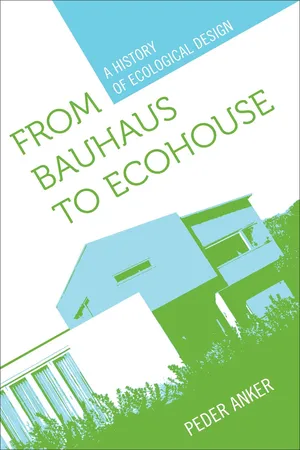
Global warming and concerns about sustainability recently have pushed ecological design to the forefront of architectural study and debate. As Peder Anker explains in From Bauhaus to Ecohouse, despite claims of novelty, debates about environmentally sensitive architecture have been ongoing for nearly a century. By exploring key moments of inspiration between designers and ecologists from the Bauhaus projects of the interwar period to the eco-arks of the 1980s, Anker traces the historical intersection of architecture and ecological science and assesses how both remain intertwined philosophically and pragmatically within the still-evolving field of ecological design.
The idea that science could improve human life attracted architects and designers who looked to the science of ecology to better their methodologies. Walter Gropius, the founder of the Bauhaus school, taught that designed form should follow the laws of nature in order to function effectively. With the Bauhaus movement, ecology and design merged and laid the foundation of modernist architecture.
Anker discusses in detail how the former faculty members of the Bauhaus school—including László Maholy-Nagy and Herbert Bayer—left Nazi Germany in the mid-1930s and engaged with ecologists during their "London period" and in the U.S. A subsequent generation of students and admirers of Bauhaus, such as Richard Buckminster Fuller and Ian McHarg, picked up their program, and—under the general banner of merging art and science in the design process—Bauhaus-minded architects began to think ecologically while some ecologists lent their ideas to design.
Anker charts complicated currents of ecological design thought spanning pre—and post—World War II and through the cold war, including pivotal changes such as the emergence of space exploration and new theories on closed-system living in space capsules, space stations, and planetary colonies. Space ecology, Anker explains, inspired leading landscape designers of the 1970s, who used the imagined life of astronauts as a model for how humans should live in harmony with nature. Theories of how to design for extraterrestrial living impacted design and ecological thinking for earth-based living as well, as evidenced in Disney's Spaceship Earth attraction as well as in the Biosphere 2 experiments in Arizona in the early 1990s.
Illuminating important connections between theories about the relationship between humans and the built environment, Anker's provocative study provides new insight into a critical period in the evolution of environmental awareness.
- 189 pages
- English
- ePUB (mobile friendly)
- Available on iOS & Android
eBook - ePub
About this book
Information
Topic
ArchitectureSubtopic
Architecture General1 THE BAUHAUS OF NATURE
In 1937 the biologist and ecologist Julian Huxley hosted a sumptuous farewell dinner party for Walter Gropius upon the occasion of the latter’s departure from London to become head of the Harvard School of Design. This major event took place at the fashionable Trocadero, on Oxford Street, with a guestlist that reads like a who’s who of modernist design in England.1 Strangely, among the guests one also finds prominent ecological scientists and environmentalists, which raises the question why they were invited to the festivity. Ecologists would seem to be unlikely guests at a party in honor of a Bauhaus architect. Social gatherings are often telling indications of an intellectual climate, however, and Gropius’s farewell dinner was no exception. What brought Bauhaus designers and ecologists together, I will argue, was a shared belief that the human household should be modeled on the household of nature.
THE LONDON BAUHAUS
The arrival of former Bauhaus faculty members in London energized the city’s designers and intellectuals. After fleeing from Nazi harassment, Walter Gropius (who arrived in 1934 and left in 1937), Marcel Breuer, László Moholy-Nagy (both of whom were there from 1935 to 1937), and Herbert Bayer (who visited briefly in 1937) were able to meet again as a group, something they had been unable to do since Gropius’s 1928 resignation from the Dessau school in Germany. They set forth to reestablish the Bauhaus school in London.2 The guestlist for Gropius’s farewell dinner is an indication of who responded favorably to their ambition. Those attending the party may be labeled the “London Bauhaus.” What brought the group of designers, town planners, and environmentalists together was a shared belief that Bauhaus design could solve social as well as environmental problems.
The former Bauhaus faculty settled in the Hampstead section of London, which at the time was a community of avant-garde designers, intellectuals, and artists. They moved into a brand-new apartment complex, the Lawn Road Flats—also known as the Isokon Building—the first modernist residence in London. Designed by Wells Coates, the building featured a common room, and there were laundry, cleaning, meal, and garage services. From his window Moholy-Nagy could enjoy a garden of “only trees, which is very peaceful, especially in London.”3
The list of carefully selected tenants included a host of left-leaning intellectuals and designers, who enjoyed what Gropius described as “an exciting housing laboratory, both socially and technically.” Technically, the building was to be a true machine for living, with state-of-the-art furniture and novelties like built-in cooking and washing facilities. Socially, the apartment complex was to promote collective life and liberate the tenants from the burden of personal possessions.4 Both Moholy-Nagy and Gropius suffered from the language barrier; the latter spoke only “three words of English.”5 Yet they were able to overcome the obstacle thanks to the communal spirit of the Flats. The tenants were encouraged to nurture a fellowship modeled on the Bauhaus workshop, and the school’s faculty were recruited as tenants to secure the intellectual climate for what in effect was a socialist architectural experiment. The building was to function like a park, where people could come and go, and it quickly became a hub for the promotion of Bauhaus design.
As the building’s architect, Coates was in the midst of gatherings that soon evolved into the Modern Architectural Research Group, or MARS. This group had about sixty members and included notable designers such as Moholy-Nagy, Gropius, Maxwell Fry (who collaborated with Gropius on several projects), Serge Chermayeff, Morton Shand, Godfrey Samuel, John Gloag, and the Russian émigré Berthold Lubetkin (who arrived in London in 1930), as well as the young Danish engineer Ove Arup (who was a frequent visitor at the Lawn Road Flats).6
They would all meet in the common room, known from 1937 as the Isobar Club, which was designed by Breuer. During his London years Breuer temporary abandoned his trademark tubular steel furniture and began to experiment with plywood. This was very much in the spirit of the debates at the Lawn Road Flats, which focused on ways in which one could build in harmony with the human body and incorporate organic materials and processes in furniture construction. The result was a series of wood-only tables and chairs known as the Isokon Laminated Furniture series, produced by Jack Pritchard. It includes Breuer’s famous masterpiece of modernist furniture, the Isokon Chaise Longue Chair of 1936.
The brothers Aladar and Victor Olgyay were two visitors who enjoyed the Isobar Club with Breuer. They met in London in 1937, the year they completed their Városmajor Utca housing project in Budapest, which immediately caught Breuer’s attention. The housing project embraced the garden and rejected the street:
The most essential characteristic about this house is its preferring not to face the street. Not because this particular street in Buda would be distasteful. On the contrary, it is attractive. No architect would have dared twenty or thirty years ago to build a house in which the inhabitants would have no view of the street. The street is the living artery of the town. Why should we hate it? But the street represents noise, dust and distraction; why—we ask today—should the house be overwhelmed by it, with our leisure disturbed, and even our breathing poisoned by infected air? [Instead they] planned a reverse house backing the street, facing completely the garden. . . . Every room faces the hill and the big trees of the garden. . . . every flat can enjoy the garden air.7
The Olgyay brothers would later flee from Budapest to New York, where they would explore, among other things, solar control and shading devices in an attempt to develop bioclimatic design.8
Their rejection of the street and embracement of the garden represents the kind of issues debated by MARS members at the Isobar Club in the 1930s in discussions that generally focused on the role of biology in the reshaping of society. The MARS group became advocates of environmental sensitivity: “There must be no antagonism between architecture and its natural setting,” they pointed out in their exhibition manifesto of 1938. A drawing of a tree growing through a building was to illustrate that “the architecture of the house embraces the garden. House and garden coalesce, a single unit in the landscape.”9 Or as Gropius pointed out, “The utilization of flat roofs as ‘grounds’ offers us a means of re-acclimatizing nature amidst the stony deserts of our great towns; for the plots from which she has been evicted to make room for buildings can be given back to her up aloft. Seen from the skies, the leafy house-tops of the cities of the future will look like endless chains of hanging gardens.”10
This appeal reflected values and ideas promoted by environmentalists such as Clough Williams-Ellis, who thought modernist design could save Britain from ecological destruction. Later hailed by Lewis Mumford as the founder of the ecological movement, Williams-Ellis became known for his England and the Octopus, of 1928, in which he rages against the evils of aesthetic and physical pollution of the countryside.11 Along with Patrick Abercrombie, professor of town planning at London University, Williams-Ellis was on a crusade against unregulated development of the English landscape. Both he and John Summerson, with whom he coauthored Architecture Here and Now, had a progressive view of history. For them, modern architecture, with its focus on light and fresh air, represented advancement in public health as well as a remedy that could halt environmental destructions of past developments. As the historian Paul Overy has shown, there was a general effort among modernists to design buildings so that they provided light, air, and openness and thus health to their users.12 Bauhaus design was particularly promising because it hailed a regeneration of the craftwork Williams-Ellis associated with the traditional English cottage.13 This environmentalist group championed, as the historian David Matless has argued, a modernist ecological order and buildings, towns, and landscapes that benefited the people who lived in them. What they feared was individualism, laissez-faire development, and rustic nostalgia for the past. They were all welcomed by the MARS group as visitors at Lawn Road Flats, and all of them were on the guestlist for Gropius’s farewell party.
Another meeting place for the Bauhaus devotees was the residence of H. G. Wells, who also lived in Hampstead. He was one of the most famous writers of popular science, novels, and science fiction of his time, arguing that the human condition should be understood from an ecological point of view. From the late 1920s he used “human ecology” as his chief methodological tool. His home was known for what the bourgeois would call a salon, though his left-wing friends referred to them as meetings. Wells was a familiar figure in Soviet circles in London, where he engaged with Lubetkin as well as the Russian-born architect Chermayeff. It was through Wells’s secretary, Moura Budberg, that Wells also came to know the Hungarian film producer Alexander Korda, who expressed a desire to make a film based on Wells’s socialist ideas about architecture.14 One of the key debating points in their gatherings was the importance of evolutionary biology and ecology in understanding the history and future welfare of the working class and the environment. These ideas became particularly important to Chermayeff, who after moving to the United States became dedicated to environmental design.
The chief source of inspiration for Wells’s interest in ecology was Julian Huxley. As secretary of the Zoological Society, Huxley enjoyed a spacious residence at the London Zoo, which he had made into a showroom for modernist design. Here scientists, architects, urban planners, and the environmentalist circle around Williams-Ellis met for discussions. The group, also present at the Gropius farewell party, included Charles Herbert Reilly, William G. Holford, Conrad H. Waddington, Eric L. Bird, Edward Max Nicholson, and James E. R. McDonagh. Their program for saving mankind from environmental, economic, and social destruction through scientific planning found its voice in Political and Economic Planning Organisation, or PEP (see chapter 2).
LEARNING FROM NATURE’S WORKSHOP
The London writings of Moholy-Nagy may provide a preliminary window into the debates about the evolutionary survival of human species that took place at the Lawn Road Flats. There are only sparse discussions of his biological outlook in the literature about the Bauhaus, even though he stressed the importance of biology in his work and his educational program. The architectural historian Reyner Banham, for example, focuses almost exclusively on the importance of mechanization to modernist design in general and to Moholy-Nagy in particular, as does Kristina Passuth, Moholy-Nagy’s biographer, who also argues that Moholy-Nagy’s “activities became highly disparate, even to the point of fragmentation” during his London years.15 What might look like fragmentation was actually a relaunching of the Bauhaus as an ecologically inspired program of design.
The Hungarian-born Moholy-Nagy had been a professor in the metal workshop and responsible for teaching the preliminary design course at the Bauhaus in Weimar. He and Gropius had previously compiled a series of books about Bauhaus design that included his own Von Material zu Arkitektur (1929) in English under the title The New Vision (1930). For many English-speaking designers The New Vision provided their first encounter with Bauhaus research methods, and according to the architectural historian John Summerson, it was one of the few books that contained a comprehensive theory of modern architecture.16
In The New Vision Moholy-Nagy advised his readers to use “nature as a constructional model” and always look for “prototypes in nature” to determine functionality.17 Functionalism is a key word in the book. Moholy-Nagy believed that the future held a new harmony between humans and their earthly environment if forms in design followed biological functions. Nature’s evolutionary development was analogous to the development of an individual organism, he believed. This belief was based on the assumption that the evolutionary history of species in nature (the phylogeny) was recapitulated in the development of a human being (the ontogeny). It was consequently important to understand the processes in nature in order to determine the functionality of design for human beings. Functionalist design was a matter of saving society from the degeneration and criminality associated with traditional ornamental arts.18
Humans were governed by their biological nature. Consequently artifacts would only be functional if they were construed in relation to human biology, Moholy-Nagy explained in The New Vision. Bauhaus design was to “guarantee an organic development” by following the laws of nature; thus it was to allow its users to “follow biological rhythms” so that people’s daily “lives would be less hysterical and less empty.”19 That is why Moholy-Nagy stressed the importance of “striving toward those timeless biological fundamentals of expression” that could capture a person’s full human potential as an “integrated” being in terms of “biological functions” in “natural balance” with his or her “intellectual and emotional power.”20 The task of design was to create a culture that strengthened people’s ability to function biologically, and the way to achieve this end was to make sure that design mirrored the balance of nature. “Technical progress should never be the goal, but instead the means” for a healthy biological life, he argued.21 The biological welfare of the individual as an actor within the larger matrix of society and the larger environment was equally important. “Art, science, technology, education, [and] politics,” Moholy-Nagy argued, were all disciplines that contributed to the “rational safeguarding of organic, biologically conditioned functions” of society and the environment.22
The chief source of inspiration for this design program was the Hungarian biologist Raoul H. Francé. Though Francé is largely forgotten today, in the interwar period he was a bestselling author and director of the prestigious Biological Institute of the German Micrological Society in Munich. He was an outspoken defender of psychobiology, the theory that a certain dynamic psyche in living matter is a driving force in evolution. As one of the founders of soil ecology, he argued that the earth had a dynamic power that gave plants a psychic energy whose goal was evolutionary harmony among living organisms. Humans could benefit from the earth’s vital powers, Francé argued, if they learned to copy nature’s inventions. For example, he designed a salt shaker based on a plant’s technique for distributing seeds.
Toward the end of copying nature for the benefit of humans, Francé created bio-technique, the science of bionics. The aim of bionics was to study nature’s workshop to generate principles, techniqu...
Table of contents
- Cover Page
- Title Page
- Copyright Page
- Contents
- Acknowledgments
- Introduction
- 1 The Bauhaus of Nature
- 2 Planning the Economy of Nature
- 3 The New American Bauhaus of Nature
- 4 The Graphic Environment of Herbert Bayer
- 5 Buckminster Fuller as Captain of Spaceship Earth
- 6 The Ecological Colonization of Space
- 7 Taking Ground Control of Spaceship Earth
- 8 The Closed World of Ecological Architecture
- Conculsion: The Unification of Art and Science
- Cast of Characters
- Notes
- Index
- Illustrations
Trusted by 375,005 students
Access to over 1.5 million titles for a fair monthly price.
Study more efficiently using our study tools.
Frequently asked questions
Yes, you can cancel anytime from the Subscription tab in your account settings on the Perlego website. Your subscription will stay active until the end of your current billing period. Learn how to cancel your subscription
No, books cannot be downloaded as external files, such as PDFs, for use outside of Perlego. However, you can download books within the Perlego app for offline reading on mobile or tablet. Learn how to download books offline
Perlego offers two plans: Essential and Complete
- Essential is ideal for learners and professionals who enjoy exploring a wide range of subjects. Access the Essential Library with 800,000+ trusted titles and best-sellers across business, personal growth, and the humanities. Includes unlimited reading time and Standard Read Aloud voice.
- Complete: Perfect for advanced learners and researchers needing full, unrestricted access. Unlock 1.5M+ books across hundreds of subjects, including academic and specialized titles. The Complete Plan also includes advanced features like Premium Read Aloud and Research Assistant.
We are an online textbook subscription service, where you can get access to an entire online library for less than the price of a single book per month. With over 1.5 million books across 990+ topics, we’ve got you covered! Learn about our mission
Look out for the read-aloud symbol on your next book to see if you can listen to it. The read-aloud tool reads text aloud for you, highlighting the text as it is being read. You can pause it, speed it up and slow it down. Learn more about Read Aloud
Yes! You can use the Perlego app on both iOS and Android devices to read anytime, anywhere — even offline. Perfect for commutes or when you’re on the go.
Please note we cannot support devices running on iOS 13 and Android 7 or earlier. Learn more about using the app
Please note we cannot support devices running on iOS 13 and Android 7 or earlier. Learn more about using the app
Yes, you can access From Bauhaus to Ecohouse by Peder Anker in PDF and/or ePUB format, as well as other popular books in Architecture & Architecture General. We have over 1.5 million books available in our catalogue for you to explore.