As a boy, James Twitchell heard stories about his ancestors in Louisiana and even played with his great-grandfather's Civil War sword, but he never appreciated the state and the events that influenced a pivotal chapter in his family history. His great-grandfather, Marshall Harvey Twitchell, a carpetbagger from Vermont, had settled in upstate Louisiana during Reconstruction, married a local girl, and encountered much success until a fateful day in August 1874. The dramatic story of the elder Twitchell's life and near assassination fuels the author's pursuit of his family's history and a true understanding of the South.
In Look Away, Dixieland, Vermont-native Twitchell sets out from his current home inFlorida on the inauguration day of America's first black president to find the "real" South and to try to understand the truth about his illustrious ancestor. He travels in an RV from Georgia's Okefenokee Swamp across Alabama and Mississippi to Coushatta, Louisiana. As he drives through the heart of Dixie, Twitchell sorts through the prejudices he learned from his northern rearing. In searching for the culture he had held at arm's length for so long, he tours small-town southern life -- in campgrounds, cotton gins, churches, country fairs, and squirrel dog kennels -- and uncovers some fundamental truths along the way. Notably, he discovers that prejudices of race, class, and ideology are not limited by geography. As one man from Georgia mockingly summed up North versus South stereotypes, "Y'all are rude and we're stupid."
Unexpectedly, Twitchell also uncovers facts about his great-grandfather and sheds new light on his family's past. An enlightening, humorous, and refreshingly honest search, Look Away, Dixieland reveals some of the differences and similarities that ultimately define us as a nation.
eBook - ePub
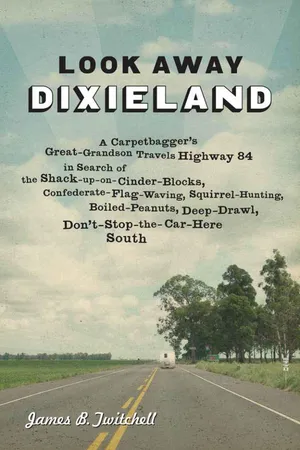
Look Away Dixieland
A Carpetbagger's Great-Grandson Travels Highway 84 in Search of the Shack-up-on-Cinder-Blocks, Confederate-Flag-Waving, Squirrel-Hunting, Boiled-Peanuts, Deep-Drawl, Don't-Stop-the-Car-Here South
- 192 pages
- English
- ePUB (mobile friendly)
- Available on iOS & Android
eBook - ePub
Look Away Dixieland
A Carpetbagger's Great-Grandson Travels Highway 84 in Search of the Shack-up-on-Cinder-Blocks, Confederate-Flag-Waving, Squirrel-Hunting, Boiled-Peanuts, Deep-Drawl, Don't-Stop-the-Car-Here South
About this book
Information
Subtopic
North American HistoryIndex
History
The Red River Valley.
What Really Happened
The past is a foreign country: they do things differently there.
—L. P. HARTLEY, The Go-Between
—L. P. HARTLEY, The Go-Between

We were going to be shown around Coushatta and the environs by a local historian, Joe Taylor, a retired plant manager for a now shut-down Sunbeam plant. Joe is a history buff and knows just about every step that MHT had taken. That’s no mean feat because almost all the action—the massacre and the attempted assassination—took place on the banks of the Red River, and the river has either completely changed course thanks to natural causes, or else been penned in and pushed aside by the irrepressible Army Corp of Engineers.
As with all the big rivers we had seen crossing Dixie (the Flint, the Alabama, the Chattahoochee, the Tombigbee, the Mississippi), the U.S. government was talked into controlling the Red, putting in levees, dams, locks, spillways, and removing all the pretzel twists and backflows that had characterized it generations ago. In MHT’s time, in dry spells, boat traffic got held up in Coushatta, unable to make the turn north. Occasionally, you could wade across the river to Starlight Plantation passing grounded steamboats.
No longer. The plantation itself is now deep underwater. Like it or not, the river is of uniform depth all year long. It’s been channelized. In one of the unintended consequences of government improvement, no sooner did the river get turned into a barge canal than the railroads cut their shipping rates. Now only a handful of barges make a weekly passage past Coushatta. Bass fishermen are happy; in fact, they are the major beneficiaries. Second in line: RV owners, who can camp out for a pittance on the grounds still managed by the Corp of Engineers. Joe knows this well. He owns an RV that makes mine look like an ice-cream truck.
Colfax
We decided to start our exploration by going south on U.S. 84 to Colfax and working our way back to Coushatta. That way we’d be moving, in a sense, along both the X and Y axes and maybe appreciate better what had happened in the 1870s. I had written to the Red River Heritage Association, and they had put me in touch with a local historian named Avery Hamilton. I had corresponded with Avery, who seemed delightful except that he included a Bible verse with his e-mail signature line. I feared I was going to get an old-style “it was a riot of ungodly blacks” interpretation of what happened in Colfax.
I mentioned to Joe that we were going first to Colfax and invited him along. He said he didn’t know much about what had happened in Colfax, which surprised me because the events along the river seemed so connected. Sparks from Colfax lit the tinder in Coushatta. But I was to find out later that this oversight was not strange. Much of local Louisiana history is not known from parish to parish. For instance, in Colfax no one I talked to had heard of the Coushatta massacre.
I don’t know what to make of this selective knowledge other than that northern Louisiana is tribal. Family history is really deep, parish history (as counties are called) is deep, regional history is adequate, but what-happened-over-the-hill is shallow. In addition, northern Louisiana doesn’t pay much attention to southern Louisiana. And vice versa. This is more than the two Californias or the two Floridas. The southern state is self-consciously French and Spanish, creole, mulatto … and cosmopolitan, while the northern is still frontier, sometimes gleefully redneck, and proudly provincial. If north Florida is culturally south Georgia, then north Louisiana is really east Texas. I got the feeling the two Louisianas enjoy not getting along. Maybe this explains the helter-skelter politics and maybe a bit of the shoving matches.
On the way down to Colfax, Joe explained to us how to read the countryside: if you saw a patch of jonquils or daffodils out in a field that usually meant that a house had once been there; a ramshackle doublepen shack could have been a converted slave cabin; a small barn with a little hooded roof was an old commissary where sugar, flour, coffee, and shoes were sold to plantation workers. Joe could tell at a half mile if that little church out in the distance was black Baptist or white.
This part of the Red River valley was rolling land, not flat enough to be profitable for large-scale farming of cotton, rice, or sugar, so it didn’t have a real slave population. Prior to the 1830s, the river was too unstable to be used for transportation and hence you couldn’t get the crops to market. The land was opened up after the Civil War when the “raft”—the massive logjam—in the river was removed by snag boats and plenty of a new invention, dynamite.
So the glory days of a place like Colfax were between 1860 and 1920, when the river was deep enough for navigation and long enough to carry produce between Shreveport and New Orleans. Driving through the town now you could see the vestiges of palmier days, the stately old hotel, the grand bank with columns, a few big Victorian houses. But those days were short-lived. The tractor ushered in large-scale farming and Walmart ushered out downtown business. And, as we were first aware in Jena, once the white/black ratios moved away from 60/40, the tipping point was crossed. Over the last generation, the ratios in Colfax have flipped. Colfax has turned bad.
It was a fitting reminder of my own racism to discover that Avery Hamilton was black. And fitting that in no way was he about to give the riot version of history. For him it was pure massacre. Avery is a jovial man, a big man with an open face and quick humor. He reminded me of Godfrey Cambridge, the stand-up comedian of the late 1960s. So when he’s recalling the grisly details of what happened to his own family it’s a bit of a shock; nothing funny about it. Avery’s dad is the minister of a nearby church, and Avery is his assistant. For a while Avery sought his fortune in Dallas, but he wanted to come home, back to the land. He married a woman from New Jersey, and, as he said, she still hasn’t gotten over what he’s gotten her into.
We met Avery outside the library, a strange-looking cement bunker of a building next to the courthouse. He spends a lot of time in the library. He’s an amateur genealogist plus local historian. One of his complaints is that it is hard to trace your family tree if you’re black. He also spends time looking at records in the courthouse. This is the third Colfax courthouse built on roughly the same place as the one that burned or, more accurately, was burned in 1873. Right out front is the infamous sign announcing that here “marked the end of carpetbag misrule in the South.” Avery spends a lot of time in this building too, although he says he’s not always welcome. But he wants the sign to stay. It’s become a famous reminder of the power of language and storytelling—in this case not to tell the truth, but to obscure the truth.
In front of this courthouse around the sign is a patch of hard-packed earth—all brown, no grass. Supposedly, grass won’t grow because it was cursed by the blood of the blacks who were killed there. Years ago, people say, there was a spring here, bubbling up not just water but natural gas. The gas was lit on fire. It made quite a sight and people came by to see it, flames inside water. But the fire has gone out, the spring dried up. Later, in the library, while we were talking to Avery and Doris Lively, the librarian, an old black man, with a string tied around his goatee, assured us that this was all true. Nothing grows until those buried bones are taken care of, he said.
Avery smiles while this is being told. He’s heard it before. It’s clear Avery is a thorn in the side of the establishment, both black and white. He enjoys a good dustup. In fact, he’s sending his daughter to a private school because he’s so upset with the way the public schools are run. New schools are being built, he says, in such a way as to encourage segregation. Why not build one good school and have all the kids attend instead of building new schools in such a way that the blacks inherit the old ones while the whites enjoy the new?
Avery is passionate about education. It’s the only way out of this mess. He remembers what happened to him. He was in one of the first integrated classes back in the 1970s. He said that when the teacher called the roll in second grade, she would call out the names of the whites first. Then she would say, “And now the niggers.” He said that only then did he begin to realize what his supposed place was. Not only would he have to wait to be counted; he would forever be in the group that comes second. He went home and told his parents. The teacher didn’t make it through the semester. He smiles slyly.
Avery knows the power of education, and that is why he wants the truth told about Colfax. Not that grass won’t grow over the cursed spot but that no progress will happen until the truth is known. He said that when Charles Lane came to talk about his book, The Day Freedom Died: The Colfax Massacre, the Supreme Court, and the Betrayal of Reconstruction, only a handful of white people showed up, and even then there was no real give-and-take, just a polite hearing and then a return to the versions “they came in with.” He said blacks didn’t come, maybe because many were ashamed. Avery was also disappointed that Lalita Tademy, who wrote a novelization of the incident called Red River, didn’t come to town to talk to anyone about what happened to the blacks on that Easter Sunday. Blacks need to know their history.
Avery knows the importance of storytelling. Probably the most noteworthy retelling of the Colfax story happened in 2003, when the Atlantic Monthly published an article by Richard Rubin called “The Colfax Riot: Stumbling on a Forgotten Reconstruction Tragedy” (July/August). Rubin’s point is that stories that don’t get told essentially means that events don’t happen. As Avery agrees, in many ways not telling a story is a more powerful control than telling it wrong.
That’s why Avery takes time to show people around town and why he’s trying to raise money to start a historical exhibit in the old bank. His last best hope is that Joseph Dorman, a documentary filmmaker at Riverside Films in New York, will see fit to tell the story. Dorman is a winner of television’s prestigious George Foster Peabody Award and has been twice nominated for Emmy awards for outstanding cultural and public affairs programming. He says he’s interested, but nothing has happened.
What interested me in my own selfish way was that Avery, for all his wanting to get his story told, was ignorant of my story. He didn’t know what happened to my people a few years after the massacre of his. Maybe the stories we really want told are those about how our ox got gored, about what happened to us. What Avery said about cherished stories was true, nonetheless. People will fight harder for a good story than for the truth. A good story makes you feel better, not always the case of the truth.
Later in the week we spent a night at the RV park down by the river near Colfax, a beautiful park, part of the legacy of the billions of dollars spent turning the river into an almost empty barge canal. I asked the park rangers what they knew of the massacre. Both were white middleaged men, and both were convinced of the truth of their version. One man said the blacks were offered safe passage out of the courthouse if they would surrender, and when they stupidly refused they got what they deserved. And the other said that the blacks had defiled a white minister’s dead baby by heaving it out of a coffin. Neither man knew a thing about what happened to the almost fifty blacks who had surrendered, how they had been beaten, stabbed, brutalized, and killed in cold blood. White atrocities didn’t fit their stories. They were dubious when I told them that what happened in their little town was the bloodiest single instance of antiblack violence in all U.S. history.
But why should I be surprised that these citizens should not have known their history? Even historians repeated the profane lie until it became … received history. That’s what makes the historical marker out in front of the courthouse so important a travesty. Here, for instance, are the WPA writers in the late 1930s reporting on what happened: “Here [in Colfax] on Easter Sunday, April 4, 1873, occurred the bloodiest riot of the Reconstruction Period in Louisiana. Under the leadership of a Negro named Ward, Negroes forcibly ejected white municipal and parish officers, and the townspeople fled from their homes. After several days, with the aid of citizens from adjoining parishes, the elected sheriff succeeded in driving out the Negroes, but only after a bloody siege. Three white men and about 120 Negroes were killed” (Louisiana: A Guide to the State [Hastings House, 1941]). How easily the words riot, forcibly ejected, townspeople fled, elected sheriff succeeded, aid of citizens, and bloody siege direct our interpretation.
Down Route 8 south of town is the riverboat cannon used in the siege. It sits in Ben Littlepage’s front yard protected on all sides by metal pipes driven into the ground. Mr. Littlepage is one of the wealthiest men in town and a major force in the Louisiana pecan industry. He runs the yearly pecan festival. His shelling and packaging plant is right there on his plantation, and the reason the cannon is surrounded by the pipes is not to protect the cannon from vandalism so much as to make sure the trucks don’t run over it while coming in to pick up or leave the pecans. Mr. Littlepage supposedly bought the cannon for the town, but he hasn’t been reimbursed, so it’s just there for safekeeping.
The cannon looks almost like a child’s toy, not at all like what you might see at Vicksburg—more like something from a Boy Scout jamboree. When I called Mr. Littlepage to ask for permission to see the famous ordnance, he said, well, just drive in my driveway and help yourself. He was very kind and told his foreman, Sam Daniels, to show us around. So we got the grand tour of not just the cannon but the pecan plant and the slave cabins that Mr. Littlepage has preserved. The two cabins, called double-pen because two families shared a common chimney, date from the old Calhoun Plantation days.
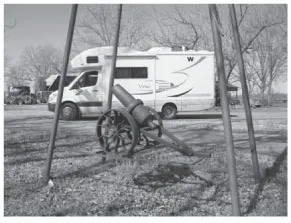
Riverboat cannon, a so-called 5-pounder, that was used in the Colfax massacre, now in Ben Littlepage’s front yard
Photo by Mary Twitchell
Before the Civil War, Meredith Calhoun was one of the largest slave owners and cotton planters in the South, and his slave quarters were built to last. Supposedly, Mr. Calhoun was the template for Simon Legree. He was certainly one of the richest men in North America. His hunchbacked son, William Smith Calhoun, always called Willie, got out of the slave business and fought for emancipation. Willie gave the name Colfax to the town, previously called Calhoun’s Landing, as a tribute to Grant’s vice president, Schuyler Colfax. And he split the entire parish off from Winn and Rapides, calling it Grant Parish after another president. Willie sided with the blacks in Colfax before the massacre. After the killings, however, he made himself scarce.
I mention this also because Willie is buried in the Colfax town cemetery about a hundred feet from the stone tribute to the men who led the massacre. Here’s what their triumphant marble obelisk, a dozen feet high, towering over every other markers, says, all in caps:
IN LOVING REMEMBRANCE
ERECTED TO THE MEMORY OF
THE HEROES,
STEPHEN DECATUR PARISH,
JAMES WEST HADNOT,
SIDNEY HARRIS,
WHO FELL IN THE COLFAX
RIOT FIGHTING FOR
WHITE SUPREMACY
APRIL 13, 1873
ERECTED TO THE MEMORY OF
THE HEROES,
STEPHEN DECATUR PARISH,
JAMES WEST HADNOT,
SIDNEY HARRIS,
WHO FELL IN THE COLFAX
RIOT FIGHTING FOR
WHITE SUPREMACY
APRIL 13, 1873
It’s more than a marker. Like the sign in front of the courthouse, it’s a taunt, spit in your eye. Nearby, Willie has a small, scuffed headstone. Scalawag Willie may have had the power to name but not the power to be memorialized.
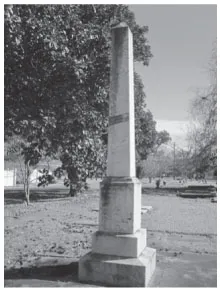
Obelisk memorializing the fallen heroes “fighting for white supremacy,” erected in 1921 by the town fathers of Grant Parish. This not-so-subtle tower is just yards away from a small headstone for Willie Calhoun, the real hero of the piece.
Photo by author
As we were driving back to Coushatta I couldn’t help but marvel at the powers of story selection. Mostof the white participants, and their descendants, in this ethnic cleansing have resolutely refused to countenance the truth. And in this case, we know the truth.
The courts knew the truth too. A total of ninety-seven whites were indicted for the killings. Twice, J. R. Beckwith, the U.S. attorney in New Orleans, presented juries with evidence that showed clear violations of the U.S. Enforcement Act of 1870, an offshoot of the Fourteenth Amendment providing protection for blacks. The court in New Orleans had reams of eyewitness reports of the slaughter of the prisoners. Perhaps because the testimony was from blacks, it couldn’t be believed. But President Grant had ordered troops to restore order to Colfax, and 2d Lt. George D. Wallace, acting assistant adjutant-general, District of Upper Red River, had submitted his report confirming what the eyewitnesses saw. Because the bodies of those tortured and maimed were not buried, they were there for all to see.
The first trial (1874) ended with an acquittal for one killer and a mistrial for all the othe...
Table of contents
- Cover Page
- Title Page
- Copyright Page
- Dedication
- Contents
- Illustrations
- Introduction: Deep in the Heart of Dixie
- My Great-Grandfather
- March across Georgia
- Sweet (Almost) Home Alabama
- Mississippi, the Most Southern Place on Earth
- Louisiana Gumbo
- The Red River Valley: What Really Happened
- Acknowledgments
Trusted by 375,005 students
Access to over 1.5 million titles for a fair monthly price.
Study more efficiently using our study tools.
Frequently asked questions
Yes, you can cancel anytime from the Subscription tab in your account settings on the Perlego website. Your subscription will stay active until the end of your current billing period. Learn how to cancel your subscription
No, books cannot be downloaded as external files, such as PDFs, for use outside of Perlego. However, you can download books within the Perlego app for offline reading on mobile or tablet. Learn how to download books offline
Perlego offers two plans: Essential and Complete
- Essential is ideal for learners and professionals who enjoy exploring a wide range of subjects. Access the Essential Library with 800,000+ trusted titles and best-sellers across business, personal growth, and the humanities. Includes unlimited reading time and Standard Read Aloud voice.
- Complete: Perfect for advanced learners and researchers needing full, unrestricted access. Unlock 1.5M+ books across hundreds of subjects, including academic and specialized titles. The Complete Plan also includes advanced features like Premium Read Aloud and Research Assistant.
We are an online textbook subscription service, where you can get access to an entire online library for less than the price of a single book per month. With over 1.5 million books across 990+ topics, we’ve got you covered! Learn about our mission
Look out for the read-aloud symbol on your next book to see if you can listen to it. The read-aloud tool reads text aloud for you, highlighting the text as it is being read. You can pause it, speed it up and slow it down. Learn more about Read Aloud
Yes! You can use the Perlego app on both iOS and Android devices to read anytime, anywhere — even offline. Perfect for commutes or when you’re on the go.
Please note we cannot support devices running on iOS 13 and Android 7 or earlier. Learn more about using the app
Please note we cannot support devices running on iOS 13 and Android 7 or earlier. Learn more about using the app
Yes, you can access Look Away Dixieland by James B. Twitchell in PDF and/or ePUB format, as well as other popular books in History & North American History. We have over 1.5 million books available in our catalogue for you to explore.