At the height of World War I, in the winter of 1917--1918, one of the Progressive era's most successful muckracking journalists, Ray Stannard Baker (1870--1946), set out on a special mission to Europe on behalf of the Wilson administration. While posing as a foreign correspondent for the New Republic and the New York World, Baker assessed public opinion in Europe about the war and postwar settlement. American officials in the White House and State Department held Baker's wide-ranging, trenchant reports in high regard. After the war, Baker remained in government service as the president's press secretary at the Paris Peace Conference, where the Allied victors dictated the peace terms to the defeated Central Powers. Baker's position gave him an extraordinary vantage point from which to view history in the making. He kept a voluminous diary of his service to the president, beginning with his voyage to Europe and lasting through his time as press secretary. Unlike Baker's published books about Wilson, leavened by much reflection, his diary allows modern readers unfiltered impressions of key moments in history by a thoughtful inside observer.
Published here for the first time, this long-neglected source includes an introduction by John Maxwell Hamilton and Robert Mann that places Baker and his diary into historical context.
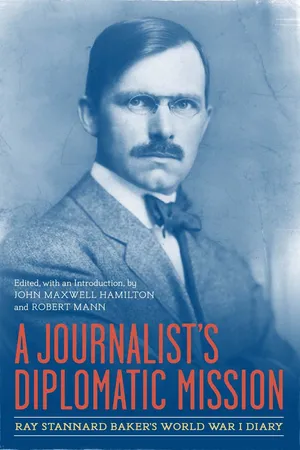
eBook - ePub
A Journalist's Diplomatic Mission
Ray Stannard Baker's World War I Diary
- 504 pages
- English
- ePUB (mobile friendly)
- Available on iOS & Android
eBook - ePub
A Journalist's Diplomatic Mission
Ray Stannard Baker's World War I Diary
About this book
Information
Subtopic
World War IIndex
HistoryPART I
Reporting on Public Opinion in Great Britain, France, and Italy
1
I Sail for England.
MARCH 1, 1918. AT SEA
It is a mild, muggy, heavy morning with a headwind. We are in the Gulf Stream. The weather, for this time of year, has been fine, sea smooth, sun shining by day and a bright moon by night. The St. Louis, although now an old-fashioned ship, is most comfortable and, in these war times, the fastest ship plying between New York and Liverpool. The passengers are almost all army and navy officers, with a large contingent of sailors and marines below; every effort is being made by both the United States and British governments to keep civilians from crossing, and there are only a few aboard, mostly home-going Britishers from Australia, South America, and the United States.
The American officers are nearly all lieutenants of the Flying Corps1 under urgent orders to report to the training fields of France and England. The highest officers aboard are a naval captain and army lieutenant colonel. These young Americans are as fine a lot of picked men as one could find anywhere in the world, handsome in their fresh new uniforms. They are practically all college men from the great universities of the middle and far west, as alike in their general characteristics as peas in a pod. Most of them have never before been abroad, a simple, frank, open-minded lot of young fellows. Last night they crowded into the lounge, one played the piano, and they all sang college and ragtime songs, and old Negro songs, exactly like a college fraternity. There was much horseplay and good-humored banter. After I went to bed I heard them still singing—enjoying themselves on the way to war! Some of the more ambitious of the officers have organized a French class, and it is being taught by one of the few women aboard the ship.
It comes over one with a kind of shock now and then that this is war. It seems too unutterably absurd that these superb young fellows should be going abroad to kill other superb young fellows ingeniously, cunningly, by many devices, on the water and underneath, in the air and on the land. Yet so it is. It seems unutterably absurd that any enemy should be lurking underneath to blow up this good ship with its valuable cargo of human beings, a good ship and a good load within it. Yet, so it is. All this enormous and expensive waste because human beings have not learned how to understand one another and work together.
We have five guns mounted aboard to sink enemy submarines—if by chance we should see them before they see us! At one o’clock yesterday afternoon, the gunners cast off a target and tried at hitting it, first with the guns on the starboard side and then, circling about, with the larboard guns. The passengers were not allowed on the gun deck, but from the narrow deck below some of us saw the target go heaving by and the great gun at the stern take it under fire. We were not high enough so that we could see whether or not they registered a hit. Each shot threw up a huge fountain of water, and several of them ricocheted in wide curves to the horizon. The shock and recoil within the ship were much less pronounced than I had expected, although the dishes in the dining room did rattle.
On the voyage before last, I am told, this ship was convoyed through the war zone by two destroyers and an English dirigible. The dirigible discovered a submarine off the stern of the ship and signaled the gun crew. The six-inch guns opened fire, so the men claim, and made a hit.
SATURDAY. AT SEA
I have been reading, a good part of the day, a history of European diplomacy by Arthur Bullard2 and several numbers of the “Round Table,”3 giving an excellent introduction to British opinion. I talked with a Scotch miner from Venezuela going homeward to enlist, and a crockery buyer from Canada making his forty-eighth voyage across the Atlantic.
When I got aboard at New York, I saw one of the mournfulest looking men I ever saw in my life. He had a child with him.
“No man,” I said to myself, “has a right to be as mournful looking as that man!”
It so chanced that I had a chair next to his on the deck, and I soon found out why he looked so mournful. War wreckage! He is a Belgian whose father owned a large woolen mill in Dinon4 and lived in a fine home. The Germans came and took or destroyed everything, the family barely escaping with the clothes they had on. Friends and neighbors, he said, were killed in cold blood. This young man came to America, leaving his parents in England. He met and married a Canadian girl. She bore him a son and died within a year. He is taking the boy back to his parents in England.
There is a group of Japanese on board, some going to the Embassy in Paris, and two Y.M.C.A. men, looking odd enough in American uniforms. They are going to study Y.M.C.A. methods at the front.
WEDNESDAY MORNING, MARCH 6. AT SEA
We had further boat drill and, in the afternoon, orders were issued that all passengers should go about constantly with their life preservers on, and should sleep the following two nights in their clothes, being now in the war zone and likely to be attacked at any moment by a “tin fish,” as the seamen call the submarines. It was an odd sight that night at dinner to see everyone come in wearing cork jackets or the inflated rubber suits, which several of the passengers had themselves provided. During Monday the rule was pretty generally obeyed, but we gradually degenerated, and the life preservers were well scattered over the ship, until this morning only a few of the faithful young officers persisted. I slept restlessly in my clothes on Monday night, and was glad enough on Tuesday morning to see two of our destroyers sailing the seas just ahead of us.
I had not realized that I was at all under strain, but the sight of those two fine ships cutting the waves and zigzagging across our course, with the watchmen in the tops and the Stars and Stripes floating from the stubby masts, gave me a curious thrill of relief. They were with us all day yesterday and are accompanying us through the yellow Irish Sea this morning as we approach Liverpool. They are grotesquely camouflaged with the streaks and blotches of black, gray, white, and blue paint, as were all the ships we have seen on the voyage. Many of the passengers have been nervous, fearing a submarine attack. The man in the stateroom with me has not been abed for the last two nights, but has wandered like a banshee about the ship. On the whole the voyage has been comfortable and interesting. I have not missed a single meal, though I felt uncomfortable on the second day out.
2
London, and an Airplane Bombing.
LONDON, FRIDAY, MARCH 8
I spent Wednesday night, after a most trying wait upon the crowded and disordered docks at Liverpool, in the Adelphi Hotel. There were no cabs to be had and no lights in the streets. A universal feeling of excitement and strain seemed to pervade everything. The war is like a boding black cloud over all the land. And yet when I at last reached the hotel I found a noisy ragtime concert going at full blast and couples dancing! One of the most noticeable things, coming freshly from America, is the scarcity of food. I have had no sugar since I came here! Two pieces of black war bread, no meat without a coupon, which I have not yet obtained, and very little butter. Plenty of fish.
I came down to London yesterday, arriving at four o’clock, and finding that the pleasant small hotels where I had stopped on former occasions had been taken over by the War Office, I found refuge in the Savoy, which is excessively crowded.
I went to bed early, being very tired. About eleven-thirty I was aroused by the terrific booming of guns, deep and ominous. At first I was not certain what it was. It recalled mistily the Fourth of July mornings of my boyhood, when the village blacksmiths at dawn fired their anvils. I went to the window over which the curtains had been closely drawn (by strict orders) and, looking upward, saw the great dipper there in the clear black sky. An instant later a flash of light leaped like a drawn blade above the tops of the buildings and began thrusting and probing among the stars. It found light fleecy clouds not visible to the eye without that penetrating gleam. A moment later another shaft appeared and then another and another, feeling restlessly like fingers through the Heavens. Following each rift of cloud, then darting swiftly forward and pouncing upon some other suspicious spot in the sky. There could be no doubt that we were in the midst of an air raid. Straightway there were other bursts of the anti-aircraft guns, near and more terrific, and far in the sky. As the searchlights crossed them, I could see the star-like bursting of the shells. But no airplanes were visible. I heard running and talking in the halls outside, and quickly dressing myself, I went downstairs. An Englishman in the lift remarked:
“Fritzy is at it again!”
In the rooms below, the late diners were pouring out, but without excitement. Taxicabs were huddled under the arches outside, and the strand in front was as deserted as a road in Arizona. A lone policeman at the corner told me it was the first raid they had had in two or three weeks. Evidently staged for my first night in London!
I had met on the ship a nervously energetic young fellow named Herbert Brenon, an expert moving picture director, who was coming over to take charge of a huge government scheme for making a propagandist picture from a scenario by Hall Caine.5 He made that remarkable sea “movie” called Neptune’s Daughter, with the first pictures taken under water, and has a long scar on his arm cut by the breaking glass of the diving bell in which he went down. He reminded me of S. S. McClure. Read the New Testament in his steamer chair on the deck, and talked to me before he had known me five minutes about his belief in an almighty God and his hatred of Jews! I ran across this man in the lobby of the hotel, and he and I picked each other up like old acquaintances and went out into the dark streets. A few dim lights were visible, but they were covered over at the tops so as not to throw any illumination upward. We saw a number of dimly illuminated signs—“Shelter During Air Raids”—with an arrow pointing to the places where one might dive to cover. We found that the entire population had dived into subways, under bridges, into basements. Trains and taxis were crowded under the arches along the embankment. Every time there was a new salvo of guns, there was a fresh rush for protection, Brenon and I with the others. The danger is not so much from the German bombs themselves as from the falling shrapnel from the anti-aircraft guns. A building at the corner of the Savoy where I am staying was blown up in a recent raid and men were killed on the strand in front of the hotel.
Brenon and I, quite like foolish Americans, walked about in the dark city streets—in itself a wholly unprecedented eerie experience—for a couple of hours. On the whole there was little excitement; the people take these things with a sort of grim silence.
It was impossible to tell at the time where the raid was or whether any planes at all got over. One man said he thought it must be a Zeppelin because the firing was spread over so much territory. Another said no bombs had been dropped, and what we heard was only from anti-aircraft guns, that bombs made a muffled sound of explosion.
“Oh, they dropped their load, right enough!” said another.
The morning papers, which I eagerly awaited, had nothing whatever to say except that an air raid was in progress, and the evening papers gave only the bare facts of the ugly business, without mentioning any definite localities. It seems that several of the airplanes did reach London and that eleven persons were killed and forty-six injured. The German report of the raid published in the London papers read as follows: “During the night, from March 7–8, London, Margate, and Sheerness were attacked with bombs by several airplanes. Good effects were observed.”
“Good effects” indeed!
The steadiness of these people is to me amazing; they seem to take it all as a matter of course.
LONDON, MARCH 9
I visited the Embassy and got my mail, and went to look for permanent apartments. It is too expensive here at the Savoy; it makes me uncomfortable. Food prices everywhere are high. Two pieces of black war bread are served with each meal. Very good, I think, but not enough of it. I have not had a mouthful of meat since I landed, having as yet no meat card. Druggy-looking little white tablets of saccharine instead of sugar; one taste was enough for me! Vegetable and nut concoctions are appearing at some of the restaurants. Candy store windows are stripped, and milk is scarce. The people, however, seem to take it all in good part.
I registered with the police in Bow Street, as I also had to register in Liverpool, being an alien. At every turn war taps one on the shoulder and demands his business and steals his time and his thought. War brooks no interference— a jealous sovereign, and tyrannical! Spending a lot of time with newspapers and weeklies. One thing the world is learning—a kind of disrespect for the authority of cash. In the golden days of innocence before the war, money would buy almost anything, but now there are scores of things that cannot be bought. Bread cannot be bought, and rich and poor must share alike; there is no more served in the Savoy Hotel than at Lyons. Safety cannot be bought, nor taxicabs on the night of a raid. I wonder if this is not in some part a valuable thing.
MARCH 10
I settled yesterday at 68 Curzon Street, W., in a sitting room and bedroom on the first floor, kept by a Mr. Toby. A comfortable looking place, and a good breakfast this morning. I visited the food control office to get a food card, but it being Saturday, I was too late. I go to Oxford tomorrow to see Professor Gilbert Murray.6
I walked down to service at Westminster Abbey this afternoon and sat under the statue of Gladstone, and came back walking by Buckingham Palace. In the park the grass was green and there were thousands of yellow and white crocuses in bloom, beautiful to see and much earlier than we get them in New England. The lilacs were breaking their hooded green buds, and all the forsythia was yellow with blossoms. A mild dull day with many people coming to the Park to enjoy the spring: soldiers on leave with their girls, nursemaids with babies, and old ladies in trundle-carts, and officers in brave uniforms. But I thought of Amherst among its many hills.
3
First Impressions of British Opinion.
In planning my campaign of inquiry I decided to talk first with several liberal-minded Englishmen whom I already knew and to whom I had letters of introduction—men upon whose objectivity of judgment and breadth of view I knew I could count. I wanted to understand the background of the situation as clearly as possible, all the various currents of opinion, before I ventured to meet the leaders of the restless groups in whom I was chiefly interested.
MONDAY, MARCH 11
I went down to Oxford by the early train and had a long talk with Professor Gilbert Murray.
The farmers in the fields along the way were plowing, and all the little areas and hedge corners were full of crocuses in bloom, although the air was chill. Spring is really coming.
I remained to lunch, and while we were talking army flying machines from a nearby training field were whirling noisily overhead, but no one took the slightest notice of them.
Before I left the United States there were rumors at Washington, apparently well substantiated, that the Lloyd George7 government was in a precarious situation and might have to resign. It was added evidence, if any were necessary, of the growing confusion and strain of the war. Professor Murray told me that the crisis had temporarily passed and while the government is under fierce attack—the Saturday Review asks this week, “Is there a Govern-ment?”—there seems no likelihood of an early overturn.
Murray is as close as anyone to Mr. Asquith8; indeed, had a talk with him yesterday. Asquith will not attack Lloyd George personally though feeling that George has treated him badly. The only reference he has heard him make to George personally was that he was “a man of somewhat rapid curves.” It is now Asquith’s view, as it is that of Professor Murray, that until the coming German offensive is over, and the Russian situation9 clears up, all forces must stick together.
Professor Murray says that the Asquith liberals are genuinely accepting the Wilson program; and in this they are supported all the way down by the labor and radical groups. (This I shall hope to verify later.) He told me that the Labour Party is rapidly gaining strength, even though it lacks experienced political leadership. In case of an election they will have candidates for as many as three hundred seats.
Professor Murray plainly agrees with the view I have heard expressed every where that the war as it affects England is now at its lowest ebb: the Russian situation, the coming German offensive in the west (which no one fears, but which everyone regards as serious), the shipbuilding situation, which is admittedly bad, and the closely related food shortage which, while it is being bravely met, gives concern. There is widespread pessimism; the country is terribly in need of a victory of some kind. No wonder; this is the fourth winter for them of this ghastly struggle!
I returned to London this evening.
MARCH 12
I plunged into the confusion of the Food Control office and emerged finally wi...
Table of contents
- Cover
- Title Page
- Copyright Page
- Contents
- Acknowledgments
- Introduction
- Part I: Reporting on Public Opinion in Great Britain, France, and Italy
- Part II: The Paris Peace Conference
- Index
Trusted by 375,005 students
Access to over 1.5 million titles for a fair monthly price.
Study more efficiently using our study tools.
Frequently asked questions
Yes, you can cancel anytime from the Subscription tab in your account settings on the Perlego website. Your subscription will stay active until the end of your current billing period. Learn how to cancel your subscription
No, books cannot be downloaded as external files, such as PDFs, for use outside of Perlego. However, you can download books within the Perlego app for offline reading on mobile or tablet. Learn how to download books offline
Perlego offers two plans: Essential and Complete
- Essential is ideal for learners and professionals who enjoy exploring a wide range of subjects. Access the Essential Library with 800,000+ trusted titles and best-sellers across business, personal growth, and the humanities. Includes unlimited reading time and Standard Read Aloud voice.
- Complete: Perfect for advanced learners and researchers needing full, unrestricted access. Unlock 1.5M+ books across hundreds of subjects, including academic and specialized titles. The Complete Plan also includes advanced features like Premium Read Aloud and Research Assistant.
We are an online textbook subscription service, where you can get access to an entire online library for less than the price of a single book per month. With over 1.5 million books across 990+ topics, we’ve got you covered! Learn about our mission
Look out for the read-aloud symbol on your next book to see if you can listen to it. The read-aloud tool reads text aloud for you, highlighting the text as it is being read. You can pause it, speed it up and slow it down. Learn more about Read Aloud
Yes! You can use the Perlego app on both iOS and Android devices to read anytime, anywhere — even offline. Perfect for commutes or when you’re on the go.
Please note we cannot support devices running on iOS 13 and Android 7 or earlier. Learn more about using the app
Please note we cannot support devices running on iOS 13 and Android 7 or earlier. Learn more about using the app
Yes, you can access A Journalist's Diplomatic Mission by John Maxwell Hamilton, Robert Mann, John Maxwell Hamilton,Robert Mann in PDF and/or ePUB format, as well as other popular books in History & World War I. We have over 1.5 million books available in our catalogue for you to explore.