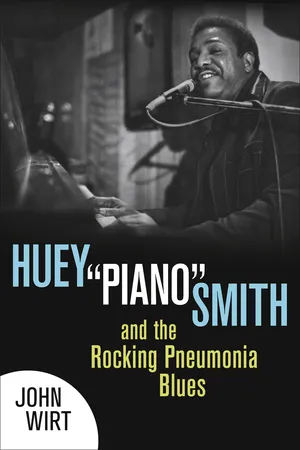
Huey "Piano" Smith's musical legacy stands alongside that of fellow New Orleans legends Dr. John, Fats Domino, Ernie K-Doe, and Allen Toussaint. His 1957 classic, "Rocking Pneumonia and the Boogie Woogie Flu, " made Billboard's top R&B singles chart, and hundreds of artists including Aerosmith, the Grateful Dead, the Beach Boys, Johnny Rivers, and Chubby Checker have recorded his songs.
The first biography of the artist responsible for hits "Don't You Just Know It, " "High Blood Pressure, " and "Sea Cruise, " Huey "Piano" Smith and the Rocking Pneumonia Blues follows the musician's extraordinary life from his Depression-era childhood to his teen years as a pianist for blues star Guitar Slim to his mainstream success in the 1950s and '60s. Drawing from extensive interviews and court records, author and journalist John Wirt also provides new insights on Smith's professional disappointments and financial struggles in the 1980s and '90s as he battled over royalties from his most successful and profitable work.
An enigmatic and guarded personality in a profession of extroverted performers, Smith made farreaching contributions to the New Orleans music scene as a songwriter, pianist, and producer. Wirt reveals that Smith's numerous collaborations with other artists -- including the Clowns, the Pitter Pats, the Hueys, and Shindig Smith and the Soul Shakers -- served as vehicles for his creative vision rather than simply as an anonymous backup for a leading front man.
Throughout this intimate account, Wirt details Smith's significant impact on rock and roll history and underscores both the longevity of his music -- which has entertained and inspired for over five decades -- and the musician's personal endurance in the face of hardship and opposition.
- 320 pages
- English
- ePUB (mobile friendly)
- Available on iOS & Android
eBook - ePub
About this book
Information
Subtopic
Music1
Robertson Street Boogie
People assumed Huey Pierce Smith’s parents named him after Huey Pierce Long, the populist governor and U.S. senator who ruled Louisiana in the 1920s and 1930s. Long delivered his “Carry Out the Command of the Lord” speech from the Senate floor on February 5, 1934, ten days after Huey Smith’s birth. The nation was at the bottom of the Depression, and Louisiana, economically and geographically, was at the bottom of the nation. “People of America,” Long announced through radios across the land, “in every community get together at once and organize a share-our-wealth society— Motto: Every man a king.”
Despite Senator Long’s notoriety, Huey’s parents actually named him after his uncle. Born January 26, Huey grew up at 2610 South Robertson Street in Uptown New Orleans, a neighborhood of frame cottages and shotgun duplexes where everyone played a song or two at the piano.
Huey’s father, Arthur Smith Sr., moved from the small southeastern Louisiana town of Independence to the city famous for jazz and Mardi Gras. His mother, Carrie Victoria Scott, came from Scotlandville, ninety miles northwest of New Orleans in East Baton Rouge Parish.
Huey was a “daddy’s boy.” He dearly loved his father and sat on the front porch every day waiting for him to come home from work. Huey waited there especially if he’d done something his mother disapproved of. Mother and son were not close. She gave him frequent whippings, so many that he felt he’d best not enter the house until his father’s return.
Although Huey never engaged in organized religion during his childhood and youth, his faith and reverence were strong. As a child of five or six, he gazed into the night sky and prayed. “But mostly because I had a fear that something might happen to my daddy,” he remembered. “Those barrooms down there, he didn’t go in them, but the people would be running out. Somebody done stabbed somebody. So I worry when my daddy be gone. I prayed that some kind of way Jehovah wouldn’t let nothing happen to him.”
Like other boys in New Orleans, Huey ran along St. Charles Avenue during Mardi Gras parades to catch beads thrown from the floats. He believed in Santa Claus, too. One rainy Christmas Eve, he cried after his mother told him to go to sleep. When she heard him crying, she entered his bedroom and pinched him. The next morning he didn’t get the bicycle he’d wanted for Christmas. Instead, he got a tiny red bike that fell to pieces in a few days. “And this boy next door, Leonard, got a big, strong bicycle,” Huey said. “I knew we couldn’t really afford nothing like that, but my mama told me, ‘Santa Claus heard you crying. That’s why you didn’t get a bicycle like Leonard!’ For years and years and years, I was angry with myself for crying.”
In Huey’s neighborhood, people concocted home remedies. Next-door neighbor Mrs. Seaberry told Mrs. Smith that tea brewed from a cockroach would cure Huey’s asthma. His mother made the cockroach tea, but luckily his daddy came home just in time to object to the noxious brew. The boy had no intention of drinking it anyhow.
Huey’s mother worked in a New Orleans laundry in the years before air conditioning became common. He wondered how she could stand such extreme conditions and never miss a day of work. Mrs. Smith cleaned her own children’s clothes at the laundry. He always had a fresh white shirt for school, a reflection of the importance his mother attached to getting a good education. Working mother though she was, Carrie Smith found time to cook a daily breakfast of smoked sausage, grits, and eggs for her family.
Huey’s father was a roofer and laborer who also found employment cutting cane during Louisiana’s sugarcane harvest. He’d stay in rural Louisiana during harvesttime and send money home. Arthur Smith’s employers valued him for being someone who could accomplish things others couldn’t. “I remember my daddy telling me, ‘Whatever you do, do it good,’ ” Huey said.
The confetti-strewn World War II victory parades that rolled through New Orleans with generals Dwight D. Eisenhower and Douglas MacArthur made less of an impression on Huey than the fact that his third-grade teacher had married a black officer. In his letters home, the teacher’s husband said things would be different for the black citizens of New Orleans after the war. The screens that separated blacks from whites on the city’s streetcars, for instance, would be banished. Half of the day, the teacher talked about her husband, always referring to him as Lieutenant Williams. She told her students about a letter she’d received from him and the inscription he’d written on the envelope: “Mailman, mailman, do your duty. Deliver this letter to my brown-skin beauty.”
Huey recalled going to the hospital with his uncle to pick up his newborn brother, Melvin. Seeing the light-skinned baby for the first time, wrapped in his blanket, alarmed Huey. “This is a white boy!” he exclaimed. But Melvin darkened with age. When Melvin was a small child, Huey let his little brother win foot races, so much so that Melvin thought he was the fastest boy on Robertson Street. Older boys in the neighborhood were kind to the younger children. Good boys in general, they didn’t curse or steal.
At twelve, Huey joined his fellow Boy Scouts Alvin Smith and Willie Lee as they walked to the edge of the Industrial Canal in the Gentilly section of New Orleans. The heavily wooded area reminded him of the jungles in Tarzan movies. The boys couldn’t swim, but they waded into the canal anyway, thinking it wasn’t deep. As they headed to the middle of the waterway, the canal’s bottom dropped from beneath their feet. Huey managed to put his hand in some mud and grab a small tree branch. Miraculously, he pulled himself from the canal. Alvin held on to Huey and he, too, escaped the muddy water. From the canal bank they looked for their friend, Willie. He was gone. A man who’d seen the boys struggling in the water told them Willie had been beneath the surface too long, that he was beyond help.
The survivors went home, leaving the lost Scout’s short pants on the bank. Huey’s father was working at night then, so Huey didn’t tell anyone about the incident. “But I recall getting in the bed by my mother,” he said. “I stayed just about all that night. I think she was surprised. I felt her caress me. Like a mother and a baby, that’s how she was holding me. I know she must have sensed something.”
In the middle of the night, some young men came to the Smiths’ house looking for Willie Lee. “Ooh,” Mrs. Smith told them, “it’s three o’clock in the morning! He’s not here.” After Mrs. Smith went to work the next morning, Huey walked to Alvin’s house. He wanted to tell Alvin’s mother about Willie but didn’t. Policemen came to the Smiths’ house later. They questioned Alvin and Huey and took them to the canal. A woman the boys didn’t know was there, too. She argued with the officers, saying there had obviously been a struggle on the canal bank. But the white policemen—all New Orleans policemen were white at this time—dismissed her scenario. The gentleman who’d witnessed the incident was there, too. He told the officers that it was a wonder all three of the boys hadn’t drowned.
The Smiths, like many Depression-era families, kept chickens. In wet New Orleans, the birds had to be kept off the ground and fed a diet of corn three or four weeks before slaughter. Otherwise they’d taste like mud. When Huey’s mother decided to kill a particularly fierce rooster, she held the bird on the wooden steps as Huey wielded a hatchet. The rooster jumped to safety and, instead of chopping the bird’s head off, the hatchet sliced into Mrs. Smith’s thumb. Neighbors accused her son, who’d gotten a whipping earlier that day, of wounding her intentionally. She didn’t believe them. “Ain’t nobody in the world going to tell me you did that on purpose,” she told him. “I know good and well that was an accident.”
Though the rooster’s day of execution came, the Smiths had one chicken they’d never harm: Nubby. When he hatched, Nubby was unusually small and his feet were turned downward. While every other chicken in the yard inevitably had an appointment with a pot, oven, or skillet, the misshapen Nubby became a family pet. Nubby was so cherished that his death via an opportunistic rat made the whole family cry.
Despite limited opportunities for blacks in the South, Arthur Smith hoped his children would grow up to be professionals—doctors, lawyers, or preachers— and ride around in Cadillacs. Huey, imitating hellfire preachers, would lie on the floor growling as he flipped through the Bible. His daddy encouraged him, saying, “Go ahead, Doc!”
A fascination for chemistry helped Huey get his Doc nickname. Like scientists in monster movies, he had a laboratory, located in the backyard. After paying twenty-five cents to a pharmacist at the Good Citizens drugstore for chemicals that he believed would ignite when combined, Huey mixed the ingredients in a matchbox. Nothing happened. Disappointed, he slipped the matchbox in his coat pocket. Sometime later he noticed his coat was aflame, the consequence of a delayed chemical reaction. He later found another, nearly as explosive reason for remembering this particular experiment. The pharmacist who sold the chemicals to him, Kermit A. Parker, became the first black man since Reconstruction to run for governor of Louisiana. Even while Louisiana and the South were deep in the grip of Jim Crow–era segregation and discrimination, Parker announced his candidacy for the state’s top elected office on June 13, 1951. “In the United States of America, some of our national, state, and local public officials are doing everything they can to impress other nations that America is practicing the Democracy she is preaching,” Parker told reporters in Baton Rouge. “However, I have had many occasion to observe many forms of injustice, many of which the general public has no idea that they are even in existence. We stress equality of opportunity and many other factors to show the world that we stand for justice.”
“Black people really wasn’t voting hardly at all at the time,” Huey recalled. “I remember my uncle came from Washington, D.C. He said, ‘He-eee can run.…’ He meant that’s the farthest Parker can go.”
The Smiths lived a few streets away from Shakespeare Park, located at Washington Avenue and Freret Street. From his back porch, Huey heard Dixieland bands playing at the park’s swimming pool. He sat there listening, beating time with the band. The Dew Drop Café, a nightclub where he would become a regular performer in the early 1950s, was a block and a half away on LaSalle Street. The Sail Inn, a rough white bar that had a watermelon stand out front, stood across the street from the Smiths. Huey heard the bar’s jukebox playing country-and-western music all night long. He particularly liked Hank Williams’s “Lovesick Blues,” the phenomenally popular country hit of 1949 that made Williams a star. Alabaman Williams likely based his rendition of “Lovesick Blues,” including its show-stopping yodeling, upon a 1928 hit by Emmett Miller. A white entertainer from Macon, Georgia, Miller performed in blackface minstrel shows from 1919 through 1949.
Williams’s rendition of “Lovesick Blues,” released February 11, 1949, reached No. 1 on May 7 and remained there for sixteen weeks. Fifteen-year-old Huey heard the song playing in the bar as he lay in bed at night. “I got a feelin’ that I’m blue-ooh-ooh,” Williams sang. Getting up the next morning, Huey would go to the piano and play and sing, “I got a feelin’ that I’m blue-ooh-ooh.…” “I liked it so much,” he said. Another barroom, a black establishment named the Duck Inn, also opened across the street. The jukebox in the new place played records through the night, too, especially the hits of Louis Jordan. Recordings by Jordan spent 113 weeks at No. 1 on Billboard’s rhythm-and-blues chart. That feat easily makes Jordan—a singer, saxophonist, and rhythm-and-blues pioneer originally from Arkansas—the genre’s biggest star of the 1940s.
Huey, an avid moviegoer, enjoyed seeing Jordan and his band in short films shown at movie theaters. Huey and his friends never missed the Red Ryder western serials, starring Wild Bill Elliott as Red Ryder and young Bobby Blake as his Indian sidekick, Little Beaver. The peace-loving Red Ryder roamed the West, enforcing justice and protecting the innocent. In 1944’s The San Antonio Kid, for instance, a bad guy named Ace plots with an oil company scout to defraud ranchers out of oil royalties. The scout intends to tell his company about the black gold he’s found in Painted Valley, but only after Ace’s thugs terrorize the ranchers into selling out cheap. The scheme-busting Red Ryder comes to the rescue.
Huey’s by now religious-minded mother believed movies were an abomination. “So,” Huey recalled, “not that my mother will say, ‘You can’t go to the movies,’ but it’s no good to ask her for to give you show fare. She’s not go’ send you there!” Bargain admission to the movies was a nickel on Thursdays, but Huey could earn thirty or forty cents cleaning for his aunt and then see a movie even on nonbargain days.
The boys in Huey’s neighborhood ran to their destinations, whether they were going to the movies, the grocery store, or anywhere else. Huey’s quick feet came in handy one evening after he’d seen the Universal Studios horror classic The Mummy’s Hand. He’d gone to the show alone that day, as he often did. By the movie’s end it was dark and deserted outside—no cars, no people, nothing but those big, scary oak trees so common in Louisiana, with limbs like tentacles. He hit the street running, not slowing until his feet reached the steps of his house.
Featuring a scenario prophetic for Huey’s own life, 1947’s Body and Soul became one of his favorite movies. The drama stars John Garfield as a prizefighter who falls under the control of a racketeer who demands 50 percent of the boxer’s earnings. My Foolish Heart, a World War II melodrama, also made a powerful impact on Huey, even though he wasn’t interested in the sad story. Huey and his friends wanted action, not kissing. It was the film’s theme music that captivated him. “When that melody shot in there, everybody in the movie got tears in their eyes,” he recalled. “The music did that. It almost scared you, and then it leveled off and it was beautiful.”
Huey and his friends also loved comic books. Huey’s favorites were science fiction, “going to the moon and stuff like that,” he said. “They never thought of nothing like that in reality, but it was in the comic book. So, really, later the comic books came alive.” He also grabbed the newspaper comics every Sunday. Medieval hero Prince Valiant was his favorite character. “And we always had Nancy. Later on, when the Afros came out, they said, ‘Hey, Nancy was the first white girl with a bush!’ ”
He found more entertainment at Lee’s Treat, a new tavern on Washington Avenue where his older sister, Oddress (pronounced Audrey), went with her friend, Rosalie. Underage though he was, the staff let him come in alone and play the jukebox. “They just looked the other way. I just sat there and put a nickel in the box when I wasn’t with my sister and them.” The jukebox selections he especially liked included the swinging “Fine Brown Frame,” a 1947 hit by Nellie Lutcher. A singer-pianist from Lake Charles, Louisiana, Lutcher moved to Los Angeles and became a recording star. Huey also played records by another L.A.-based artist, the singer-pianist dubbed the queen of boogie, Hadda Brooks. His other favorites were Houston singer-pianist Amos Milburn’s signature tune, “Chicken Shack Boogie,” and tenor saxophonist Gene Ammons’s warm and lyrical 1950 rendition of the movie theme “My Foolish Heart.” Ammons’s record was the debut release from a new Chicago label, Chess Records. The saxophonist was the son of the first boogie-woogie pianist Huey had ever heard, Albert Ammons.
Huey’s own piano playing began when he was eight or nine years old. He and his siblings learned about the keyboard by observing their uncle and neighbor, Isidore Miller. Their uncle’s repertoire included singer-pianist Leroy Carr’s mournful “How Long—How Long Blues,” recorded in 1928.
Sometimes I feel so disgusted and I feel so blue,
That I hardly know what in this world, baby, just to do.
For how long, how long, baby, how long?
That I hardly know what in this world, baby, just to do.
For how long, how long, baby, how long?
The Smiths’ next-door neighbor, Dorothy Porter, knew “How Long,” too. Between watching her and Uncle Isidore, Huey learned the song’s eight-bar progression. He discovered, too, that he could use the identical progression to play hundreds of other blues songs. Blues was the dominant African American music of the time.
Smith sisters Oddress and Jackelee took lessons from piano teachers, known as professors, who rode bicycles through New Orleans neighborhoods. Huey bought sheet music for the girls at a music store on Jackson Avenue: “Amazing Grace,” “What a Friend We Have in Jesus,” and whatever else they might want. Unlike his sisters, he taught himself to play. He preferred simply playing to studying the fundamentals. And not spending the money his father gave him to take piano lessons at the Grunewald School of Music on Magazine Street— where many African American veterans back from World War II used their G.I. Bill benefits to finance music lessons—meant he could spend it on other things.
Huey’s interest in the piano soon surpassed that of his sisters. “They wasn’t even concerned about playing piano,” he said. “But me, myself, I’m banging on the piano all day. Miss Thelma, next door, she beat on the wall that separated our houses. Boom-boom, boom-boom. ‘Knock it off over there!’ But as soon she quieted down, I’m back at it again.” Arthur Smith Jr., Huey’s older brother by five years, was even more enthusiastic about the piano than Huey. But because Arthur never learned more than one song, “How Long”—the blues standard that apparently everyone in New Orleans could sing and play at the piano—a future for him in music seemed unlikely.
Practicing the piano for hours, Huey attracted his first fan. As he played, a half-naked, curly-topped little boy about three years old peeped through the blinds on a daily basis. Three decades later, whenever Huey saw television commercials produced by the international charity organization Feed the Children, the doe-eyed, ragged children on the screen reminded him of the boy with no pants who’d watched him practice on South Robertson Street. That child’s name was June “Curley” Moore Jr., and he’d grow up to sing in Huey’s group, the Clowns. “Hu-ree raised me,” Curley liked to say.
In addition to Huey’s blooming piano skills, he began composing rhymes. “We played little games at school and put a beat and music to it,” he said. The aspiring songwriter’s first musical partner was a boy in the neighborhood, Percy Anderson. Percy’s straight hair earned him the nickname “Slick.” “Everybody sang, all the neighbors, but Percy, we be walking to school, he be singing. ‘It was early one morning, on my way to school. Was that Monday morning, I broke my teacher’s rule.’ Percy and I used to always get by the piano and sing and play little things. We be sitting on the step making up songs, ‘The Robertson Street Boogie’ and stuff like that.”
On the spur of the moment, Huey and Percy entered the Lincoln Theatre’s weekly talent show. Billing themselves as Slick and Doc, they performed “The Robertson Street Boogie.”
Get hip everybody to a street that’s all reet. It’s not Canal, but it’s
Robertson Street.
…
The kastatacality was driving you mad. Say, “Hey little daddy, ain’t I bad?” It’s the...
Robertson Street.
…
The kastatacality was driving you mad. Say, “Hey little daddy, ain’t I bad?” It’s the...
Table of contents
- Cover
- Title Page
- Copyright Page
- Contents
- Preface
- Acknowledgments
- Author’s Note
- Introduction
- 1. Robertson Street Boogie
- 2. New Arrivals
- 3. They Got Another Guitar Slim
- 4. Ace Recording Artist
- 5. Rocking Pneumonia
- 6. Rockin’ and Drivin’
- 7. Don’t You Just Know It
- 8. Clowns on Stage
- 9. Sea Cruise
- 10. The Money’s Funny
- 11. Pop-Eye
- 12. Christmas Blues
- 13. Pitter Patting
- 14. Jehovah’s Witness
- 15. Rocking Pneumonia, Part II
- 16. Disaster at Sea-Saint
- 17. Red Stick
- 18. You Are Entitled To and Can Collect Your Royalties
- 19. You’re Fired
- 20. Artists Rights vs. Artist
- 21. A New Suit
- 22. Bankruptcy and Farewells
- 23. Pioneer Days
- 24. Piano Night
- 25. The Money’s Still Funny
- Coda
- Notes
- Bibliography
- General Index
- Index of Song Titles
Trusted by 375,005 students
Access to over 1.5 million titles for a fair monthly price.
Study more efficiently using our study tools.
Frequently asked questions
Yes, you can cancel anytime from the Subscription tab in your account settings on the Perlego website. Your subscription will stay active until the end of your current billing period. Learn how to cancel your subscription
No, books cannot be downloaded as external files, such as PDFs, for use outside of Perlego. However, you can download books within the Perlego app for offline reading on mobile or tablet. Learn how to download books offline
Perlego offers two plans: Essential and Complete
- Essential is ideal for learners and professionals who enjoy exploring a wide range of subjects. Access the Essential Library with 800,000+ trusted titles and best-sellers across business, personal growth, and the humanities. Includes unlimited reading time and Standard Read Aloud voice.
- Complete: Perfect for advanced learners and researchers needing full, unrestricted access. Unlock 1.5M+ books across hundreds of subjects, including academic and specialized titles. The Complete Plan also includes advanced features like Premium Read Aloud and Research Assistant.
We are an online textbook subscription service, where you can get access to an entire online library for less than the price of a single book per month. With over 1.5 million books across 990+ topics, we’ve got you covered! Learn about our mission
Look out for the read-aloud symbol on your next book to see if you can listen to it. The read-aloud tool reads text aloud for you, highlighting the text as it is being read. You can pause it, speed it up and slow it down. Learn more about Read Aloud
Yes! You can use the Perlego app on both iOS and Android devices to read anytime, anywhere — even offline. Perfect for commutes or when you’re on the go.
Please note we cannot support devices running on iOS 13 and Android 7 or earlier. Learn more about using the app
Please note we cannot support devices running on iOS 13 and Android 7 or earlier. Learn more about using the app
Yes, you can access Huey "Piano" Smith and the Rocking Pneumonia Blues by John Wirt in PDF and/or ePUB format, as well as other popular books in Media & Performing Arts & Music. We have over 1.5 million books available in our catalogue for you to explore.