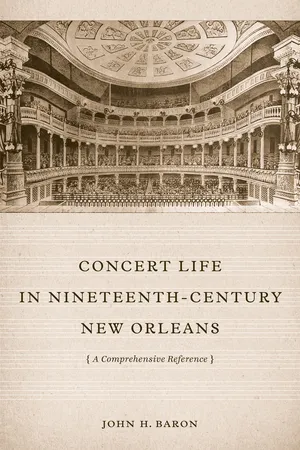
During the nineteenth century, New Orleans thrived as the epicenter of classical music in America, outshining New York, Boston, and San Francisco before the Civil War and rivaling them thereafter. While other cities offered few if any operatic productions, New Orleans gained renown for its glorious opera seasons. Resident composers, performers, publishers, teachers, instrument makers, and dealers fed the public's voracious cultural appetite. Tourists came from across the United States to experience the city's thriving musical scene. Until now, no study has offered a thorough history of this exciting and momentous era in American musical performance history. John H. Baron's Concert Life in Nineteenth-Century New Orleans impressively fills that gap.
Baron's exhaustively researched work details all aspects of New Orleans's nineteenth-century musical renditions, including the development of orchestras; the surrounding social, political, and economic conditions; and the individuals who collectively made the city a premier destination for world-class musicians. Baron includes a wide-ranging chronological discussion of nearly every documented concert that took place in the Crescent City in the 1800s, establishing Concert Life in Nineteenth-Century New Orleans as an indispensable reference volume.
- 752 pages
- English
- ePUB (mobile friendly)
- Available on iOS & Android
eBook - ePub
About this book
Information
Subtopic
MusicNOTES
PREFACE
1. Henry A. Kmen’s Music in New Orleans: the Formative Years, 1791–1841 (Baton Rouge: Louisiana State University Press, 1966) remains a valuable study. Its focus, however, is different; it covers all aspects of the music of New Orleans, not just the concert life. I go into much greater detail on the concert life, including the personalities and the institutions. Also, Kmen stops at 1841, just as New Orleans was reaching its greatest years, while I continue to 1897 and include those great years, the Civil War, Reconstruction, and the gradual decline of the city in the late nineteenth century.
2. The essays on Paul Emile Johns and Jeanne Franko, though now updated, were originally published elsewhere.
INTRODUCTION
1. For an excellent scholarly discussion of the political and cultural origins of New Orleans, see Lawrence N. Powell, The Accidental City: Improvising New Orleans (Cambridge, Mass.: Harvard University Press, 2012). See also Ned Sublette, The World That Made New Orleans: From Spanish Silver to Congo Square (Chicago: Lawrence Hill Books, 2008.
Book I, Part I
CHAPTER ONE
1. An important early private venue for concerts took place at the home of Madame Herries on Chartres Street (see page 294). See also the private house concert described in Henry Didimus, New Orleans As I Found It (New York: Harper and Brothers, 1845), 54–60.
2. Winston C. Babb, “French Refugees from Saint-Domingue to the Southern United States, 1791–1810,” Ph.D. diss., University of Virginia, 1954, 210.
3. Grétry’s Silvain was performed frequently in Haiti from 1770 on. Jean Fouchard, Artistes et Répertoire des scenes de Saint-Domingue (Port-au-Prince: Imprimerie de l’État, 1955).
4. Kmen, Music in New Orleans, 47, 64, 67.
5. Moniteur de la Louisiana, Jan. 28, 1807, p. 2, col. 4; Jan. 31, 1807, p. 2, col. 4.
6. Ibid., Dec. 26, 1807, p. 2, col. 3.
7. Ibid., Oct. 22, 1808, p. 3, col. 1.
8. Ibid., May 24, 1806, 3 pages.
9. Kmen, Music in New Orleans, 67. The term “Chinoise” meant that it was decorated in a manner suggesting Chinese art.
10. Moniteur de la Louisiana, Mar. 4, 1809, p. 3, col. 2.
11. John Smith Kendall, The Golden Age of New Orleans Theater (Baton Rouge: Louisiana State University Press, 1952), 2–3.
12. The Telegraphe, Apr. 5, 1808, p. 3.
13. On Dec. 22, 1819, a French citizen of New Orleans went to the American Theatre which was occupying the St. Philippe Street Theatre. Instead of the artistic, subtle sounds of famous French operas he heard “Yankee Doodle” and other low-class things. He found a few laudable things to say, but basically he looked down on the Americans in the audience who seemed to thoroughly enjoy the entertainment (Gazette de la Louisiana, Dec. 22, 1819, p. 1, col. 5). At the same time, an American went to the same theatre on the same evening. He was much more sympathetic to the Americans and was basically opposed to the sneering view of the French citizen (Louisiana Gazette, Dec. 22, 1819, p. 2, col. 1). On Jan. 8, 1820, however, to commemorate the end of the War of 1812 (1815) the Théâtre d’Orléans united both the French and American troupes, to great acclaim.
14. New Orleans Directory for 1842 (New Orleans: Pitts and Clarke, 1842), vol. 2: 53.
15. Kendall, The Golden Age, 2. See John Davis’s announcement for the building of the second theater in Courier, Nov. 13, 1816, p. 2, col. 3.
16. Tribune de la N.-Orleans, Dec. 8, 1866, p. 1, col. 4; L’Abeille de la Nouvell-Orléans, Dec. 9, 1866, p. 1, col. 2.
17. Albert A. Fossier, New Orleans, the Glamour Period, 1800–1840 (New Orleans: Pelican Publishing Co., 1957), 469.
18. The Bee, Nov. 7, 1837, p. 2, col. 2, and L’Abeille, Nov. 9, 1837.
19. The Bee, Dec. 12, 1866, p. 1, col. 2; Dec. 17, 1866, p. 1, col. 5; Dec. 24, 1866, p. 1, col. 1.
20. Concerts were held on Jan. 28, 1808; Mar. 29, 1808; Oct. 22, 1808; Nov. 18, 1808; Jan. 3, 13, 1809; Feb. 18, 1809; Dec. 8, 1809; Feb. 11, 1810; Mar. 9, 1810; Nov. 26, 1810; Dec. 6, 11, 12, 1810; and Mar. 2, 1811.
21. Jan. 27, 1812; Mar. 9, 19, 1813; Dec. 7, 10, 20, 1813; Mar. 9, 1814; Apr. 11, 1814; Jan. 10, 15, 22, 26, 1816; Feb. 5, 16, 1816; May 11, 1816; Dec. 30, 1816; Jan. 21, 1817; Feb. 4, 8, 25, 1817; Jan. 1, 1818.
22. Dec. 9, 1817 (the announcement states that this was the first concert at this theater); Dec. 31, 1817; Jan. 12, 17, 1818; Feb. 19, 1818; Apr. 7, 1818; Nov. 23, 25, 1818; Dec. 4, 1818; Jan. 18, 1819; Feb. 3, 10, 17, 1819.
23. Mar. 7, 13, 1811; Jan. 16, 1812; Feb. 20, 1813; Mar. 9, 1814; Feb. 27, 1819; Mar. 9, 1819; Apr. 1, 1819; May 6, 1819; Dec. 22, 1819.
24. Apr. 23, 1818; Feb. 10, 1819.
25. Such as on Nov. 4, 1817.
26. Kmen, Music in New Orleans, 6.
27. These are mentioned in the account of the 1866 fire in L’Abeille, Dec. 9, 1866, p. 1, col. 2. The description that follows is from New-Orleans Directory for 1842 (New Orleans: Pitts & Clarke, 1842).
28. Kendall, The Golden Age, 18.
29. Ibid., 35–36.
30. Ibid., 167–68.
31. New Orleans Directory for 1842 2: 54.
32. After 1899 there was a third St. Charles Theater that became a movie house and was demolished in ...
Table of contents
- Cover
- Title Page
- Copyright Page
- Dedication
- Contents
- List of Illustrations
- Preface
- Acknowledgments
- Introduction: New Orleans
- BOOK I. A TOPICAL HISTORY
- BOOK II. A CHRONOLOGICAL HISTORY
- Notes
- Bibliography
- Index
Trusted by 375,005 students
Access to over 1.5 million titles for a fair monthly price.
Study more efficiently using our study tools.
Frequently asked questions
Yes, you can cancel anytime from the Subscription tab in your account settings on the Perlego website. Your subscription will stay active until the end of your current billing period. Learn how to cancel your subscription
No, books cannot be downloaded as external files, such as PDFs, for use outside of Perlego. However, you can download books within the Perlego app for offline reading on mobile or tablet. Learn how to download books offline
Perlego offers two plans: Essential and Complete
- Essential is ideal for learners and professionals who enjoy exploring a wide range of subjects. Access the Essential Library with 800,000+ trusted titles and best-sellers across business, personal growth, and the humanities. Includes unlimited reading time and Standard Read Aloud voice.
- Complete: Perfect for advanced learners and researchers needing full, unrestricted access. Unlock 1.5M+ books across hundreds of subjects, including academic and specialized titles. The Complete Plan also includes advanced features like Premium Read Aloud and Research Assistant.
We are an online textbook subscription service, where you can get access to an entire online library for less than the price of a single book per month. With over 1.5 million books across 990+ topics, we’ve got you covered! Learn about our mission
Look out for the read-aloud symbol on your next book to see if you can listen to it. The read-aloud tool reads text aloud for you, highlighting the text as it is being read. You can pause it, speed it up and slow it down. Learn more about Read Aloud
Yes! You can use the Perlego app on both iOS and Android devices to read anytime, anywhere — even offline. Perfect for commutes or when you’re on the go.
Please note we cannot support devices running on iOS 13 and Android 7 or earlier. Learn more about using the app
Please note we cannot support devices running on iOS 13 and Android 7 or earlier. Learn more about using the app
Yes, you can access Concert Life in Nineteenth-Century New Orleans by John H. Baron in PDF and/or ePUB format, as well as other popular books in Media & Performing Arts & Music. We have over 1.5 million books available in our catalogue for you to explore.