White, black, and Native American women in the early South often viewed motherhood as a composite of roles, ranging from teacher and nurse to farmer and politician. Within a multicultural landscape, mothers drew advice and consolation from female networks, broader intellec-tual currents, and an understanding of their own multifaceted identities to devise their own standards for child rearing. In this way, by con-structing, interpreting, and defending their roles as parents, women in the South maintained a certain degree of control over their own and their children's lives. Focusing on Virginia and the Carolinas from 1750 to 1835, Katy Simpson Smith's widely praised study examines these maternal practices to reveal the ways in which diverse groups of women struggled to create empowered identities in the early South.
We Have Raised All of You contributes to a wide variety of historical conversations by affirming the necessity of multicultural—not simply bi-racial—studies of the American South. Its equally weighted analysis of white, black, and Native American women sets it distinctly apart from other work. Smith shows that while women from different backgrounds shared similar experiences within the trajectory of motherhood, no universal model holds up under scrutiny. Most importantly, this book suggests that parenthood provided women with some power within their often-circumscribed lives. Alternately restricted, oppressed, belittled, and enslaved, women sought to embrace an identity that would give them some sense of self-respect and self-worth. The rich and varied roles that mothers inherited, Smith shows, afforded women this empowering identity.
This paperback edition includes a new preface by Smith that examines the power of storytelling, and the ways in which we think and talk about the past. No one, she suggests, is better suited to tell our collective story than our mothers.
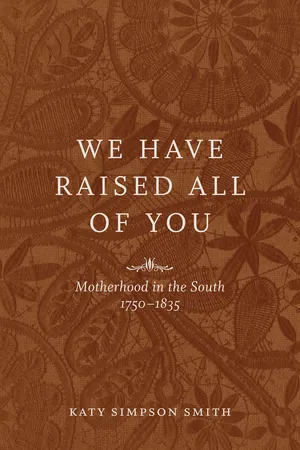
- 360 pages
- English
- ePUB (mobile friendly)
- Available on iOS & Android
eBook - ePub
About this book
Information
PART I
THEY SPRUNG
FROM A WOMAN
Indian Mothers
“I found food for you and I was your food.... But your mother will remain a mother to you, even though you kill her; take heed, therefore, and treasure up her words.”
—SELU, THE MOTHER OF THE CHEROKEES
How did Indian women define motherhood? For Cherokee and Catawba women, motherhood was not a single thread connecting woman and child, but a multidirectional web that spread out across a town and community. Women were connected to family through elaborate kinship networks that defined the outlines of virtually every individual relationship. As for white and black women, motherhood for southeastern Indian women was as much a social construction as a biological relationship, but more than any other group of women, matrilineal Indians viewed their motherhood as a justification for a remarkably broad social involvement. Being a mother meant taking responsibility for the agricultural production of one’s community, weighing in on political decisions at town councils, and speaking up in treaty negotiations with foreign nations. These activities were not incidental to women’s motherhood; they formed the very basis of their maternal identities. To “mother,” then, meant to provide for and to protect not only one’s own sons and daughters but a host of symbolic children, including relatives, towns, fields of corn, and nations.
Motherhood for Cherokee and Catawba women was also a very cosmological project and incorporated a variety of spiritual tasks and rituals. From the ancestral corn mother, Selu, who first brought corn and beans to the Cherokees, mothers inherited a spiritual duty. Not only were women responsible for the physical sustenance of their families and the continuation of their communities; their roles as mother and farmer were linked in spiritual importance. Mothers who planted seeds each spring contended with a natural world that could be unpredictable and violent. When a storm threatened to damage young corn, Chero kees would reason with the storm and persuade it to adjust its path. “Let your paths stretch out along the tree tops on the lofty mountains,” a priest would call out to the thunderclouds. Women who gave birth entered into a tacit agreement with the spiritual world; they would raise their children to be respectful if the world did them no harm. During childbirth, women coaxed infants out with both loving words and hollow threats. “You little man, get up now at once. There comes an old woman,” an attendant would warn. “Listen! Quick! Get your bed and let us run away.”1 Negotiations with the spiritual world were just as important as treaty discussions for mothers who had to protect their families.
Finally, being a Native American mother in the late eighteenth- and early nineteenth-century South meant understanding one’s own history in order to survive rapidly changing environments. Catawba mothers forged their identities out of the coalescence of dozens of small piedmont and low-country nations in the mid-eighteenth century, and they discovered that one way to hold on to their sense of authority and responsibility in the face of enormous population loss was to turn the domestic art of pottery into a marketable trade. Cherokee mothers, long a voice in international negotiations, dealt with the poverty in the aftermath of Revolutionary War violence by turning their children over to Christian missionaries in order to acquire not only food and clothing but a generation of white-educated allies in the fight against Cherokee land loss. Women gauged their surrounding environment as part of the daily process of being a mother. Whether that environment included a seasonal drought, an imbalance in the spiritual world, or the arrival of white traders, women practiced a maternalism that was fluid and responsive while still being grounded in fundamental values.
How did Indian mothers define power? Unlike many other women in the South, who relied on their own initiative to carve spaces of power within otherwise unyielding hierarchies, Cherokee and Catawba mothers enjoyed a maternal authority that was built into their very social structure. Power entailed being able to direct the course of one’s children and one’s community, and mothers earned that privilege through the spiritual potency of their fertility and their role in structuring both kin and clan. Lineages, marriages, and inheritance were all under a mother’s purview in matrilineal societies, and the mother’s prominence in the foundations of daily life contributed to women’s sense of authority. Power, for Native American women and men, was also imbued with spirituality, and it was not a fixed quantity but was in constant balance with the power of others, particularly the natural world. For mothers, this meant that their own realm of control stretched over agricultural production, household creation, and familial networks, but it also jostled and commingled with men’s power in the arena of politics. Whether their power was autonomous or shared, women exercised it on behalf of the maintenance and survival of their families, both biological and symbolic.2
Because mothers were farmers, they translated their bodily fertility onto fields of crops, where they nurtured corn, beans, and squash the way they nurtured children. Women were not compelled to farm, which is what many Europeans assumed when they compared hardworking Indian women to the men, who seemed to laze about; they had a right to agricultural production, a responsibility that derived not from any lower social status but from the link between the power of producing children and the power of sustaining them. Among Cherokees, the mythical figure of Selu, who brought forth both children and corn from her belly, proved that motherhood was a sacred role and that the land and all its bounty must fall under women’s powerful hands.
Because mothers were providers, they sustained their children’s bodies, finding them food and clothing even when poverty’s reach suggested that was an impossible task. Using the presence of whites, some mothers received material support from the very people who were threatening their children’s lands. By relentlessly pursuing their communities’ best interests, mothers could forge beneficial relationships with white settlers, thereby turning hardship into help. Mothers adapted to changing conditions not because their own habits were so mutable, but because adaptation was the only way to pursue unshakable goals.
Because mothers were spiritual guides, their motherhood was a cosmological force, a connection to a world of spirits and omens that solidified their status among their people. Menstrual blood symbolized maternal power, and Cherokees and Catawbas constructed strict guidelines to prevent this power from overwhelming a community. From this position of authority, mothers raised their children to be cautious of the natural world and to use the balance of spirits in the universe to their advantage. When white missionaries introduced Christianity, some women believed the religion offered a new degree of comfort and security in a new world. If any religious teaching held a chance for a better life for their children, mothers considered it. By the nineteenth century, Indian mothers used a blend of spiritual beliefs and customs to tend to their children’s bodies and souls.
Because mothers were teachers, they shaped their children’s understandings of the world through lessons in gender roles, practical skills, and cultural identity. When home instruction became inadequate for children who needed to cope with an increasingly white world, some mothers sent their children to mission schools to learn those foreign subjects that would best equip them for negotiations with their new neighbors. Whatever lessons mothers advocated, they maintained consistent goals: preparing all their children, from their sons and daughters to their nation, to succeed in the uncertain future.
Because mothers were politicians, they used their authority over the childlike nation to issue opinions, demands, and suggestions in both local councils and international negotiations. Motherhood was a relationship to one’s people, and both Cherokees and Catawbas knew that women’s voices were necessary to reach decisions about the fate of the nation. In instances when kin connections were implicated, mothers had virtually complete control. When men brought war captives home, women were the ones to decide whether they were executed or adopted into the fold; mothers had both the symbolic and the actual power of life and death in their hands.
Disease, warfare, depopulation, and an invasion of white settlers, soldiers, and missionaries created a more drastically changed landscape for Indian mothers in the late eighteenth and nineteenth centuries than for any other group of southern women. Responding with the strategies they had developed from centuries of adaptation, Cherokee and Catawba mothers endured hardships from child mortality to Indian Removal by relying on their authority as mothers. This authority enabled women to make choices about their children’s and communities’ futures, and while some Indian elites may have sought to curtail women’s power by the early nineteenth century, women themselves continued to exercise a maternal prerogative that had been shaped and sharpened by generations of their forebears.
On a Saturday in November 1818, a Cherokee woman arrived on the doorstep of Brainerd mission school in eastern Tennessee, physically drained from her journey, with an eight-year-old girl by her side. Recently abandoned by her husband, the impoverished woman sought to place her child with the missionaries and thus assure her an education and a sturdy set of clothes. The missionaries gladly accepted the young girl but made the mother promise not to take the child away again, as they had witnessed with so many Cherokee mothers who were torn between affection for their children and security for their sons and daughters in a time of economic uncertainty. This particular Cherokee mother, now with neither husband nor child, may have had another goal in mind as well. Five months earlier, a committee of Cherokee women had drafted a petition protesting the discussion of Removal. They reminded the National Council of the Cherokees’ unquestionable right to their land, but the women also hinted that their efforts at “civilization” were intended as proof that they were no different than the white settlers overrunning the land. Like many women, this weary Cherokee mother may have placed her child in school as further evidence of her “civilization,” and by extension, her own strengthened claim to the land. But women were not invulnerable to the pressures on their motherhood. Eight days after the Cherokee mother surrendered her daughter to the Brainerd missionaries, she returned to claim her, having learned that “the child cried for mother when she was going to bed.” The missionaries chastised the “unenlightened” mother to no avail; the woman returned home along the same trail, daughter safe in hand once more. The strong continuity of women’s goals as mothers undergirded a strategic manipulation of opportunities offered by the many social changes in the early nineteenth century. That continuity simply shone through most strongly in those historical moments when mothers sacrificed the promise of food and clothing in order to comfort a distressed child.3
1
Indian Farmers
In the Cherokee origin story, Selu—the mythological mother of all Cherokees—physically produced both corn and children as synonymous symbols of her fertility. At the beginning of time, she provided food for her husband and sons by slipping away to a secret cabin and performing a ritual that linked her body to the earth: when she rubbed her belly and her armpits, corn and beans emerged. These she gathered in a basket and brought back to her hungry family. Soon, her sons grew suspicious and plotted to spy on her. Upon witnessing this magic, they feared their mother, calling her a sorceress, and decided to kill her. Imperturbable, Selu overheard their plans and told them that after they killed her, they must follow her instructions in order to provide for their people. She told them to drag her body in a circle seven times around the packed earth, for where her blood fell, the corn would grow. The milk and flesh of the corn would be their mother, and like their mother, it would nourish the Cherokees for generations.1
Connecting the story of Selu to a narrative of maternal authority involves no special imaginative powers; the correlation is direct. More than any other group of women in the South, mothers in matrilineal Native societies lived with daily confirmations of their communal and individual value. In the property they owned, the lineages they controlled, and the councils to which they contributed, women experienced a general respect for motherhood (both actual and symbolic) that translated into a concrete sense of their own worth and capabilities. This sense allowed Indian women to raise their children with a confidence that weathered the storms of the late eighteenth and early nineteenth centuries, when white settlers, traders, missionaries, and enslaved Africans and African Americans filtered onto Indian lands.
Land was at the center of the lives of Native mothers; it provided the most basic illustration of their maternal worth, and its vulnerability in the face of white expansion was the greatest threat to mothers’ continued control over their families and communities. As a result, women’s symbolic connection to land and agriculture deserves our first consideration. Cherokees and Catawbas form the heart of this study; both groups were matrilineal residents of the South, but their experiences within the region were very different. Cherokees were well established as a dominant political and military force in the region before Europeans arrived, while Catawbas coalesced as a group only in the mid-eighteenth century from the diverse piedmont and low-country peoples who had been scattered and picked apart by the Yamasee War, smaller skirmishes, and epidemics of smallpox and dysentery.2 When white colonists took on the British army in the 1770s, most Cherokees sided with the British while the Catawbas joined forces with rebel Americans; the subsequent years looked very different for the two groups as Cherokees faced retaliation from their newly entrenched neighbors and Catawbas enjoyed a certain amount of protection.3 To both peoples, though, land was an essential part of their identity, whether that land was ancient and ancestral or patched together through treaties and coalitions, and where land was central, so were mothers. For Cherokee women in the eighteenth century, that land held forested hills plunging into lush valleys, abundant streams, and a climate that, unlike much of the South, retained some hint of coolness in the summer. Catawba women worked a lower ground to the south, covered in loblolly pine rather than spruce and sugar maple, and though they were based in the piedmont, they could access swampy bottomlands for crops that needed richer soil.4
As Selu’s marvel demonstrates, Cherokees, along with their matrilineal neighbors, believed that the yearly fertility of the earth represented the fertility of Selu and, by extension, all mothers. Selu’s gift emerged not just from her womanhood, but specifically from her maternalism; the fertility of her body represented both the reproduction of Native communities and their agricultural subsistence. This connection was borne out in the gendered division of labor, as women took charge of the land and its bounty, becoming skilled farmers while men focused their energies on the transient hunt and supplemented a crop-based diet with seasonal game. For Cherokees, the knowledge it took to coax crops from the soil was inextricable from the knowledge needed to raise children from seedlings to strong adults. And because both plants and children were necessary to the community’s survival, the tenders of those precious objects—the mothers—wielded an enormous amount of social, economic, and political power.
In the eighteenth and early nineteenth centuries, Cherokee and Catawba lands were threatened by more than the droughts, late frosts, and enemy raids that had marked a farmer’s trials for centuries before. With the arrival of Europeans and Africans in the Southeast, and the diseases and escalated warfare they brought with them, land became newly vulnerable. Women had to find new ways to assert their guardianship of the land, even as the land itself was shrinking. Within the varied communities of the Southeast, motherhood was a particular way of interacting with other men and women that embodied social and economic responsibility. It derived from women’s childbearing, but it was never a solely biological role. The tie of motherhood to economic production was potent in eighteenth-century Native societies, and despite the threats to their land, Cherokee and Catawba women continued to assert this power in the nineteenth century. They understood that women, as the prim...
Table of contents
- Cover
- Title Page
- Copyright Page
- Dedication
- Contents
- Preface to the Updated Edition
- Acknowledgments
- Introduction
- Part I. They Sprung from a Woman: Indian Mothers
- Part II. Sowing Good Seed: White Mothers
- Part III. She Was With Me in the Night: Black Mothers
- Conclusion
- Notes
- Selected Bibliography
- Index
Trusted by 375,005 students
Access to over 1.5 million titles for a fair monthly price.
Study more efficiently using our study tools.
Frequently asked questions
Yes, you can cancel anytime from the Subscription tab in your account settings on the Perlego website. Your subscription will stay active until the end of your current billing period. Learn how to cancel your subscription
No, books cannot be downloaded as external files, such as PDFs, for use outside of Perlego. However, you can download books within the Perlego app for offline reading on mobile or tablet. Learn how to download books offline
Perlego offers two plans: Essential and Complete
- Essential is ideal for learners and professionals who enjoy exploring a wide range of subjects. Access the Essential Library with 800,000+ trusted titles and best-sellers across business, personal growth, and the humanities. Includes unlimited reading time and Standard Read Aloud voice.
- Complete: Perfect for advanced learners and researchers needing full, unrestricted access. Unlock 1.5M+ books across hundreds of subjects, including academic and specialized titles. The Complete Plan also includes advanced features like Premium Read Aloud and Research Assistant.
We are an online textbook subscription service, where you can get access to an entire online library for less than the price of a single book per month. With over 1.5 million books across 990+ topics, we’ve got you covered! Learn about our mission
Look out for the read-aloud symbol on your next book to see if you can listen to it. The read-aloud tool reads text aloud for you, highlighting the text as it is being read. You can pause it, speed it up and slow it down. Learn more about Read Aloud
Yes! You can use the Perlego app on both iOS and Android devices to read anytime, anywhere — even offline. Perfect for commutes or when you’re on the go.
Please note we cannot support devices running on iOS 13 and Android 7 or earlier. Learn more about using the app
Please note we cannot support devices running on iOS 13 and Android 7 or earlier. Learn more about using the app
Yes, you can access We Have Raised All of You by Katy Simpson Smith in PDF and/or ePUB format, as well as other popular books in History & North American History. We have over 1.5 million books available in our catalogue for you to explore.