A national map of legalized gambling from 1963 would show one state, Nevada, with casino gambling and no states with lotteries. Today's map shows eleven commercial casino states, most of them along the Mississippi River, forty-two states with state-owned lotteries, and racetrack betting, slot-machine parlors, charitable bingo, and Native American gambling halls flourishing throughout the nation. For the past twenty years, the South has wrestled with gambling issues. In How the South Joined the Gambling Nation, Michael Nelson and John Lyman Mason examine how modern southern state governments have decided whether to adopt or prohibit casinos and lotteries. Nelson and Mason point out that although the South participated fully in past gambling eras, it is the last region to join the modern movement embracing legalized gambling. Despite the prevalence of wistful, romantic images of gambling on southern riverboats, the politically and religiously conservative ideology of the modern South makes it difficult for states to toss their chips into the pot.
The authors tell the story of the arrival or rejection of legalized gambling in seven southern states -- Mississippi, Louisiana, Tennessee, South Carolina, Georgia, Arkansas, and Alabama. The authors suggest that some states chose to legalize gambling based on the examples of other nearby states, as when Mississippi casinos spurred casino legalization in Louisiana and the Georgia lottery inspired lottery campaigns in neighboring South Carolina, Alabama, and Tennessee. Also important was the influence of Democratic policy entrepreneurs, such as Zell Miller in Georgia, Don Siegelman in Alabama, and Edwin Edwards in Louisiana, who wanted to sell the idea of gambling in order to sell themselves to voters. At the same time, each state had its own idiosyncrasies, such as certain provisions of their state constitutions weighing heavily as a factor.
Nelson and Mason show that the story of gambling's spread in the South exemplifies the process of state policy innovation. In exploring how southern states have weighed the moral and economic risk of legalizing gambling, especially the political controversies that surround these discussions, Nelson and Mason employ a suspenseful, fast-paced narrative that echoes the oftentimes hurried decisions made by state legislators. Although each of these seven states fought a unique battle over gambling, taken together, these case studies help tell the larger story of how the South -- sometimes reluctantly, sometimes enthusiastically -- decided to join the gambling nation.
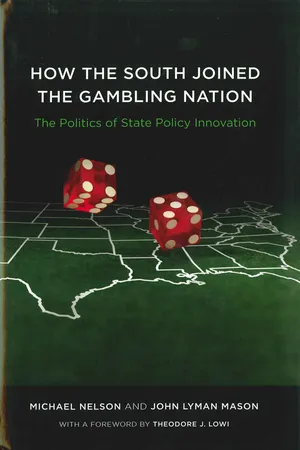
eBook - ePub
How the South Joined the Gambling Nation
The Politics of State Policy Innovation
- 280 pages
- English
- ePUB (mobile friendly)
- Available on iOS & Android
eBook - ePub
How the South Joined the Gambling Nation
The Politics of State Policy Innovation
About this book
Information
NOTES
Introduction
1 The historical survey that follows draws heavily on John Lyman Mason and Michael Nelson, Governing Gambling (New York: Century Foundation Press / Brookings Institution, 2001), chaps. 2–3; Patrick A. Pierce and Donald E. Miller, Gambling Politics: State Governments and the Business of Betting (Boulder, Colo.: Lynne Rienner, 2004), chap. 2; Ronald M. Pavalko, Risky Business: America’s Fascination with Gambling (Belmont, Calif.: Wadsworth, 2000), chap. 3; and John Samuel Ezell, Fortune’s Merry Wheel: The Lottery in America (Cambridge, Mass.: Harvard University Press, 1960).
2 Quoted in John J. Dinan, The American State Constitutional Tradition (Lawrence: University Press of Kansas, 2006), 251.
3 Because this book studies policy innovations by state governments, its focus is on lotteries and commercial casinos. Tribal casino gambling is discussed to the extent that it involves state governments or affects state policy making. Tribal casinos are the subject of Mason and Nelson, Governing Gambling, chap. 4.
4 Calculated from data in Steven Andrew Light and Kathryn R. L. Rand, Indian Gaming and Tribal Sovereignty: The Casino Compromise (Lawrence: University Press of Kansas, 2005), 163–68. The eighteen facilities, most of them bingo halls, are in Alabama (Poarch Band of Creek Indians, 3), Florida (Miccosukee Tribal Indians of Florida, 1; Seminole Tribe, 5), Louisiana (Chitimacha Tribe of Louisiana, 1; Coushatta Tribe of Louisiana, 1; Tunica-Biloxi Tribe of Louisiana, 1), Mississippi (Mississippi Band of Choctaw Indians, 2), North Carolina (Eastern Band of Cherokee Indians,
2), South Carolina (Catawba Indian Nation, 1), and Texas (Kickapoo Traditional Tribe of Texas, 1).
5 Charles T. Clotfelter and Philip J. Cook, Selling Hope: State Lotteries in America (Cambridge, Mass.: Harvard University Press, 1989).
6 Ibid., chap. 8.
7 Frances Stokes Berry and William D. Berry, “State Lottery Adoptions as Policy Innovation: An Event History Analysis,” American Political Science Review 63 (Sept. 1969): 880–99.
8 Pierce and Miller, Gambling Politics, 62, also argue that low-tax states are more likely to adopt a lottery than higher-tax states. John E. Filer, Donald L. Moak, and Barry Uze reach the opposite conclusion in “Why Some States Adopt Lotteries and Some Don’t,” Public Finance Quarterly 16 ( July 1988): 259–83.
9 Berry and Berry, “State Lottery Adoptions.”
10 Pierce and Miller, Gambling Politics, 39.
11 John Dombrink and William N. Thompson, The Last Resort: Success and Failure in Campaigns for Casinos (Reno: University of Nevada Press, 1990). The important political factors they list are: “political environment,” such as the economy and the state’s prior experience with gambling; “political elite and active interests,” including the stance of public officials and business interests on casinos; “campaign sponsorship,” such as the credibility and financial commitment of casino advocates; and “campaign issue dominance,” notably, the ability of casino supporters to frame the issue as one of economic development rather than of crime, morality, or quality of life.
12 Pierce and Miller, Gambling Politics, chaps. 5–6. The quoted phrases appear on pages 172 and 94, respectively.
13 Berry and Berry’s study of lotteries ended in 1986, Cook and Clotfelter’s in 1988, and Pierce and Miller’s in 1990. See Cook and Clotfelter, Selling Hope; Berry and Berry, “State Lottery Adoptions”; and Pierce and Miller, Gambling Politics. Dombrink and Thompson’s study of casinos ended in 1989 (The Last Resort).
14 Jack L. Walker, “The Diffusion of Innovation Among the American States,” American Political Science Review 63 (Sept. 1969): 880–99.
15 See Scott P. Hays, “Controversy and Reinvention in the Diffusion of State Policy Innovation,” Political Research Quarterly 49:13–632; and Henry R. Glick and Scott P. Hays, “Innovation and Reinvention in State Policy Innovation: Theory and the Evolution of Living Will Laws,” Journal of Politics 53:835–50. See also Michael Nelson and John Lyman Mason, “The Politics of Gambling in the South,” Political Science Quarterly 104 (Winter 2003–4): 645–69.
16 Everett M. Rogers, Diffusion of Innovations, 4th ed. (New York: Free Press, 1995), 178.
17 Virginia Gray, “Competition, Emulation, and Policy Innovation,” in New Perspectives on American Politics, ed. Lawrence C. Dodd and Calvin Jillson (Washington, D.C.: CQ Press, 1994), 230–48.
18 In Gambling Politics, Pierce and Miller say more likely, but their conclusion is not supported in the southern states by this study.
19 John W. Kingdon, Agendas, Alternatives, and Public Policies (Boston: Little, Brown, 1984).
20 Michael Mintrom, “Policy Entrepreneurs and the Diffusion of Innovation,” American Journal of Political Science 41 ( July 1997): 738–70.
21 J. David Woodard, The New Southern Politics (Boulder, Colo.: Lynne Rienner, 2006), chap. 8.
22 Graham T. Allison, Essence of Decision: Explaining the Cuban Missile Crisis (Boston: Little, Brown, 1971); Robert A. Dahl, Who Governs?: Democracy and Power in an American City (New Haven, Conn.: Yale University Press, 1961; Herbert Kaufman, The Forest Ranger: A Study in Administrative Behavior (Baltimore: Johns Hopkins University Press, 1960); and Jeffrey L. Pressman and Aaron B. Wildavsky, Implementation: How Great Expectations in Washington Are Dashed in Oakland (Berkeley and Los Angeles: University of California Press, 1973).
23 Sidney Verba, “Some Dilemmas in Comparative Research,” World Politics 20 (1967): 111–27; Arend Lijphart, “Comparative Politics and the Comparative Method,” American Political Science Review 65 (Sept. 1971): 682–93; Harry Eckstein, “Case Study and Theory in Political Science,” in Handbook of Political Science, vol. 7, ed. F. I. Greenstein and N. W. Polsby (Reading, Mass.: Addison-Wesley, 1975), 79–137.
24 John Gerring, “What Is a Case Study and What Is It Good For?” American Political Science Review 98 (May 2004): 341–54.
25 In terms of the phases and execution of our research, we employ the case study method as outlined by Alexander L. George, “Case Studies and Theory Development: The Method of Structured, Focused Comparison,” in Diplomacy: New Approaches in History, Theory, and Policy, ed. Paul Gordon Lauren (New York: Free Press, 1979), 54–57.
26 Gerring, “What Is a Case Study and What Is It Good For?” 348.
Chapter 1
1 Joint Committee on Performance Evaluation and Expenditure Review, Mississippi Legislature, A Report on the Adequacy of the Mississippi Gaming Commission’s Regulation of Legalized Gambling in Mississippi (Sept. 11, 1996), 1.
2 “Mississippi,” USA Today, Jan. 8, 1990.
3 Peter J. Boyer, “Gone with the Surge,” New Yorker, Sept. 26, 2005, 76–86.
4 Dave Palermo, “The Day Gambling Died,” Biloxi Sun-Herald, Aug. 23, 1998. Although “never the same,” gambling continued in various Gulf Coast establishments long after Kefauver and his committee left. See Deanne Stephens Newer and Greg O’Brien, “Mississippi’s Oldest Pastime,” in Resorting to Casinos: The Mississippi Gambling Industry, ed. Denise von Herrmann ( Jackson: University Press of Mississippi, 2006), 11–25.
5 Benjamin Schwarz and Christina Schwarz, “Mississippi Monte Carlo,” Atlantic Monthly ( Jan. 1996), 67–82.
6 Thomas B. Shepherd III and Cheryn L. Netz, “Mississippi,” in International Casino Law, 3d ed., ed. Anthony N. Cabot, William N. Thompson, Andrew Tottenham, and Carl G. Braunlich (Reno, Nev.: Institute for the Study of Gambling and Commercial Gaming, 1999), 72–91.
7 IGRA’s enactment went virtually unnoticed: it received only four mentions in the Lexis-Nexis newspaper database in the year it was passed. Matthew Continetti, The K Street Gang: The Rise and Fall of the Republican Machine (New York: Doubleday, 2006), 141.
8 Interview with H. L. “Sonny” Merideth, former representative, Mississippi Legislature, Nov. 1999.
9 Interview with Charlie Williams, representative, Mississippi legislature, Sept. 20, 1999.
10 Interview with Paul Jones, Nov. 5, 1999.
11 Interview with Charlie Wi...
Table of contents
- COVER
- TITLE PAGE
- COPYRIGHT PAGE
- CONTENTS
- FOREWORD
- ACKNOWLEDGMENTS
- INTRODUCTION
- ONE: MISSISSIPPI: Casinos Come South
- TWO: GEORGIA: Politics and HOPE
- THREE: SOUTH CAROLINA: “We Just Luuuvv South Carolinians Playing Our Lottery”
- FOUR: ALABAMA: The Governor, the Churches, and the “Sin Legislator”
- FIVE: TENNESSEE: “Let the People Decide”
- SIX: ARKANSAS: Politics Gets Wacky
- SEVEN: LOUISIANA: The Place Where “Gaming” Isn’t “Gambling”
- CONCLUSION: Why the South Joined the Gambling Nation
- NOTES
- INDEX
Trusted by 375,005 students
Access to over 1.5 million titles for a fair monthly price.
Study more efficiently using our study tools.
Frequently asked questions
Yes, you can cancel anytime from the Subscription tab in your account settings on the Perlego website. Your subscription will stay active until the end of your current billing period. Learn how to cancel your subscription
No, books cannot be downloaded as external files, such as PDFs, for use outside of Perlego. However, you can download books within the Perlego app for offline reading on mobile or tablet. Learn how to download books offline
Perlego offers two plans: Essential and Complete
- Essential is ideal for learners and professionals who enjoy exploring a wide range of subjects. Access the Essential Library with 800,000+ trusted titles and best-sellers across business, personal growth, and the humanities. Includes unlimited reading time and Standard Read Aloud voice.
- Complete: Perfect for advanced learners and researchers needing full, unrestricted access. Unlock 1.5M+ books across hundreds of subjects, including academic and specialized titles. The Complete Plan also includes advanced features like Premium Read Aloud and Research Assistant.
We are an online textbook subscription service, where you can get access to an entire online library for less than the price of a single book per month. With over 1.5 million books across 990+ topics, we’ve got you covered! Learn about our mission
Look out for the read-aloud symbol on your next book to see if you can listen to it. The read-aloud tool reads text aloud for you, highlighting the text as it is being read. You can pause it, speed it up and slow it down. Learn more about Read Aloud
Yes! You can use the Perlego app on both iOS and Android devices to read anytime, anywhere — even offline. Perfect for commutes or when you’re on the go.
Please note we cannot support devices running on iOS 13 and Android 7 or earlier. Learn more about using the app
Please note we cannot support devices running on iOS 13 and Android 7 or earlier. Learn more about using the app
Yes, you can access How the South Joined the Gambling Nation by Michael Nelson,John Lyman Mason in PDF and/or ePUB format, as well as other popular books in Política y relaciones internacionales & Historia de Norteamérica. We have over 1.5 million books available in our catalogue for you to explore.