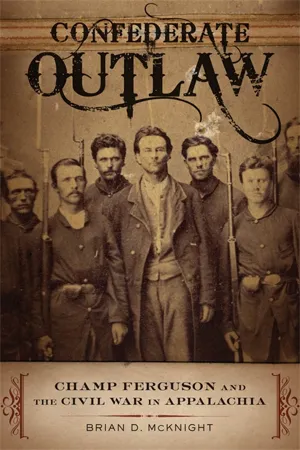
In the fall of 1865, the United States Army executed Confederate guerrilla Champ Ferguson for his role in murdering fifty-three loyal citizens of Kentucky and Tennessee during the Civil War. Long remembered as the most unforgiving and inglorious warrior of the Confederacy, Ferguson has often been dismissed by historians as a cold-blooded killer. In Confederate Outlaw: Champ Ferguson and the Civil War in Appalachia, biographer Brian D. McKnight demonstrates how such a simple judgment ignores the complexity of this legendary character.In his analysis, McKnight maintains that Ferguson fought the war on personal terms and with an Old Testament mentality regarding the righteousness of his cause. He believed that friends were friends and enemies were enemies—no middle ground existed. As a result, he killed prewar comrades as well as longtime adversaries without regret, all the while knowing that he might one day face his own brother, who served as a Union scout.Ferguson's continued popularity demonstrates that his bloody legend did not die on the gallows. Widespread rumors endured of his last-minute escape from justice, and over time, the borderland terrorist emerged as a folk hero for many southerners. Numerous authors resurrected and romanticized his story for popular audiences, and even Hollywood used Ferguson's life to create the composite role played by Clint Eastwood in The Outlaw Josey Wales. McKnight's study deftly separates the myths from reality and weaves a thoughtful, captivating, and accurate portrait of the Confederacy's most celebrated guerrilla.An impeccably researched biography, Confederate Outlaw offers an abundance of insight into Ferguson's wartime motivations, actions, and tactics, and also describes borderland loyalties, guerrilla operations, and military retribution. McKnight concludes that Ferguson, and other irregular warriors operating during the Civil War, saw the conflict as far more of a personal battle than a political one.
- 280 pages
- English
- ePUB (mobile friendly)
- Available on iOS & Android
eBook - ePub
About this book
Information
1
THE “NATURAL MAN”
We had a scuffle, and I kept cutting him all the time, until he fell, and I stabbed him once or twice.
—CHAMP FERGUSON on his killing of a local constable in 1858
I was let out on bail, and when the war broke out, I was induced to join the army on the promise that all prosecution in the case would be abandoned. That is how I came to take up arms.
—CHAMP FERGUSON regarding his entry into the Civil War
Champ Ferguson entered the world on November 29, 1821. Born on Spring Creek near the county seat of Albany in Cumberland County, Kentucky,1 he was the oldest of ten children who came to William R. and Zilpha Huff Ferguson.2 A contemporary described the simplicity of William Ferguson’s place as consisting of a small log house, a log stable, corn crib, and a little still-house near the creek.3 Purportedly named after his grandfather, who carried the nickname “Champion,” Ferguson probably spent his youth like other hill-country boys growing up in similar circumstances.4 Although little is known of his childhood and teenage years, Champ likely spent the bulk of his youth performing chores around the house, at work in the fields with his father, or walking fences in search of stray livestock. When spare time presented itself, he could choose between recreation and education. The keen shooting eye and intimate knowledge of local geography and terrain that he would display in his later life suggest that recreation prevailed. Horsemanship was another important farm-grown talent that Champ cultivated. Ferguson spent a good portion of his leisure time on horseback.5 All of these formative influences helped define the man Champ would become.
Lewis Collins’s 1847 Historical Sketches of Kentucky described the Clinton County young Champ Ferguson knew. It held two significant towns: Albany and Seventy-Six. Although the county had borrowed the surname of DeWitt Clinton, the visionary governor of New York State and sponsor of the wildly successful Erie Canal, there was apparently no connection between the name of the county seat and New York’s seat of government.6 Collins recorded that the thriving little town of Albany “contain[ed] a court-house and other public buildings, a United Baptist church, one school, three stores, two taverns, three lawyers, two doctors, fifteen mechanics’ shops, and one hundred and thirty inhabitants.” Seventy-Six, presumably named after the year of American independence, was much smaller. Having only twenty-five people living in town, it also claimed “a lawyer, post office, tannery, saw and grist mill.”7
Young men and women from the central Appalachian region have always had limited educational opportunities. Such was the case for young Champ. Near the time of his death, he recalled that he “never had much schooling,” and indeed, many middling whites felt no need for education, particularly if their future would be spent in the fields. Having attended Clinton County’s only school for what he estimated to have been “about three months,” Champ learned to “read, write, and cipher right smart.”8 Ferguson’s memory of his school days illustrates the common standard for farm boys of his era in Kentucky. Apart from the availability of a proper school, family support was also an important factor. Most parents considered an education complete when the child learned the most basic skills, expecting that a signature, limited reading skills, and a command of simple mathematics would suffice for life as an adult. However, little more is known about Ferguson’s education beyond his personal reminiscences. Unfortunately, the United States census failed to record education information until 1840, a time when Ferguson was past school age, when it showed Clinton County as the home of two primary schools with forty-nine students and a single academy with twenty-five older pupils.9 Also important is Ferguson’s own estimation of his literacy skills. He considered his three months in school to have been sufficient to learn the basics of education, although he gauged his abilities as nothing “to brag on.”10
Although Champ Ferguson’s later infamy might lead one to dismiss religion as an important formative factor, it cannot be ignored. Like much of the American frontier, the region of south-central Kentucky had scant opportunities for religious education. The 1850 census provided the first record of Clinton County’s churches. That year, three Baptist congregations and two Methodist churches offered the only formal religious instruction in the county. Ten years later, the 1860 census noted a substantial increase to five Baptist churches, eight Methodist congregations, and a single Presbyterian church.11 Of note is the Calvinist background of the Baptist faith. During the first decades of the nineteenth century, Calvinism and Arminianism were competing for control of the Baptists. After many failures, some Baptist churches, particularly those in the south-central part of the state, found enough common ground to unite under one roof.12
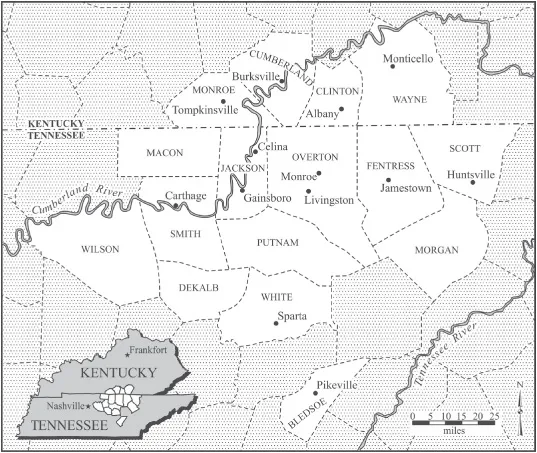
Champ Ferguson’s Upper Cumberland region (Map by Mary Lee Eggart)
Ferguson grew up in this changing religious landscape of southern Kentucky. He publicly professed a belief in a higher being and attended church services. Although he never joined a specific congregation, he did, by the end of his life, announce an affinity for a group called the “Campbellites,” or the Stone-Campbell Movement. Although it initially splintered into two separate groups, another group, the Disciples of Christ, maintained significant influence in the Appalachian highlands of Kentucky and Tennessee. The theology of the Disciples movement was based on a primitive form of New Testament Christianity and emphasized theological unity over denominational differences. It is likely that many mountaineers combined the basic tenets of the Disciples with more traditional and practical Old Testament teachings to build a satisfying and useful faith that could speak to God’s love on the one hand and swift retribution of wrongs on the other.
The Presbyterians were another theological influence in the mountains. Like the Puritans of New England, Presbyterians brought a distinctly Calvinistic bent to their faith. As John Calvin disseminated his punitive brand of Christianity throughout Europe, the Scots received Presbyterianism as their religious link to the famous reformer. With similar behavioral standards and basic theological traditions, Presbyterians became the Puritans of the southern Appalachian region.
In the case of the Appalachian Civil War and the guerrilla tactics that dominated there, a certain style of Calvinism with particular reflection on Old Testament themes resonates. The concept of power and judgment can be seen in the behavior of the many local warlords who rose to positions of power during the war. What often seems to be a style of Old Testament tribalism appears in geographical, social, and cultural contexts and stresses the value of localism and kinship ties within the mountain region. The dual concepts of predestination and total depravity hold that man is powerless to resist his fate, and this may make it easier for him to accept the radical and illogical actions that internecine war brings about. Whatever his specific theological beliefs, Champ Ferguson interpreted religion somewhat predictably along these more fatalist and predestinarian lines. In the unforgiving world of mid-nineteenth-century Appalachia, Ferguson embraced this curious combination of love and vengeance as a way to answer the difficult questions of everyday life. As his wartime actions would later illustrate, rules were absolute and unbending; men either good or bad; and citizens either with him or against him.
Another subtle influence on Ferguson’s life was political. By the time the first shots of the Civil War were fired, Kentucky’s 4th district could look back on a generation of political transition. What had started with the Whig party all but dominating regional politics had evolved into open competition with the Democrats, and after the Whigs’ ultimate demise, the 4th district became a Democratic stronghold until hostilities grew inevitable. With sectionalism at a crisis point, enough voters returned to their Whig roots to seek a way out of the national quandary by electing opposition, and later, Union, candidates.13
Conjecture puts Champ Ferguson in the Democratic Party. As a rising farmer during the 1850s, he likely sought protection for his newly acquired property and success. When secession became an issue, he allied himself with the cause of the Confederacy without hesitation. His move to Tennessee and embrace of the southern ideal during the war further bolster the suggestion of his Democratic roots. For many Kentucky Democrats, the Civil War offered hope of political influence after years of Whig near-dominance. Indeed, noted unionist and wartime nemesis J. A. Brents, in an 1863 publication, identified Ferguson as a supporter of the Democratic Party before the war.14
Although political and religious matters were important to the average white Kentuckian, more basic aspects of daily life proved more defining. Life in Kentucky and Tennessee during the antebellum period generally revolved around agricultural production. This was particularly true of Clinton County, in the Pennyroyal region of south-central Kentucky, along the Tennessee border. The rolling hills alternating with level and fertile bottomland and access to the navigable Cumberland River gave the county much agricultural potential. Although the Sixth Census did not record specific agricultural information, the farm dominated the nearly twenty-year-old Champ Ferguson’s life. At this point, Champ shared the outside labor with his father and two younger brothers, as the family owned no slaves.15
Clinton County in 1840 was an anomaly. Whereas the surrounding counties of south-central Kentucky held comparatively large numbers of slaves, Clinton could only claim 188 slaves among a total population of 3,863. The holding of such a small number of slaves—less than 5 percent of the population—in the hands of the most successful men in the county embedded the idea in young minds, like Champ Ferguson’s, that the ownership of slaves was the identifying factor in economic success.16
By the time he matured into adulthood, Champ had grown into a large and strong man. Standing a full six feet tall and weighing around 180 pounds, “without any surplus flesh,” he was one of the bigger men in the community and well equipped for the physical demands of the coming war. J. A. Brents described him as having “a large foot, and [he] gives his legs a loose sling when walking, with his toes turned out—is a little stooped with his head down.”17 Combining the physical description of Ferguson with the way in which he came to prosecute the Civil War, it is easy to see him, as Daniel Sutherland sees many similar Civil War guerrillas, in the European philosophic tradition of the “natural man.” Despite modern efforts, the historical record strongly indicates that Ferguson was “basic, uncomplicated, primordial,” like the style of warfare he preferred.18
On May 12, 1844, the twenty-two-year-old Champ married Ann Eliza Smith. It is likely that the newlyweds built a small house and remained on the family farm, which offered a subsistence living, and would one day be passed to Champ as oldest son. Shortly after, Ann gave birth to a son. Tragedy struck, however, when in 1847 both Champ’s wife and young son died of unspecified causes.19 As one would expect, the loss of his family affected him terribly.
A widower at only twenty-five, Ferguson sought to end his forced bachelorhood and on July 23, 1848, married twenty-two-year-old Martha Owens. In early 1850, the two welcomed a daughter, Ann Elizabeth, into the family.20 Although little is known about the Ferguson women and children, the apparent naming of Martha’s daughter after her husband’s first wife suggests a couple of possibilities: That Martha had known and respected Ann Eliza Smith and wished to remember her husband’s first wife by giving her daughter the same name, or, more likely, that Champ had not fully recovered from the death of his first wife.
Just as Champ’s life began settling into a predictable pattern, he was again jolted by bad news. In 1850, his father died. That same year, the more detailed Seventh Census recorded 499 farms in Clinton County. With 29,771 improved and 55,767 unimproved acres reported, the average farm family held just under sixty acres of cleared land and nearly 112 acres still in timber or brush.21 The size of William Ferguson’s farm is unknown, but Champ probably inherited most of it along with added familial obligations. A survey done on November 1, 1855, placed 194 acres of land on Spring Creek in Champ’s name, making him a larger-than-average landholder in comparison with most others in Clinton County. In addition to his own small family, he became responsible for the sustenance and care of his mother and siblings, several of whom were young children.22
The 1850s kept Champ busy filling his various roles and responsibilities. In the years that followed his father’s death, Champ threw himself into expanding and improving the modest farm. The county census for 1860 recorded that the county’s 975 families lived on 590 farms encompassing more than 41,000 acres of improved farmland, an average farm size of seventy acres.23 By 1860, Champ owned 462 acres of land and had accumulated an estimated $2,000 in wealth. That year’s census report placed Ferguson in the 13th percentile of Clinton County landowners.24
With his late increase in prosperity, Ferguson, like many southern farmers wishing to produce more immediate wealth and, at the same time, invest in the future, began to accumulate a few slaves. Although Clinton County’s tradition of relatively small subsistence farms combined with its distance from major trade routes to make large-scale slavery largely impractical there, opportunistic farmers embraced the investment potential. In 1860, the county’s white population stood at nearly 5,800, with only 258 slaves recorded.25 Ferguson, who by the time of the Civil War could be classified as a rising farmer, owned three mulatto slaves. One, a forty-five-year-old man, assisted Champ with the myriad duties related to the farm, and two young sisters, nine-year-old Sara Eliza and her sister, Mary Jane, a year younger, helped in the home.26 At this young age, Sara Eliza and Mary Jane provided minimal housekeeping help but remained potentially lucrative investments for the family. This small number of slaves placed Champ in the top five percent of slave owners in largely nonslaveholding Clinton County.27 The 1860 census also notes that Marion Cowan, a twenty-one-year-old farmer, lived with the Ferguson family. Although nothing is known of Cowan or his relationship with the family, he worked for Ferguson as a farm hand. It is possible that by 1860, Champ was performing considerably less fi...
Table of contents
- Cover Page
- Title Page
- Copyright Page
- Dedication
- Contents
- Acknowledgments
- Introduction
- 1 The “Natural Man”
- 2 Exiled to Tennessee
- 3 Fight on the Cumberland
- 4 The Tensions of the Borderland
- 5 Stability and Partition
- 6 Lessons of Perseverance
- 7 The Borderland Guerrilla Lifestyle
- 8 A Terrible Career’s Grand Climax
- 9 Revelation of a Clear Conscience
- 10 Quiet Resurrections of An Unlikely Hero
- Notes
- Bibliography
- Index
Trusted by 375,005 students
Access to over 1.5 million titles for a fair monthly price.
Study more efficiently using our study tools.
Frequently asked questions
Yes, you can cancel anytime from the Subscription tab in your account settings on the Perlego website. Your subscription will stay active until the end of your current billing period. Learn how to cancel your subscription
No, books cannot be downloaded as external files, such as PDFs, for use outside of Perlego. However, you can download books within the Perlego app for offline reading on mobile or tablet. Learn how to download books offline
Perlego offers two plans: Essential and Complete
- Essential is ideal for learners and professionals who enjoy exploring a wide range of subjects. Access the Essential Library with 800,000+ trusted titles and best-sellers across business, personal growth, and the humanities. Includes unlimited reading time and Standard Read Aloud voice.
- Complete: Perfect for advanced learners and researchers needing full, unrestricted access. Unlock 1.5M+ books across hundreds of subjects, including academic and specialized titles. The Complete Plan also includes advanced features like Premium Read Aloud and Research Assistant.
We are an online textbook subscription service, where you can get access to an entire online library for less than the price of a single book per month. With over 1.5 million books across 990+ topics, we’ve got you covered! Learn about our mission
Look out for the read-aloud symbol on your next book to see if you can listen to it. The read-aloud tool reads text aloud for you, highlighting the text as it is being read. You can pause it, speed it up and slow it down. Learn more about Read Aloud
Yes! You can use the Perlego app on both iOS and Android devices to read anytime, anywhere — even offline. Perfect for commutes or when you’re on the go.
Please note we cannot support devices running on iOS 13 and Android 7 or earlier. Learn more about using the app
Please note we cannot support devices running on iOS 13 and Android 7 or earlier. Learn more about using the app
Yes, you can access Confederate Outlaw by Brian D. McKnight in PDF and/or ePUB format, as well as other popular books in History & American Civil War History. We have over 1.5 million books available in our catalogue for you to explore.