In the spring of 1861, tens of thousands of young men formed military companies and offered to fight for their country. Near the end of the Civil War, nearly half of the adult male population of the North and a staggering 90 percent of eligible white males in the South had joined the military. With their husbands, sons, and fathers away, legions of women took on additional duties formerly handled by males, and many also faced the ordeal of having their homes occupied by enemy troops. With occupation, the home front and the battlefield merged to create an unanticipated second front where civilians-mainly women-resisted what they perceived as unjust domination. In Occupied Women, twelve distinguished historians consider how women's reactions to occupation affected both the strategies of military leaders and ultimately even the outcome of the Civil War.
Alecia P. Long, Lisa Tendrich Frank, E. Susan Barber, and Charles F. Ritter explore occupation as an incubator of military policies that reflected occupied women's activism. Margaret Creighton, Kristen L. Streater, LeeAnn Whites, and Cita Cook examine specific locations where citizens both enforced and evaded these military policies. Leslie A. Schwalm, Victoria E. Bynum, and Joan E. Cashin look at the occupation as part of complex and overlapping differences in race, class, and culture. An epilogue by Judith Giesberg emphasizes these themes. Some essays reinterpret legendary encounters between military men and occupied women, such as those prompted by General Butler's infamous "Woman Order" and Sherman's March to the Sea. Others explore new areas such as the development of military policy with regard to sexual justice. Throughout, the contributors examine the common experiences of occupied women and address the unique situations faced by women, whether Union, Confederate, or freed. Civil War historians have traditionally depicted Confederate women as rendered inert by occupying armies, but these essays demonstrate that women came together to form a strong, localized resistance to military invasion. Guerrilla activity, for example, occurred with the support and active participation of women on the home front. Women ran the domestic supply line of food, shelter, and information that proved critical to guerrilla tactics. By broadening the discussion of the Civil War to include what LeeAnn Whites calls the "relational field of battle, " this pioneering collection helps reconfigure the location of conflict and the chronology of the American Civil War.
eBook - ePub
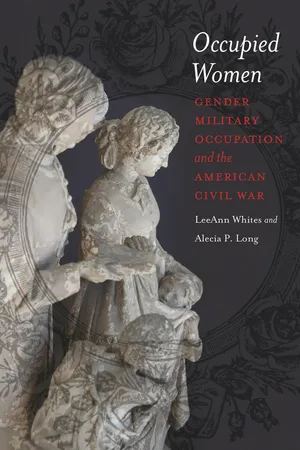
Occupied Women
Gender, Military Occupation, and the American Civil War
- 264 pages
- English
- ePUB (mobile friendly)
- Available on iOS & Android
eBook - ePub
Occupied Women
Gender, Military Occupation, and the American Civil War
About this book
Information
Table of contents
- Cover Page
- Title Page
- Copyright Page
- Contents
- Introduction LeeAnn Whites and Alecia P. Long
- [ I ] GENDER RELATIONS AND THE DEVELOPMENT OF UNION MILITARY POLICY
- [ II ] OCCUPIED WOMEN AND THE WAR AT HOME
- [ III ] OCCUPATIONS WITHIN OCCUPATION: RACE, CLASS, AND CULTURE
- Epilogue: The Fortieth Congress, Southern Women, and the Gender Politics of Postwar Occupation JUDITH GIESBERG
- Notes
- Notes on Contributors
- Index
Trusted by 375,005 students
Access to over 1.5 million titles for a fair monthly price.
Study more efficiently using our study tools.
Frequently asked questions
Yes, you can cancel anytime from the Subscription tab in your account settings on the Perlego website. Your subscription will stay active until the end of your current billing period. Learn how to cancel your subscription
No, books cannot be downloaded as external files, such as PDFs, for use outside of Perlego. However, you can download books within the Perlego app for offline reading on mobile or tablet. Learn how to download books offline
Perlego offers two plans: Essential and Complete
- Essential is ideal for learners and professionals who enjoy exploring a wide range of subjects. Access the Essential Library with 800,000+ trusted titles and best-sellers across business, personal growth, and the humanities. Includes unlimited reading time and Standard Read Aloud voice.
- Complete: Perfect for advanced learners and researchers needing full, unrestricted access. Unlock 1.5M+ books across hundreds of subjects, including academic and specialized titles. The Complete Plan also includes advanced features like Premium Read Aloud and Research Assistant.
We are an online textbook subscription service, where you can get access to an entire online library for less than the price of a single book per month. With over 1.5 million books across 990+ topics, we’ve got you covered! Learn about our mission
Look out for the read-aloud symbol on your next book to see if you can listen to it. The read-aloud tool reads text aloud for you, highlighting the text as it is being read. You can pause it, speed it up and slow it down. Learn more about Read Aloud
Yes! You can use the Perlego app on both iOS and Android devices to read anytime, anywhere — even offline. Perfect for commutes or when you’re on the go.
Please note we cannot support devices running on iOS 13 and Android 7 or earlier. Learn more about using the app
Please note we cannot support devices running on iOS 13 and Android 7 or earlier. Learn more about using the app
Yes, you can access Occupied Women by LeeAnn Whites, Alecia P. Long, LeeAnn Whites,Alecia P. Long in PDF and/or ePUB format, as well as other popular books in History & American Civil War History. We have over 1.5 million books available in our catalogue for you to explore.