"Bolton is admirably focused, centering broader ventures around precise turning points in the documents and incidents she has selected.... The book crosses generic boundaries... in the spirit of an other who transcends any single history or discipline." -- Religion and Literature
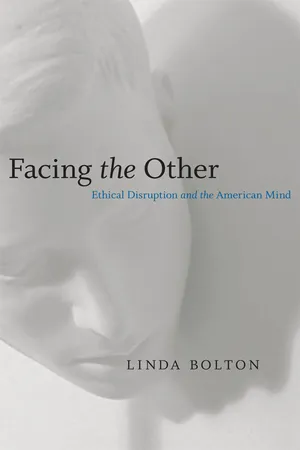
Linda Bolton uses six extraordinarily resonant moments in eighteenth- and nineteenth-century American history to highlight the ethical challenge that the treatment of Native and African persons presented to the new republic's ideal of freedom. Most daringly, she examines the efficacy of the Declaration of Independence as a revolutionary text and explores the provocative question "What happens when freedom eclipses justice, when freedom breeds injustice?" Guided by the intellectual influence of philosopher Emmanuel Levinas, Bolton asserts that the traditional subject-centered -- or "I" -- concept of freedom is dependent on the transcendent presence of the "Other, " and thus freedom becomes a privilege subordinate to justice. There can be no authentic freedom as long as others, whether Native American or African, are reduced from full human beings to concepts and thus properties of control or power. An eloquent and thoughtful rereading of the U.S. touchstones of democracy, this book argues forcefully for an ethical understanding of American literary history.
"Facing the Other is not a cultural history; its focus is the relevance of an ethical analytic to all of eighteenth- and nineteenth-century American literature.... Using Emmanuel Levinas to guide her discussions, Bolton argues that the way in which Americans valorize freedom as an ideal leads us to ignore our responsibilities for doing justice." -- American Literature
- 224 pages
- English
- ePUB (mobile friendly)
- Available on iOS & Android
eBook - ePub
About this book
Information
1 FACING ALTERITY
The Ethics of Conversion in Crèvecoeur’s Letters from an American Farmer
In September 1759, Michel-Guillaume-Jean de Crèvecoeur, having resigned his commission as a second lieutenant in the French Canadian militia, arrived in New York City. Although born in France, Crèvecoeur had been a resident of England before his initial emigration to Canada. It was in America, however, that he would realize the promise of distinction that had previously eluded him. Upon his arrival in New York, Crèvecoeur reinvented himself as “J. Hector St. John”—surveyor, merchant, farmer, and eventually, as A. W. Plumstead suggests, “one of the most admired literary men of his epoch.” Purchasing 120 acres of virgin land near Chester, New York, Crèvecoeur devoted the following six years of his life to the discovery of “what it is to be an American farmer—to be free to enjoy a life he could create himself.”1 This endeavor would prove to be fertile ground for his first and most celebrated book.
In 1780, having endured the strains of war, imprisonment, and a forced departure from his newly adopted homeland, Crèvecoeur returned to the country of his birth to begin reworking and revising the “trunk full of manuscripts” in which he had recorded his travails in the New World. Two years later, under his adopted name, he emerged as the admired author of Letters from an American Farmer. Far beyond its popularity among the literate European audience, Letters gained Crèvecoeur distinction as an American author. Through its rustic images of a “pure, idyllic life” and “gentle geography of meadowland … woods, cattle, hogs, birds, [and] bees,” Letters from an American Farmer would serve as a template for a pastoral vision of an America in which freedom, prosperity, and happiness prevailed.2
If Letters from an American Farmer opened a vista through which the New World could be imagined, its real significance lay in its transformative power. Not only did Letters represent the American territories as a promised land in which the European commoner could discover the miracle of personal metamorphosis, but through language and the performative power of text, Crèvecoeur reinvented himself as the literary first farmer of the American landscape. In 1784, only two years after publication of Letters, Benjamin Franklin would signal the national importance of Crèvecoeur’s book, turning to it as an exemplary representation of the social and physical landscapes that characterized the interior regions of the New World’s enterprise in freedom. Over the next two hundred years, Letters has continued to be read as a representative text of the early American experience—perhaps eclipsed only by Franklin’s subsequent Autobiography —and it has become famous for its particular enunciation of American identity.
More traditional interpretations of Letters have read it in three ways: as an initially celebratory presentation of the New World as an Edenic garden, full of the possibility of an unparalleled experience in freedom; as an “impassioned, unqualified defense of American agrarianism”; and as a work that attempts a “straightforward natural and social history of young America” through the experiential eye of its prototypical American narrator, the farmer James.3 At the heart of Letters, and of tremendous import in its classification as an authoritative text, is Farmer James, who comes to embody the myth of the American self through his claim to an individuality that is both unique and symbolic. What is unique about Farmer James is his natural innocence. As the simple farmer, James must rely primarily upon his natural “perspicuity,” as well as a “warmth of imagination” through which his encounters with the world can be mediated. As James’s minister suggests in the introductory letter, part of what qualifies him for this literary undertaking is not his stature as a man of letters and philosophy, but rather his singular capacity for original reflection. James is the untainted I/eye, a “ Tabula rasa, where spontaneous and strong impressions are delineated with facility” (LAF, 11). This untainted innocence makes James a credible individual through whom the “truth” of the American experience can be rendered in print.
But James is not a “tabula rasa” of pure impression, and his conclusions quickly supersede the parameters of mere individual perception to become both exemplary and emblematic. In this regard, several forces collude to transform Letters from the purely subjective musings of a curious, adventurous individual into representative literature. As Thomas Philbrick argues, Crèvecoeur composed Letters “at a time when interest in agriculture, both in England and on the Continent, was at its peak.” Thus, far from constituting an originary contribution to eighteenth-century literary culture, Letters takes its cue from an increasing interest in agriculture as a redemptive and honorable vocation, one in which the simple farmer emerges as the “ ‘natural man,’ man uncorrupted by the perversions and artificialities of civilization … ennobled by close and essential contact with the wisdom and beauty of nature.”4 Given the correlation Philbrick asserts between the “exaltation of farming and the promise of the New World,” evident in several late eighteenth-century texts (Abbé Raynal’s 1770 Histoire philosophique in particular), Crèvecoeur’s Farmer James can be seen as a representative voice of the American self whose virtue is demonstrated through his simple but rigorous dedication to the land and, in certain respects, through his very “sameness” of person and purpose.5
Equally influential in establishing Letters as a representative text is its reliance upon and incorporation of an Enlightenment rationality that makes possible the elevation of the senses—Farmer James’s “spontaneous impressions”—into an evidentiary ground upon which material reality can be unveiled. On the one hand, Crèvecoeur creates in James a narrator who appeals to readers through what at least one critic has described as a “logic of association”: it is not simply that James reports what he sees, but that his narrative asks his readers “to feel with James, to engage with him imaginatively as he engages his world,” thus enabling the construction of a text in which Americanness is made a “product of the personal,” and therefore one that solidifies a “new way of defining national identity.”6 On the other hand, James’s concluding observations and their rise to “representative” status also engage the problematic notion of correspondence that troubles Enlightenment reason. Insofar as Letters reveals its Enlightenment bias, it presumes an uncontested faith in the materiality of the world that makes possible the “conflation of sense with reason,” as if the world could be rendered empirically intelligible. Here, “sense and reason, materiality and reality would all be strung together into a series of equivalencies: symmetrical, airtight, mutually entailed, mutually reflexive.”7 The difficulty with reading Letters solely in terms of its representative stature involves this ideology of equivalence. By its very nature, such a reading precludes the disruptive potential of the Other.
If Crèvecoeur’s Letters is a representative text, it is also a text that continues to resonate with the disruptive and troublesome face of Otherness, which bears no such representable equivalence. I am interested in reading Letters in terms of its excess—its moments of dissonance and diachrony, in which the presence of the Other pierces that particular free American identity. Indeed, it is the face and presence of the Other that persists and contests all ideals of phenomenological symmetry. In Letters, the face of alterity has not yet relinquished its gaze—it stares back from beyond the parameters of narrative, unsettling the conclusiveness of historical discourse.
In the most famous of the letters, “What is an American?” Crèvecoeur provides a definition of Americanness in which the national identity of the new republic is projected through personal experience and imagination. At the same time, the essay supersedes Letters’ purely historical context to “foreshadow with striking completeness and precision the characteristics and values that in the nineteenth and twentieth centuries were to be enshrined as national ideals.”8 If Letters anticipates the articulation of the ideals at the heart of a future American identity, it also anticipates the move in Western philosophy towards the valorization of freedom as the ultimate end of human existence. Letters might then be read as a text that opens onto yet another moment in the historical evolution of Western thought. Its essential equation for the forging of individual identity participates in what will later distinguish metaphysical philosophy.
When Crèvecoeur represents the essence of the American through the figure of the farmer, he celebrates the possibility of an individual freedom that is inherent in a New World society characterized by the ideal of democracy. This notion of democracy is predicated upon the representation of an America in which the political and social hierarchies of the European past are dismantled, leaving the individual, suddenly released from the burden of history, free to pursue and define the parameters of his own self-worth. “By what invisible power has this surprising metamorphosis been performed?” James asks his readers. His answer is twofold: first, through the protective agency of a system of “indulgent laws” that safeguard the rights of the individual, and second, through the “accumulated rewards” of land that confer the “title of freemen,” to which “every benefit is affixed which men can possibly acquire” (LAF, 38).
In Crèvecoeur’s admiration for laws that “stamp” upon the dispossessed European the “symbol of [his] adoption,” one is reminded of the voice of John Adams, who twenty-three years earlier had argued that a unique aspect of the American experiment would be the constitution of laws in which the rights of the general populace—rights “undoubtedly, antecedent to all earthly government” and “derived from the great Legislator of the Universe”—would achieve recognition.9 But it is Crèvecoeur’s James through whom the acquisition of rights is eloquently articulated through the paradigm of property. In the Crèvecoeurian model, individual identity is achieved through the acquisition of land. Above all, the “rewards” of property enable the metamorphosis from invisibility into subjectivity, according the rights of citizenship and the entitlement to freedom.
Numerous critics have pointed out that Crèvecoeur’s concept of property is indebted to a Lockean philosophy of natural right in which the right of property is both a moral imperative and a necessary element in the transition from natural life into civil society. Yet this concept overflows the specificity of its historical origins. Crèvecoeur’s understanding of property to some extent foreshadows that of Hegel. In Letters, James’s acquisition of land establishes the foundation of his freedom. The prospective American first learns how to sustain his own existence—one carved, as it were, from the ground of nature and thus self-interest. That labor lays the foundation for acquisition, and soon thereafter he purchases land: “His good name procures him credit. He is now possessed of the deed, conveying to him and his posterity the fee simple and absolute property of two hundred acres of land. … He is become a freeholder, from perhaps a German boor—he is now an American” (LAF, 55). James’s scenario describes the process through which the dispossessed move from invisibility, as the “slave of some despotic prince,” into the domain of visibility—“from nothing to start into being”—where it is possible “to become a free man, invested with lands” (LAF, 55–6). For Crèvecoeur, property becomes the sign of the self: the validation of personal existence by the investment of individual will into that which enables its external recognition.
In the language of Hegelian philosophy, particularly in The Philosophy of Right, it is the function of property to effect the translation of personal freedom into the external world so that it can achieve existence as an Idea. The abstract personality, as the nascent presence of self-knowledge, aspires towards its certainty as a reality in the public sphere of the tangible. In Hegel’s words, the personality struggles “to give itself reality, or in other words to claim that external world as its own.” To achieve that claim, which is imperative to the articulation of self-certainty, a “person must translate his freedom into an external sphere in order to exist as Idea.” Here is the miraculous metamorphosis that property effects: as the site of the individual will, the external proof of an inherent subjectivity, property enables the representation of the self through its translation into the visible. Hegel asserts that “from the stand of freedom”—where one becomes an entity discernible even to the self—“property is the first embodiment of freedom and so is in itself a substantive end.”10
The importance of the acquisition of property as a “substantive end” in Crèvecoeur’s narrative needs little elaboration. That property constitutes the “stand of freedom” is similarly evident. Property bestows upon James the right of membership in the social realm; moreover, it is the site of freedom, through which an otherwise unknown individual gains visibility. When James proclaims in Letter II that “the instant I enter on my own land, the bright idea of property, of exclusive right, of independence exalt my mind” (LAF, 20), his words perpetuate an “idyll of domestic felicity”11 and thus participate in the Romantic mythology of agrarianism.
But it is also true, as James subsequently proposes, that the acquisition of land becomes the ground upon which his freedom is constituted as an objective fact; it effects the translation of selfhood from the realm of potentiality into the sphere of materiality, where what is “first only a possibility” is constituted as a manifest Idea. This is the equation that informs James’s assertion that the farm he has inherited from his father “has established all our rights; on it is founded our rank, our freedom, our power as citizens, our importance as inhabitants of such a district” (LAF, 20–1). James’s language here is significant, since it is property—as the sign of individual freedom—that comes to constitute “what may be called the true and the only philosophy of an American farmer” (LAF, 21).
If property forms the foundation of the philosophy of the American farmer, it does so through a process of translation through which the self comprehends the actuality of its own freedom and converts it into an incontrovertible presence, visually readable in the external world. James’s farm is suggestive of the Hegelian ground in which freedom is invested, because it is through the farm that James emerges into the world as a person both capable and worthy of recognition. For Hegel, recognition is an essential component in the struggle that self-consciousness undergoes in its pursuit and claim for certainty. The claim that the farm enables James’s emergence as “person” relies upon a distinction like Hegel’s between a notion of “subject” and “person.” In this context, the term subject represents a state of incompleteness: “every living thingof any sort is a subject.” To become a person, however, is to be a “subject aware of [its] subjectivity.” In other words, “A person is a unit of freedom aware of its sheer independence. As this person, I know myself to be free in myself.” Here, property becomes the means of that transformation because of its unique capacity for the “supersession of the pure subjectivity of personality.”12 Once we recognize that Crèvecoeur constructs property as Hegel would, rather than as Locke had, we must also recognize that Lockean interpretations of Crèvecoeur tend to underempha size the pivotal relationship between property and the embodiment of freedom.
Eric Cheyfitz has written compellingly on the process of translation that inheres in the concept of property. He makes the argument that the histories of both self and property are inseparably interwoven into the historical discourse of Western cultures.13 Although Cheyfitz’s immediate intent in his chapter “Translating Property” is on the intranslatability of the term property in the initial meetings between the English colonists and the Native American peoples, his remarks concerning the signification and function of property within the cultural landscape of European thought are particularly relevant to this study. Cheyfitz writes, “Property is not essence, which is the very heart of identity in Western metaphysics; yet it is the sign of essence,” that which bears the weight of signification through which a “perpetually transcendent identity” is glimpsed. He continues:
Paradoxically, property is the language of an always silent essence, its figure in the world. In the metaphysical realm, property is the shadow of substance. But as we translate property across the frontier into the physical realm, it becomes substance itself. And those who own it and who in this system of property must inevitably ground their identities on it become its shadow. In the West’s system of things, we are the shadows of property; and if we own nothing, then even this obscure visibility is denied to us. In the West, property, in that tangled space where the physical and the metaphysical mix, is the very mark of identity, of that which is identical to itself: what we typically call a “self” or an “individual,” indicating the absolute boundaries that are predicated of this entity.14
Cheyfitz’s analysis of the place of property in Western logic points explicitly to the connection between self and sign, abstract potentiality and material embodiment, that is so fully resonant in Crèvecoeur’s Letters. My intent here is to suggest the ways in which Letters anticipates the move in nineteenth-century philosophy that articulates identity through the embodiment of property precisely because it establishes the ground of freedom. In Letter II, James confesses a “happiness” that is directly tied to his “new situation” as the American farmer “possessing freedom of action, freedom of thoughts” (LAF, 18). All of these things are conferred upon him by the material reality signified in his farm, his house, his barn. One might say that James’s notion of happiness is conceived in the evidentiary ground of place, not only as the sign of his freedom but as the originary site of his dwelling in the world.
This logic of identity, characteristic of Western ontological philosophy, constructs the s...
Table of contents
- Cover Page
- Title Page
- Copyright Page
- Dedication
- Contents
- ACKNOWLEDGMENTS
- ABBREVIATIONS
- INTRODUCTION: Towards Confronting the “Hatred by the Other Human”
- 1 FACING ALTERITY: The Ethics of Conversion in Crèvecoeur’s Letters from an American Farmer
- 2 IN THE NAME OF “JUSTICE AND HUMANITY”: Thomas Paine’s Ethical Envisionings of the American Republic
- 3 STANDING IN THE “FIELD OF FREEDOM”: Thomas Jefferson and the Reverberations of that Declaratory Promise
- 4 FUGITIVE POSEURS: The Native Eloquence of Frederick Douglass and Sarah Winnemucca
- 5 IN THE PRESENCE OF THE GREAT AMERICAN CRIMINAL: John Brown’s Triumphant Failure at Harpers Ferry
- BIBLIOGRAPHY
- INDEX
- Footnotes
Trusted by 375,005 students
Access to over 1.5 million titles for a fair monthly price.
Study more efficiently using our study tools.
Frequently asked questions
Yes, you can cancel anytime from the Subscription tab in your account settings on the Perlego website. Your subscription will stay active until the end of your current billing period. Learn how to cancel your subscription
No, books cannot be downloaded as external files, such as PDFs, for use outside of Perlego. However, you can download books within the Perlego app for offline reading on mobile or tablet. Learn how to download books offline
Perlego offers two plans: Essential and Complete
- Essential is ideal for learners and professionals who enjoy exploring a wide range of subjects. Access the Essential Library with 800,000+ trusted titles and best-sellers across business, personal growth, and the humanities. Includes unlimited reading time and Standard Read Aloud voice.
- Complete: Perfect for advanced learners and researchers needing full, unrestricted access. Unlock 1.5M+ books across hundreds of subjects, including academic and specialized titles. The Complete Plan also includes advanced features like Premium Read Aloud and Research Assistant.
We are an online textbook subscription service, where you can get access to an entire online library for less than the price of a single book per month. With over 1.5 million books across 990+ topics, we’ve got you covered! Learn about our mission
Look out for the read-aloud symbol on your next book to see if you can listen to it. The read-aloud tool reads text aloud for you, highlighting the text as it is being read. You can pause it, speed it up and slow it down. Learn more about Read Aloud
Yes! You can use the Perlego app on both iOS and Android devices to read anytime, anywhere — even offline. Perfect for commutes or when you’re on the go.
Please note we cannot support devices running on iOS 13 and Android 7 or earlier. Learn more about using the app
Please note we cannot support devices running on iOS 13 and Android 7 or earlier. Learn more about using the app
Yes, you can access Facing the Other by Linda Bolton in PDF and/or ePUB format, as well as other popular books in Literature & Literary Criticism. We have over 1.5 million books available in our catalogue for you to explore.