Employing recent theories of memory from multiple areas of study, Possessing the Past illuminates the tangled relationships among trauma, fantasy, and the public sphere, and their impact on the "South" in imagination and in reality. Focusing on the roles that narrative and fantasy play in creating a sense of regional distinctiveness, Lisa Hinrichsen brings a wealth of critical scholarship to her consideration of memory and southern literature.
Hinrichsen's nuanced readings of a diverse group of southern authors, including William Faulkner, Roberto Fernández, Erna Brodber, Monique Truong, and Katharine Du Pre Lumpkin, offer new ways of conceptualizing memory, place, and history. She unravels southern literature's critical confrontation with the region's history through complex systems of remembrance and erasure, and she traces how fantasy mediates trauma and adjudicates identity. Expansive in its psychoanalytical approach, her work explores issues of law, testimony, and social justice; the role of nostalgic fantasies of gentility at midcentury; the relationship between white empathy and social fantasy; the resemblance of regional patterns of disavowal to national ideologies of forgetting in Vietnam-era fiction; and the impact of contemporary multicultural literature on memory and community.
Possessing the Past broadens the theoretical framework used to conceptualize memory and trauma, while grounding traumatic testimony in the specifics of time and place amply offered by southern literature. It provides new readings of an array of southern writers and deepens our understanding of the continuing importance of history, memory, and fantasy in the literature of the U.S. South.
eBook - ePub
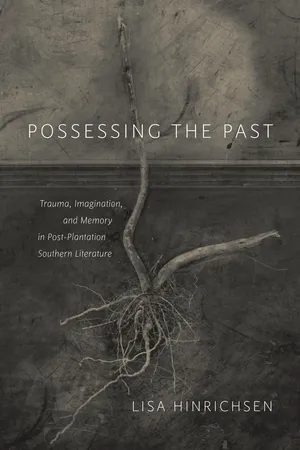
Possessing the Past
Trauma, Imagination, and Memory in Post-Plantation Southern Literature
- 304 pages
- English
- ePUB (mobile friendly)
- Available on iOS & Android
eBook - ePub
Possessing the Past
Trauma, Imagination, and Memory in Post-Plantation Southern Literature
About this book
Information
INDEX
Note: Page numbers followed by “n” indicate endnotes.
Abraham, Nicholas, 232n10, 232n15
Absalom, Absalom! (Faulkner), 34, 46, 231n8, 242n9
Adams, Clementina R., 200
Adams, Jessica, 19
Adler, Thomas P., 238n14
Adorno, Theodor, 66, 72, 236n4
affect: Berlant on, 7, 241n6
in Cao’s Monkey Bridge, 183
as form of history, 195–96
Grossberg on, 103
historical mediation and, 3
in Lumpkin’s The Making of a Southerner, 101–5, 107
in Mason’s In Country, 139, 148, 149
in Morris’s North Toward Home, 123, 124
Naipaul on, 13
in Truong’s Bitter in the Mouth, 192–93
African Americans. See specific works and topics, such as segregation or blackness
Allison, Dorothy, 213
Althusser, Louis, 59–60, 115
American dream, 205–6
American exceptionalism, 134, 163, 208, 241n5. See also national identity
The Americanization of Dixie (Egerton), 134
anamorphosis, 57–59, 235n35
Anderson, Benedict, 7, 161
anthropological practice in Brodber’s Louisiana, 168, 170–72
Appadurai, Arjun, 7, 26–27, 72, 160–61
Asian Americans, 177–78, 182. See also Bitter in the Mouth (Truong); Monkey Bridge (Cao)
autobiography: common themes, 94–100
Gilmore’s auto/biographical demand, 98
Lumpkin’s The Making of a Southerner, 100–108
Morris’s North Toward Home, 122–32
Smith’s Killers of the Dream, 108–22
Ayers, Edward L., 10–11, 15, 96, 179
“backwardness,” southern, 13–14, 229n18
Baker, Houston A., Jr., 15, 16, 160, 212, 215–23, 243n1, 245n7
Bauman, Zygmut, 86
belonging, 5, 96, 97–98, 99, 118, 180, 203
Beloved (Morrison), 139, 241n12
Benjamin, Walter, 66, 92
Bennett, Jill, 184
Berlant, Lauren, 7, 97–98, 143, 228n10, 241n6
Betts, Doris, 135
Bhabha, Homi, 165, 187, 204
bildungsroman genre, 123–24, 179–80, 181, 192
Bitter in the Mouth (Truong), 162, 176–80, 191–97
black identity, 165, 218–25
black modernism, 217–18
blackness: Brodber’s Louisiana and, 171–72, 175
Brodber’s remapping of black subjectivity, 165–66
Gilroy’s Black Atlanticism, 165–66
trauma of black body reinscribed onto white body, in Smith’s Killers of the Dream, 120–21
Williams’s A Streetcar Named Desire and, 239n22. See also race
Bleikasten, André, 35, 38, 40, 232n14
Blight, David, 95
body and embodiment: Asian body as “jettisoned,” 177–78
black bodies, regulation of, 217–18
Bourdieu on, 238n17
in Brodber’s Louisiana, 171–72
in Cao’s Monkey Bridge, 183–84
disavowal of, 114–15
Foucault on, 238n16
immigrant body and representative burden, 209
in Lumpkin’s The Making of a Southerner, 101, 103–5
in Mason’s In Country, 147–49
in Morris’s North Toward Home, 122–23
role in dramatizing memory’s performance, 184
in Smith’s Killers of the Dream, 110, 113–16, 120–21
taste and synesthesia in Truong’s Bitter in the Mouth, 194–97
trauma of black body reinscribed onto white body, 120–21
Watson on recalcitrant role of, 241n11
in Williams’s A Streetcar Named Desire, 74–75
Bone, Martyn, 21
The Book of Salt (Truong), 191
boundaries, 159, 163–64
Bourdieu, Pierre, 79–80, 82, 238n17, 239n21
Bow, Leslie, 179
Brodber, Erna, 164, 171. See also Louisiana (Brodber)
Brooks, Cleanth, 231n5
Brooks, Peter, 231n8
Brown, Judith, 78
Brundage, Fitzhugh, 5, 69–70
Burnham, Michelle, 244n3
Butler, Judith, 76, 100, 222
Caldwell, Erskine, 67
Campbell, Will, 98
Cao, Lan, 180. See also Monkey Bridge (Cao)
Caribbeanness, 169. See also Louisiana (Brodber)
Caruth, Cathy, 14, 38, 47, 139, 175
Cash, W. J., 4, 8, 13, 16, 25, 68–69, 101
Castle, Terry, 42
Castronovo, Russ, 228n10
Cheng, Anne Anlin, 16–17, 18
Chong, Sylvia Shin Huey...
Table of contents
- Cover
- Title Page
- Copyright Page
- Dedication
- Contents
- Acknowledgments
- Introduction. Memory in Transit: Mourning, Memorialization, and the Work of Fantasy in the U.S. South
- One. Trauma, Testimony, and Temple Drake in Sanctuary and Requiem for a Nun
- Two. Wanting Magic: Fantasy, Fiction, and Cultural Capital in A Streetcar Named Desire
- Three. Southern Autobiography, Wound Culture, and the Politics of Victimhood
- Four. Visions and Revisions of Vietnam: Misrecognition, Memory, and the Meaning of War
- Five. Imagining Otherwise: The Post-Plantation Multicultural Imagination
- Coda. Turning South Again: A Meditation on Repetition, Renewal, and Remembering
- Notes
- Works Cited
- Index
Trusted by 375,005 students
Access to over 1.5 million titles for a fair monthly price.
Study more efficiently using our study tools.
Frequently asked questions
Yes, you can cancel anytime from the Subscription tab in your account settings on the Perlego website. Your subscription will stay active until the end of your current billing period. Learn how to cancel your subscription
No, books cannot be downloaded as external files, such as PDFs, for use outside of Perlego. However, you can download books within the Perlego app for offline reading on mobile or tablet. Learn how to download books offline
Perlego offers two plans: Essential and Complete
- Essential is ideal for learners and professionals who enjoy exploring a wide range of subjects. Access the Essential Library with 800,000+ trusted titles and best-sellers across business, personal growth, and the humanities. Includes unlimited reading time and Standard Read Aloud voice.
- Complete: Perfect for advanced learners and researchers needing full, unrestricted access. Unlock 1.5M+ books across hundreds of subjects, including academic and specialized titles. The Complete Plan also includes advanced features like Premium Read Aloud and Research Assistant.
We are an online textbook subscription service, where you can get access to an entire online library for less than the price of a single book per month. With over 1.5 million books across 990+ topics, we’ve got you covered! Learn about our mission
Look out for the read-aloud symbol on your next book to see if you can listen to it. The read-aloud tool reads text aloud for you, highlighting the text as it is being read. You can pause it, speed it up and slow it down. Learn more about Read Aloud
Yes! You can use the Perlego app on both iOS and Android devices to read anytime, anywhere — even offline. Perfect for commutes or when you’re on the go.
Please note we cannot support devices running on iOS 13 and Android 7 or earlier. Learn more about using the app
Please note we cannot support devices running on iOS 13 and Android 7 or earlier. Learn more about using the app
Yes, you can access Possessing the Past by Lisa Hinrichsen in PDF and/or ePUB format, as well as other popular books in Literature & Literary Criticism. We have over 1.5 million books available in our catalogue for you to explore.