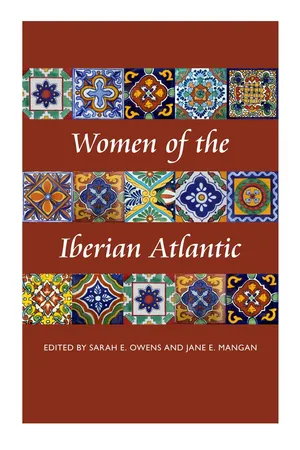
The ten essays in this interdisciplinary collection explore the lives, places, and stories of women in the Iberian Atlantic between 1500 and 1800. Distinguished contributors such as Ida Altman, Matt D. Childs, and Allyson M. Poska utilize the complexities of gender to understand issues of race, class, family, health, and religious practices in the Atlantic basin. Unlike previous scholarship, which has focused primarily on upper-class and noble women, this book examines the lives of those on the periphery, including free and enslaved Africans, colonized indigenous mothers, and poor Spanish women.
Chapters range broadly across time periods and regions of the Atlantic world. The authors explore the lives of Caribbean women in the earliest era of Spanish colonization and gender norms in Spain and its far-flung colonies. They extend the boundaries of the traditional Atlantic by analyzing healing knowledge of indigenous women in Portuguese Goa and kinship bonds among women in Spanish East Texas. Together, these innovative essays rechart the Iberian Atlantic while revealing the widespread impact of women's activities on the emergence of the Iberian Atlantic world.
- 288 pages
- English
- ePUB (mobile friendly)
- Available on iOS & Android
eBook - ePub
About this book
Information
1
Navigating the Atlantic Divide
Women, Education, and Literacy in Iberia and the Americas
LISA VOLLENDORF
The study of Iberia and the Americas traditionally has occurred in two parallel worlds, and the study of women in those spaces is no exception.1 Iberianists and Latin Americanists have made significant advances in understanding women’s economic, cultural, and political engagement in early modern Iberia and the Iberian Atlantic in the past thirty years, yet most of the work has involved women on one continent or the other and has not attended to the to and fro of people, objects, and ideas that defined the age of transatlantic contact. More recently, as suggested by the present volume, a transatlantic focus on women’s cultural history has emerged. Not coincidentally, the new scholarly focus coincides with a cultural turn in the field of Atlantic studies.2 John Elliott has captured that turn by defining the approach as the study of “the creation, destruction, and re-creation of communities as a result of the movement, across and around the Atlantic basin, of people, commodities, cultural practices, and ideas.”3 Studies of women and gender in the Iberian Atlantic have built on initial research that focused discretely on women in Europe and, separately, in the Americas, to bring broader, more integrative perspectives to bear. One such example is my volume, coedited with Daniella Kostroun, Women, Religion, and the Atlantic World (1600–1800), which looks at the Atlantic space vis-à-vis gender, religion, and spirituality.
Recently, more attention has been given to questions of community, diaspora, and networks that formed part of the broader Iberian Atlantic space. The vast and diverse nature of that space and its communities presents a challenge that requires delimitation of one sort or another. Therefore, the present essay operates with the definition of the early modern Iberian Atlantic as the geographical space affected by contact between Iberian Europeans and non-Europeans and centered primarily on areas that bordered the Atlantic Ocean. From a cultural perspective, the movement of people, ideas, and objects during the early modern period offers an opportunity for decentered examination of individual lives, group networks, and both commonalities and differences from a transatlantic perspective. The approach reminds scholars that the exchange of ideas, people, and objects can and should be examined for synergies and mutual influences, and not just from a one-dimensional perspective.
One case that exemplifies the benefits of expanding approaches to early modern women’s studies to encompass a transatlantic framework can be found in studies on Sor Juana Inés de la Cruz (1648–1695). Sor Juana now is understood as a writer who forged a uniquely American baroque aesthetic that both drew and expanded on European philosophy and style.4 As one of the few Ibero-American women who has been studied in terms of her Atlantic presence, Sor Juana provides direct evidence for the impact of the movement of people, books, and ideas in the seventeenth century. Her political connections with the viceroys of New Spain gave her access to colonial high society. When she ran into controversy with the Church, it was due to her critique of a sermon by Portuguese Jesuit Antonio Vieira. Her resulting controversial piece, La respuesta (The Answer), was published posthumously across the Atlantic in Spain in 1700.5 La respuesta constitutes a defense of women’s right to both secular and religious education and to this day stands among the most important examples of women’s literature from the baroque period. Significant for its brilliant structure and all-encompassing defense of multidisciplinary knowledge as the bedrock of a solid Catholic education, La respuesta also gives us insight into Sor Juana’s participation in a transatlantic writing community of women, as she mentions the writing of four Spanish nuns and draws on many ideas and writing strategies found in European texts. Sor Juana wrote another explicitly transatlantic piece: her Enigmas ofrecidos a la Casa del Placer, a compilation of riddles written for nuns in a Lisbon convent and likely transported to Europe by the Countess of Paredes.6 This collection written for Atlantic sisters was not rediscovered until the 1960s, thus reminding us of the thousands of texts that remain buried in archives throughout the Atlantic sphere.
Sor Juana’s explicit engagement with transatlantic women in these texts provides concrete evidence of a widespread community of female readers and writers who built on each others’ self-authorizing strategies.7 Thanks to Sor Juana’s premier status as one of the finest and most studied authors of the baroque, we have a firm understanding of the ways in which she placed herself within a transatlantic sphere of readership and exchange. These two texts speak to the ways in which Sor Juana provides us with an initial foray into understanding the deep and complex intellectual and cultural exchanges that occurred throughout the Atlantic and provides one path for us to follow to better understand women’s place in the Atlantic sphere. As recent movement in the field of early modern and colonial women’s studies attests, scholars now can use knowledge of Sor Juana’s and other women’s engagement with a transatlantic world to uncover more connections among those whose life stories and texts are less readily accessible and less easily studied.
The case of Sor Juana serves as one example of what scholars stand to learn by expanding conceptualizations of women’s history to include the broader Atlantic basin as a point of reference. For instance, the role played by the Countess of Paredes in the transport of Sor Juana’s Enigmas serves as a reminder that women’s travel between Europe and the Americas has yet to be sufficiently analyzed.8 Jacqueline Holler has probed this field in her study of the beatas (lay religious women) who traveled from Spain to model Christianity in New Spain. Throughout the early modern period, select groups of nuns were called on by their orders to found convents in Peru, Mexico City, and Guatemala.9 Like other religious men and women who would follow, they undertook rigorous journeys for which no monastic training or personal experience had prepared them. Like men, they were called to duty by the Church. Unlike men, they broke with religious and gender codes that dictated enclosure when they ventured out of the cloister onto the high seas. For Sarah E. Owens’s group of intrepid Spanish Capuchin nuns who traveled to Peru in the early eighteenth century to found a convent, the notion of a navigable space that both bridged and separated Europe from other continents likely would have resonated on a very personal level.10 These women endured two years of travel delays, including a stint as prisoners of Dutch corsairs, before docking in the New World. The Capuchins’ example also highlights one of the challenges of viewing the early modern world through an Atlantic lens: a space colonized by the Spanish yet bordering the Pacific, Peru is one of the many locales that can be considered from the lens of both Atlantic and Pacific studies. As the Jesuits who traveled to Asia knew, the impulse to expansion encompassed a broad global territory in the period.11 In all of these cases, the Atlantic framework serves as a space of connections and communities, offering a lens through which scholars might reconsider their understandings of the early modern Ibero-American world and the possible gender differentiation of individual and group experiences.
Not all who set forth for the Americas or traveled to Europe had religious missions. Many women who came to the Americas did so to accompany husbands and other male relatives who had sought better opportunities in the uncharted territory of the Americas. Indeed, Allyson Poska’s essay in the present volume opens the understudied arena of women’s migration to the Americas and pushes historians to question the extent to which the separation of Iberian and colonial history has resulted in a lack of understanding of gender relations throughout the empire. Like some male travelers, a few of those women wrote letters to loved ones in Iberia in which they detailed material and emotional hardship.12 Similarly, many travelers stayed closer to home, such that the conceptualization of movement of people also should include a focus on migrations on the same continent. Catholicism’s most famous nun of the period, Saint Teresa of Avila, traveled extensively within her home country and interacted with those who had gone abroad. Madre Teresa’s tireless travels and labor led to the foundation of Carmelite convents across Spain. She wrote of her own travels to her brother in the Americas, emphasizing that she traveled to “so many places” and “so many people speak” to her.13
The question of travel provides a point of entry into broader considerations of women’s lives in the Iberian Atlantic and to the ways in which scholars can further deepen understanding of women in that space. First and foremost, as suggested by the examples mentioned above, much of the nuance brought to the understanding of women and gender in recent years is based on texts written by and about women in the Iberian Atlantic. Literacy and education have been very difficult to trace except insofar that, for certain individuals and groups, we have access to texts produced by or about women, thus providing suggestive evidence about women’s relationship to the written word. Of fundamental importance is the reality that reading and writing were taught as separate skills in the early modern period, a fact that will continue to help scholars interpret emerging evidence of engagement with the written word. Stories of literate merchant-class women who owned books, took legal action, wrote their own wills, and ran businesses increasingly reveal that girls across class lines were educated in both skills more than previously imagined.14 Private and communal reading was an important part of the early modern experience, as only those who could read had access to private reading experiences.15
Fundamentally, reading must be understood to be both private and public, since the aural consumption of texts was by far the most common means by which people accessed the written word. Indeed, recent statistics for sixteenth-century Spain suggest that female reading literacy rates ranged dramatically, with some rural areas at 0 percent female literacy and most urban areas reaching as high as 40 percent.16 Women’s book inventories from the sixteenth century show chivalric novels, such as Amadís de Gaula, recipe books, and devotional books among those that women from the merchant and aristocratic classes most frequently owned, thus suggesting commonalities among women’s reading experiences and suggesting lines of inquiry about women readers that remain unexplored.
Women’s access to education adds yet another point of differentiation among women’s lives, which varied depending on time frame, place, class, and ethnic identity. Women’s relationship to the written word intimately relates to the broader question of how scholars approach women’s history for the Iberian Atlantic. Better deciphering who had access to education promises to move the field to a more nuanced understanding of how local and community variations manifest themselves and how women and the disenfranchised in general accessed authority and power throughout the Atlantic basin. Many scholars—including many whose work appears in the current volume—have articulated an urgent need for us to pay attention to the local particularities found in different communities and places. Some standouts in this large field include studies on Iberian women’s influence in the political and cultural realms; cultural minorities; rural women; widows; and women’s writing.17 For the Americas, an even larger body of work has focused on authority, race, economics, and gender.18 The religious sphere has received significant attention for Ibero-America and Iberia alike. This attention is well represented in this volume’s essays by Ras Michael Brown, Matt D. Childs, Nuria Salazar Simarro, and Sarah E. Owens.19
Alison Weber has summarized the ways in which historians of women and gender have struggled to find appropriate frameworks to understand women’s history, relying in the early years on “Terms such as ‘gendered domains,’ ‘separate spheres,’ and ‘the public/private dichotomy.’”20 In calling for a methodology that would “account for how power and agency sometimes elide spatial categorization and migrate between spaces and subjectivities,” Weber addresses the need for early modern studies to assess current methodologies and to develop new critical questions that will help us move forward in our efforts to develop more nuanced understandings of women in different times and places as well as of individuals and groups in the early modern world.21
The call for more attention to local culture also must be considered in light of the great ethnic and racial variation of the Atlantic population. One cannot possibly assume great commonalities among the experiences of the women featured in the present volume. Sor Juana’s life was different from the experiences of women settlers in the early Caribbean, as explored by Ida Altman’s essay; those experiences differed from the lives of the indigenous mothers in conquest-era Peru discussed by Jane E. Mangan; and the ritual experts in Bantu spiritual cultures analyzed by Ras Michael Brown certainly had different lives from those of Timothy D. Walker’s folk healers in the Luso-Brazilian world or the women of the East Texas Borderlands discussed by Carla Gerona, for example. As all essays in this volume attest, scholars can develop a better understanding of women’s position vis-à-vis the broader Iberian and Ibero-American cultures by examining the ways in which women navigated belief, religion, laws, and economic systems. Within this context, scholars can and should seek ways to further decipher how women and other groups engaged, upheld, subverted, and circumvented mechanisms aimed at social control. While scholars still have direct textual or material evidence about only a small minority of in...
Table of contents
- Cover
- Title Page
- Copyright Page
- Contents
- Acknowledgments
- Introduction: Women of the Iberian Atlantic: Gendered Dimensions of Empire
- 1. Navigating the Atlantic Divide: Women, Education, and Literacy in Iberia and the Americas
- 2. An Ocean Apart: Reframing Gender in the Spanish Empire
- 3. Spanish Women in the Caribbean, 1493–1540
- 4. Indigenous Women as Mothers in Conquest-Era Peru
- 5. Women and Kinship in Spanish East Texas at the End of the Eighteenth Century
- 6. Cloistered Women in Health Care: The Convent of Jesús María, Mexico City
- 7. The Role and Practices of the Female Folk Healer in the Early Modern Portuguese Atlantic World
- 8. The Botany of Colonial Medicine: Gender, Authority, and Natural History in the Empires of Spain and Portugal
- 9. Mother Nganga: Women Experts in the Bantu-Atlantic Spiritual Cultures of the Iberian Atlantic World
- 10. Gendering the African Diaspora in the Iberian Atlantic: Religious Brotherhoods and the Cabildos de Nación
- Contributors
- Index
Trusted by 375,005 students
Access to over 1.5 million titles for a fair monthly price.
Study more efficiently using our study tools.
Frequently asked questions
Yes, you can cancel anytime from the Subscription tab in your account settings on the Perlego website. Your subscription will stay active until the end of your current billing period. Learn how to cancel your subscription
No, books cannot be downloaded as external files, such as PDFs, for use outside of Perlego. However, you can download books within the Perlego app for offline reading on mobile or tablet. Learn how to download books offline
Perlego offers two plans: Essential and Complete
- Essential is ideal for learners and professionals who enjoy exploring a wide range of subjects. Access the Essential Library with 800,000+ trusted titles and best-sellers across business, personal growth, and the humanities. Includes unlimited reading time and Standard Read Aloud voice.
- Complete: Perfect for advanced learners and researchers needing full, unrestricted access. Unlock 1.5M+ books across hundreds of subjects, including academic and specialized titles. The Complete Plan also includes advanced features like Premium Read Aloud and Research Assistant.
We are an online textbook subscription service, where you can get access to an entire online library for less than the price of a single book per month. With over 1.5 million books across 990+ topics, we’ve got you covered! Learn about our mission
Look out for the read-aloud symbol on your next book to see if you can listen to it. The read-aloud tool reads text aloud for you, highlighting the text as it is being read. You can pause it, speed it up and slow it down. Learn more about Read Aloud
Yes! You can use the Perlego app on both iOS and Android devices to read anytime, anywhere — even offline. Perfect for commutes or when you’re on the go.
Please note we cannot support devices running on iOS 13 and Android 7 or earlier. Learn more about using the app
Please note we cannot support devices running on iOS 13 and Android 7 or earlier. Learn more about using the app
Yes, you can access Women of the Iberian Atlantic by Sarah E. Owens, Jane E. Mangan in PDF and/or ePUB format, as well as other popular books in History & European History. We have over 1.5 million books available in our catalogue for you to explore.