In the eighteenth and nineteenth centuries, French cooks began to claim central roles in defining and enforcing taste, as well as in educating their diners to changing standards. Tracing the transformation of culinary trades in France during the Revolutionary era, Jennifer J. Davis argues that the work of cultivating sensibility in food was not simply an elite matter; it was essential to the livelihood of thousands of men and women.
Combining rigorous archival research with social history and cultural studies, Davis analyzes the development of cooking aesthetics and practices by examining the propagation of taste, the training of cooks, and the policing of the culinary marketplace in the name of safety and good taste. French cooks formed their profession through a series of debates intimately connected to broader Enlightenment controversies over education, cuisine, law, science, and service. Though cooks assumed prominence within the culinary public sphere, the unique literary genre of gastronomy replaced the Old Regime guild police in the wake of the French Revolution as individual diners began to rethink cooks' authority. The question of who wielded culinary influence -- and thus shaped standards of taste -- continued to reverberate throughout society into the early nineteenth century.
This remarkable study illustrates how culinary discourse affected French national identity within the country and around the globe, where elite cuisine bears the imprint of the country's techniques and labor organization.
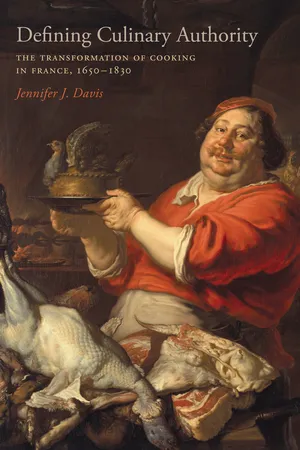
eBook - ePub
Defining Culinary Authority
The Transformation of Cooking in France, 1650-1830
- 264 pages
- English
- ePUB (mobile friendly)
- Available on iOS & Android
eBook - ePub
About this book
Information
1
Masters of Disguise
ARTIFICE AND NATURE IN CULINARY AESTHETICS
At its heart the job of the cook mediates between the natural world and the realm of human artistry.1 For centuries European elites had demanded of their cooks a triumphantly artistic and artificial cuisine. From the winged hare presented at Trimalchio’s dinner in ancient Rome to the four-and-twenty-blackbird pie of English nursery rhyme fame, elite Europeans delighted in food that was not what it appeared to be.2 In the year 800 Charlemagne’s cooks skinned a peacock to preserve the beautiful plumage, then spiced, larded, and roasted the naked bird. The skin was placed over the cooked carcass, the feathery tail fanned out, and a little flaming cotton ball placed in its mouth just before it was brought into the banquet hall. Plumaged peacocks and swans regularly graced royal tables throughout the Middle Ages.3 Spectacular examples of artifice abound, notably in the realm of sweets and desserts, such as the Yule log, marzipan fruits, wedding cakes, and sugar sculptures.4 Artifice had been an enduring ideal of elite European cuisine from the ancient world, and early modern cookbooks strived to equate a cook’s ability to “deceive” diners with professional excellence.5
In the royal court of Louis XIV spectacle and artifice remained crucial tools to articulate the king’s singularity and to symbolize his radical control over nature.6 However, the king also championed a classical aesthetic ideal in diverse arenas of visual display. This ideal prized symmetry, harmonious proportion, and simplicity in all things, which increasingly privileged the natural over the spectacularly artificial.7 At Versailles, classicism remained in dynamic tension with more extravagant productions variously termed rococo, baroque, or precious. Extending classical aesthetics to cuisine threatened royal cooks’ claims to culinary authority by questioning extravagant culinary flourishes of disguise, the trade’s long-held standard of excellence. Culinary classicism also potentially challenged royal authority as expressed at the table. Over time it became clear that a “natural” cuisine might privilege less-educated female cooks over their more technically skilled male colleagues. As artifice ceased to function as an important gauge of culinary skill, male cooks sought to redefine what constituted natural cuisine, seeking new foundations for their authority in medical and chemical theories of digestion and health. By depicting cuisine as a science, these cooks made a concerted bid for professional recognition.
This key transformation in culinary aesthetics—French cooks’ movement from spectacular artifice to an embrace of naturalness—provides the first window into the communicatory dynamic between cooks and diners of different social classes and genders over two centuries. At the same time that male cooks and diners sought to create a more natural elite cuisine, they also strived to redefine the tenets of both masculinity and their trade, paralleling similar movements in the visual arts and music. The technical flourishes of baroque or rococo styles of art came to signify femininity associated with emotion and excess.8 Only in cuisine did flamboyant artifice continue to signify masculinity of both producers and consumers. However, as a forcefully gendered critique of artifice emerged in early eighteenth-century texts on art and literature, male cooks and especially cookbook authors turned their backs on centuries of masculine leadership in the techniques and ideals of culinary artifice.
ARTIFICE AND THE ROYAL COURT
Manners and taste marked the sinews of power nowhere more clearly than at Louis XIV’s court at Versailles. The French king, who witnessed the costs of a weak state as a child during the Fronde, the noble-led civil war in the 1640s, endeavored at Versailles to instantiate a strong centralized state.9 In this effort the king enjoyed the support of a wide range of his subjects. Nicolas Bonnefons, valet to the young king, wrote a cookbook for aristocratic country estates titled Les délices de la campagne (The delights of the countryside) in 1654. In a prefatory letter, Bonnefons apologized for the long delay between his publication of Le jardinier françois (The French gardener) and this cookbook, attributing it to “the divisions and factions of civil wars that have disturbed this State and seem to threaten to ruin it.”10 The specter of civil war motivated the aristocracy, even those who had fought to limit royal power during the Fronde, to accept and support Louis XIV as he strengthened monarchical authority. Versailles and the absolutist monarchy it purportedly embodied remained an ambition for Louis XIV rather than an achieved and settled fact.11 For much of Louis XIV’s reign, Versailles constituted a great construction site rather than the grand palace and gardens that one sees today.12
To recognize the striving nature of both Versailles and absolutism under Louis XIV dramatically alters our understanding of the power dynamics between the king and the nobility.13 Absolute monarchy represented an unwritten political compact between the king and the nobility by which the nobility gained increased access to the king’s person and privilege, while the king gained unprecedented local authority throughout the kingdom by way of his representatives. The king also pursued a focused strategy of ennobling men of talent, thus creating competition among members of the established aristocratic families. As a result, the nobility of the 1660s grew increasingly dependent on the king for important economic privileges and career advancement, and they closely imitated his tastes at court in the quest to cultivate favor.14 Access to the king, particularly the king’s person, constituted power and conferred privileges within this society. However, the king relied on these nobles to legitimate his rule, to administrate his kingdom, and to accord him power. He also depended on them to recognize the limits of imitation, modeling taste and consumption appropriate for their position subordinate to his authority. Therefore, it was both at the royal court and in the households of the kingdom’s leading noble families that a distinctively French elite cuisine took shape.
The royal kitchen (bouche du roi) comprised seven departments dedicated to furnishing the king’s food and drink. Supervising all seven was the grand maître de la maison du roi (grand master of the king’s household), appointed directly by the king. The grand maître nominated all officers who served in the royal kitchen, although the king had the final say.15 The gobelet was charged with carrying glasses and drinks to the king at table, as well as providing him with glasses and drink in his bedroom when he woke or on the hunt when he required refreshment. The cuisine-bouche prepared the king’s food, the paneterie provided bread and baked goods, the échansonnerie supervised all wine and drinks within the kitchen, the cuisine-commune provided sustenance for the household’s officers, the fruiterie was responsible for fresh and preserved fruits, and the fourrière provisioned the household with firewood and charcoal.16 Within the cuisine-bouche the controlleur served as the main supervisor and accountant. Throughout the eighteenth century the Chatelain family held this important position, the office passing from father to son in 1775.17 All offices at Versailles were venal, meaning that the Chatelains, like all royal cooks, paid for the privilege of serving the king. At retirement, culinary officers were eligible for royal pensions, which provided substantial security in old age.18 Eleven ecuyers de cuisine served as the king’s main cooks, each working for six months at a time; five of the eleven posts passed from father to son during the eighteenth century. Four maîtres-queux shared the responsibility of preparing sauces and stews, each serving for three months at a time. Four hâteurs de la bouche directed the roasting of meat, again each serving for three months at a time. Finally, four potagers prepared soups, and four pâtissiers made pastries, also on a quarter system. Therefore, although the royal kitchen generally had no more than ten cooks at a time, a total of twenty-seven men labored simply to cook the king’s food. In addition to these cooks, a multitude of boys and women worked in the kitchens peeling vegetables and cleaning dishes. A similar team staffed the cuisine-commune, as well as the kitchen that served the queen and the households of all the princes and princesses of the blood.
Such divisions resulted in rivalry between the many kitchens and animosity among the staffs when two members of the royal family enjoyed a meal together, as occurred when the future Louis XVI and his wife Marie Antoinette dined together in 1772.19 In 1712 the royal kitchen employed 324 people.20 More offices were created steadily throughout the eighteenth century. In 1780, when the minister of finance, Jacques Necker, orchestrated a dramatic restructuring of the royal household, he abolished 406 posts within the cuisine-bouche and the cuisine-commune in an attempt to bring the palace’s expenses under control while still maintaining an extensive kitchen staff. The Crown bought back these positions by reimbursing the exiting cooks. By 1788, of 51 million livres’ worth of posts some 17 million livres’ had been reimbursed by the royal household.21 The need to streamline the royal household had long been clear, but how to accomplish this goal without damaging the king’s table or reputation remained a dilemma.
As in every other arena of arts and culture, Louis XIV mandated that his court display the very finest, most expensive food available. Initially this required prodigious amounts of meat, spices, and other displays of spectacular artifice, as had been the rule at European royal courts from the Middle Ages.22 In the arts and architecture, engineering and the sciences, Louis XIV’s ambition to represent his reign through excellence resulted in the creation of academies.23 While the king never founded an academy of cuisine, the royal kitchens seem to have functioned as a sort of informal academy, training future cooks and patronizing established cooks financially, thereby burnishing their reputations through alliance with the royal household.24
The tastes of court became public knowledge in several ways. First, the king’s meals at court were public occasions witnessed and talked about by hundreds of courtiers, foreign dignitaries, and servants.25 The leftovers from the royal tables were made available for public purchase in the village of Versailles. Finally, the king’s meals were documented in cookbooks that spurred elite fads in whatever delicacies the king indulged.26 Although the king’s tastes did not vary greatly from his predecessors’ in terms of preparation techniques or use of spices, Louis XIV’s kitchens did break some older limitations on cuisine, whether imposed by geography or by seasonal availability. The head of the royal kitchen garden, Jean-Baptiste de la Quintinie, grew a wide variety of vegetables and fruits, resulting in a nearly year-round availability of produce.27 La Quintinie also led the way in developing new technologies, including hot beds and bell jars to force delicate vegetables during the winter and the rigorous pruning and training of fruit trees to maximize fruit production.28 The king’s gardens made possible the impossible and demonstrated the king’s spectacular control over nature by producing green peas or asparagus even in the middle of winter and in early spring. Madame de Maintenon observed in May 1696, “At court, the chapter of peas continues. The impatience to eat them, the pleasures of eating them, and the joy of eating them again are the three points that our princes have been discussing these last four days…. It is a fashion, a furor.”29 Thanks to all the innovation brought to the French king’s gardens and kitchens, Louis XIV maintained a royal table that his predecessors would have considered in excellent taste, furnished with mountains of meat, flavored with immoderate exotic spices, and laid with flourishes of spectacular culinary artifice.
The king usually dined alone, although occasionally he granted permission for the queen or another member of the royal family to join his repast. The whole court witnessed his evening meal when he dined au grand couvert in one of the large public rooms at Versailles. Just before dining, the king washed his hands in a basin provided for that purpose; this was followed by the recitation of the Benedictus in Latin lead by an appointed chaplain.30 The five courses arrived in succession, carried in covered platters from the kitchen, which was located more than a quarter-mile away from the palace. A grand couvert menu from 1683 provides a sense of the tremendous quantities of meat set before the king at one meal. First came the soup course, at which the king could choose from six different soups made from poultry and game birds. Next came the entrées: a twenty-pound quarter of veal, twelve pigeons in a pie, six fried chickens, two minced partridges, three partridges served au jus, two grilled turkeys, three truffled fattened chickens, six meat pies. The third course comprised boiled meats: a ten-pound cut of beef, mutton short ribs, a capon, a cut of veal, three chickens. Then arrived the roast meats: two fattened capons, nine chickens, nine pigeons, two adolescent chickens, six pheasants, and four meat pies. Finally, three plates of entremets—six pheasants, two woodcocks, and three teals—rounded out the meal.31 Such an abundance of meat dishes was in accordance with the recommendations for elite feasts provided in contemporary cookbooks. As the last dishes were removed, fruits and pastries were brought in for dessert. However, this menu provides only the most basic information about the meal. It does not offer enough detail about preparations to judge which dishes might have demonstrated an extravagant display of artifice. Nor does it chronicle any accompanying vegetables, the requisite bread, or the assiettes volantes, small dishes designed to introduce novelty into the tradition-bound royal table.
Before any plate was presented to the king, the head of the panneterie would wipe its edge clean with a napkin designated for that purpose. For the midday dinner the king generally dined in his own apartments with his brother or, later, his son au petit couvert under the gaze of a select few courtiers. Such public solitary dining was a relatively recent innovation within the French court, established by Henri III in the late sixteenth century to emulate the royal ceremonies of the central European courts.32 The practice embodied the king’s status above all other mortals in what Susan Pinkard terms “ceremonial expressions of absolutism.”33 The king enjoyed unique authority, which he and his courtiers represented in every action every day.
Contemporary descriptions of royal banquets provide more insight into the force of spectacular food at Versailles. In May 1664 Louis hosted a festival replete with theatrical performances, music, and outdoor banquets that he called the “Pleasures of the Enchanted Isle.”34 A horseshoe-shaped table enabled the king to dine with select courtiers, while the remainder dined at separate tables. For the first collation—the term used for any light, informal meal—even the setting and service became theater, as forty-eight servants carried the meal to the table on forty-eight platters, carefully balanced on their heads and piled high with symmetrical pyramids of preserved fruit, seasonal vegetables, meat, and pastries. During a festival in 1674 a massive edible building took pride of place in royal culinary theatrics. This temple composed of sugar paste took up most of a table and contained more t...
Table of contents
- Cover
- Title Page
- Copyright Page
- Contents
- Acknowledgments
- Note on Currency
- Introduction: Taste in the Kitchen
- 1 Masters of Disguise: Artifice and Nature in Culinary Aesthetics
- 2 Educating Cooks: Service and Apprenticeship
- 3 Educating Taste: Cooks as Critics in the Culinary Public Sphere
- 4 Policing Taste: Guilds and the Culinary Marketplace
- 5 Disputing Tastes: Gastronomy and Surveillance in the Culinary Marketplace of Post-Revolutionary France
- 6 Citizen Cooks: Service and Knowledge in the Culinary Trades of Post-Revolutionary France
- Conclusion: Inventing Traditions of Honor in Post-Revolutionary France
- Notes
- Bibliography
- Index
Trusted by 375,005 students
Access to over 1.5 million titles for a fair monthly price.
Study more efficiently using our study tools.
Frequently asked questions
Yes, you can cancel anytime from the Subscription tab in your account settings on the Perlego website. Your subscription will stay active until the end of your current billing period. Learn how to cancel your subscription
No, books cannot be downloaded as external files, such as PDFs, for use outside of Perlego. However, you can download books within the Perlego app for offline reading on mobile or tablet. Learn how to download books offline
We are an online textbook subscription service, where you can get access to an entire online library for less than the price of a single book per month. With over 1.5 million books across 990+ topics, we’ve got you covered! Learn about our mission
Look out for the read-aloud symbol on your next book to see if you can listen to it. The read-aloud tool reads text aloud for you, highlighting the text as it is being read. You can pause it, speed it up and slow it down. Learn more about Read Aloud
Yes! You can use the Perlego app on both iOS and Android devices to read anytime, anywhere — even offline. Perfect for commutes or when you’re on the go.
Please note we cannot support devices running on iOS 13 and Android 7 or earlier. Learn more about using the app
Please note we cannot support devices running on iOS 13 and Android 7 or earlier. Learn more about using the app
Yes, you can access Defining Culinary Authority by Jennifer J. Davis in PDF and/or ePUB format, as well as other popular books in History & European History. We have over 1.5 million books available in our catalogue for you to explore.