Propaganda has become an inescapable part of modern American society. On a daily basis, news outlets, politicians, and the entertainment industry -- with motives both dubious and well-intentioned -- launch propagandistic appeals.
In Propaganda and American Democracy, eight writers explore various aspects of modern propaganda and its impact. Contributors include leading scholars in the field of propaganda studies: Anthony Pratkanis tackles the thorny issue of the inherent morality of propaganda; J. Michael Sproule explores the extent to which propaganda permeates the U.S. news media; and Randal Marlin charts the methods used to identify, research, and reform the use of propaganda in the public sphere.
Other chapters incorporate a strong historical component. Mordecai Lee deftly analyzes the role of wartime propaganda, while Dan Kuehl provides an astute commentary on former and current practices, and Garth S. Jowett investigates how Hollywood has been used as a vehicle for propaganda. In a more personal vein, Asra Q. Nomani recounts her journalistic role in the highly calculated and tragic example of the ultimate act of anti-American propaganda perpetrated by al-Qaeda and carried out against her former colleague, Wall Street Journal reporter Daniel Pearl.
Propaganda and American Democracy offers an in-depth examination and demonstration of the pervasiveness of propaganda, providing citizens with the knowledge needed to mediate its effect on their lives.Edited by Nancy Snow
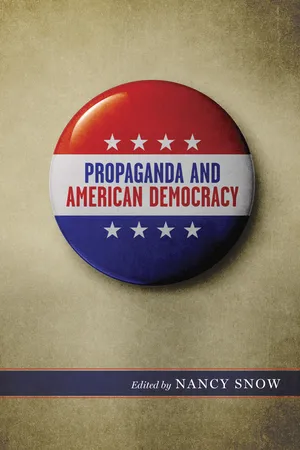
- 232 pages
- English
- ePUB (mobile friendly)
- Available on iOS & Android
eBook - ePub
Propaganda and American Democracy
About this book
Information
1
PROPAGANDA IN THE DIGITAL AGE
Propaganda seems to fit well into that old definition of obscenity: hard to define, but easy to identify. But not only is that trite, it’s inaccurate, because it really isn’t that easy to identify. While it is certainly easy to recognize simplistic and obvious examples—North Korean posters of the latest “great leader”—it is far more difficult to discern more subtle examples in things that we might not even categorize as propaganda.
Propaganda is defined via the eyes and ears of the audience. One individual or group may define it very differently than another. The thesis of this chapter is that although propaganda has been with us for thousands of years, its form and substance have changed significantly in the past few decades because of several synergistic developments. Some of those are political, with the rise of large, authoritarian states in the past century. More important has been the explosion of what are termed information and communication technologies (ICT), such as global television, the spectacularly rapid growth of the Internet, and the decreasing size, increasing capability, and expanding mobility of personal information devices. A critical connective thread is the ability of these technologies to capture, modify, and disseminate images, because the visual dimension is the most critical way through which propaganda creates its impact.
DEFINING PROPAGANDA
While few would dispute that the word itself has attained an almost universally pejorative meaning, it was not always so. An exhaustive analysis of how we have defined propaganda would require another book rather than this chapter.1 But many of the definitions of propaganda yield useful insights, culminating in the current Department of Defense definition. The term, used for decades before in the Counter-Reformation, gained a new level of institutional prominence in 1622 with the Vatican’s “propagation of the faith” (Congregatio de Propaganda Fide), which was certainly not a pejorative term, at least not to that community. In all of the thousands of pages in the massive 120 serial volumes of the American Civil War’s fabled Official Records, the term appears only once, suggesting that in nineteenth-century America the word had not attained the widespread usage of today, although the use of what we would call propaganda has been widespread throughout recorded history.
The concept of propaganda and its use is far more important than the evolution of the term itself. The twentieth century has been the “century of propaganda,” primarily because of two ravenous world wars, two enormously powerful and authoritarian political systems, and a steady stream of advances in ICT.
World War I was a breakout event for propaganda, as both Germany (and its allies) and Great Britain (and its allies, including the United States) made extensive use of it, both domestically and globally. Unlike in earlier wars, such as the U.S. Civil War and the German wars of unification, by WWI the marriage of new means of creating propaganda (photography, the print media, and even early movies) and the means of disseminating it (telegraphy and radio) opened a tremendous new battlefield for propaganda to paint “ourselves” in the best possible light and “them” in the worst.2 British control of information connectivity3 to the United States in 1915–1917 was a significant factor in shifting American public opinion toward entering WWI on the Allies’ side. It was during and after this period that propaganda became a pejorative term as a result of how both sides used it to demonize the other side, often falsely. Radio as a stepping stone to the modern era of television enabled the dissemination of propaganda with much greater speed and over greater distances. The developments in radio during the 1930s set the stage for its use as a key propaganda medium during WWII.
If the regimes of WWI gave propaganda a bad name, then those of WWII cemented it. The Nazis and the Communists combined inherent political evil with the widespread and all-encompassing use of propaganda to support that evil. The Nazis had two men—Adolf Hitler and Joseph Goebbels—who were geniuses in its use, and the Nazi regime put together an apparatus that established extremely close ties between policy and propaganda, especially internally and domestically.4 They also had the benefit of an artistic genius filmmaker, Leni Riefenstahl, whose film Triumph des Willens (Triumph of the Will) about the 1934 Sixth Nazi Party Congress in Nuremberg is arguably one of the best propaganda films ever made.5 The Communists also made use of propaganda globally throughout the Cold War. Sometimes it was crude—North Korean propaganda posters come to mind—and sometimes it was very insightful and leveraged the actions and missteps of their adversaries to make powerful points against the United States and its allies. Starting in the 1950s, both sides in the Cold War used the new medium of television as a weapon in their war of ideas, influence, and images, and this struggle for influence using electronically transmitted imagery continues today, over the Internet and its many variants.6
But what do we mean by the term? Two major schools of thought have emerged. One is that propaganda is essentially amoral, and its use and intended effects must be analyzed before a judgment can be rendered as to its morality. The great American broadcast journalist Edward R. Murrow once said that “truth is the best propaganda,”7 and the late Phil Taylor,8 along with this book’s editor, argued that as a process of communication, propaganda must first be viewed as value-neutral.9 Political communications scholar Harold Lasswell observed, “Propaganda as a mere tool is no more moral or immoral than a pump handle.”10 Even the United States Holocaust Memorial Museum uses a value-neutral definition of propaganda as “biased information spread to shape public opinion and behavior.”11 On the other side of this debate are George Orwell12 and Jacques Ellul, who observed that propaganda is inherently immoral, regardless of who is using it or for what purpose, because propaganda possesses immutably evil characteristics designed for political control.13 This is not the place to explore these two arguments—that has been done far more exhaustively elsewhere—but they help inform the debate over what we call propaganda.
Many of the definitions provide insight into the person or entity offering that particular definition. Every dictionary includes a definition of propaganda. All include propaganda’s objective of influencing opinion, and many of them also tie this objective specifically to government. (George Orwell’s deep suspicion of government led him to define propaganda as inherently evil, as noted above. Just before the end of the Communist era in Eastern Europe, the German Democratic Republic defined propaganda as “the systematic spreading and thorough explanation of political, philosophical, economic, historical, as well as scientific, technical, and other types of ideas.”14 While fairly straightforward, without alluding to lies, deceit, or manipulation, it drew a clear distinction between the nefarious aims of “imperialist” propaganda as contrasted with Marxist-Leninist propaganda, which only aimed to advance the historic cause of the working class.15
While this approach clearly hewed to the “ours is okay, theirs is bad” perspective on propaganda during the early years of the Cold War, in which both sides made widespread use of propaganda, it also argued that everyone uses it. NATO, in its 2011 guidance for military public affairs, defines propaganda as “Information, ideas, doctrines, or special appeals disseminated to influence the opinion, emotions, attitudes, or behaviour of any specified group in order to benefit the sponsor, either directly or indirectly.”16 It acknowledges that adversaries may use propaganda but does not allude to any Alliance use. The definition officially endorsed by the Department of Defense (DOD) in 2006, “Any form of communication in support of national objectives designed to influence the opinions, emotions, attitudes, or behavior of any group in order to benefit the sponsor, either directly or indirectly,” was similarly value-neutral.17 The basic approach used in all these definitions could be applied also to commercial advertising.18
The DOD’s newest official definition of propaganda, promulgated in early 2010, has two subtle but important changes, highlighted here in italics: “Any form of adversary communication, especially of a biased or misleading nature, designed to influence the opinions, emotions, attitudes, or behavior of any group in order to benefit the sponsor, either directly or indirectly.”19 This change reflected a significant debate within the Pentagon, much of it spurred by the Pentagon’s Public Affairs organizations. This effort clearly wanted to distinguish propaganda, with its negative connotations, from truthful and legitimate efforts to persuade and influence.20 This approach stands Edward R. Murrow’s famous dictim about “truth being the best propaganda” on its head. This definition appears intended to do several things. First, it declares that we certainly don’t do propaganda, only the other adversarial side does. Next, it establishes that it is propaganda’s nature to use information that is at least deceptive if not outright deceitful. Third, when combined with another terminology change that redefined “Psychological Operations” into “Military Information Support Operations,” the DOD appears to be trying to distance itself as far as possible from any suggestion that its influence activities could be described as propaganda, especially as there is significant concern within other elements of the government—particularly the Congress—about those activities. While the State Department does not issue official definitions of terminology and activities—there is no official State Department definition for strategic communication or public diplomacy, for example—there can be little doubt that it would share this perspective.21
Regardless of how we define propaganda, it inevitably brings us to information designed to influence someone. It may be intended to convince you to purchase a commercial product, espouse a philosophy or ideology, or support or oppose a political cause, but it seems to always end with behavior. This chapter is not a “history of propaganda” since entire books have explored that. Rather, it explores some of the many ways humans have employed propaganda, even if at the time those activities took place the term propaganda did not yet exist.
We in the modern digital world often think of an “image” in a technological sense, a set of ones and zeroes translated onto a page or a screen and depicting a person, or event, or some other form of informational content. But if we expand its meaning to include any visual representation, it then becomes clear that images have been used as propaganda for thousands of years. In ancient eras we didn’t have the connective means to transmit images over distance, so we moved the audience to the image. Stone carvings done by Mesopotamian empires such as the Assyrians are an example of this. The Assyrians used stone tablets, called orthostats, to depict their rulers in activities such as lion hunts, making treaties with other empires, and conquering and subduing enemies. Some of the depictions—captives beheaded, impaled on stakes, or being blinded—remain terrifying more than two millennia later. Their intent was to serve a political function emphasizing Assyrian power and the risks of opposing it; propaganda, in other words. The Persians did this also, but their images often emphasized a more peaceful and unifying message, an early form perhaps of propaganda emphasizing soft power.22 The Romans, especially after the Republic became the Empire, raised propaganda to a monumental form. Two millennia later, visitors to Rome can still see Trajan’s Column or the Arch of Constantine and see the depictions in stone of their conquests. Caesar Augustus is depicted in various statuary as a general, statesman, religious leader, and deity, each intended to create a different impression—influence and propaganda in stone.23 Various forms of public punishment, from the Romans’ use of crucifixion to the French Revolution’s use of the guillotine, were conducted with a propagandistic intent.
Much of the art produced over the past several hundred years, of kings and battles and nobles, had a similar, if often understated objective, but it was with the rise of the Westphalian nation state that “art is propaganda,” to use George Orwell’s phrase, came into adulthood.24 The American Revolution had it. Paul Revere’s classic depiction of “The Bloody Massacre Perpetrated in King Street” was, as one commentator observed, “long on political propaganda and short on accuracy.”25 In the nineteenth century a unique form of visual propaganda emerged, the cyclorama or panorama, large circular paintings in which an audience was literally immersed while the painting was rotated around them. While many of them were indeed nothing more than entertainment, others were clearly intended to glorify some historical event, such as the battles of Gettysburg, Waterloo, or Borodino.26
Until about a century ago, most visual propaganda was of an isolated and individual scene or event, whether Assyrian orthostats, Michelangelo’s frescoes in the Sistine Chapel, or the architectural propaganda of Rome.27 The three great ICT developments of the twentieth century, however, totally remade the scope, reach, and techniques of propaganda. Radio enabled the delivery of audible propaganda over distances that would have been unimaginable to those striving to keep “within earshot” of a speech or oration. But the twin inventions of the motion picture and then television transformed propaganda. The invention of the motion picture and newsreel early in the twentieth centu...
Table of contents
- Cover
- Title Page
- Copyright Page
- Dedication
- Contents
- Acknowledgments
- Introduction
- 1. Propaganda in The Digital Age
- 2. Good Propaganda or Propaganda for Good
- 3. Propaganda and Public Discourse
- 4. Propaganda for War
- 5. Pervasive Propaganda in America
- 6. Journalists as Propagandists
- 7. Propaganda as Entertainment
- 8. Reforming the Worst Propaganda
- Contributors
- Index
Trusted by 375,005 students
Access to over 1.5 million titles for a fair monthly price.
Study more efficiently using our study tools.
Frequently asked questions
Yes, you can cancel anytime from the Subscription tab in your account settings on the Perlego website. Your subscription will stay active until the end of your current billing period. Learn how to cancel your subscription
No, books cannot be downloaded as external files, such as PDFs, for use outside of Perlego. However, you can download books within the Perlego app for offline reading on mobile or tablet. Learn how to download books offline
Perlego offers two plans: Essential and Complete
- Essential is ideal for learners and professionals who enjoy exploring a wide range of subjects. Access the Essential Library with 800,000+ trusted titles and best-sellers across business, personal growth, and the humanities. Includes unlimited reading time and Standard Read Aloud voice.
- Complete: Perfect for advanced learners and researchers needing full, unrestricted access. Unlock 1.5M+ books across hundreds of subjects, including academic and specialized titles. The Complete Plan also includes advanced features like Premium Read Aloud and Research Assistant.
We are an online textbook subscription service, where you can get access to an entire online library for less than the price of a single book per month. With over 1.5 million books across 990+ topics, we’ve got you covered! Learn about our mission
Look out for the read-aloud symbol on your next book to see if you can listen to it. The read-aloud tool reads text aloud for you, highlighting the text as it is being read. You can pause it, speed it up and slow it down. Learn more about Read Aloud
Yes! You can use the Perlego app on both iOS and Android devices to read anytime, anywhere — even offline. Perfect for commutes or when you’re on the go.
Please note we cannot support devices running on iOS 13 and Android 7 or earlier. Learn more about using the app
Please note we cannot support devices running on iOS 13 and Android 7 or earlier. Learn more about using the app
Yes, you can access Propaganda and American Democracy by Nancy Snow in PDF and/or ePUB format, as well as other popular books in Politics & International Relations & North American History. We have over 1.5 million books available in our catalogue for you to explore.