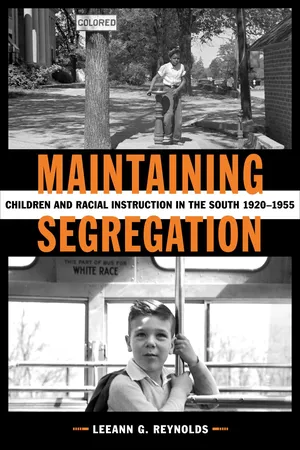
In Maintaining Segregation, LeeAnn G. Reynolds explores how black and white children in the early twentieth-century South learned about segregation in their homes, schools, and churches. As public lynchings and other displays of racial violence declined in the 1920s, a culture of silence developed around segregation, serving to forestall, absorb, and deflect individual challenges to the racial hierarchy. The cumulative effect of the racial instruction southern children received, prior to highly publicized news such as the Brown v. Board of Education decision and the Montgomery bus boycott, perpetuated segregation by discouraging discussion or critical examination.
As the system of segregation evolved throughout the early twentieth century, generations of southerners came of age having little or no knowledge of life without institutionalized segregation. Reynolds examines the motives and approaches of white and black parents to racial instruction in the home and how their methods reinforced the status quo. Whereas white families sought to preserve the legal system of segregation and their place within it, black families faced the more complicated task of ensuring the safety of their children in a racist society without sacrificing their sense of self-worth. Schools and churches functioned as secondary sites for racial conditioning, and Reynolds traces the ways in which these institutions alternately challenged and encouraged the marginalization of black Americans both within society and the historical narrative.
In order for subsequent generations to imagine and embrace the sort of racial equality championed by the civil rights movement, they had to overcome preconceived notions of race instilled since childhood. Ultimately, Reynolds's work reveals that the social change that occurred due to the civil rights movement can only be fully understood within the context of the segregation imposed upon children by southern institutions throughout much of the early twentieth century.
eBook - ePub
Maintaining Segregation
Children and Racial Instruction in the South, 1920-1955
- 272 pages
- English
- ePUB (mobile friendly)
- Available on iOS & Android
eBook - ePub
About this book
Information
CHAPTER 1
“THE SOUTHERN NEVER-NEVER LAND”
Racial Instruction in White Homes
Writing in the late 1950s, after being the target of years of harassment for her stance on civil rights, white Kentuckian Anne Braden did not blame the segregationists in her community or consider them “evil men.” Instead, she considered them “trapped.” Like many white southerners, they had learned myths about segregation “as they learned their ABC’s; they had absorbed it with the air they breathed.”1 Lillian Smith described the process by which white children learned about segregation in similar terms: “We learned far more from acts than words, more from a raised eyebrow, a joke, a shocked voice, a withdrawing movement of the body, a long silence, than from long sentences.”2 White southerners who have written about what they learned about race and segregation at home have focused more on what was unspoken, assumed, or taken for granted than on specific lessons from their parents. This phenomenon can likely be attributed to the very way white parents went about educating their children about the system. Segregation was not to be questioned or even acknowledged in many white households, so intentional instruction would have presented the system as something to be consciously considered. Smith remembered, “Like sex, the word segregation was not mentioned in the best circles.”3 Parents often relied, instead, on nonverbal cues within the home, along with the signs and scripted performances of segregation in the larger community, to teach their children what was expected of them.
The recollections that follow are primarily those of white southerners who grew up in the segregated South and later criticized the region’s racial practices as writers and/or activists. Most were considered to be “southern liberals,” part of a small group of white southerners who questioned the South’s racial order and often its economic system. Many of these individuals experienced some sort of racial awakening, which most white southerners at the time did not, and were eventually in a position to have their recollections published, which most southerners, again, were not. Although these conditions may suggest that the accounts are not representative and thus reveal little about white southern experience in general, this is not the case. While these authors largely recognized that their awakening experiences were atypical, they stressed that their childhoods were ordinary.
In addition to emphasizing that their experiences were commonplace, the authors were interested in establishing the validity of their liberal credentials; they wanted to prove the extent of their racial transformations by showing just how complicit they had been in the segregated system. Fred Hobson has noted that although such authors were writing as white southerners who had experienced racial awakenings, they were writing about a time before those awakenings occurred.4 For a substantial portion of their narratives, they are believers in and adherents to the segregated system; that is, they are segregationists. Thus, these writers constitute a unique body of informants who wanted both to show how limiting the system could be and to explain how people with humanitarian impulses—themselves, as proved by their later liberal activism—could become so implicated in the system as to be unable to recognize its detrimental impact on themselves and others. While these sources must be used with some degree of caution, they offer a valuable insider’s view of a system that those who maintained a belief in its validity have been more hesitant to reveal.
One of the most influential white writers was Lillian Smith, who described Killers of the Dream, her autobiographical work first published in 1949, as a “personal memoir” but also asserted that “in another sense, it is Every Southerner’s memoir.”5 More than any other firsthand observer, Smith emphasized that segregation was maintained through silence. Her career reveals a deep concern with issues of race and childhood. For many years Smith owned and operated Laurel Falls Camp for Girls in Clayton, Georgia, where she and her partner, Paula Snelling, encouraged the young female campers to think critically about taboo issues such as segregation.6 Smith and Snelling also edited a journal under a succession of titles, most notably South Today, in which they encouraged critical discussion of the South’s racial and economic conditions, and Smith’s controversial 1944 novel Strange Fruit explored issues of interracial sex and lynching in the segregated South.7 In light of Smith’s instrumental role in articulating the notion that segregation thrived as an institution because it was unquestioned, her analysis warrants further exploration.
Smith stressed the idea that an understanding of segregation was absorbed from the atmosphere rather than consciously taught. Born in 1897, Smith explained how her generation, that which saw the establishment of segregation within their lifetimes, was introduced to the institution: “We were born into it. Signs were put over doors when we were babies. We took them for granted just as we took heat and sandspurs and mosquitoes. . . . People find it hard to question something that has been here since they were born.” Although she became aware of the existence of racial violence in her youth through the whispers of adults around her, she recalled that by the time she was in her late teens, around the start of World War I, “things had quieted down. Race relations seemed ‘settled.’ Segregation had hardened around our lives and feelings.” Smith believed black children experienced the same ritualized instruction that she had. “From the time little southern children take their first step,” she wrote, “they learn their ritual. . . . Some, if their faces are dark, learn to bend, hat in hand; and others, if their faces are white, learn to hold their heads high. Some step off the sidewalk while others pass by in arrogance.”8 Over time these movements became reflexes, or conditioned responses, that southerners performed without thinking and, in the case of whites, Smith concluded, without feeling. Of this aspect of the system, she had observed earlier in South Today, “the trouble is, that we have more reflexes than thoughts concerning the race situation. A reconditioning of reflexes must therefore be brought about.”9 Smith sketched a picture of a society in which individuals performed an orchestrated series of movements that were learned by example and intimation early in childhood and became habits, never to be consciously examined. She also highlighted the conditioning of both black and white southerners.
In a revealing analysis Jay Watson drew on aspects of Smith’s language to further explain the choreographed nature of the segregated system. Building on her characterization of segregation as a “twisting turning dance,” Watson described this dance as “less a spontaneous personal improvisation than a kind of collective lockstep.”10 Of the ritualized steps that Smith described, Watson wrote, “As these rituals become progressively internalized, white Southerners can practice segregation without the need for any legitimating ideas at all. They simply live their ideology, to their benefit and detriment at once, without thinking about it.” Watson noted how the ideology of segregation could control the body, often against its own interests and without its conscious input.11 Smith had questioned, “What white southerner of my generation ever stops to think consciously where to go or asks himself if it is right for him to go there!”; instead, the “muscles know” where to go, whether it was to the front of the bus or to the bigger school.12 Darlene O’Dell referred to this phenomenon as “habit memory (memory stored in the movement of the body).”13 Watson expanded on this theme: “When the muscles know, when belief is quite literally incorporated, abstract or strictly cognitive forms of understanding, such as ethical reflection, are superfluous.”14 Once the movements of the body had been disciplined by the ideology of segregation in childhood, the individual southerner need never make a conscious choice about whether to accept the system or not; he or she endorsed it through motion. Such childhood conditioning was hard to overcome. Smith concluded, “These ceremonials in honor of white supremacy, performed from babyhood, slip from the conscious mind down deep into muscles and glands and become difficult to tear out.”15 For this reason an individual’s response to breaching the segregated code could be quite visceral.
Killers of the Dream served as a devastating critique of segregation’s impact on white as well as black southerners. Like white southerners in subsequent generations who became critical of the system, Smith did so in part because she began to realize the intellectual and emotional limitations it placed on the lives of whites. She explained, “I began to understand slowly at first but more clearly as the years passed, that the warped, distorted frame we have put around every Negro child from birth is around every white child also. Each is on a different side of the frame but each is pinioned there.”16 Earlier Smith had written, “We need to understand the great injury that the philosophy and practice of segregation inflict upon white children as well as upon colored children. To hate tears up the mind and heart as surely as to be hated. To segregate is as injurious to character growth as to be segregated.”17 The system had crippled both black and white children, in her view, and even after the metaphorical frame was removed and a critical assessment begun, the impact of having lived in a society that encouraged one to deny feelings and ignore doubts lasted a lifetime. White children, in her analysis, “became little crooked wedges that fit into the intricately twisting serrated design of life which THEY WHO MAKE THE RULES had prepared for us in Dixie.”18
Although she was somewhat vague about who had actually made the rules, Smith clearly had specific villains in mind. Throughout much of her text she referred to what “THEY” did or what “Southern Tradition” wanted people to believe. She wrote rather cryptically, “Southern Tradition taught well: we learned our way by doing. You never considered arguing with teacher, because you could not see her. You only felt the iron grip of her hand and knew you must go where all the other children were going.”19 In Watson’s assessment Smith viewed segregation as “an authorless theater,” “a stage set on which social actors are moved about like puppets by Southern tradition, mouthing lines they did not write.”20 Smith sought to convey the sense that southerners were being led by an “invisible power” that controlled their movements and that they were incapable of resisting.21 Segregation thrived precisely because the system obscured what the source of its power actually was. Although reluctant to name a villain, Smith explored elsewhere in Killers of the Dream who the killers really were. She had several suspects, including politicians—who told “lies about skin color,” thus “forcing decayed pieces of theirs and the region’s obscenities into the minds of the young and leaving them there to fester”—and Mr. Rich White, who had made a bargain with Mr. Poor White that he could “boss the nigger” if he let Mr. Rich White “boss the money.”22 Smith’s primary villains were elite white males, whom she saw as culpable for the ways in which segregation limited the lives of black men, poor white men, and women of both races.23
In her account of how segregation came to be seen as immutable, Smith asserted that even the region’s “responsible” elites “did not know how to stop this monster created of poverty, fear, ignorance, guilt, political greed, and crazed by the drug of white supremacy.” Unable to find a solution to the region’s social problems, these elites “laid down a smoke screen of silence over the South’s racial tensions.” She explained how this process was accomplished: “It became taboo to talk of these problems; bad form to question; ‘irresponsible’ to discuss the issues in newspapers or write about them in books. They hoped silence would cure what intelligence and good will felt helpless to combat. If one did not mention these ghosts, maybe they would just go away.”24 Smith was surprisingly conciliatory in this analysis, suggesting that a segment of the elite white population would solve the region’s racial problems if only they knew how, though the very practices she condemned had been established to serve the interests of the white community. Separate from the issue of who created the system and why, Smith’s analysis conveys the sense that segregation had somehow slipped free from the control of its creators and was now functioning without their active involvement, that it had become self-perpetuating, a “Frankenstein,” in historian James W. Silver’s terms, that could no longer be stopped.25
Other contemporary critics of segregation and later observers of the institution have likewise attributed the system’s power and persistence to the way in which it became self-perpetuating as it matured. Carl Rowan described segregation as “its own best defender and perpetuator.”26 John Cell argued, “Force lay behind segregation. . . . Yet most of the time segregation was largely self-enforcing.”27 Of racism in American society more broadly, Andrew Young observed, “The historical roots of American racism are conscious and deliberate, but sheer ignorance perpetuates it without any extra effort.”28 Likewise, psychologist Beverly Daniel Tatum wrote, “Because racism is so ingrained in the fabric of American institutions, it is easily self-perpetuating. All that is required to maintain it is business as usual.”29 Although deliberately established for the benefit of the white community, the segregated system seemed to take on a life of its own as it matured. This feature unfortunately served in the minds of many to divorce responsibility for the system’s functioning from those whose interests it served.
Much of Lillian Smith’s effort to assign culpability for maintaining segregation to some invisible force or to the South’s political and economic leaders was an attempt to acquit the more likely candidates for blame: the parents of white children. By shifting blame from white parents in general, she may have been trying to shift responsibility from her own parents. Smith remembered of her childhood, “The mother who taught me what I know of tenderness and love and compassion taught me also the bleak rituals of keeping Negroes in their ‘place.’” Her father taught her about the equality of all people and scolded her for her arrogance toward working-class children at her school but also “trained [her] in the steel-rigid decorums I must demand of every colored male.” Yet she dedicated Killers of the Dream to them because they had “valiantly tried to keep their nine children in touch with wholeness even though reared in a segregated culture.” Smith believed white parents had no choice but to teach their children contradictory messages. Her parents taught their children “ideals they did not practice and did not expect us to practice and which we could not have practiced had we wanted to.” Smith held the pressures of the segregated system responsible for white parents’ ambiguous racial messages, concluding that white parents lived in “terror” lest their children “be other than orthodox southerners.”30 White families faced real consequences, primarily in terms of social ostracism, if their children did not learn to conform to the prevailing racial order.
Smith had previously explored the implications of white parents’ racial instruction in South Today. She observed that as white southerners grew up and had experiences that might have served to challenge their childhood conditioning, they were faced with the predicament that to question the received regional wisdom about race constituted questioning their own parents. Smith explained, “Any new feeling, any profoundly different feeling, would seem to our unconscious minds a betrayal of childhood love for our parents—for most of us have never learned to separate this love from the ‘right’ and ‘wrong’ which our parents taught us. All are tied up together and to all we react with indiscriminant emotion.”31 White children viewed the lessons they learned about segregation as sacrosanct because they were imbued with the emotional power of childhood love and respect for parents. Margaret Jones Bolsterli, a white southerner of a later generation who wrote her own memoir about growing up in the segregated South, described Smith’s view of the region’s racial and sexual taboos: “Those who violate the taboos are traitors to everything the white culture values and has t...
Table of contents
- Cover
- Title Page
- Copyright Page
- Dedication
- Contents
- Acknowledgments
- Introduction
- Chapter 1 “The Southern Never-Never Land”
- Chapter 2 The African American Dilemma
- Chapter 3 Supplementary Reading
- Chapter 4 “Red and Yellow, Black and White”
- Chapter 5 To Make the Tolerable Intolerable
- Conclusion
- Notes
- Bibliography
- Index
Trusted by 375,005 students
Access to over 1.5 million titles for a fair monthly price.
Study more efficiently using our study tools.
Frequently asked questions
Yes, you can cancel anytime from the Subscription tab in your account settings on the Perlego website. Your subscription will stay active until the end of your current billing period. Learn how to cancel your subscription
No, books cannot be downloaded as external files, such as PDFs, for use outside of Perlego. However, you can download books within the Perlego app for offline reading on mobile or tablet. Learn how to download books offline
Perlego offers two plans: Essential and Complete
- Essential is ideal for learners and professionals who enjoy exploring a wide range of subjects. Access the Essential Library with 800,000+ trusted titles and best-sellers across business, personal growth, and the humanities. Includes unlimited reading time and Standard Read Aloud voice.
- Complete: Perfect for advanced learners and researchers needing full, unrestricted access. Unlock 1.5M+ books across hundreds of subjects, including academic and specialized titles. The Complete Plan also includes advanced features like Premium Read Aloud and Research Assistant.
We are an online textbook subscription service, where you can get access to an entire online library for less than the price of a single book per month. With over 1.5 million books across 990+ topics, we’ve got you covered! Learn about our mission
Look out for the read-aloud symbol on your next book to see if you can listen to it. The read-aloud tool reads text aloud for you, highlighting the text as it is being read. You can pause it, speed it up and slow it down. Learn more about Read Aloud
Yes! You can use the Perlego app on both iOS and Android devices to read anytime, anywhere — even offline. Perfect for commutes or when you’re on the go.
Please note we cannot support devices running on iOS 13 and Android 7 or earlier. Learn more about using the app
Please note we cannot support devices running on iOS 13 and Android 7 or earlier. Learn more about using the app
Yes, you can access Maintaining Segregation by LeeAnn G. Reynolds in PDF and/or ePUB format, as well as other popular books in Politics & International Relations & Civil Rights in Politics. We have over 1.5 million books available in our catalogue for you to explore.