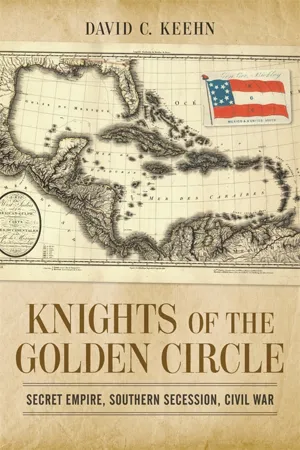
Based on years of exhaustive and meticulous research, David C. Keehn's study provides the first comprehensive analysis of the Knights of the Golden Circle, a secret southern society that initially sought to establish a slave-holding empire in the "Golden Circle" region of Mexico, the Caribbean, and Central America. Keehn reveals the origins, rituals, structure, and complex history of this mysterious group, including its later involvement in the secession movement. Members supported southern governors in precipitating disunion, filled the ranks of the nascent Confederate Army, and organized rearguard actions during the Civil War.
The Knights of the Golden Circle emerged in 1858 when a secret society formed by a Cincinnati businessman merged with the pro-expansionist Order of the Lone Star, which already had 15, 000 members. The following year, the Knights began publishing their own newspaper and established their headquarters in Washington, D.C. In 1860, during their first attempt to create the Golden Circle, several thousand Knights assembled in southern Texas to "colonize" northern Mexico. Due to insufficient resources and organizational shortfalls, however, that filibuster failed.
Later, the Knights shifted their focus and began pushing for disunion, spearheading prosecession rallies, and intimidating Unionists in the South. They appointed regional military commanders from the ranks of the South's major political and military figures, including men such as Elkanah Greer of Texas, Paul J. Semmes of Georgia, Robert C. Tyler of Maryland, and Virginius D. Groner of Virginia. Followers also established allies with the South's rabidly prosecession "fire-eaters, " which included individuals such as Barnwell Rhett, Louis Wigfall, Henry Wise, and William Yancey.
According to Keehn, the Knights likely carried out a variety of other clandestine actions before the Civil War, including attempts by insurgents to take over federal forts in Virginia and North Carolina, the activation of prosouthern militia around Washington, D.C., and a planned assassination of Abraham Lincoln as he passed through Baltimore in early 1861 on the way to his inauguration. Once the fighting began, the Knights helped build the emerging Confederate Army and assisted with the pro-Confederate Copperhead movement in northern states. With the war all but lost, various Knights supported one of their members, John Wilkes Booth, in his plot to assassinate President Lincoln.
Keehn's fast-paced, engaging narrative demonstrates that the Knights' influence proved more substantial than historians have traditionally assumed and provides a new perspective on southern secession and the outbreak of the Civil War.
- 328 pages
- English
- ePUB (mobile friendly)
- Available on iOS & Android
eBook - ePub
About this book
Information
1
POWERFUL ANTECEDENTS
THE MYSTIC ORDER of the Knights of the Golden Circle was the brainchild of a multitalented doctor and editor living in Ohio named George W. L. Bickley. George had been born at Bickley Mills (Russell County) in southwest Virginia to a poor laboring family on July 18, 1823. When he was five, George’s mother insisted that the family move to her home territory near Petersburg, Virginia, where George’s father died of cholera a few years later. George’s mother was left so destitute that a subscription had to be raised in Richmond for care of the family. George’s gallivanting mother moved between Petersburg and Richmond, and shunted her young son off to relatives in southern Virginia. Here the emotionally neglected and unhappy George lived until he reached the age of twelve, when he ran away.
For the next ten years, George subsisted on the strength of his glib tongue and good looks while working at a series of odd jobs and then in a trading business at Geneva, Alabama (that was supplied out of New Orleans). In October 1846, George wrote a relative asking for forgiveness due to the “sircumstances [sic] I deceived you last Spring.”1 By 1847, George was living with relatives in Greencastle, Indiana, and attending the local college. He then moved to North Carolina, fathering a son there named Charles Simmons Bickley, whom he placed with relatives when his first wife died in 1850. At this point, George headed back to Russell County, Virginia, where he studied medicine under a local doctor and then opened his own office at the Union Hotel in Jeffersonville (now Tazewell).2
He is shown on the 1850 Russell County census as “G. W. L. Bickley (only one in family) 26 years old, male, Phrenologist, worth $400, native of Russell County, VA.” At the time, phrenology—the study of contours of the skull as a predictor of human behavior—was popular and regarded by many as a true science although subject to abuse by con men.3
As a result of his unstable background, Bickley developed incurable habits of prevaricating and scheming. He also displayed a driving ambition, resourcefulness, and a determination to make a name for himself in wide-open nineteenth-century America. Somehow along the way, he picked up a credible knowledge of world history and a command of the English language that enabled him to become a prolific writer and a notable speaker.4
By 1851, the fast-talking Bickley made a considerable leap in status from a country doctor to professor at Cincinnati’s Eclectic Medical Institute, a reform medical school started in the mid-1840s that focused on unconventional methods such as physical manipulation and herbal remedies. To obtain his faculty position, Bickley lied about his medical credentials, saying he had attended top medical schools in the East and on the European continent. His quick wit and brief experience as a country doctor allowed him to bluff his way as an accomplished phrenologist and as an authority on physiology and scientific botany.5
While at the Eclectic Institute, Bickley authored books on his medical specialties as well as several histories and a novel. He completed a History of the Settlement and Indian Wars of Tazewell County, Virginia that is relied on to this day. He finished a rustic novel set in a southwest Virginia cove, titled Adalaska, Or, The Strange and Mysterious Family of the Cave of Genreva.6 Bickley also wrote copiously in his fields of pseudo-medicine, including an introductory lecture that traced the ancient and modern history of medical science with Eclecticism at its apex (he later penned a biography of the Eclectic Institute itself).7 Students at the Eclectic Institute accused Bickley of being a “novelist” and unable to deliver an extemporaneous medical lecture. He nevertheless was a tireless worker, and claimed he dictated sixteen to twenty pages of foolscap an hour in writing a 209-page volume on physiological botany and a 2,700-page written course of lectures.8
Then, in early 1853, the ambitious Bickley freed himself from the mundane need to earn a living: he married Rachel Dodson, a wealthy widow and scion of Cincinnati’s Kinney family of bankers. He soon took a leave of absence from the Eclectic Medical Institute and moved to Rachel’s family farm near Portsmouth, Scioto County, in south central Ohio. Here Bickley pursued multifaceted interests including newspaper editing and local real estate development, as well as more far-flung ventures, reportedly including investing in coal mines in the Dominican Republic and exporting farm implements to Russia.9 He also proposed the establishment of a “conservative daily newspaper” to Kentucky senator John Crittenden, to be owned and edited by prominent citizens from each of the thirty-one states in order to counter New York City’s Republican papers (which Bickley believed were stirring up sectional animosities).10
In addition, Bickley also pursued several enterprises more directly tied to his formation of the Knights. Among these was the 1854 publication of a short-lived Manifest Destiny journal called Bickley’s West American Review, which contained a variety of articles (mostly written by Bickley) on the arts, commerce, and politics. One early article titled “Inter-oceanic Railroad—Federal Capital” urged that the capital of the United States should be moved to the Ozarks because “the circle of our limits” will soon encompass “a part of the British possession, the West Indies, and Mexico.”11 In publishing his journal, Bickley likely came into contact with kindred “Young America” spirits such as John O’Sullivan and George Sanders, owners/editors of the Democratic Review that was published in New York City. Like the Young American wing of the Democratic Party, the Democratic Review preached that republicanism was the ultimate destiny of society and would lead to world peace through the extinction of monarchical despotism. Its editor, John O’Sullivan, had coined the phrase “Manifest Destiny” in 1845 to signify that the United States’ expansion throughout the North American continent was inexorable and destined by Providence.12
Bickley also developed a fascination with secret societies that he felt contributed to the welfare and happiness of mankind as the source of immutable social and political laws. Secret societies flourished in nineteenth-century America since they allowed aspirants to temporarily escape from the monotony of their daily lives. Bickley formed a short-lived chapter (referred to as a “Circle”) of a patriotic order based in Philadelphia called the “Brotherhood of the Union,” which blended patriotic imagery with U.S. expansionism and social-betterment goals for the working class. Like the KGC after it, the Brotherhood of the Union was ruled by a supreme council, utilized a system of numbered codes to preserve secrecy, and was (at least in theory) to be divorced from political party strife.13
Like John Wilkes Booth, Bickley also joined a lodge of the Know-Nothings, a secret nativist movement that disparaged Catholics and immigrants, and utilized cryptic handshakes and codes. During the mid-1850s, the Know-Nothing movement transformed into the American Party, which nominated former U.S. chief executive Millard Fillmore for president in 1856. But it soon faded out as a national party when its northern and southern wings split over slavery.14
Another of Bickley’s avocations was the formation of a drill company consisting of sixty young men whom he planned to equip with dazzling uniforms so that they could travel the globe and perform intricate military exhibitions. Such drill squads, usually connected with local militia units, were prevalent, especially in the South, and their competitions provided opportunities for military-minded men to get together and share their perspectives. Bickley’s drill company provided him with a ready source of recruits that he shifted to the KGC when he established its first chapters in Scioto County and Cincinnati.15
But Bickley’s entrepreneurial pastimes were suddenly interrupted in 1857, when his wealthy wife discovered that he had been secretly trying to convert her substantial assets to his own name. She got her banker brother to kick Bickley off their Scioto County farm. The pseudo-physician was forced to return to Cincinnati and resume teaching at the Eclectic Medical Institute.16
In 1858, Bickley become editor of the Scientific Artisan, the house journal for the American Patent Company, to promote inventions and the proper handling of patent cases. It was in the Scientific Artisan’s offices that Bickley came up with the emblem for the Knights—a Maltese cross superimposed on the Lone Star—designed to be worn as a breast pin.17 He also organized “The American Colonization and Steamship Company of ‘1’ [Monterrey]” as a financial vehicle to raise capital for the KGC’s planned ventures.18 A coworker on the Artisan described Bickley as “an ignorant pretender, as restless and scheming as he was shallow, very vain of his person, exceedingly fond of military display, and constantly engaged either in devices to borrow money and crazy schemes of speculation.”19
Bickley apparently got the message that he wasn’t appreciated since he soon resigned from the Artisan and headed south. Here he reportedly worked with the “Southern Rights Associations” that had spread across the towns of the Deep South as well as North Carolina and Virginia in opposition to the various compromises over slavery during the 1850s. Through speeches, rallies, and by publishing tracts, these associations promoted states’ rights, resisted further encroachments on slavery, and in some cases backed southern fire-eaters calling for separate state secession.20 Bickley later alluded to the Knights’ southern origins when he said it had been founded by southern men and was originally intended to advance the rights and interests of the southern states.21 Bickley now devoted all his time to promoting the Knights as a vehicle to achieve his Manifest Destiny dream of southern empire and to selling KGC-related steamship bonds to wealthy planters.22
During his sojourn across the South, George was somehow able to convince the leaders of a preexisting southern society called the “Order of the Lone Star” (OLS) to merge with his Knights.23 This had truly an exponential impact since the OLS already had more than fifteen thousand members in at least fifty chapters spread across ten southern states with large concentrations in Mississippi, Louisiana, Texas, and Alabama. It also had chapters in northern port cities including Baltimore and New York, where it operated out of Tammany Hall and the Empire Club. This merger with the OLS suddenly transformed Bickley’s nascent KGC into a truly powerful force with far-flung members and prestige.24
To advance their expansionist agenda, the OLS and its members promoted a practice known as “filibustering”—the launching of a privately funded expedition to invade a neighboring country (with which the U.S. government was formally at peace). Although filibusterers often justified their expeditions as freeing the local inhabitants from tyrannical rule, the underlying purpose was generally to garner land and treasure for the participants.25 The filibusters conducted in the 1840s and 1850s were usually headed by a well-known U.S. leader who had the capability to raise needed funds and recruit the idle young men who congregated in U.S. ports such as New Orleans and San Francisco.26
Cuban émigrés and southern expansionists had formed the OLS in September 1851 in the aftermath of Narcisco López’s disastrous filibustering invasion of Cuba at Bahia Honda.27 López had launched his invasion with a band of 450 U.S.-based insurgents dedicated to freeing Cuba from Spanish rule. Upon reaching Cuba’s northern coast, López and his men were surrounded and captured by Spanish-led troops after the expected indigenous support failed to show up. López as well as the expedition’s artillery commander, William Crittenden (nephew of the noted U.S. senator from Kentucky), were executed. Indigenous supporters of the expedition from within Cuba were subsequently rounded up and arrested.28
As the López expedition proved, there were substantial risks to filibustering. One was in violating the U.S. Neutrality Act of 1818, which made it a felony to “prepare the means for any military expedition” from the jurisdiction of the United States against a country with which the United States was at peace.29 Even more significant was the outcome experienced by López and his men—a hostile reception in the country or colony being invaded. Neighboring countries such as Cuba and Mexico made it a crime, punishable by death, to be involved in a foreign-based filibuster that reached their territory.30
To continue the mission of freeing Cuba from Spanish rule and eventually annexing it to the United States as a slaveholding territory, Cuban ex-patriots and southern adventurers formed the Order of the Lone Star in 1851 at the offices of the pro-expansionist Lafayette (La.) True Delta newspaper. John Henderson, a Mississippi cotton planter and U.S. senator, formulated the OLS ritual, and Pierre Soule, another U.S. senator from Louisiana, served as its president.31
The OLS, like its KGC successor, was organized in a hierarchical fashion with three degrees, including the military degree at the bottom and a fund-raising benevolent degree above that. At the apex was the political degree, with the goal of supporting U.S. political candidates who would advance the society’s filibustering and proslavery objectives. A supreme council governed the group’s overall policy.32
The OLS was structured so that once three divisions were formed in any state, a statewide general assembly was to be created. By the 1850s, the OLS was reputed to be a shadow organization within the Democratic Party, dedicated to expansionism and serving as a counterweight to the American, or Know-Nothing, Party.33
In Texas, the society was known as the “Order of the Lone Star of the West” and became very popu...
Table of contents
- Cover
- Title Page
- Copyright Page
- Contents
- Illustrations
- Prologue: The Shadowy Knights
- 1. Powerful Antecedents
- 2. Formal Organization
- 3. The Drive for Mexico
- 4. A Regional Coalition
- 5. Transforming to Secession
- 6. The Paramilitary’s Core
- 7. Seizure of Federal Forts
- 8. The Plot to Seize the District of Columbia
- 9. Rustling Texas Out of the Union
- 10. Spreading Secession
- 11. Call to Arms
- 12. The Struggle for Kentucky
- 13. A Rejuvenated KGC?
- Epilogue
- Acknowledgments
- Notes
- Bibliography
- Index
Trusted by 375,005 students
Access to over 1.5 million titles for a fair monthly price.
Study more efficiently using our study tools.
Frequently asked questions
Yes, you can cancel anytime from the Subscription tab in your account settings on the Perlego website. Your subscription will stay active until the end of your current billing period. Learn how to cancel your subscription
No, books cannot be downloaded as external files, such as PDFs, for use outside of Perlego. However, you can download books within the Perlego app for offline reading on mobile or tablet. Learn how to download books offline
Perlego offers two plans: Essential and Complete
- Essential is ideal for learners and professionals who enjoy exploring a wide range of subjects. Access the Essential Library with 800,000+ trusted titles and best-sellers across business, personal growth, and the humanities. Includes unlimited reading time and Standard Read Aloud voice.
- Complete: Perfect for advanced learners and researchers needing full, unrestricted access. Unlock 1.5M+ books across hundreds of subjects, including academic and specialized titles. The Complete Plan also includes advanced features like Premium Read Aloud and Research Assistant.
We are an online textbook subscription service, where you can get access to an entire online library for less than the price of a single book per month. With over 1.5 million books across 990+ topics, we’ve got you covered! Learn about our mission
Look out for the read-aloud symbol on your next book to see if you can listen to it. The read-aloud tool reads text aloud for you, highlighting the text as it is being read. You can pause it, speed it up and slow it down. Learn more about Read Aloud
Yes! You can use the Perlego app on both iOS and Android devices to read anytime, anywhere — even offline. Perfect for commutes or when you’re on the go.
Please note we cannot support devices running on iOS 13 and Android 7 or earlier. Learn more about using the app
Please note we cannot support devices running on iOS 13 and Android 7 or earlier. Learn more about using the app
Yes, you can access Knights of the Golden Circle by David C. Keehn in PDF and/or ePUB format, as well as other popular books in History & American Civil War History. We have over 1.5 million books available in our catalogue for you to explore.