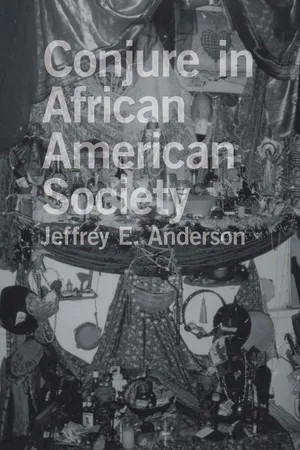
From black sorcerers' client-based practices in the antebellum South to the postmodern revival of hoodoo and its tandem spiritual supply stores, the supernatural has long been a key component of the African American experience. What began as a mixture of African, European, and Native American influences within slave communities finds expression today in a multimillion dollar business. In Conjure in African American Society, Jeffrey E. Anderson unfolds a fascinating story as he traces the origins and evolution of conjuring practices across the centuries.
Though some may see the study of conjure as a perpetuation of old stereotypes that depict blacks as bound to superstition, the truth, Anderson reveals, is far more complex. Drawing on folklore, fiction and nonfiction, music, art, and interviews, he explores various portrayals of the conjurer -- backward buffoon, rebel against authority, and symbol of racial pride. He also examines the actual work performed by conjurers, including the use of pharmacologically active herbs to treat illness, psychology to ease mental ailments, fear to bring about the death of enemies and acquittals at trials, and advice to encourage clients to succeed on their own. By critically examining the many influences that have shaped conjure over time, Anderson effectively redefines magic as a cultural power, one that has profoundly touched the arts, black Christianity, and American society overall.
- 248 pages
- English
- ePUB (mobile friendly)
- Available on iOS & Android
eBook - ePub
Conjure in African American Society
About this book
Information
1
Vodu and Minkisi:
The African Foundation of Black American Magic
The African Foundation of Black American Magic
DURING THE FIRST half of the twentieth century scholars debated the degree to which African beliefs and practices survived in the New World. Over time those arguing in favor of substantial African survivals prevailed.1 In light of this current scholarly consensus, it is surprising that historians have done little to systematically trace conjure’s multiple African roots.2 Nevertheless, its transformation from African religion to American magic made it into a microcosm of the African American experience that combined elements of loss with a persistent drive to survive in the face of persecution. Nineteenth-century hoodoo was a result of creolization and syncretism, the mixing of multiple African, European, and Native American cultures, which together resulted in a form of magic unique to the American South. Ultimately, however, the origins of hoodoo lie in the traditional religious beliefs of the land from which the slaves’ ancestors hailed.
The roots of conjure extend deep into sub-Saharan Africa, where magic has long been a feature of everyday life throughout most of the region. Moreover, no one tribe or people group can claim to be the origin of hoodoo.3 Instead, certain groups played greater or lesser roles, depending heavily on the demographics of slave importation into particular areas. African influences on hoodoo fell into two primary cultural zones corresponding roughly to the distinct areas settled by Latin and English colonists.
Modern American conjure is a mixture of magical beliefs originating in the two zones of European settlement, which remained quite distinct during the seventeenth, eighteenth, and nineteenth centuries. The first of the areas to be settled by substantial numbers of European colonists was the Atlantic Coast, encompassing Maryland, Virginia, North Carolina, South Carolina, and Georgia. These British colonies received shipments of slaves beginning in 1619, and the trade accelerated in the late seventeenth and eighteenth centuries. The primary element that set this area apart from the rest of the South was the strong English influence that shaped it from the early seventeenth century onward. Within the English-settled region, the Sea Islands of South Carolina and Georgia proved the most important. High black-to-white ratios and relative isolation from the rest of the South set these locations apart. From their initial settlements along the Atlantic coast, Anglo-American settlers moved west to occupy the lands of the central South and the trans-Mississippi region, as far as Texas.
The second area included French and Spanish settlements, chiefly on the Gulf of Mexico and the lower Mississippi River. A handful of Spanish troops and settlers arrived in 1565, founding St. Augustine, Florida. Shortly thereafter small numbers of Spanish settlers moved into what is now Texas. The French did not reach the American South in significant numbers until the early eighteenth century. Their largest settlement was New Orleans, but smaller ones also occupied the Gulf Coast as far east as Florida. During the late eighteenth and early nineteenth centuries the Latin cultural area grew far more slowly than the English domain. The chief area of expansion was the Mississippi River. Along its banks, French settlers gradually advanced northward. In other regions, Latin influence declined as the Protestant English moved westward. Louisiana, which fell under American control in 1803, retained much of its Latin culture because of its large French population. South Florida, which had a very small colonial population, likewise escaped rapid assimilation to the American culture, primarily because few American settlers wanted to move into an area with such a climate and terrain.
In the lands settled by the French and Spanish, the Fon, Yoruba, Ewe, and Mande speakers of northern West Africa laid the groundwork for an African American culture, partially through their heavy importation during the colonial period. In Louisiana, in particular, these and closely related peoples made up more than half of all Africans brought into the area. During the early republican and antebellum periods the number of slaves from northern West Africa declined drastically. West-central Africans replaced them, the largest number of whom hailed from the Kongo kingdom. Despite the shift in importation patterns, the early presence of slaves from the closely related cultures of the Fon, Ewe, and Yoruba and the more distinct Mande defined the area’s magical practices. Later arrivals modified but could not replace them. Moreover, in both French Louisiana and Spanish Florida brief spurts of immigration from the Caribbean bolstered the influence of the earlier groups. In Louisiana these were Haitian refugees fleeing revolution. In Florida the late-nineteenth-century arrival of Afro-Cubans seeking economic opportunity not only bolstered existing beliefs but also created large black communities in areas where none had existed.4
While west-central Africans proved only a secondary influence in the Latin area, they were the primary influence on the magic of the region settled by the English. Their numbers were particularly pronounced in coastal South Carolina and Georgia, where they made up more than half of all imports throughout the period when slavery was legal. Once again, the Kongo people were the largest contingent among the unwilling arrivals from west-central Africa. Also, as in Louisiana, the Mande were a significant, though minority, presence. Although the chief features of conjure derived from the Fon, the Ewe, and the Yoruba in the Latin area, the Kongo in the lands settled by the English, and the Mande in both, other groups, including the Igbo, the Akan, and the Ga-Dangme, played important roles in the creation of African American conjure, especially in particular aspects of hoodoo.5
The ethnic differences between the settlers of the Latin and English cultural zones led to persistent differences between the areas. One of the most obvious of these distinctions was the difference in words used to refer to conjure. In New Orleans, where French influence dominated, whites knew African Americans’ syncretic religion and its associated magic as Voodoo, while blacks called it hoodoo.6 Male practitioners were typically known as wangateurs, and female practitioners as wangateuses. Gris-gris and zinzin denoted charms and spells, while tobies and wangas were more specific words for good and evil charms, respectively. In Missouri noodoo, a variant of Voodoo, was the favored term for the practice of African American magic. In southern Florida, an area long ruled by Spain, a Voodoo-like religion and magical system developed from the Santería and Palo Mayombe faiths practiced by Cuban immigrants to area. It was known as Nañigo, and its priests and priestesses were known as papa-lois and mama-lois, respectively. Conjurers were termed brujas. Along the English-settled Atlantic seaboard, black sorcerers called themselves conjurers, rootworkers, and double-heads. The performance of their art was known by such words as conjure, rooting, tricking, fixing, and goophering. In some cases terms were localized. For instance, Maryland blacks knew conjurers as high men or women. Likewise, rootworkers was a designation particularly popular along the Georgia and South Carolina coasts, as was goopher, a term almost unknown outside of the English cultural area. In Mississippi, African Americans used mojo to refer to benevolent magic. Virginian blacks sometimes called conjuring Gombre-work. Though the words used for conjure varied widely throughout the South, terms deriving from European languages were more common in the area settled by Anglos.7
The influence of specific African cultures is readily apparent in some of the unique terms applied to conjure, particularly those of the Latin zone. Voodoo derived from the Fon and Ewe term vodu, meaning “god” or “worship or fear of the gods.” Hoodoo, originally used in the Latin area to identify conjure, is most likely a variation of Voodoo. However, Zora Neale Hurston claimed that it was a corruption of juju, another West African term, meaning “magic” or “charm.”8 The Louisianian terms gris-gris, zinzin, and wanga, denoting various types of spells and charms, likewise derive from West African terms. Gris-gris, a general term for magic, came from the Mandingo tribe, a subgroup of Mande speakers, who used magical items know as gerregerys or gregory bags, to harm others. Mande-speaking members of the Bambara tribe introduced the term zinzin, which referred to positive charms designed to confer strength or power on their possessors.9 Wanga, denoting malevolent magic and charms, and the derived terms wangateur and wangateuse were probably also of Mande origin. Toby reflected the early republican and antebellum influx of west-central African Kongos, whose tobe charms brought good luck to their owners. In Florida the titles papa-loi and mama-loi were the African American creolizations of the Yoruba word for a diviner-herbalist, babalawo.10
Conjure terminology with African origins was rare outside of the Latin cultural area. Goopher, used in such combinations as goopher doctor or goopher dust, was an exception to the rule. Employed in coastal Georgia and the Carolinas to designate items derived from the dead or persons dealing with them, it most likely developed from the Kongo word kufwa, meaning “to die.” Mojo and its variant Joe Moe were Kongo-derived terms found in both cultural zones that described magic and charms usually designed for positive ends. In the Kongo kingdom mooyo referred to spirits that dwelt within magical charms and was easily transferred to the spirits’ dwelling place.11
More than simply words survived the Middle Passage, however. In the Latin area, African deities continued to play a role in the lives of blacks. According to Kofi Asare Opoku, author of West African Traditional Religions, traditional northern West African gods and spirits were of six sorts. First, there was a unique being, often far separated from humanity, who gave life and power to all other beings, including lesser gods and spirits. Among Fon speakers this being was known as Mawu-Lisa, an androgynous god/goddess incarnate in the moon and sun. Among Yoruba speakers Olorun filled the role of supreme being. Virtually every other West African people had such a god. While Africans prayed to these supreme beings, they rarely offered sacrifices or otherwise sought to win their favor; beings so perfect had no need of such mundane acts of service. The next tier in the spiritual hierarchy was filled with ancestral spirits, whom West Africans believed existed alongside their living descendants. The living honored the dead with offerings of food, celebrations, and sometimes deification. Next followed a variety of lesser deities, who, unlike the supreme being, could be relied upon to take direct action in the lives of their followers, for good or ill. Each god and goddess played a particular role. Among the Fon speakers of Dahomey, Da, chief of the earth deities, was a snake god, worshiped in the form of sacred pythons. Da was also recognized as an early ancestor of the Dahomey kings. An important god of the Fon and Ewe, Legba, served as a divine linguist, interpreting the decrees of the gods to mortals, and trickster. Da was primarily confined to Fon speakers, but Legba-like gods appeared in most West African pantheons. For instance, among the Yoruba, Elegba or Eshu fulfilled the same role.12
Below the ancestral spirits and deities were a variety of lesser beings. The most important were totemic animals and plants that were important to particular individuals, families, and tribes. Usually these were reputed to have had a prominent place in the lives of their forebears. Two final types of spiritual beings were closely associated with magic. Occupying the fifth level of the spiritual hierarchy were beings who assisted sorcerers in the performance of both good and evil spells. One of the more well known of these was Sasabonsum, a cannibalistic spirit who aided Tshi-speaking witches in working evil. The sixth tier was filled by the indwelling spirits of the charms made by workers of magic.13
Kongolese traditional religion had a similar hierarchy. At the top was Nzambi, the supreme being. Below Nzambi were four types of spirits, all of which had once been living humans. Together these roughly corresponded to the second tier of northern West African belief. Bakulu, or “ancestors,” were the most important type of spirit and were honored in various ceremonies and sacrifices performed by the heads of clans, chiefs, and smiths. Next in the ranking were a variety of gods or spirits called basimbi, who occupied specific territories, localities, villages, and even physical objects such as bridges, bends in roads, and rivers. Another type of beings, minkisi (singular nkisi), occupied charms made by priests and magicians. While all types of the foregoing beings were generally benevolent, a final group of spirits, the min’kuyu, were malevolent ghosts. In life min’kuyu had been witches, and after death they had been refused entrance to the dwelling place of the ancestors.14
Blacks did not leave the spiritual hierarchies of Africa behind when they were dragged from their homeland by slave traders. On the contrary, elements of the old religions survived in the American South. The most apparent of these were the lesser deities of the Fon, the Ewe, and the Yoruba who survived in the Latin area (see table 1). By the nineteenth century, however, these lesser deities had also taken over the role of magical helpers, which had been a separate class in Africa. In French-settled areas the gods of the Fon and Ewe speakers predominated. As in northern West Africa, the serpent god ruled the pantheon. Believers in the Fon-speaking kingdom of Dahomey had worshiped Da as a sacred python. Pythons were unobtainable in the American South, forcing substitutions of other snakes. African Americans continued to worship Da in the area around New Orleans, where he was known as Blanc Dani of Danny. In the United States the Voodoo “queens” kept the snakes of indeterminate species, bringing them out during major community rituals to signal the beginning of a period of praise to and possession by Blanc Dani. As with the supreme god of African beliefs, believers only occasionally utilized the serpent god in magic. He was too exalted a being.15
Other deities who survived in New Orleans had no compunctions about helping their devotees work magic. Legba, the second most powerful god of the Fon and Ewe, was always available to those who wished to call on him for conjure. Moreover, he retained his African role as the linguist of the gods, opening lines of communication to a variety of other beings. Early in major Voodoo ceremonies, believers called on Papa Lébat, Liba, or LaBas, the New Orleans forms of Legba, saying, “Bon jour Liba, ouvert la porte; Ouvert la porte, Bon jour ma cousin; Bon jour ma cousin, Bon Jour Liba” (Good day Liba, open the door; Open the door, Good day my cousin; Good day my cousin, Good day Liba).16 Two of the gods to whom Lébat opened the door were Monsieur Assonquer and Monsieur Agoussou, the gods of good fortune and love, respectively. Because of their respective functions, these two were particularly popular among believers.17
The survival of African gods in New Orleans is well known, but they also persisted in other places as well. In Missouri the serpent god Da lived on in the form of Grandfather Rattlesnake, whom believers honored with dances. Florida’s distinctive brand of syncretic religion, Nañigo, had a richer pantheon, drawn primarily from the gods of the Yoruba. Florida’s blacks had no snake god, but they retained Obatala, greatest of the Yoruban gods. Obatala was the most powerful spirit, and unlike in the case of Blanc Dani, this power made him the best god to call upon for the performance of spells. Elegba, a trickster and phallic god among the Yoruba people, reportedly became an evil god in America. For this reason, he was especially useful in the performance of evil magic. Shango, god of thunder, and Yemaya, goddess of air and water, were two other prominent gods who survived from Yoruba belief. Nanga, an evil spirit in Nañigo, appears to have been a rare Kongo contribution to the pantheon. In Kongo belief, Nanga was a legendary hero who led his people on a great migration to the present-day home of the Kongo people. In contrast to their survival in the Latin areas, the lesser gods had largely died out in the English-settled lands by the nineteenth century. Occasional sacrifices to bring good weather or prosperity and praying to rivers before baptisms were two rare exceptions to the rule.18
What was different about the Anglo-influenced zones that made them less hospitable to such African traditional deities? Ultimately, a combination of black-to-white ratios, importation of slaves from the Caribbean, and European religious differences provide the answer. The territories around New Orleans and around the South Caroli...
Table of contents
- Cover
- Title Page
- Copyright Page
- Contents
- Preface Defining the Realm of Investigation
- Acknowledgments
- Introduction
- 1: Vodu and Minkisi: The African Foundation of Black American Magic
- 2: Witches and Medicine Men: European and Native American Building Blocks of Hoodoo
- 3: The Conjurers’ World: The Social Context of Hoodoo in Nineteenth-Century Black Life
- 4: The Conjurers Themselves: Performing and Marketing Hoodoo
- 5: Conjure Shops and Manufacturing: Changes in Hoodoo into the Twentieth Century
- 6: The Magic Continues: Hoodoo at the Turn of the Twenty-first Century
- Conclusion
- Notes
- Note on Sources
- Bibliography
- Index
Trusted by 375,005 students
Access to over 1.5 million titles for a fair monthly price.
Study more efficiently using our study tools.
Frequently asked questions
Yes, you can cancel anytime from the Subscription tab in your account settings on the Perlego website. Your subscription will stay active until the end of your current billing period. Learn how to cancel your subscription
No, books cannot be downloaded as external files, such as PDFs, for use outside of Perlego. However, you can download books within the Perlego app for offline reading on mobile or tablet. Learn how to download books offline
Perlego offers two plans: Essential and Complete
- Essential is ideal for learners and professionals who enjoy exploring a wide range of subjects. Access the Essential Library with 800,000+ trusted titles and best-sellers across business, personal growth, and the humanities. Includes unlimited reading time and Standard Read Aloud voice.
- Complete: Perfect for advanced learners and researchers needing full, unrestricted access. Unlock 1.5M+ books across hundreds of subjects, including academic and specialized titles. The Complete Plan also includes advanced features like Premium Read Aloud and Research Assistant.
We are an online textbook subscription service, where you can get access to an entire online library for less than the price of a single book per month. With over 1.5 million books across 990+ topics, we’ve got you covered! Learn about our mission
Look out for the read-aloud symbol on your next book to see if you can listen to it. The read-aloud tool reads text aloud for you, highlighting the text as it is being read. You can pause it, speed it up and slow it down. Learn more about Read Aloud
Yes! You can use the Perlego app on both iOS and Android devices to read anytime, anywhere — even offline. Perfect for commutes or when you’re on the go.
Please note we cannot support devices running on iOS 13 and Android 7 or earlier. Learn more about using the app
Please note we cannot support devices running on iOS 13 and Android 7 or earlier. Learn more about using the app
Yes, you can access Conjure in African American Society by Jeffrey E. Anderson in PDF and/or ePUB format, as well as other popular books in Social Sciences & African American Studies. We have over 1.5 million books available in our catalogue for you to explore.