We accomplish extraordinary things when we do ordinary things together. This heartfelt and hopeful conviction led LSU professor Marybeth Lima to begin the LSU Community Playground Project as a way to involve her students in the larger Baton Rouge community. Fifteen years and over seven hundred students later, Building Playgrounds, Engaging Communities tells the remarkable story of the Playground Project's ongoing partnership with area public schools to design and build safe, fun, accessible, kid-designed playgrounds.
Lima's experiences with the Playground Project range from outright failures to hard-won victories. Overcoming the challenges of working with scarce resources and persevering despite many setbacks, Lima and her students succeeded with hope, humor, and dedication.
Building Playgrounds, Engaging Communities emphasizes the major impact people have when they work together for the common good—whether by building playgrounds, establishing neighborhood gardens, or participating in honest, respectful conversations. To this end, Lima provides an appendix with practical advice for local engagement. People wanting to make a difference in their communities can use this book as a road map; those active in long-term endeavors will draw on it for ideas and inspiration.
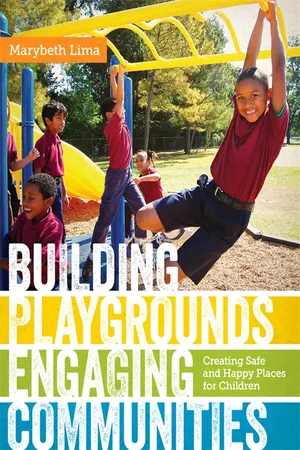
eBook - ePub
Building Playgrounds, Engaging Communities
Creating Safe and Happy Places for Children
- 216 pages
- English
- ePUB (mobile friendly)
- Available on iOS & Android
eBook - ePub
About this book
Information
Subtopic
Cultural & Social AnthropologyIndex
Social SciencesYou’re not going to give up on us now, are you?
—Georgia Jenkins
1
How to Fit a Playground
through the Back Door
My heart pounded in my throat, and I could feel the blood rushing through my ears. The twelve laughing children were suspended in air, defying gravity as they gripped the steering wheel and railings of the model fire truck, which balanced precariously at a 45-degree angle from the ground. “Turn!” the leader shouted, and the other children shifted their weight starboard in one smooth motion, bringing the truck back down to the earth with a metal against concrete crash that reminded me a little of nails on a chalkboard. I was watching “Put out the Fire,” the favorite game of the children of Beech-wood Elementary School, on their favorite piece of play equipment. As the children bounced along on the spring-loaded truck, I could hear chatter between the “radio” and the driver, while the kids gripping the railings let go to begin putting on imaginary fire gear. “ETA five minutes!” the driver yelled back to his firefighters. “Pull left!” The children grabbed the railings again and leaned toward port as the large metal fire truck vaulted onto two wheels to take a fast corner in slow motion. The smiles on the children’s faces showcased their confidence and sense of adventure; my pounding heart and clenched jaw betrayed my concern for their safety.
My presence at Beechwood was completely arbitrary. When I was in graduate school, I was lucky to befriend Mary Sansalone, a civil engineering professor who was the faculty advisor of the Cornell University civil engineering student club. One of the students in this club had designed a playground, and Mary had assisted the student in making the design a club service project. I participated in a day of service for building that playground, which was constructed at a local school. The project stuck in my mind, and when I considered projects for my first-year engineering students to undertake as part of their engineering design experience, I thought about playgrounds. Their appeal is universal, and virtually everyone is familiar with them; I thought that a playground design could be moved into the classroom as a project. I shared these ideas with a group of friends over dinner one night, and upon hearing my thoughts, Ramona Patterson jumped up from her chair and said, “I am a teacher at Beechwood Elementary School and you can do our school playground! Wait until you see it, the kids really need a new playground.”
I visited Beechwood for the first time in the fall of 1998. The first place I went on the school campus was the first place one should always go when visiting a school: the front office. There, I met Georgia Jenkins, the principal at Beechwood. Principal Jenkins should be on the poster for outstanding school leaders; she was competent, professional, and had the best interests of all 325 children at Beechwood in mind and in heart. She was a master at “time on task” and at simultaneously keeping a tight ship while providing a nurturing environment for her students.
Georgia gave me a tour of the classrooms during instruction and of the playground during recess. She informed me that the playground had been built in 1960, the same year that the school was constructed. The playground was then thirty-eight years old, six years older than I was at the time, and much worse for the wear. It was during this visit that I saw the children play “Put out the Fire” for the first time. My heart-stopping nervousness was appropriate. I learned later, in playground safety school, that impact failures, in which equipment falls on top of children, were one of the main reasons that children are killed on playgrounds. Luckily, this never happened at Beechwood.
I made a couple of more visits to Beechwood in the fall of 1998, meeting the teachers and some of the students; we planned when my students would come to meet with Beechwood students to start designing a playground. We were careful to work around the children’s school schedules so that the children would receive maximal instruction but would also have a chance to interact with my students to talk shop about play and playgrounds.
The semester started in January 1999. I stood up on the first day of class and told my students, “This semester, we’re going to design a playground with a local public school. I don’t know how to design a playground right now, but we’re going to learn together.” I taught my students about engineering design; I also searched the literature for information on playground design and synthesized this information into lessons a day before I taught it to my students. The children at Beechwood shared all their ideas about play, including what they actually did on the playground and what they hoped to do on a new playground.
Beechwood students taught my students how to play “King of the Tire,” which is the same thing as “King of the Hill,” but in which the winner stood on top of a partially sunken old tire in the ground instead of on an actual hill. The Beechwood students wanted a place to swing and to slide; they could do neither in their current playground. Georgia, assistant principal Laura East, and the teachers at Beechwood provided additional guidance. “This may not look like much of a playground to you,” they told my students, “but to these kids, it is everything they have and they are proud of it. Do everything you can to keep all this equipment. Add to what we have, don’t take anything away. If what we have is not safe, make it safe. Remove it only as a last resort.” I taught my students about active play places and passive play places, and how having both on a playground is critically important to provide children with a variety of opportunities to experience different kinds of play, whether it involves running around, climbing, and playing games like “Put out the Fire” or “King of the Tire,” or whether it involves storytelling and watching butterflies in the garden.
My students created three playground design concepts based on basic information about engineering design and playgrounds provided by me, dynamic knowledge about play and the playful spirit from the Beechwood children, and the twin mandates of safety and sustainability given by the Beechwood teachers and administrators. When my students presented these playground design concepts to the Beechwood kids, they received very specific feedback: “We love the spiral slide. We hate that climber. We want that playhouse under our oak tree. Change the color of that wheel from yellow to red,” and so on. My students changed their playground design concepts in response to Beechwood student input, wrote up their final reports, completed their playground drawings, and submitted them to me for a grade. The semester ended.
When I received my teaching evaluations (anonymously filled out by my students) a few weeks after the end of the semester, the highest score I received (3.9/4.0)—higher than “student interest was generated in the subject matter,” “instructor encouraged questions and answered them clearly,” and “student reactions were given consideration”—was “instructor thoroughly understood the subject matter.” I was surprised, since I’d announced on the first day of class that I didn’t know how to design a playground—that is, I didn’t know the subject matter, much less thoroughly know it. I thought about this anomaly and came to the conclusion that I had received a high score on this metric because I modeled how to learn to design a playground instead of just how to design a playground. The importance of teaching students “how to learn” in addition to “how to” was a critical lesson for me as a young teacher. Teaching students the conceptual framework of how to learn, in addition to the techniques that they learn, remains a core aspect of my teaching philosophy to this day.
In May 1999, I had three possible playground designs for Beechwood Elementary sitting on my desk. I brought the reports to Beechwood and began working with the School Improvement Team (SIT), which was comprised of Beechwood teachers, administrators, and parents, to combine the three possibilities into one consolidated design. We finished this process in several months, after the SIT conferred with the children, teachers, physical education teacher, principal, assistant principal, and parents about which parts of each design should be included in the final playground. Our dream playground design featured a composite structure with a spiral slide, a wave slide, an arch climber, a tic-tac-toe board, a steering wheel, and a ladder. We also added a swing set, a playhouse, and a series of tunnels. We planned to refurbish the fire truck and big geodesic dome by adding paint, shortening bolts that were too long (and were thus entanglement hazards), and ensuring that the springs in the fire truck were properly attached to the concrete slab below. We planned to leave the sunken tires in place and buy a new tether ball for the tether pole, as well as basketball nets and basketballs for the existing court. Finally, we planned to place playground safety surfacing, known as “surfacing” for short, under and around all the playground equipment. Playground safety surfacing is a soft material that breaks falls and is a critical part of having a safe playground so that kids do not sustain life-threatening head injuries if they fall to the ground from elevated playground equipment. The new design was going to cost at least $30,000.
We had no money to build the playground, so the next order of business was to figure out how to get it. Georgia Jenkins leaned on me for this part of the process, so I started writing proposals to fund the new playground. Georgia never let me forget her school, not once. She called me like clockwork every two months, saying “You’re not going to give up on us, are you?” The SIT provided guidance and told me that the math and science magnet program at Beechwood could be a hook for potential funders if we could figure out a way to link the magnet program with the playground. The magnet program was a source of pride for the school, but it was also a potential stress; one SIT member bluntly informed me that Beechwood would not be able to keep the magnet program if the school couldn’t attract more white students to enroll in it.
I started writing proposals for the Beechwood playground and started getting rejections immediately. A small grant, in the $1,000 range, led to my students and Beechwood students building a butterfly garden and bird sanctuary at the school, but bigger grants that could fully fund the playground remained elusive.
I wasn’t giving up, but I was still learning the ropes of proposal writing as an early-career assistant professor. I learned quickly through trial and error that many organizations would not fund equipment or infrastructure, and I wrote several more unsuccessful proposals to fund the Beechwood playground.
On my fifth or sixth try, I finally got funded by a Louisiana Board of Regents program called LaCEPT, an acronym which stands for “Louisiana Collaborative for Excellence through the Preparation of Teachers.” Although funding for LaCEPT no longer exists, this program was immensely helpful to me because it put me in touch with a number of faculty members from around the state who were conducting research on best practices for STEM (Science, Technology, Engineering, and Mathematics) educators in K–12 and higher education settings.
I worked in this collaborative and with the teachers at Beechwood (especially magnet educator Lois LeDuff) to develop a mini-curriculum for elementary school students to learn about math and science while on a playground. Measurement was an important concept for fourth-graders, so we developed a unit on playground measurements and why they are important. The type of equipment on a playground—for example, climbers and swings—is used to determine the use zone around this equipment. The use zone is the area under and around play equipment in which a child who falls from the equipment is likely to land. We could teach fourth-graders how to determine the use zone of various types of play equipment using measurement, highlighting the calculation of perimeter and area. Measuring the height of the equipment will provide one with the depth of surfacing needed within the use zone, so students could figure out the volume of material needed, and so on.
Thus, the playground for Beechwood was funded through the back door. We didn’t get the grant to build the playground; we got the grant to develop the playground curriculum. If the sum total of our efforts in curriculum development led to the construction of a playground—the outdoor learning environment in which we could execute the play curriculum—then we fully met the project objectives of the grant. This was another important lesson for me as a young faculty member: the idea that some projects could be funded in a straightforward manner, while others took a little creative framing. I have used this concept so many times in the ensuing years of community-based playground design and building that I often feel like I live through the back door.
With grant money in hand, I proceeded to butcher my way through the LSU bid process, not intentionally, but due to the fact that my previous training had not encompassed writing bid specifications, which tell a company exactly what is needed on a project. After many iterations on the bid document, LSU finally published the bid solicitation so that playground manufacturing companies could compete to provide the materials for our playground, as well as the supervision for our student volunteers who would build it. Although our design was unique, we planned to build the playground with prefabricated components supplied by a playground manufacturing company in order to minimize liability. A small, family-owned, local company named Agrestics got the bid. Just as Georgia Jenkins belongs on the “awesome school principal” poster, Agrestics belongs on the “taking pride in your hard work” poster.
I worked with Agrestics to get the equipment components ordered and with Beechwood to determine our build days. At this point, I was also staying up at night thinking to myself, “How can we guarantee the safety of 325 kids a day, 182 days a year, plus the safety of all the neighborhood kids 365 days a year?” (Beechwood, like most public schools, shared its playground with the local community.) Luckily, knowledge is power, and I was learning more about playgrounds all the time. Agrestics personnel and further research provided me with enough information to end my sleepless nights. While we can’t guarantee that no one will ever be hurt on a playground, with proper maintenance of playground equipment, constant compliance with playground safety recommendations, and proper adult supervision, we can minimize serious injuries on playgrounds.
When I approached my students about volunteering to build the Beech-wood playground, I was pleasantly surprised by their interest and enthusiasm. Many of the thirty-seven students who had been involved in the initial playground design volunteered because they were eager to participate in a process that would take their designs on paper to designs in reality. Many other biological engineering students also volunteered; by the end of the build, almost half of our 130 majors had spent at least four hours at the site. Twelve of my students came out almost every day, for ten hours a day, without fail. So did four of the students from Beechwood who lived in the neighborhood. Build hours were 7 a.m. to 5 p.m. Monday through Friday for two weeks, with the second weekend thrown in for final touches. My partner Lynn was also on the playground site full-time; she had moved from Columbus, ohio, ten days before the build began, thankfully ending the long-distance chapter in our relationship.
We began our work on July 31, 2000. Kenny, the construction foreman from Agrestics, was our fearless leader during the build. He was also a character. Think Jack Nicholson, add twenty pounds, and take away absolutely no attitude. For the first three days of the build, all of us were working on the same thing: digging holes with post hole diggers, or PhDs. There are no PhDs (doctors of philosophy) on a playground site other than post hole diggers. Anyone with a PhD on a playground site must check their degree credentials and their egos at the door. Playground building is a time for flat-out working hard with your hands, your heart, and every ounce of strength and brawn that you possess; degree credentials are meaningless in this context.
We sweated and slogged those first three days, working entire mornings to dig about four inches into the soil, as Baton Rouge was experiencing a rare but significant drought. We took breaks in the shade of oak trees, drinking gallons of water from big plastic water dispensers. Every single day at lunchtime, Georgia Jenkins and Laura East would provide lunch to the volunteers, either out of their own pockets or courtesy of a group of neighborhood women whose children went to the school and/or attended the local church. Every day we were treated to a full spread. My students and the Beechwood students worked hard, but we were all fed well and encouraged to keep going by Georgia, Laura, and the neighborhood ladies, who lavished us with equal portions of food and support during the lunch hour.
On the fourth morning, we were digging holes in the ground for the large composite structure when two students called me over and said, “Hey, Doc, look at this! Pink concrete! It’s kind of pretty. We’re chipping through some of it. What do you think it is?” I was admiring the pretty color when Kenny came on the run, his ancient penny loafers beating across the sidewalk. He reached us and puffed, “STOP DIGGING.”
I didn’t know it at the time, but red concrete (as it is known) means danger; it is used to enclose power lines that can carry up to two millions volts of electricity. Despite the fact that we had dutifully contacted Louisiana one Call, which is required when digging to identify the location of all power, sewer, water, and gas lines so you won’t dig into them, and despite the fact that Lousiana one Call had in turn dutifully marked all our lines beforehand and we were digging well away from them, we had located lines that were not on any map. We filled in the hole and, on the fly, had to move the play equipment we were planning to install in that location to another location. Kenny earned his pay every day, but especially on that day, when he saved us from potential disaster.
After four full days of digging, Agrestics decided to dispense with the slow way and rented a Bobcat for digging the holes we had not yet finished. Although the rental of this machine meant that Agrestics received less money for the build portion of the project, it sped our progress immensely.
On the seventh day of building, I was wearing an old pair of cut-off jeans and split them open while bending down to scoop dirt out of a hole. I pulled my T-shirt down over my split pants the rest of the day and learned the embarrassing way that material like denim is not conducive to playground builds during hot weather—its propensity to stick to your body because of sweat is sometimes greater than its ability to move in response to your body. I’ve never again worn jeans on a construction site in the summer and have never again split open my pants on a work site.
Throughout the two-week build, I was struck by the egalitarian nature of the construction process. Agrestics provided a strong example for everyone in this context; Belinda, Kenny’s niece, knew as much about construction as Kenny did. Playground volunteers weren’t chosen for particular jobs because of gender or experience, but for other reasons, such as whoever happened to be within arm’s reach of Kenny or Belinda. In my case, because I am the approximate size of a fifth-grader, they’d put me on top of decks when first placed against support posts to fasten hardware from the top. Since volunteers had to support my weight plus the weight of the deck, being little made me ideal for such a job.
Although I’d used a hammer before, I was no construction expert. During this period, I learned how to mix and pour concrete, how to build sturdy wood borders to contain surfacing, and how to use a ram set, a tool which drives nails through concrete. I also learned about the second half of the 80/20 rule. The 80/20 rule says that you get 80 percent of a project done in 20 percent of the time, and that the last 20 percent of the project—the details—takes 80 percent of the time. I am pretty good at the 80 percent part of the rule, stopping a project when I deem something good enough; the 20 percent part reminds me of perfectionism territory, a place I don’t often venture, especially in outdoor, physical work and construction, building-type projects. Agrestics made their living with the 80 percent part of the Beech-wood construction job; they created their sense of purpose and showed their great care in their work in the remaining 20 percent. It is because of Agrestics and the Beechwood playground build that I now go for 100 percent of any job as much as I can. There are worlds of difference between “good enough” and “great.”
The construction of the Beechwood playground reminded me of a regular construction site, with lots of people doing fairly mundane things for a long time and the sum total of our work looking like nothing much was happening. But like a regular construction site, once we got all the holes dug and the equipment unwrapped and hardware organized, the playground went up FAST. We felt so accomplished when the equipment was up and the surfacing containment zones were built. That process took eight days.
Then it was on to two straight days of surfacing, which involved unpacking mulch from bags packaged by the pallet, cutting them open with box cutters (pre 9/11, when a box cutter was just a box cutter), and dumping the surfacing throughout the play area. On the second day of surfacing, which was the Friday before school started, Georgia Jenkins brought out all her teachers to help. It was a scene close to bedlam,...
Table of contents
- Cover
- Title Page
- Copyright Page
- Dedication
- Contents
- Prologue
- 1. How to Fit a Playground through the Back Door
- 2. You Can’t Make a Playground Gumbo without the Ladies
- 3. Playgrounds Rule and Playground Rules
- 4. Triumphing over Murphy’s Law on Steroids
- 5. Community Stone Soup: Breaking the Myth of “Broken” Schools
- 6. A Brief Survival Guide for Community Engagement Marathons
- 7. Getting Involved: Advice from Community Fire Plugs
- Epilogue
- Appendix 1: Information on Playground Safety
- Appendix 2: Volunteer Organizations
- Note on Sources
- Acknowledgments
- Index
- Illustrations
Trusted by 375,005 students
Access to over 1.5 million titles for a fair monthly price.
Study more efficiently using our study tools.
Frequently asked questions
Yes, you can cancel anytime from the Subscription tab in your account settings on the Perlego website. Your subscription will stay active until the end of your current billing period. Learn how to cancel your subscription
No, books cannot be downloaded as external files, such as PDFs, for use outside of Perlego. However, you can download books within the Perlego app for offline reading on mobile or tablet. Learn how to download books offline
Perlego offers two plans: Essential and Complete
- Essential is ideal for learners and professionals who enjoy exploring a wide range of subjects. Access the Essential Library with 800,000+ trusted titles and best-sellers across business, personal growth, and the humanities. Includes unlimited reading time and Standard Read Aloud voice.
- Complete: Perfect for advanced learners and researchers needing full, unrestricted access. Unlock 1.5M+ books across hundreds of subjects, including academic and specialized titles. The Complete Plan also includes advanced features like Premium Read Aloud and Research Assistant.
We are an online textbook subscription service, where you can get access to an entire online library for less than the price of a single book per month. With over 1.5 million books across 990+ topics, we’ve got you covered! Learn about our mission
Look out for the read-aloud symbol on your next book to see if you can listen to it. The read-aloud tool reads text aloud for you, highlighting the text as it is being read. You can pause it, speed it up and slow it down. Learn more about Read Aloud
Yes! You can use the Perlego app on both iOS and Android devices to read anytime, anywhere — even offline. Perfect for commutes or when you’re on the go.
Please note we cannot support devices running on iOS 13 and Android 7 or earlier. Learn more about using the app
Please note we cannot support devices running on iOS 13 and Android 7 or earlier. Learn more about using the app
Yes, you can access Building Playgrounds, Engaging Communities by Marybeth Lima in PDF and/or ePUB format, as well as other popular books in Social Sciences & Cultural & Social Anthropology. We have over 1.5 million books available in our catalogue for you to explore.