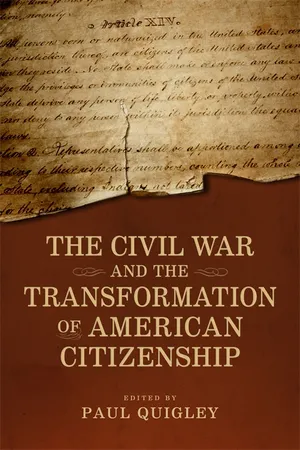
The meanings and practices of American citizenship were as contested during the Civil War era as they are today. By examining a variety of perspectives—from prominent lawmakers in Washington, D.C., to enslaved women, from black firemen in southern cities to Confederate émigrés in Latin America—The Civil War and the Transformation of American Citizenship offers a wide-ranging exploration of citizenship's metamorphoses amid the extended crises of war and emancipation.
Americans in the antebellum era considered citizenship, at its most basic level, as a legal status acquired through birth or naturalization, and one that offered certain rights in exchange for specific obligations. Yet throughout the Civil War period, the boundaries and consequences of what it meant to be a citizen remained in flux. At the beginning of the war, Confederates relinquished their status as U.S. citizens, only to be mostly reabsorbed as full American citizens in its aftermath. The Reconstruction years also saw African American men acquire—at least in theory—the core rights of citizenship. As these changes swept across the nation, Americans debated the parameters of citizenship, the possibility of adopting or rejecting citizenship at will, and the relative importance of political privileges, economic opportunity, and cultural belonging. Ongoing inequities between races and genders, over the course of the Civil War and in the years that followed, further shaped these contentious debates.
The Civil War and the Transformation of American Citizenship reveals how war, Emancipation, and Reconstruction forced the country to rethink the concept of citizenship not only in legal and constitutional terms but also within the context of the lives of everyday Americans, from imprisoned Confederates to former slaves.
OATHS, OCCUPATIONS, AND THE WARTIME BOUNDARIES OF CITIZENSHIP
Swallowing the Oath
The Battle Over Citizenship in Occupied Winchester
JONATHAN M. BERKEY
By the summer of 1862, Winchester, Virginia native Emma Riely’s homesickness had reached desperate heights. The fourteen-year-old had hurriedly left Winchester with her sister Kate just before Confederate troops under Thomas J. “Stonewall” Jackson evacuated the lower Shenandoah Valley town in March. Emma and her family had hoped that Jackson’s retreat up the Valley was a temporary ruse to lure the advancing Union army into a decisive battle.1 The Riely sisters had packed one small trunk with enough clothing for a week or two, but by August they had been refugees from their home for about six months.2 As August arrived in Luray, forty-three miles south of Winchester, Emma determined to risk a journey home even though it was occupied by the Yankee army. Kate did not share her sister’s boldness (or desperation) and elected to remain a refugee.3
Reluctant to travel alone, Riely convinced Fannie Burracker, a Luray resident with relatives in Clarke County, to accompany her. On the day they began their journey, Riely and Burracker stuffed their shoes full of letters from civilians and Confederate soldiers bound for addresses in Winchester and other areas behind Union lines. Although their journey featured several challenges, the party reached the outskirts of Winchester without major incident. They encountered Federal pickets just outside of town, who took them to the provost marshal. There, they learned that all civilians aged eighteen or older had to take the oath of allegiance before entering Winchester. Luckily, Emma Riely was able to provide proof that she was only fourteen; she could cross the Union lines without condition. Fannie Burracker was not so lucky; after she admitted that she was twenty-one, the provost marshal insisted that she take the oath before entering town. Riely recalled that Burracker “broke down and just boo-hooed in the most heart-broken style.” She felt sorry for Burracker and urged her to take the oath. Finally, “after a great persuasion she swallowed it, although each word seemed the size of a cannon ball to swallow and you could hear a gulping sound as each one went down.” While Burracker was swearing not to provide aid and comfort to the Confederacy, the contraband letters from Confederate soldiers to friends and relatives in the vicinity of Winchester remained in her shoes.4
Countless Confederate civilians living in or around Union-occupied areas faced a challenge similar to that of Burracker when they had to make very difficult choices about taking the oath of allegiance to the United States. Many studies of occupied areas suggest that Burracker’s response was typical. In occupied Nashville, Memphis, New Orleans, and East Carolina, secessionists swallowed the oath of allegiance to the United States for pragmatic reasons: doing so allowed them to travel and trade freely, and often protected their property from use by occupying military forces.5
Despite facing challenges similar to those encountered by their peers in other occupied areas of the Confederacy, relatively few secessionists in Winchester took the oath of allegiance. This essay explores the issues that made Fannie Burracker’s decision to swallow the oath, so commonplace elsewhere, unique in Winchester. Battles over the oath were battles between different aspects of citizenship. Swallowing the oath marked an explicit rejection of Confederate citizenship. Union authorities attempted to eliminate Confederate allegiance by imposing the oath of allegiance on civilians before they could enjoy the tangible privileges of citizenship like free travel. The Union military’s efforts were unsuccessful largely because their campaigns against the formal aspects of citizenship were unable to break the affective bonds of citizenship forged and guarded by Winchester’s secessionist community.
Scholars of citizenship have stressed its fluid nature and complexity. More than formal rights and responsibilities, citizenship invokes a sense of belonging to a community. This affective citizenship is particularly strong because it involves an emotional tie to the community—what Stephen Kantrowitz calls “a citizenship of the heart.”6 Fannie Burracker acknowledged the power of affective citizenship when she faced her moment of decision at Winchester. The prospect of taking the oath of allegiance meant breaking her bonds to the Confederate community. When Emma Riely urged Burracker to take the oath, her first thought was of her community. Burracker lamented, “Oh, Emma, I will be disgraced amongst my friends.” When Riely claimed that her friends would never find out that she took the oath, Burracker was unconvinced. “You and Mr. Hart [her driver] will tell on me and they will all say I’m disloyal.” Burracker’s greatest fear upon swallowing the oath was her community’s rejection.7
Most Winchester civilians, when forced to choose between the privileges of formal citizenship offered by Union military authorities—such as the ability to trade, travel, and hold property securely—and the affective bonds of the secessionist community, chose the latter. Civilian confidence in the Confederate cause made this choice a little easier. In many occupied areas of the Confederacy, the arrival of Union troops occurred relatively early in the war and, despite occasional threats, Confederate forces did not regain control of these regions. Residents of Winchester were able to hold on to the hope of Confederate deliverance much longer than their counterparts in other occupied areas of the South; indeed, the lower Shenandoah Valley witnessed the return of a major Confederate force as late as autumn 1864.
Examining the struggle over the oath of allegiance in occupied Winchester through the lens of citizenship illuminates the agency that the town’s civilians expressed in their struggle to maintain their sense of identity and the social boundaries of their community. Union military authorities could determine who could travel and purchase freely, but only Winchester’s secessionist civilians could determine who belonged.
I.
Emma Riely’s hometown was the seat of Frederick County and a key market center in the lower Shenandoah Valley.8 Its 1860 population consisted of 4,392 residents, including 680 free black people and 708 slaves. The town served the region’s farmers by providing goods and facilitating the sale and marketing of wheat, the region’s main staple crop. Seven main roads fanning out in several directions connected Winchester to its agricultural hinterland. Two macadamized roads dominated this transportation hub: the Martinsburg Pike tied Winchester to neighboring Berkeley County’s emerging rail center, while the Valley Pike linked the town to destinations in the upper Valley. Other roadways connected Winchester to eastern Virginia through the passes in the Blue Ridge Mountains. The Winchester & Potomac Railroad connected to the Baltimore & Ohio system at Harpers Ferry. Baltimore served as the town’s primary market for cattle and flour, and many Winchester residents had business and family ties in the city.9
When war came, Winchester became an important strategic target for the contending armies. It produced valuable resources coveted by military forces, including wheat, beef, butter, and cloth. Its location heightened its importance. Winchester is north of Washington, DC; a Confederate army occupying the town would threaten not only the northern capital, but Maryland and Pennsylvania as well. A Federal army moving up the Valley would be traveling southwest, away from the Confederate capital of Richmond, but if it could occupy Staunton (about ninety-five miles from Winchester) it would threaten railroad connections to eastern Virginia via the Virginia Central railroad.10
Winchester’s wartime experience confirms its strategic importance. Frederick County witnessed five significant battles during the war—three of which were fought through Winchester—and numerous skirmishes and raids. The town changed hands thirteen times and was between the lines for about 20 percent of the war. From March 1862 through the end of the war, Barton family scholar Margaretta Barton Colt estimates that Winchester was in Federal hands over 50 percent of the time. Because of the uneven pattern of military activity in and around the town, British observer Arthur J. L. Fremantle dubbed “unfortunate” Winchester the “shuttlecock” of the contending armies in the Valley.11
In a town that changed hands so frequently, it is understandable that notions of loyalty among its residents remained fluid. By the summer of 1862, after two Federal occupations of the town, residents had become adept at keeping military officials guessing about their loyalty. The behaviors one Union newspaper correspondent observed in occupied Winchester frustrated him. He noted that he had always been a successful reporter in Washington, DC, despite the fact that many politicians there changed their “political jacket” every four years. In Winchester, “it was done every week without any inconvenience at all!!!!” His report became more heated as he continued:
These are they who are “loyal” today, but the Lord only knows what they may be tomorrow—. These are they who can be “loyal,” and yet curse the Government to whom that loyalty is due—. These are they who can straddle the political fence, and touch the ground on both sides, be ready to cry “Good Lord or good devil,” as the case may require. Periodically, they are “union men,” and are very “loyal” just now; but no longer than Jackson’s last visit to Winchester they were ready to swing their hats and hurrah for Jeff Davis.12
The correspondent’s frustration resulted from contested notions of loyalty. What he saw as clear signs of disloyalty were interpreted by Winchester’s secessionist community as necessary tactics to ensure survival in an unpredictable environment. Union military officials attempted to use the oath of allegiance as a weapon to solidify the fluid notions of loyalty that Winchester secessionists deemed acceptable. The oath’s wording left little room for interpretation. Oath-takers had to swear to support, protect, and defend the Constitution and the government of the United States, and to bear “true faith, allegiance, and loyalty to the same.” As Emma Riely observed, “the language of that oath was as strong as it could be made.”13
Union commanders utilized the oath during the first occupation of Winchester in the spring of 1862. Initially used to ensure that suspicious persons picked up by the army could be released safely, the oath became a tool to limit the privileges of Winchester’s secessionists. The first rumblings about the oath in Winchester centered on a pledge to the Restored Government of Virginia.14 In April, representatives of Restored Governor Francis Pierpont arrived in Winchester to administer an oath of allegiance to county officials. Swearers of this oath pledged allegiance to the United States and the restored state government. County magistrates A. Nulton, J. S. Davis, and R. Bowen took the oath. Nulton later explained to John Peyton Clark that he signed the oath to bring some sense of civil authority to the town, which would allow civil officials to control petty crime and discipline Winchester’s black residents.15
The furor over the oath to the restored government of Virginia marked the beginning of the lengthy struggle among members of Winchester’s secessionist community to resist the Union’s assault on Confederate citizenship. Nulton’s explanation did not impress most Winchester secessionists. John Peyton Clark noted that there was “much feeling and talk in town upon the subject of the conduct of these men.” He joined this chorus, claiming that the magistrates signed the oath because of their “cowardice, ignorance, or inclination.” Two days after taking the controversial oath, the magistrates repudiated it, claiming that they had not truly understood the consequences of agreeing to it. As Clark’s comments suggest, the most crucial consequence of taking the oath was exclusion from the Confederate community.16
Mary Greenhow Lee feared that the magistrates’ oath was the first step of a broader assault on the town’s Confederate citizens. She had heard rumors that every man, woman, and child in Winchester would be made to take the oath. “Now comes the tug of war, for us who cannot fight for our country,” she confided to her diary. “I very much fear there are some who will not stand the test.” About a week later, Lee’s confidence in her fellow secessionists’ fortitude had increased. Reporting another rumor that those who refused to take the oath would not be permitted to practice their professions, she acknowledged that “We are being more & more oppressed every day,” but concluded, “the spirit of resistance rises in proportion.”17
The spirit of resistance that Lee noted rose in response to the Union army’s campaign of limiting privileges of Winchester secessionists in order to entice them into taking the oath of allegiance. As Stephen Ash notes, the army could not force civilians to take the oath at gunpoint; it had to be voluntary to be binding. By the middle of April the Federal campaign had begun in earnest. Besides the limitations on Winchester businesses, Union policy forbade clergymen from performing the marriage ceremony unless they pledged their loyalty to the Union government. Civilians who wished to obtain a pass for traveling outside of Winchester also had to take the oath.18
Most members of Winchester’s secessionist community resisted the temptation to repudiate Confederate citizenship in exchange for the formal privileges of citizenship. After the first battle of Winchester on May 25, 1862, John Peyton Clark jubilantly wrote, “for the first time within two months . . . I went . . . outside the corporate limits of Winchester.” When many residents wrote of their freedom that returned with the Confederate forces, the freedom of movement and to practice their livelihoods, which had been tied to the oath of allegiance during the Union occupation, surely were on their minds.19
The euphoria of Winc...
Table of contents
COVER
TITLE PAGE
COPYRIGHT PAGE
CONTENTS
ACKNOWLEDGMENTS
INTRODUCTION
RACE AND THE REDEFINITION OF CITIZENSHIP
OATHS, OCCUPATIONS, AND THE WARTIME BOUNDARIES OF CITIZENSHIP
FORGING NEW FORMS OF CITIZENSHIP AFTER 1865
AFTERWORD
CONTRIBUTORS
INDEX
Trusted by 375,005 students
Access to over 1.5 million titles for a fair monthly price.
Study more efficiently using our study tools.
Frequently asked questions
Yes, you can cancel anytime from the Subscription tab in your account settings on the Perlego website. Your subscription will stay active until the end of your current billing period. Learn how to cancel your subscription
No, books cannot be downloaded as external files, such as PDFs, for use outside of Perlego. However, you can download books within the Perlego app for offline reading on mobile or tablet. Learn how to download books offline
Perlego offers two plans: Essential and Complete
Essential is ideal for learners and professionals who enjoy exploring a wide range of subjects. Access the Essential Library with 800,000+ trusted titles and best-sellers across business, personal growth, and the humanities. Includes unlimited reading time and Standard Read Aloud voice.
Complete: Perfect for advanced learners and researchers needing full, unrestricted access. Unlock 1.5M+ books across hundreds of subjects, including academic and specialized titles. The Complete Plan also includes advanced features like Premium Read Aloud and Research Assistant.
Both plans are available with monthly, semester, or annual billing cycles.
We are an online textbook subscription service, where you can get access to an entire online library for less than the price of a single book per month. With over 1.5 million books across 990+ topics, we’ve got you covered! Learn about our mission
Look out for the read-aloud symbol on your next book to see if you can listen to it. The read-aloud tool reads text aloud for you, highlighting the text as it is being read. You can pause it, speed it up and slow it down. Learn more about Read Aloud
Yes! You can use the Perlego app on both iOS and Android devices to read anytime, anywhere — even offline. Perfect for commutes or when you’re on the go. Please note we cannot support devices running on iOS 13 and Android 7 or earlier. Learn more about using the app
Yes, you can access The Civil War and the Transformation of American Citizenship by Paul D. Quigley in PDF and/or ePUB format, as well as other popular books in Histoire & Histoire de la guerre de Sécession. We have over 1.5 million books available in our catalogue for you to explore.