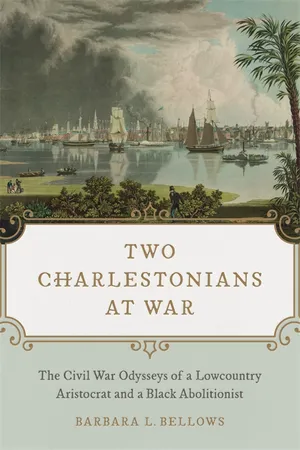
Tracing the intersecting lives of a Confederate plantation owner and a free black Union soldier, Barbara L. Bellows' Two Charlestonians at War offers a poignant allegory of the fraught, interdependent relationship between wartime enemies in the Civil War South. Through the eyes of these very different soldiers, Bellows brings a remarkable, new perspective to the oft-told saga of the Civil War.
Recounted in alternating chapters, the lives of Charleston natives born a mile a part, Captain Thomas Pinckney and Sergeant Joseph Humphries Barquet, illuminate one another's motives for joining the war as well as the experiences that shaped their worldviews. Pinckney, a rice planter and scion of one of America's founding families, joined the Confederacy in hope of reclaiming an idealized agrarian past; and Barquet, a free man of color and brick mason, fought with the Union to claim his rights as an American citizen. Their circumstances set the two men on seemingly divergent paths that nonetheless crossed on the embattled coast of South Carolina.
Born free in 1823, Barquet grew up among Charleston's tight-knit community of the "colored elite." During his twenties, he joined the northward exodus of free blacks leaving the city and began his nomadic career as a tireless campaigner for black rights and abolition. In 1863, at age forty, he enlisted in the 54th Massachusetts Volunteer Infantry—the renowned "Glory" regiment of northern black men. His varied challenges and struggles, including his later frustrated attempts to play a role in postwar Republican politics in Illinois, provide a panoramic view of the free black experience in nineteenth-century America.
In contrast to the questing Barquet, Thomas Pinckney remained deeply connected to the rice fields and maritime forests of South Carolina. He greeted the arrival of war by establishing a home guard to protect his family's Santee River plantations that would later integrate into the 4th South Carolina Cavalry. After the war, Pinckney distanced himself from the racist violence of Reconstruction politics and focused on the daunting task of restoring his ruined plantations with newly freed laborers.
The two Charlestonians' chance encounter on Morris Island, where in 1864 Sergeant Barquet stood guard over the captured Captain Pinckney, inspired Bellows' compelling narrative. Her extensive research adds rich detail to our knowledge of the dynamics between whites and free blacks during this tumultuous era. Two Charlestonians at War gives readers an intimate depiction of the ideological distance that might separate American citizens even as their shared history unites them.
JOSEPH H. BARQUET WAS BORN on September 10, 1823. It was the worst of times. His parents, John Pierre and Barbara Barquet, no longer cherished the same hopes for his future as they had for their other four children. Even though they owned their Meeting Street home and possessed greater security than the majority of Charleston’s free people of color (and a significant portion of the white population too), they felt ill at ease and vulnerable to forces beyond their control. Economic stagnation had settled upon the city like dust in an abandoned house. Dwelling in an ether of social suspended animation—neither slaves nor citizens—the Barquets never knew from one year to the next what new (and to their minds, irrational or simply punitive) restrictions might be inflicted upon them by South Carolina’s legislature. The rising tide of antislavery sentiment in the nation and the South’s declining power in Congress had thrust the state’s leaders into a defensive state of mind.1
Since the birth of their fourth child in 1821, the Barquets felt that their community had lost ground. The 1820 state law prohibiting all manumissions without special legislative approval dashed the hopes of their friends who had been saving every penny to buy family members out of bondage. With the exception of those fortunate ones emancipated by their owner’s will, enslavement had become a life sentence.
Free blacks in Charleston could still legally marry, freely associate, and travel. They could participate in the economy by owning property, investing in bank stocks and city bonds, loaning money at interest, and making contracts. Whatever wealth they accrued could be passed on to their children. Their participation in civic life was restricted to petitioning the legislature and bringing lawsuits in certain situations. In short, they possessed privileges rather than constituted rights. Those thin threads separating their status from that of the slave majority were anchored to windward only by the indulgence of their fair-weather friends among the city councilmen and state legislators.2
Whenever white Charlestonians lay sleepless in their beds, free blacks also tossed and turned. When city leadership began calculating the value and safety of staying in the Union, as they did during the 1820s, free blacks began calculating the value and safety of staying in Charleston. Friends of the Barquets already had started moving to northern cities, such as New York and Philadelphia, that had long-established free black communities.
In 1822 tragedy knocked the precarious racial equilibrium of the city out of kilter. Given the incomplete and corrupted nature of the existing historical record, no one can say with 100-percent certainty that Denmark Vesey, a freed carpenter in his fifties, actually masterminded a rumored slave uprising against Charleston. By the same token, no one can say with 100-percent certainty that the complex, nefarious plot of which he was accused ever existed beyond a “grotesque fantasy” in the minds of the scores of slaves forced to give testimony under intense pressure. The narrative that evolved contained elements of the popular gothic-horror novels of the day. Vesey’s conspiracy was conflated with elements of the Haitian Revolution and said to have involved the collaboration of masses of slaves from the town and country intent on randomly murdering whites (with particularly evil intent toward women), torching the city, and liberating all those in bondage, with the leaders fleeing to Haiti afterward. In some versions sympathetic Haitians, acting in black solidarity for the cause of freedom, would come to Charleston to participate in the slaughter.3
What no one disputes is that in July of that year, Vesey and thirty-four of his accused co-conspirators were publicly hanged after being found guilty in a secret trial. Consequently, the bonds upon the enslaved were tightened, while the free people of the city became less free.
The story of Denmark Vesey told around the Barquet dinner table during Joseph’s youth surely differed from the current interpretation, which holds him up as an iconic freedom fighter. From that free family’s perspective, the hero of 1822 was not the man who wanted to burn Charleston, but rather the man who wanted to save it—their longtime friend, tinsmith William Pinceel.4
It cannot be strictly proven, but it is unthinkable that, on the evening of May 22, Pinceel would not have dashed the one long block up Meeting Street from his Queen Street workshop to the Barquet home, anxious to share some inflammatory, possibly dangerous, news. Earlier that day Peter Francis Desverney, an enslaved man whom John Pierre knew as well, had come to him in a panic of indecision. While he idled at the harbor’s edge after finishing his Saturday shopping, Desverney reported, an enslaved man of his acquaintance had whispered that a massive conspiracy of city and country slaves was preparing to rise up to “shake off our bondage.” When asked if he wanted to join, “horror struck” Desverney said “no,” turned on his heels, and left lest he be seen and later connected with the possible trouble to come. Desverney’s question to Pinceel was now whether he should tell his master, Colonel John Cordes Prioleau, what he heard or stay mum.5 In contrast to most slaves, Desverney had received permission from Mrs. Prioleau to marry in St. Philip’s Episcopal Church, where she attended services and he had been baptized. He wanted at all costs to protect his wife, a freewoman of color, and their two little children, who by law took their mother’s status and were also free.6
The two men could see danger in both choices. The white community, they understood, was like a sleeping tiger: any hint of caballing slaves, the slightest breaking of a twig of intrigue, could arouse indiscriminate fury, blind slashing and tearing of all within reach. Pinceel told Desverney “with great earnestness” to tell the truth. This he did. Colonel Prioleau later took him to city hall to testify, and Desverney set the wheel of fate in motion, although in truth he reported merely smelling smoke, not actually seeing a fire.7
Both Pinceel and Desverney received rewards for their commitment to public safety. Illustrative of the divided mind of the city toward free people of color, though, just before the official account of intendant James Hamilton, Negro Plot, went to press, a “vide” was inserted into the text ostensibly correcting the original version that praised Pinceel’s wisdom in advising Desverney. The new version, betraying the constant fear of collaboration between free and unfree blacks, has Desverney turning first to the teenaged “young master” for guidance, thus placing “the fidelity of the slave who first gave the intelligence of the intended insurrection, on much higher ground.”8
When he first heard about the possible slave uprising, Pinceel would have been particularly anxious to alert John Pierre Barquet since as a “French negro” born in Saint Domingue, he could become a suspect in any plot. Neither man had anything to gain and everything to lose by violence; given their histories, they held no romantic notions about the virtue of the enraged, uneducated mob. Both knew firsthand that whatever noble goals and justified anger might inspire the first pitch of a torch or toss of a rock, riots usually ended up causing suffering to innocents in their paths rather than righting any wrongs. They also understood the complex social divisions among peoples of color, free and enslaved, and were familiar with the exaggerated high talk animating the urban grapevine. Every slave, they acknowledged, craved freedom. An enormous chasm loomed, however, between their wish for liberty and their willingness to do murder. But if a well-orchestrated slave revolt actually was brewing in the lowcountry, Barquet realized from his experience of violent revolution in Saint Domingue that free people of color, the well-to-do gens de couleur libre, especially those with slaves, would be among the first targets.
Legislation enacted during 1822 and 1823 in the wake of the Vesey panic transformed the legal contours of the state. The Barquets suffered from the reimposition of a burdensome capitation tax (basically a levy for being black and free), and the knowledge that at any time they might be stopped and demanded to show proof of their freedom. Other laws diminished free blacks’ ability to associate in any numbers, while any leaving South Carolina could never return for fear that they would bring with them revolutionary ideas espoused by northern abolitionists. For much the same reason, black seamen, who also could read the night sky and had knowledge of paths of escape, were to be jailed while in Charleston. Every free black man had to have a white “guardian,” who would testify that they were free, of good character, and not a danger to the community. Knowing his vulnerability, Barquet strove to avoid all appearances of impropriety and enlisted auctioneer John W. Payne to vouch for him. Payne would never be suspected of abolitionist sentiments, for at his auction house he rang his gavel down on large lots of slaves with the same regularity as he did fine Philadelphia-made furniture.9
Two months after Vesey’s execution, the premonition of danger from the West Indies that had so preoccupied white Charlestonians during the summer of 1822 was realized, though in a quite different way than they had imagined. Late on the night of September 27, startled dreamers awoke to a nightmare. Were those the sounds of black Jacobins banging at the door and breaking glass, some wondered. No, it was the wind, howling like a thousand banshees. The most destructive hurricane in a century had blown up from the Caribbean and murderously pummeled the Carolina coast in “an awful exhibition of the elemental war” and as a fitting coda to that summer of hell. Great gusts rocked houses back and forth, broke window glass, ripped off roofs like tissue paper, and lifted wooden piazzas up and away. Boats in the harbor crashed and splintered like children’s toys as they were hurled against the shore. All around the Barquets’ house, buildings were damaged; theirs could not have escaped. The storm mauled the handsome city hall, only a few of blocks away. No structures, humble or grand, were immune from the gale’s indiscriminate furies. The next day black and white bodies alike were found crushed under fallen houses; others dotted the beaches up and down the coast. All told, hundreds perished.10 The lesson that might have been learned was that on that narrow peninsula where the races lived in such physical proximity, any harm that came to one would come to all. No one was exempt from the brutal forces of nature—or history.
THE FOLLOWING SEPTEMBER, 1823, Charleston was mercifully spared another storm. The Barquets’ fifth child, Joseph Humphries, was safely delivered into an increasingly anxious world. They named him in honor of another close family friend, Joseph Humphries, a well-respected Queen Street tailor of Scottish descent who in 1803 had helped found the Minor’s Morality Society to aid orphans of the free black community.11
Young Joseph’s childhood in Charleston would be a mixture of sunshine and shadow. Not a slave, but not altogether free, not black, but also not white, he dwelled in the shade of differences ever searching for his place. His parents taught him the proper racial etiquette about what he could wear, how he should carry himself, when to avoid eye contact, when to yield the sidewalk to whites, and where he was permitted to go. The newly built pleasure gardens at the tip of the peninsula were off-limits to him. The rules were not so very different from what John Pierre would have learned as a young gens de couleur libre in Saint Domingue before the revolution. But his parents also taught their son self-respect.12
Joseph enjoyed the one element that makes all the difference in the complex equation of human happiness—he was loved. He grew up feeling himself a person of worth, even potentially of power. He had the benefit, not common in the larger world of free blacks, of living with two parents, who were always accessible. They worked together making and repairing umbrellas in a little shop adjacent to their house at 113 Meeting Street, on a busy thoroughfare in the heart of town. No matter what unkindness, hostility, or even danger lurked outside the sturdy brick walls of their home, once inside, the Barquets could lock the doors and enjoy their own haven in a heartless world.
By 1827, seven children filled the Barquets’ two-story house with laughter and tears, fun and games, and the inevitable conflicts of family life. With a new addition born every two years, the little Barquets stood like stair steps. They bore the names of close friends and relatives, reflecting their diverse family tree: Margaret Campbell (1815), Mary Louisa (1817), Carolina Eudora (1819), Liston Warren (1821), Joseph Humphries (1823), Bissett (1825), and Edod or Edouard (1827).13
Since their 1814 marriage, Barbara and John Pierre Barquet had woven themselves into the small circle of mixed-race families sometimes referred to as the “colored elite” or even “aristocracy,” an upper caste of mixed-blood men and women often with French, British, or Portuguese ancestry. These were relative terms only. “Petite bourgeois” perhaps better reflects their modest living circumstances and their aspirations for their children. The term used is not as important as the understanding that in their minds ethnicity, class, religion, or caste often trumped race in the formation of their identity.
At the time of Joseph’s birth in 1823, the population of Charleston hovered around 25,000 residents, with whites making up close to 43 percent; slaves, 51 percent; and free blacks, 6 percent. The Barquets belonged in the upper quadrant of the literate and propertied free people of color. The majority of free blacks suffered from the multiplied effects of intense poverty and illiteracy as well as the lack of stable families, training or skills, and any contacts in the white world of authority and power. Many fell into bad habits of drinking, prostitution, and crime that eventually landed them in the workhouse and gave evidence to those slaveowners who complained that such people endangered the public safety and corrupted the morals of the enslaved.14
With women also having opportunities in the city for paid work, the two-parent household emerged as the free blacks’ engine of economic advancement, with the family as their core social unit. Joseph would never in his adult life enjoy the same financial security that he did as a child. As the artisans and mechanics, seamstresses and caterers of the city, the most skilled enjoyed some comfort; a few reached affluence through thrift, skill, and prudent investments. Those who could afford to buy slaves to bolster their earnings did so. Some treated their slaves as family (which, indeed, sometimes they were), while others considered them as chattels to be sold or even mortgaged when need mandated. Throughout Barquet’s childhood and youth, his mother owned as many as ten slaves whom she hired out in the city, receiving their wages in return.15
Joseph first tried to sort out his complex genealogy when he came of age and began to ask the question “Who am I?” His elder brother, Liston, described their father as “French, from Hayti” and their maternal grandmother, born enslaved, as “a negro,” which was by the definition of the time a stateless person. By federal law, even American-born blacks were then legally classified as “persons of African descent,” a species of foreigner who, unlike freeborn white aliens, could never be naturalized into citizens.16
By embracing their French heritage, the Barquets could claim a national identity. Using the French language and forms of address as they did in their household gave the children cachet in their community. That their father belonged to the independent urban artisan class and did not use the common Gullah language—a sort of Esperanto of necessity forged among enslaved Africans from different regions—further distinguished them from the black majority in the city and created a massive gulf with those bondsmen laboring on the outlying plantations. As late as 1860 William Ellison, Stateburg gin owner and slave master as well as the Barquets’ longtime family friend, still referred to Joseph’s brother as “Monsieur Barquet.”17
By presenting himself as French, Joseph Barquet could transcend, in his own mind at least, American racial particularism and adopt as his inheritance the Enlightenment traditions of France and the democratic impulses of the Haitian Revolution. Though barred from citizenship in the United States, Joseph considered him...
Table of contents
COVER
TITLE PAGE
COPYRIGHT PAGE
CONTENTS
ILLUSTRATIONS & MAPS
ACKNOWLEDGMENTS
PROLOGUE: The Two Roads to Coffin Island
1. JOSEPH’S STORY: Sunshine and Shadow
2. THOMAS’S STORY: In the Shadow of Greatness
3. “WHAT HAVE WE DONE. . . ?”
4. GENERAL PINCKNEY’S SWORD
5. AGAINST WIND AND TIDE
6. DEATH AND REBIRTH IN THE DRAGON’S DEN
7. THE FIFTY-FOURTH AND THE SIX HUNDRED
8. FROM LIBERATOR TO CONQUEROR
9. WE HAVE LOST OUR COUNTRY
10. CITIZEN BARQUET
11. THE PRICE OF PEACE
EPILOGUE: Lest We Forget
NOTES
INDEX
Trusted by 375,005 students
Access to over 1.5 million titles for a fair monthly price.
Study more efficiently using our study tools.
Frequently asked questions
Yes, you can cancel anytime from the Subscription tab in your account settings on the Perlego website. Your subscription will stay active until the end of your current billing period. Learn how to cancel your subscription
No, books cannot be downloaded as external files, such as PDFs, for use outside of Perlego. However, you can download books within the Perlego app for offline reading on mobile or tablet. Learn how to download books offline
Perlego offers two plans: Essential and Complete
Essential is ideal for learners and professionals who enjoy exploring a wide range of subjects. Access the Essential Library with 800,000+ trusted titles and best-sellers across business, personal growth, and the humanities. Includes unlimited reading time and Standard Read Aloud voice.
Complete: Perfect for advanced learners and researchers needing full, unrestricted access. Unlock 1.5M+ books across hundreds of subjects, including academic and specialized titles. The Complete Plan also includes advanced features like Premium Read Aloud and Research Assistant.
Both plans are available with monthly, semester, or annual billing cycles.
We are an online textbook subscription service, where you can get access to an entire online library for less than the price of a single book per month. With over 1.5 million books across 990+ topics, we’ve got you covered! Learn about our mission
Look out for the read-aloud symbol on your next book to see if you can listen to it. The read-aloud tool reads text aloud for you, highlighting the text as it is being read. You can pause it, speed it up and slow it down. Learn more about Read Aloud
Yes! You can use the Perlego app on both iOS and Android devices to read anytime, anywhere — even offline. Perfect for commutes or when you’re on the go. Please note we cannot support devices running on iOS 13 and Android 7 or earlier. Learn more about using the app
Yes, you can access Two Charlestonians at War by Barbara L. Bellows in PDF and/or ePUB format, as well as other popular books in Histoire & Histoire de la guerre de Sécession. We have over 1.5 million books available in our catalogue for you to explore.