Throughout the twentieth century, cities such as Houston, Galveston, New Orleans, and Mobile grappled with the safety hazards created by oil and gas industries as well as the role municipal governments should play in protecting the public from these threats. James B. McSwain's Petroleum and Public Safety reveals how officials in these cities created standards based on technical, scientific, and engineering knowledge to devise politically workable ordinances related to the storage and handling of fuel.Each of the cities studied in this volume struggled through protracted debates regarding the regulation of crude petroleum and fuel oil, sparked by the famous Spindletop strike of 1901 and the regional oil boom in the decades that followed. Municipal governments sought to ensure the safety of their citizens while still reaping lucrative economic benefits from local petroleum industry activities. Drawing on historical antecedents such as fire-protection engineering, the cities of the Gulf South came to adopt voluntary, consensual fire codes issued by insurance associations and standards organizations such as the National Board of Fire Underwriters, the National Fire Protection Association, and the Southern Standard Building Code Conference. The culmination of such efforts was the creation of the International Fire Code, an overarching fire-protection guide that is widely used in the United States, Mexico, the Caribbean, and Central America. In devising ordinances, Gulf South officials pursued the politics of risk management, as they hammered out strategies to eliminate or mitigate the dangers associated with petroleum industries and to reduce the possible consequences of catastrophic oil explosions and fires.Using an array of original sources, including newspapers, municipal records, fire-insurance documents, and risk-management literature, McSwain demonstrates that Gulf South cities played a vital role in twentieth-century modernization.
eBook - ePub
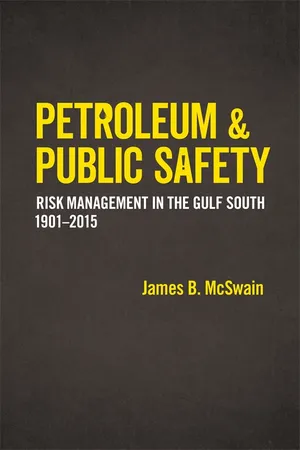
Petroleum and Public Safety
Risk Management in the Gulf South, 1901-2015
- 368 pages
- English
- ePUB (mobile friendly)
- Available on iOS & Android
eBook - ePub
About this book
Information
1
PETROLEUM AND NINETEENTH-CENTURY RISK CULTURE
The historical roots of Gulf South rules and regulations that governed the storage and use of fuel oil can be traced to a nineteenth-century risk culture, one important component of which was the discovery, distribution, and public consumption of flammable hydrocarbons, such as petroleum and its products.1 Canadian Abraham Gesner contributed to this culture when he obtained three patents in 1854 to distill asphaltum, petroleum, and other bitumens. Using this process he redistilled crude coal-oil made from heating coal into several fractions he called kerosenes. One produced a brilliant light and proved to be a highly marketable burning fluid.2
During the period from 1860 to 1900, crude petroleum emerged as a cheap alternative to coal for producing kerosene.3 To match the demand for this popular illuminant, refiners in Pittsburgh, New York, Philadelphia, and Cleveland expanded production, benefiting after 1870 from process efficiencies, extension of the rail system into the oil fields, and reliable bulk-rail transportation.4
Controlling the hazards of crude petroleum, widely consumed kerosene, and other flammable liquids was an important task in nineteenth-century risk culture that provided Gulf South cities in 1901–2 a valuable hazard-mitigation, risk-management tradition. States, municipalities, and insurance groups took part in a century-long struggle to control petroleum hazards. The federal government participated, banning in 1866 the storing of combustible materials such as cotton, hay, or straw on the decks of passenger steamers unless covered by canvas or other material, and restricting “coal oil or crude petroleum” to decks or in “open holds” away from fire and furnaces.5
Congress added more safety provisions for steam-powered vessels in 1871, stipulating that refined petroleum could be onboard such ships if it had an ignition point of no less than 110 degrees Fahrenheit, and if there was no other practical way of transporting it. The act empowered steamboat inspectors working out of the Treasury Department to prescribe additional regulations in such cases. The secretary of the treasury could also permit vessel owners to burn “petroleum or other mineral oils” for propulsion and devise and enforce regulations for its safe use. Flammable liquids and explosives such as gunpowder, “coal oil, crude or refined petroleum,” and the lighter products of the first refining of petroleum, such as benzine, could be carried as freight if shipped in secure, labeled packages, boxes, or casks.6
Acting in step with the evolution of lighting and heating technology, as well as petroleum production, refining, and transportation, federal and state governments as well as municipalities formed a risk-management tradition shaped by safety and liability concerns for passenger vessels and insured property in which lamps, fixtures, and gas machines burned turpentine, camphene mixtures of turpentine and alcohol, as well as naphtha, gasoline, and kerosene.7
Early in the nineteenth century, state and city officials laid the groundwork for this tradition, as was evident in Massachusetts, where camphene and burning fluids became alternatives in the 1830s and 1840s to whale oil or lard. Burning turpentine in lamps was not satisfactory, but redistilling it produced a volatile fraction known as camphene. Adulterating turpentine or camphene with alcohol made brighter but more volatile illuminants known as burning fluids that called for careful regulation.8
In the 1850–70 period the commonwealth and the city of Boston in the face of numerous accidents and fires passed statutes and ordinances that regulated the manufacturing, refining, storage, and sale of camphene, burning fluids, crude petroleum or its products.9 They limited the amount of flammable liquids that could be kept in buildings; banned storage and refining under sidewalks, in dwellings or alleys, and along wharves; imposed fire and flash tests conducted by inspectors; and required a license to handle flammable liquids in any building above the cellar.10
Flammable liquids provoked serious political controversies and investigations in Philadelphia. A catastrophic fire in February 1865 ignited a coal-oil yard, destroyed five squares of buildings, and killed many residents. In response the state legislature banned large-scale storage of crude and refined petroleum, benzine, and naphtha in “built-up districts” in the city. Four years later the Evening Telegraph published an account of its investigation into the widespread sale of adulterated kerosene, a Philadelphia market that supposedly had been reined in by an 1868 state law establishing a city oil inspector, only to see it subverted by political corruption and bribery.11
In 1872–73 the Franklin Institute, long concerned with exploiting science for practical purposes, joined the battle over controlling flammable liquids in Philadelphia. William H. Wahl, secretary of the institute, read a short paper before its Optical Section, March 1872, in which he sketched out the development of “artificial illumination,” taking note of the enrichment or carburetion of water gas with hydrocarbons, production of gas from coal distillation, and refinement of crude petroleum to obtain light fractions such as naphtha, benzine, and gasoline.12
The next year, 1873, the institute commissioned a two-part committee report on the dangers of these illuminants. The first part introduced statistics for 1871 that identified petroleum as the “most prolific cause of conflagrations” in the city. It also described the ineffective legal efforts to test coal oil and kerosene in Pennsylvania, and cautioned readers that cheap illuminating oils were hazards comparable to gunpowder and should be never be used near open flames.13
In the second part William Wahl identified nine petroleum distillates, including naphtha and kerosene, recounted their specific gravities and boiling points, and explained how their flash and ignition points identified various mixtures of these substances by which one could detect dangerous, adulterated kerosene that flashed at room temperatures. The public should use petroleum illuminants with extraordinary care, Wahl exhorted readers, because without proper precautions petroleum fractions and poor-quality kerosene caused “terrible accidents,” death and destruction of property.14
While properly constructed lamps and high-quality kerosene from coal or crude petroleum mitigated these hazards, Wahl noted that random tests of oil samples from Philadelphia dealers showed that many of the most dangerous were advertised as “safe oils.” He also charged that “carburetting” illuminating gas—passing it through the vapors of the light products of petroleum to make it burn brightly—was very dangerous as was the vaporization of naphtha, gasoline, or kerosene in air-gas machines for light, both uses objectionable because they employed “incendiary petroleum oils.” Deeply impressed by Wahl’s scientifically informed mitigation material, the NBFU printed ten thousand copies of the report and distributed them to all board members and eight thousand general, special, and local agents.15
In 1874, Pennsylvania set down mandatory oil-inspection procedures, to which the legislature added extensive rules for pipeline operations in 1878 and 1883 that were revised in 1888 and still in place in 1900. Acts passed in 1865 and 1871 were part of a comprehensive 1887 statute that restricted the refining, manufacturing, or storage of crude petroleum, benzine, or naphtha to specific areas in Philadelphia. The restrictions did not apply to locations where existing large-scale refining and storage had the space for “sufficient excavations or embankments” to control overflows “in case of fire or accident.”16
Controlling the hazards posed by petroleum and its products was also a contentious issue in New York City in the 1860–1900 era.17 As early as 1813 the state authorized the city to restrict the keeping and storage of dangerous substances including pitch, tar, turpentine and its fractional distillates.18 On the eve of the Civil War the city fire marshal reported a tragic record of fires and injuries from camphene and burning fluids in the city. Three years later the fire marshal cautioned officials about the dangers that coal-oil lamps posed to women and girls. He also asked for an ordinance “prohibiting the storage of Petroleum in large quantities within the city fire limits.” In 1866 he documented damaging and lethal kerosene fires and explosions.19
As early as 1862, New York City was under pressure to regulate petroleum storage. Even though the state passed two laws in 1865–66 setting down the conditions under which one could store “Crude petroleum, earth or rock oil, or any of its products,” including a fire test of 100 degrees Fahrenheit for “refined petroleum, kerosene or machinery oils,” unsafe handling of petroleum in New York City was unabated. The NYT reported in August 1869 that the fire commissioners had collected samples of kerosene oil throughout the city, only to find that most of it was very dangerous.20
From an economic perspective the source of this danger came from the fact that before the Civil War there was limited demand for naphtha and benzine—the volatile “top cuts” produced by the distillation of raw coal oil or petroleum before kerosene boils off.21 This tempted some refiners to turn out incompletely refined kerosene or to mix small amounts of these explosive fractions with kerosene, producing a poorly refined, low-quality “burning oil” that was cheap, profitable, and deadly. Drugstores and street vendors sold it to the poor, who often died or were badly burned when it exploded. It was a threat to public health that could not be ignored.22
It should be noted, however, that technical improvements in naphtha-gas production soaked up some of the available naphtha-benzine stocks after 1870, taking advantage of the so-called Gale-Rand process that converted naphtha into a permanent gas that did not condense in pipelines and could be burned for light or heat or for enrichment of coal gas. There were still abundant supplies of the light cuts of petroleum to tempt wayward kerosene refiners and suppliers, but the improvements gave the petroleum industry “its first large-volume market” for benzine and naphtha, even though both substances as well as their manufacturing remained dangerous on whatever scale they were processed or consumed as far as fire-insurance underwriters were concerned.23
In 1868–70, New York City’s Board of Health investigated the sale of dangerous kerosene in the metropolitan area and passed an ordinance covering the retail sale of petroleum, kerosene, or similar substances such as burning fluids (illuminants) unless they passed a flash test of 110 degrees Fahrenheit.24 A Health Department chemist, Dr. C. F. Chandler of Columbia University, led these investigations and published a lengthy report in 1871 of his findings at the behest of the board in the interest of the “suppression of the traffic in dangerous oils.”25
Chandler’s report was an expansive exploration of the history of petroleum, its chemical composition, distillation, and refining. He explained why most kerosene sold in New York City was dangerous, how it should be tested scientifically, what the Board of Health had tried to do to stop retail sales, and legal obstacles to enforcement.26 He surveyed the risk-management policies of other cities and states, ending with a portion of the text of an 1871 New York statute that consolidated and augmented the above-cited laws of 1865–66 on petroleum storage under the fire-prevention rubric of “storage and keeping of combustible material.”27
The risk-management policies of these major cities regarding flammable liquids were part of a legal campaign in many states to control these substances. From 1865 to early 1871 thirteen states, including Ohio, Illinois, Michigan, and Pennsylvania, passed laws that established safety standards, including flash and ignition tests, for coal oil and petroleum products (benzine, naphtha, kerosene), sold or stored within their jurisdictions. There were shortcomings such as voluntary adoption of regulations and no penalties for lax enforcement. Even so, persistent campaigns to tighten restrictions on petroleum hazards built upon this flawed legal platform. Michigan underwriters, for example, petitioned the state in 1893 to amend its laws regarding kerosene testing by adopting “stringent rules and regulations.”28
The Gulf South also had statutes and ordinances to regulate petroleum hazards that specifically addressed flammable liquids such as distilled turpentine, burning fluids, petroleum, and kerosene. Mobile (1866), Galveston (1871), and New Orleans (by 1881), prompted by coal-oil and kerosene accidents, restricted storage locations and amounts for retail sale, and set down minimum flash or burning temperatures.29
FLAMMABLE-LIQUID HAZARDS AND THE INSURANCE INDUSTRY
Fire-insurance companies, boards, and associations also played a major role in the risk culture of the nineteenth century, their attention drawn to any event or condition that posed a fire hazard, including mill and building design; electrical wiring; machinery-manufacturing; distilleries, lumber yards, and gas machines and carburetors; as well as refining, storing, and handling crude petroleum and its products.30
In the 1860s the Philadelphia Board of Fire Underwriters (PBFU), out of concern over numerous accidents involving crude oil and mineral-based illuminants (popular substitutes for sperm oil and lard candles), investigated the “Hazardous nature” of petroleum, coal oil, and their products. Retail dealers told the board’s secretary, John Williams, that these substances were dangerous only if stored in poorly ventilated buildings. Subsequently, a committee appointed to recalibrate premiums and set restrictions on oil storage recommended maintaining existing rates on benzine, naphtha, or benzole stored in three barrels or less, charging the current rates applied to “specially hazardous risks” for refined coal oil stored in five or less barrels, and assessing progressively higher rates on more than five barrels. No contracts could be issued on crude coal oil, petroleum, rock or earth oil when stored in the “built-up portions” of Philadelphia. If stored in properly vented, isolated buildings or on wharves or in sheds, a minimum 5 percent per annum rate applied.31
The committee also urged the underwriters to draft laws prohibiting the storage of dangerous oils in densely occupied areas of the city, confining oil refining and manufacturing to buildings constructed for these purposes. In 1863 the board drew up a memorial to the City Council, asking it to recognize the explosive and flammable nature of petroleum and coal oil and their products, and to pass an ordinance to restrict storage of same within the city limits. In January 1864 the Philadelphia Board increased tariffs on refined oil to 2.5 percent and 7.5 percent on crude petroleum per year.32
Hazardous flammable liquids also caught the attention of Zachariah Allen (1795–1882), prominent mill owner, inventor, and insurance leader, who founded the Manufacturers’ Mutual and the Rhode Island Mutual Fire Insurance companies in 1835 and 1848, respectively. With the Boston Manufacturers’ Mutual Fire Insurance Company (BMMF...
Table of contents
- Cover
- Title Page
- Copyright Page
- Dedication
- Contents
- Preface
- Acknowledgments
- Abbreviations
- Introduction
- 1. Petroleum and Nineteenth-Century Risk Culture
- 2. Fire Hazards and Petroleum Risks in Mobile, Alabama, 1894–1910
- 3. Risk Management in the Bayou City: Fuel Oil in Houston, 1901–1914
- 4. Competition and Conflagration: Exploiting and Regulating Fuel Oil in New Orleans, 1901–1943
- 5. Hazards, Risks, and Vulnerability: Galveston, Texas, 1901–1937
- Conclusion
- Epilogue: Risk Management of Flammable Liquids in the Twentieth and Twenty-First Centuries
- Notes
- Bibliography
- Index
- Illustrations
Trusted by 375,005 students
Access to over 1.5 million titles for a fair monthly price.
Study more efficiently using our study tools.
Frequently asked questions
Yes, you can cancel anytime from the Subscription tab in your account settings on the Perlego website. Your subscription will stay active until the end of your current billing period. Learn how to cancel your subscription
No, books cannot be downloaded as external files, such as PDFs, for use outside of Perlego. However, you can download books within the Perlego app for offline reading on mobile or tablet. Learn how to download books offline
Perlego offers two plans: Essential and Complete
- Essential is ideal for learners and professionals who enjoy exploring a wide range of subjects. Access the Essential Library with 800,000+ trusted titles and best-sellers across business, personal growth, and the humanities. Includes unlimited reading time and Standard Read Aloud voice.
- Complete: Perfect for advanced learners and researchers needing full, unrestricted access. Unlock 1.5M+ books across hundreds of subjects, including academic and specialized titles. The Complete Plan also includes advanced features like Premium Read Aloud and Research Assistant.
We are an online textbook subscription service, where you can get access to an entire online library for less than the price of a single book per month. With over 1.5 million books across 990+ topics, we’ve got you covered! Learn about our mission
Look out for the read-aloud symbol on your next book to see if you can listen to it. The read-aloud tool reads text aloud for you, highlighting the text as it is being read. You can pause it, speed it up and slow it down. Learn more about Read Aloud
Yes! You can use the Perlego app on both iOS and Android devices to read anytime, anywhere — even offline. Perfect for commutes or when you’re on the go.
Please note we cannot support devices running on iOS 13 and Android 7 or earlier. Learn more about using the app
Please note we cannot support devices running on iOS 13 and Android 7 or earlier. Learn more about using the app
Yes, you can access Petroleum and Public Safety by James B. McSwain in PDF and/or ePUB format, as well as other popular books in Technology & Engineering & North American History. We have over 1.5 million books available in our catalogue for you to explore.